
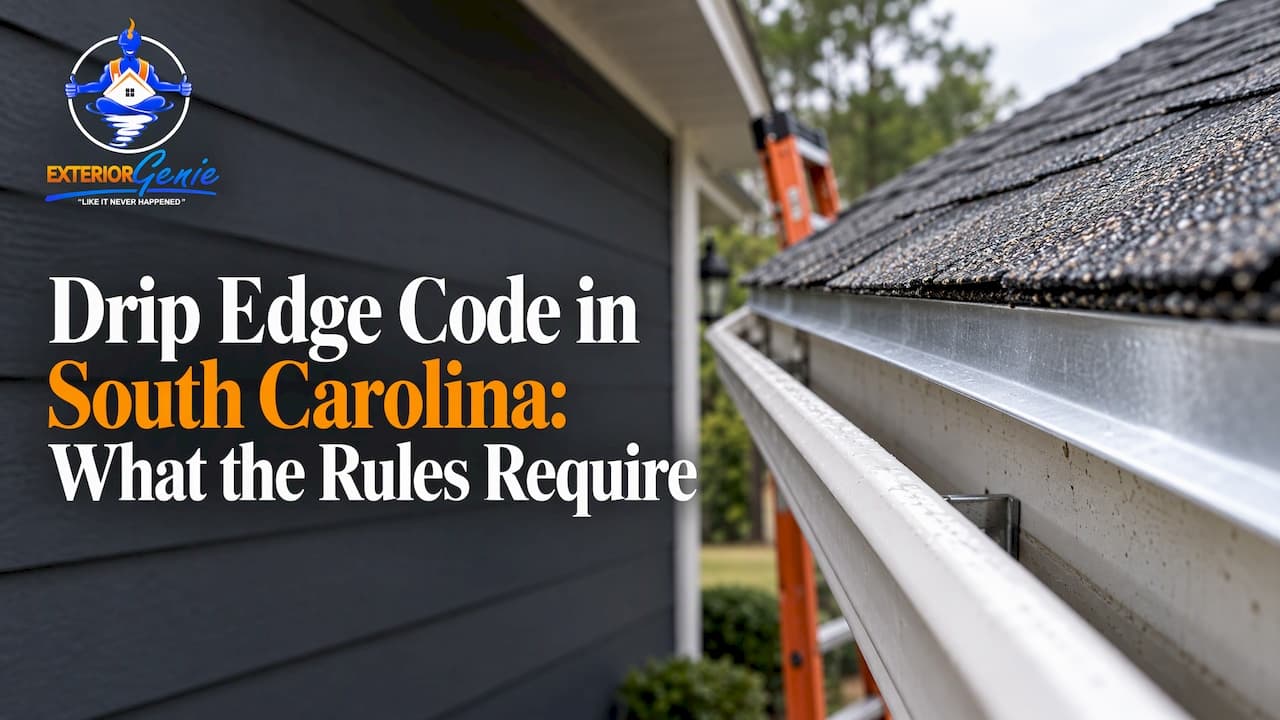
South Carolina's residential code requires drip edge at the eaves and rake edges of asphalt-shingle roofs, where the shingle manufacturer requires it. S.C. Code Regs. § 8-1228 carries that language for the state. Local building departments enforce it, and some read it more strictly than the bare text. A newer statewide modification with detailed installation rules is scheduled to arrive with the 2024 code cycle. If you are planning a re-roof in Lexington, Columbia or anywhere in the Midlands, this guide covers what the code says, how the pieces should go on, and what to confirm before work starts.
TL;DR
- Drip edge is required at the eaves and rakes of asphalt-shingle roofs under the state's adopted residential code, where the manufacturer requires it.
- Some jurisdictions, such as Fort Mill, read the rule as requiring metal drip edge at all roof edges on shingle work, and they ask for photos at permit closeout.
- The 2024 statewide modification spells out a 2-inch overlap, a 1/4-inch drop below the sheathing, a 2-inch return on the deck and fastening at 12-inch centers. Its implementation date is January 1, 2027.
- At eaves the underlayment goes over the drip edge. At rakes it goes under.
- Ask your roofer which code edition and local rules apply to your address, and who pulls the permit.
Table of Contents
- What South Carolina code says about drip edge
- Which code edition applies to your address
- How drip edge must be installed under the 2024 modification
- Where drip edge goes on the roof
- Why a bare-minimum drip edge is not the goal
- Permits and inspections: what to confirm before work starts
- Our perspective on drip edge
- Drip edge after storm damage
- Work with a Midlands roofer who builds to code
- FAQ
- Sources
What South Carolina code says about drip edge
The rule comes from the International Residential Code, section R905.2.8.5, as South Carolina adopts it. The state's published version says a drip edge must be provided at eaves and rake edges of asphalt-shingle roofs where the manufacturer requires it (S.C. Code Regs. § 8-1228). Most national shingle manufacturers' installation instructions call for drip edge, so in practice it goes on nearly every shingle roof.
The model code text that Google's top results quote adds one more detail: adjacent segments of drip edge must be lapped at least 2 inches. That overlap shows up again in the state's newer installation rule below.
Which roofs the rule covers
The express wording of the 2021 South Carolina Residential Code's drip-edge section is limited to asphalt-shingle roofs (Chapter 9, South Carolina Residential Code). Tile, slate, metal panel, wood shake and low-slope membrane roofs are governed by their own code sections and the manufacturer's instructions. That does not mean those systems go without edge metal. It means the drip-edge section itself is not the rule that applies to them.
New roofs, replacements and repairs
The code language does not draw a sharp line between a new roof and a tear-off. Local offices fill in that gap. The Town of Fort Mill's roofing requirements call for a valid building permit before roofing repairs or installation, read the rule as requiring metal drip edge at all roof edges on asphalt-shingle work, and ask for photographs of the metal drip edge at final permit closeout (Town of Fort Mill Roofing Requirements). Not every town does this, but it shows how an inspector can treat the item.
Which code edition applies to your address
South Carolina adopts its codes statewide, and the Building Codes Council publishes the schedule. Its adoption page identifies the 2021 South Carolina Building Codes as adopted with an effective date of January 1, 2023, and it separately lists 2024 code materials (SCLLR Building Codes Council).
The 2024 modification index says implementation is January 1, 2027 (2024 South Carolina Building Codes Modifications Index). So for a roof permitted today, the 2021 edition is the baseline. A job that is permitted after the new cycle starts will fall under the newer rules. If your project straddles the change, the permit date is what your building department will look at. Ask them.
Cities and counties can add their own administrative requirements on top, such as permit forms, photo documentation or wind-zone underlayment tables. That is why two houses 30 miles apart can get slightly different inspection conversations under the same state code.
How drip edge must be installed under the 2024 modification
The state's 2024 modification gives a detailed installation rule instead of leaving everything to manufacturer instructions. According to the Building Codes Council's modification index, it calls for the following (2024 Modifications Index):
| Detail | Requirement |
|---|---|
| Overlap between pieces | At least 2 inches |
| Drop below roof sheathing | At least 1/4 inch |
| Return back onto the roof deck | At least 2 inches |
| Fastening | Mechanically fastened to the deck at a maximum of 12-inch centers, using the applicable R905.2.5 fasteners |
| Underlayment at eaves | Installed over the drip edge |
| Underlayment at rakes | Installed under the drip edge |
The index also explains why the modification was continued. Jurisdictions found drip edge hard to inspect as its own standalone phase, so a detailed rule gives inspectors something concrete to check from the ground or from photos.
Why the underlayment order matters
The over-at-eaves, under-at-rakes sequence has a purpose. At the eave, water running down the underlayment is directed over the metal and into the gutter, not behind it. At the rake, wind-driven rain pushes uphill, so the metal sits on top of the underlayment to shed water off the edge instead of letting it find a seam.

The U.S. Department of Energy's Building Science Education page describes drip edge at eaves and rakes as a moisture and storm-resistance measure, and recommends installing it over fully adhered membrane underlayment in high-wind construction (DOE Building Science Education). That matters along the coast and during hurricane season, but the Midlands see their share of severe thunderstorms and tropical remnants too.
How it connects to underlayment rules in wind zones
Underlayment requirements vary by roof covering and wind-design area. Charleston County's 2021-code underlayment form is one example. For asphalt shingles in the high-wind table it cites, two layers start with a 19-inch strip at the eave, followed by 36-inch sheets overlapping 19 inches, with 4-inch end laps offset by 6 feet (Charleston County Roof Underlayment Form). Those figures are Charleston County's, not a Midlands rule, but they show how the underlayment you choose changes what sits beneath and above your drip edge.

Where drip edge goes on the roof
Picture the roof's perimeter in two parts:
- Eaves: the low edges where the roof meets the gutter line. Drip edge sits on the deck, with the underlayment laid over it.
- Rakes: the sloped edges along the gable ends. Drip edge goes on top of the deck, and the underlayment runs beneath it.
Valleys and ridges do not take drip edge. They use their own flashing and ridge-cap details. Where the roof meets a wall, step flashing and counterflashing do the job.
Why a bare-minimum drip edge is not the goal
Code sets the floor. A roof can pass inspection and still have problems when the metal is thin, pieces are butted instead of lapped, or nails are skipped between the corners. Here is what a careful installation looks like on a Midlands roof:
- Inspect the deck edge first. Old fascia and soft decking are repaired before new metal goes on, since drip edge is only as sound as what it is nailed to.
- Set the eave metal before the underlayment. It is nailed along the roof deck at the spacing the code calls for.
- Lap every joint. Adjacent pieces overlap by at least 2 inches, with the upslope piece over the downslope piece so water runs off the lap.
- Run the underlayment correctly. Over the metal at eaves, under it at rakes.
- Match the metal to the system. Shingle manufacturers publish edge-metal guidance, and following it protects the warranty. Owens Corning, for example, publishes installation resources with its shingle lines.
- Photograph the work. Some jurisdictions ask for it, and it is good practice either way, because the metal disappears under shingles within hours.
Permits and inspections: what to confirm before work starts
Before a crew tears off a single shingle, confirm these points with your roofer and your building department:
- Is a permit required for this job? Fort Mill requires one before repairs or installation of roofing material. Rules differ between towns and counties, so verify yours.
- Who pulls the permit? The contractor should, and it should be in your name and address, not a vague handshake.
- Which code edition applies on your permit date? The 2021 codes are the baseline now, with the 2024 cycle scheduled for January 1, 2027.
- What does the inspector want to see? In Columbia, the City's inspections page states that rough-in inspections are required for work involving roofing, and that roofing components must not be concealed until the rough-in and framing inspection is approved (City of Columbia Inspections).
- Is photo documentation needed at closeout? Fort Mill asks for photos of the metal drip edge, so ask whether your office does the same.
A contractor who works your area every week will know these answers. If yours is vague, that is worth noticing before you sign.
Our perspective on drip edge
We install drip edge on shingle roofs as part of doing the job right, and we do it the same way whether an inspector is looking or not. Edge metal is a small line item on an estimate, but it protects the part of the roof where water has the most chances to get in: the fascia, the deck edge and the first course of shingles.
As a veteran-owned contractor, we bring military discipline to details like these. Lapped joints, correct fastening and the right underlayment order are checklist items on our jobs, not afterthoughts. We are an Owens Corning Platinum Preferred Contractor, and our inspectors are HAAG certified, so we read manufacturer instructions and code language closely.
If a storm has damaged your roof edges or gutters, drip edge is often something we look at during an honest repair-versus-replacement assessment. We would rather tell you what the roof needs than sell you more than it does. Our workmanship is backed by a lifetime workmanship warranty.
Ebben
Drip edge after storm damage
Wind lifts shingles at the edges first, and that is exactly where drip edge sits. After a storm, damaged or displaced edge metal can leave the deck edge exposed to the next rain. If a claim is in play, document the edges with photos before any temporary repairs. Our storm damage restoration team works with homeowners and property managers on inspections, emergency tarping and insurance claim assistance, and our HAAG-certified inspectors know what to look for along the roof perimeter.
Work with a Midlands roofer who builds to code
If you are replacing your roof, we handle the details covered above: edge metal, underlayment order, fastening and permit-ready documentation. We serve homeowners, business owners and property managers across Lexington, Columbia and the surrounding Midlands, with 24/7 emergency roof repair when a leak cannot wait.
Look at our roof replacement and repair services, see how we approach roof repair, or start at Exterior Genie to talk through your project.
FAQ
Is drip edge required in South Carolina?
Yes, for asphalt-shingle roofs. The state's adopted residential code requires drip edge at eaves and rake edges where the manufacturer requires it (S.C. Code Regs. § 8-1228). Because shingle manufacturers generally call for it, it goes on virtually every shingle roof. Local offices may enforce it more broadly, so check with yours.
Where do I need a drip edge?
At the eaves and rakes of the roof. At the eaves the underlayment goes over the metal, and at the rakes it goes under, according to South Carolina's 2024 modification (Modifications Index). It is not used at ridges or valleys.
Does drip edge code apply to roof repairs or only full replacements?
The code text does not separate them, and local practice varies. Fort Mill requires a permit before roofing repairs or installation and wants photos of the metal drip edge at closeout (Fort Mill Roofing Requirements). Ask your building department whether your specific repair triggers a permit or inspection.
What changes on January 1, 2027?
The 2024 modification index lists that date for implementation of the 2024 code cycle. It spells out the 2-inch overlap, 1/4-inch drop, 2-inch deck return and 12-inch fastener spacing for drip edge (Modifications Index). Your permit date decides which edition applies.
Sources
- S.C. Code Regs. § 8-1228, IRC R905.2.8.5 Drip Edge
- Chapter 9 Roof Assemblies, South Carolina Residential Code
- Town of Fort Mill Roofing Requirements
- SCLLR Building Codes Council adoption page
- 2024 South Carolina Building Codes Modifications Index
- DOE Building Science Education: Drip Edge at Roof Eaves and Rakes
- Charleston County Roof Underlayment Form
- City of Columbia Inspections
- Owens Corning Roofing