
K-style gutters are the better default for most houses: they hold more water per foot, cost less installed, and pair with almost any hidden hanger system on the market today. Half-round earns its premium on historic homes and wooded lots, where its curved trough sheds leaves instead of trapping them. The trade-off comes down to math: a 5-inch K-style gutter holds about 1.20 gallons per foot versus 0.96 gallons for 5-inch half-round, and half-round typically costs more to install in the same material.
TL;DR:
- Most homes benefit from 6-inch K-style gutters due to their higher capacity and lower installation cost compared to half-round options.
- Proper sizing involves calculating your roof's drainage area and matching it to gutter capacity, often requiring a larger size or additional downspouts for high rainfall zones.
- Half-round gutters perform better in shedding debris and suit historic or heavily wooded areas but tend to cost more and have lower water capacity at the same size.
- Homeowners should ensure correct hanger spacing and adequate downspout pairing to maximize gutter lifespan and prevent overflow issues.
- When requesting bids, specify the gutter size, profile, material, seam method, and warranty to avoid under- or over-specification and unnecessary costs.
Table of Contents
- K-Style vs. Half-Round Gutters at a Glance
- What Are K-Style Gutters, and Where Do They Work Best?
- What Are Half-Round Gutters, and Why Do They Cost More?
- How Much Gutter Capacity Does Your Roof Actually Need?
- What Do K-Style and Half-Round Gutters Cost Installed?
- How Much Maintenance Do These Gutter Styles Actually Need?
- Which Gutter Style Matches Your Home's Architecture?
- How Do You Choose the Right Gutter for Your Bids?
- What Installers Notice That Homeowners Miss
- The Verdict on K-Style vs. Half-Round Gutters
- Get a Free Estimate on Your Gutter Installation
- Sources
- FAQ
K-Style vs. Half-Round Gutters at a Glance
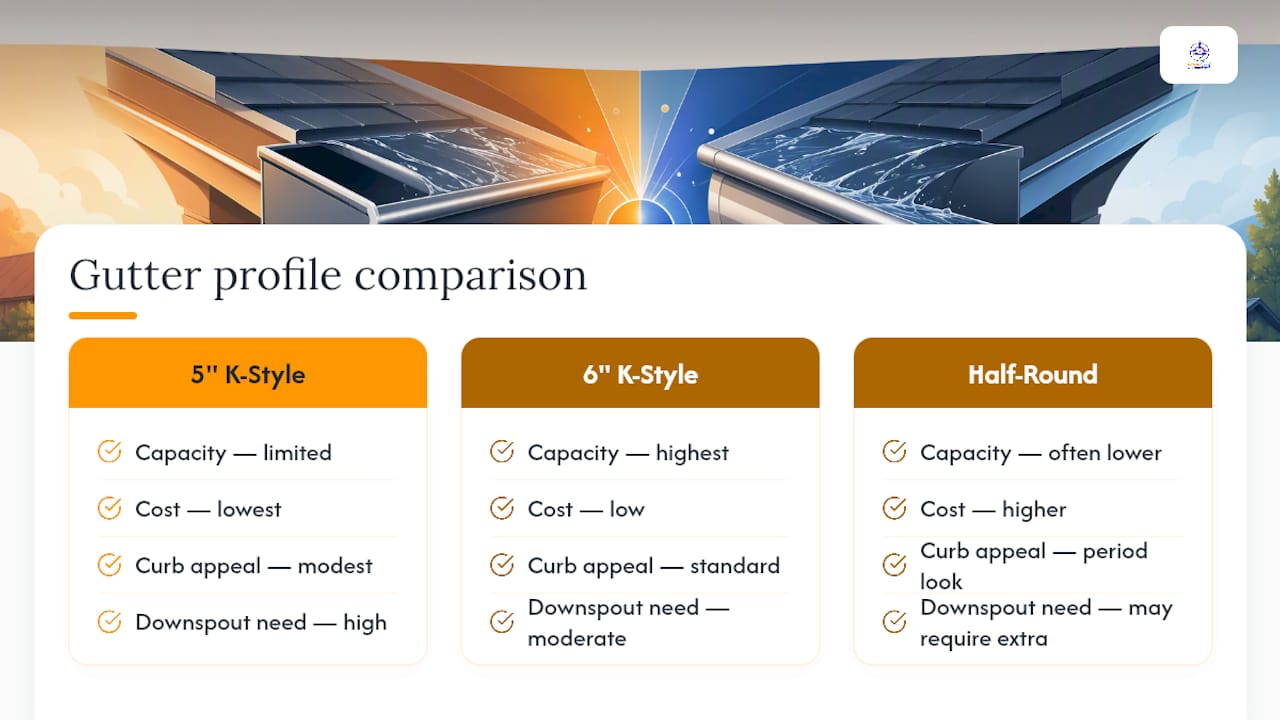
Capacity, price, and upkeep diverge fast once you put the two profiles side by side. A 6-inch K-style handles roughly 2.00 gallons per foot and drains close to 2,000 square feet of roof at a 1-inch-per-hour rainfall rate, according to sizing data from The Roofing Brief. Half-round needs to jump a size to match that same flow.
| Factor | K-style | Half-round |
|---|---|---|
| 5" capacity | 1.20 gal/ft | 0.96 gal/ft |
| 6" capacity | 2.00 gal/ft | Lower capacity than 6-inch K-style |
| Installed cost (aluminum) | $7 to $13/ft | $9 to $16/ft |
| Mounting | Hidden hangers, flush to fascia | External brackets |
| Cleaning frequency | More frequent on wooded lots | Less frequent, curved trough sheds debris |
K-style wins on raw capacity and price. Half-round wins on looks and lower cleaning frequency for properties buried in leaves and pine straw.
What Are K-Style Gutters, and Where Do They Work Best?
The K-style profile gets its name from its ogee front face, which resembles crown molding, backed by a flat vertical wall that seats tight against the fascia board. Most installers run it with hidden hangers screwed into the fascia every 24 to 36 inches, and because it's roll-formed on-site from aluminum coil, a crew can produce a seamless run the full length of your roofline in one pass.
That seamless fabrication is a big reason K-style dominates new residential construction. Fewer seams mean fewer leak points, and the flat back gives extra protection to the fascia itself.
- Slightly higher capacity than half-round at the same nominal width
- Lower installed cost in aluminum, the most common residential material
- Broad compatibility with leaf guards and covers
- Corners in the trough can trap small debris, requiring more frequent cleanouts under trees
- The boxy profile can look out of place on Victorian, Craftsman, or other period homes
Downspout pairing matters as much as gutter width. A 5-inch K-style run typically feeds 2x3-inch downspouts, while 6-inch systems move up to 3x4-inch outlets to keep pace with higher flow.
Pro Tip: If your K-style gutters overflow at the corners during storms, the fix is often an extra downspout, not a bigger gutter. Check outlet spacing before you pay for a full upsize.
What Are Half-Round Gutters, and Why Do They Cost More?
Half-round gutters are exactly what the name says: a U-shaped trough, usually hung from external brackets rather than hidden hangers, and historically the standard on homes built before aluminum roll-forming existed. You'll find them in copper, aluminum, and zinc, with copper being the material of choice for anyone restoring a historic property.
The curved interior is the whole point. Without flat corners to catch leaves and grit, half-round sheds debris more readily than K-style, which cuts down on cleaning visits over a season.
- Curved trough resists clogging better than a cornered profile
- Period-correct look for historic and traditional architecture
- Lower capacity than K-style at the same nominal size, so many homes need to size up
- Installs are often sectional with more bracket work, which drives up labor cost
- Fewer leaf guard options fit the rounded shape
Because a 5-inch half-round falls short of a 5-inch K-style on flow, contractors commonly recommend jumping to 6-inch half-round on larger roofs. Mounting also matters here: external brackets need proper flashing behind the gutter to stop water from wicking back into the fascia.
How Much Gutter Capacity Does Your Roof Actually Need?
Sizing a gutter isn't guesswork. The industry standard is the watershed method: multiply your roof's effective drainage area (footprint adjusted for pitch) by expected rainfall intensity, then match that number against gutter capacity, an approach rooted in the storm drainage provisions of the International Plumbing Code.
| Size | K-style capacity | Half-round capacity | Roof area at 1 in/hr |
|---|---|---|---|
| 5" | 1.20 gal/ft | 0.96 gal/ft | ~1,200 sq ft |
| 6" | 2.00 gal/ft | Lower capacity than 6-inch K-style | ~2,000 sq ft |
| 7" | ~2.00 gal/ft | Rare in residential use | ~2,000 sq ft |
Three steps get you to the right size:
- Calculate effective roof area by multiplying footprint square footage by a pitch factor for steep roofs.
- Compare that number against the capacity table above at your local rainfall intensity.
- Add downspout outlets before upsizing the whole gutter, since pairing a 2x3-inch downspout with a 5-inch run is often enough to fix chronic overflow.
If you live somewhere prone to sudden downpours, plan for 6-inch as your default rather than 5-inch, and pair it with a drainage plan for where the water lands. A downspout extension or French drain setup keeps that volume away from your foundation once it clears the gutter.
What Do K-Style and Half-Round Gutters Cost Installed?
Material drives cost more than profile does, but profile still moves the number. K-style aluminum runs about $7 to $13 per linear foot installed, while half-round aluminum lands closer to $9 to $16 per foot. Copper half-round, the classic choice for historic restorations, commonly runs $25 to $45 per linear foot.
- Seamless roll-forming keeps K-style aluminum labor costs down
- Half-round installs are frequently sectional, needing more brackets and crew hours per foot
- Soldered copper joints cost more in labor than riveted aluminum seams
- On a 175-foot job, the gap between K-style aluminum and half-round aluminum can run into the thousands; copper half-round pushes that gap several times higher
How Much Maintenance Do These Gutter Styles Actually Need?
Geometry decides how often you're on a ladder. K-style's flat corners collect leaf litter and grit, so homes under heavy tree cover often need two or three cleanouts a year. Half-round's curved trough sheds that same debris with less buildup, which is why wooded properties frequently justify the extra install cost with fewer service calls.
Joint type matters for longevity too. Soldered copper seams on half-round tend to outlast riveted aluminum seams on K-style, though both fail eventually at fastener points and end caps if hangers are spaced too far apart.
- Keep hanger spacing at 24 to 36 inches to prevent sagging between screws
- Maintain a slight pitch, about a quarter inch per 10 feet, toward the downspout
- Leaf guards fit K-style more easily than half-round, so factor that into your maintenance plan
Pro Tip: Before buying leaf guards, confirm the brand fits your exact gutter profile. Half-round guard options are far more limited than K-style, and a poor fit defeats the purpose entirely.
Which Gutter Style Matches Your Home's Architecture?
Half-round shows up on Colonial, Victorian, farmhouse, and other pre-1950s builds where the rounded profile was standard before aluminum roll-forming existed. K-style suits ranch, contemporary, and most production-built suburban homes where the crown-molding look reads as clean rather than out of place.
Material shifts the visual impact further. Painted aluminum half-round can mimic the traditional look at a lower price than copper, while raw copper develops a patina over years that many historic district guidelines specifically require.
- If your home sits in a historic district, check local rules before choosing a profile
- Half-round copper often supports resale value on period-correct homes
- K-style in a neutral color blends into most modern subdivisions without objection
How Do You Choose the Right Gutter for Your Bids?
Getting three quotes for the same job only works if every contractor is bidding the same specs. Use this checklist before you sign anything:
- Measure your roof's effective drainage area, accounting for pitch on steep sections.
- Match that area against the capacity table to pick 5-inch, 6-inch, or 7-inch.
- Calculate downspout count based on outlet capacity, not just gutter width.
- Choose K-style or half-round based on your home's architecture and how much cleaning you're willing to do.
- Ask every bidder for the exact size, material, hanger spacing, seam method (soldered vs. riveted), and written warranty terms.
Red flags to watch for: a bid with no stated gutter size, no warranty in writing, or a price far below competitors with no explanation of material or labor scope. A professional gutter installation should always start with a measured sizing plan, not a flat per-foot guess.
What Installers Notice That Homeowners Miss
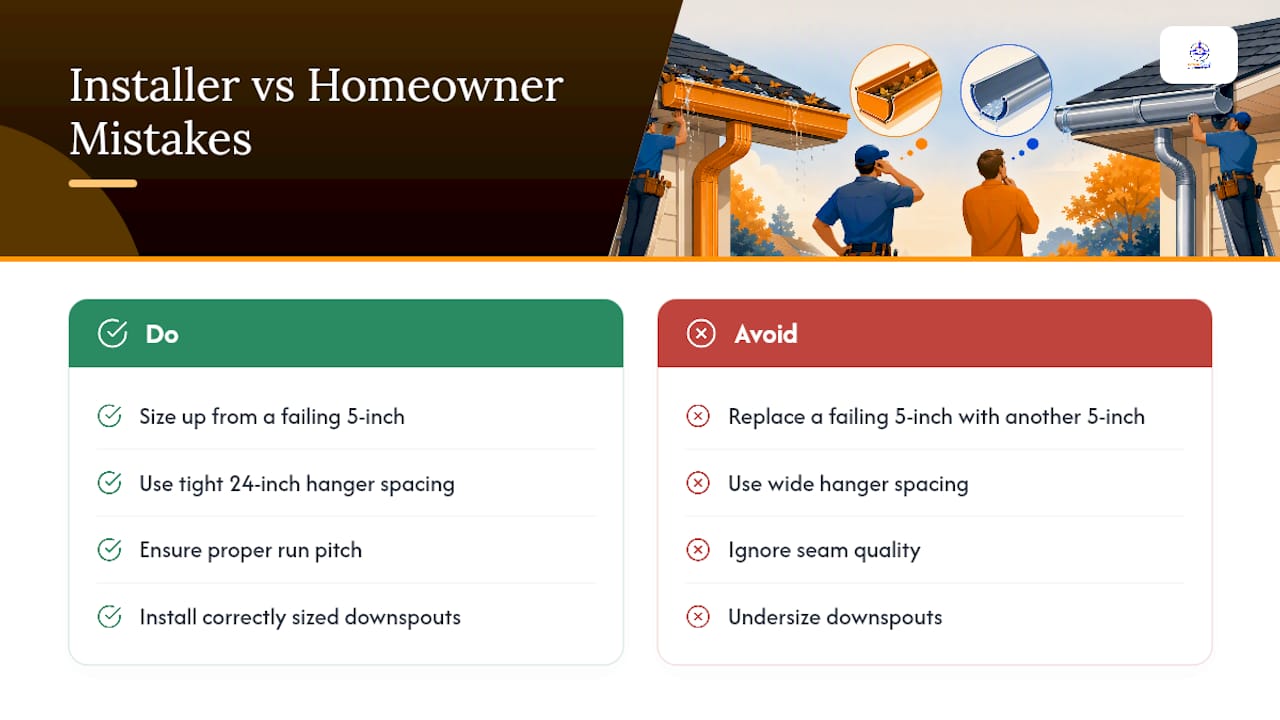
Exteriorgenie is a veteran-owned general contractor and an Owens Corning Platinum Preferred Contractor, and that installer's-eye view catches mistakes before they become callbacks. The most common one: homeowners replace a failing 5-inch K-style with another 5-inch system instead of sizing up, and the overflow problem just repeats itself next storm season.
Hanger spacing and seam quality decide whether a system lasts 20 years or 8. Tight 24-inch spacing on a properly pitched run, paired with correctly sized downspouts, prevents the chronic overflow that sends homeowners back to the drawing board within a few seasons.
The Verdict on K-Style vs. Half-Round Gutters
Most of the advice floating around treats this as a pure style choice, and that undersells the math. Capacity, not curb appeal, is what actually prevents foundation and fascia damage, and a lot of half-round installs on standard suburban homes are oversized on price and undersized on flow relative to what a 6-inch K-style would deliver for less money.
Where the conventional wisdom really falls short is downspout guidance. Homeowners fixate on gutter width and skip the outlet math entirely, when adding a second downspout frequently solves an overflow problem that a full gutter replacement wouldn't touch.
If you take one thing from this comparison, prioritize the roof area calculation before you fall in love with a profile. Figure out your effective drainage area first, match it to the capacity table, and only then decide whether K-style's economics or half-round's debris-shedding and period look matter more for your house. Skipping that order is how homeowners end up paying twice: once for the wrong gutter, and again when it overflows onto a fascia board that now needs roof repair too.
— Ebben
Get a Free Estimate on Your Gutter Installation
Exteriorgenie sizes gutters the way this article just walked through, not by guessing at a standard width. Every job starts with a roof measurement, a capacity calculation for your specific footprint and pitch, and a material recommendation that matches your budget and your home's style.

From there, HAAG-certified inspectors and Owens Corning Platinum Preferred installers handle the install with hidden hangers or properly flashed brackets, depending on the profile you choose, backed by a written warranty instead of a verbal promise. If your current gutters are overflowing, sagging, or just don't match your home anymore, get a free estimate on gutter installation and repair and find out what size and material actually fits your roof.
Sources
- K-Style vs. Half-Round Gutters: Capacity & Cost | TRB
- Half-round gutters: Benefits, sizing, and life span | This Old House
- IPC Chapter 11 — Storm drainage (ICC codes)
FAQ
What Are the Downsides of Half-Round Gutters?
Half-round costs more to install because sectional runs and external brackets take more labor, and at the same nominal width it holds less water than K-style, often requiring a size upgrade to match flow.
Are Half-Round Gutters Worth the Extra Cost?
They're worth it on historic homes and heavily wooded lots, where the curved trough sheds debris better than K-style and the period-correct look supports resale value.
Which Gutter Shape Is Best for Most Homes?
K-style is the practical default for most residential properties because it holds more water per foot and costs less installed, making it the better fit unless architecture or maintenance tolerance points toward half-round.
How Long Do K-Style Gutters Typically Last?
K-style aluminum gutters commonly last 20 years or more with proper hanger spacing and pitch, though lifespan drops faster in wooded areas without regular cleaning.
Should I Choose 5-Inch or 6-Inch Gutters?
Choose 6-inch if your roof area exceeds roughly 1,200 square feet or you live in a high-intensity rainfall zone, since 6-inch K-style handles about 2,000 square feet at 1 inch per hour versus roughly 1,200 for a 5-inch system.