

Pick James Hardie fiber cement if you're in a wildfire zone, want the longest service life, and care about resale value. Pick LP SmartSide if you're in hail country or a hard freeze-thaw climate, want a faster install, and want to spend less upfront. Installation quality decides more of your outcome than the brand on the box, but the material still sets the ceiling on how well that installation holds up. The rest of this comparison walks through the technical reasons behind that rule.
TL;DR:
- Hardie fiber cement siding is non-combustible and offers a 30-year non-prorated warranty, making it ideal for wildfire-prone regions and long-term ownership.
- LP SmartSide is lighter, more impact-resistant in hail and freezing conditions, and generally costs significantly less to install than Hardie.
- Proper installation and sealing of cut edges are critical, as product-specific features like moisture management and impact resistance affect durability and warranty coverage.
- Weather conditions and hazard types should guide material choice, with Hardie better for fire and moisture resistance, and LP SmartSide preferred for impact and cold-weather performance.
- Contractor experience, proper sealing, and dust control during installation are more important influences on siding longevity than the brand itself.
Table of Contents
- LP SmartSide vs Hardie: The Quick Comparison
- What Are LP SmartSide and Hardie Board Made Of?
- Which Siding Is More Fire Resistant, and What Does the Warranty Cover?
- Which Siding Holds Up Better to Hail and Cold?
- How Much Does Each Siding Cost Installed?
- How Often Do You Need to Repaint, and How Does Siding Affect Resale?
- How Do You Choose Between LP SmartSide and Hardie?
- What We See on Real Siding Jobs
- Get a Siding Bid Built Around Your Climate, Not a Sales Script
- Where to Verify the Technical Details
- Sources
- FAQ
LP SmartSide vs Hardie: The Quick Comparison
Before the deep dive, here's how the two stack up on the factors that actually change your decision.
- Composition: Hardie is fiber cement (cement, sand, cellulose fiber); LP SmartSide is engineered wood strand treated with zinc borate.
- Fire rating: Hardie is non-combustible under ASTM E136; LP SmartSide is classified as combustible.
- Impact behavior: LP SmartSide flexes and often survives hail impacts that crack or chip fiber cement.
- Installed cost: LP SmartSide runs roughly $4.50 to $11 per square foot; Hardie runs roughly $8 to $16.
- Install difficulty: LP is lighter and cuts with standard woodworking tools; Hardie requires silica dust controls and specialized blades.
- Warranty type: Hardie offers a non-prorated 30-year warranty; LP uses a prorated 5/50 structure.
If you remember one line from this list, make it the decision rule from Remodel Calculators: fire and longevity favor Hardie, hail and cold favor LP.
What Are LP SmartSide and Hardie Board Made Of?
Hardie board is fiber cement: Portland cement, silica sand, and cellulose fiber pressed and cured into dense, rigid boards. That density is why it resists fire and holds paint well, but it's also why it's heavy (roughly two to three times the weight of engineered wood siding per square foot) and why it cracks rather than bends under a sharp impact.
LP SmartSide is an engineered wood product, strand-based substrate treated with zinc borate for decay and termite resistance, then coated with a resin-saturated overlay and factory finish. It behaves more like a very tough plywood than a plank of solid wood. Because it's lighter and has more inherent flex, it absorbs impact instead of transmitting it into a crack. The tradeoff is that it's still wood at its core, which means moisture management at cut edges and seams matters more than it does with cement.
Texture and finish options look similar on a spec sheet from both manufacturers, but factory-applied finishes on either product tend to outperform field-applied paint over time. The material you pick determines which failure mode you're managing: cracking and moisture intrusion at joints for cement, moisture wicking at unsealed cuts for engineered wood.
Which Siding Is More Fire Resistant, and What Does the Warranty Cover?
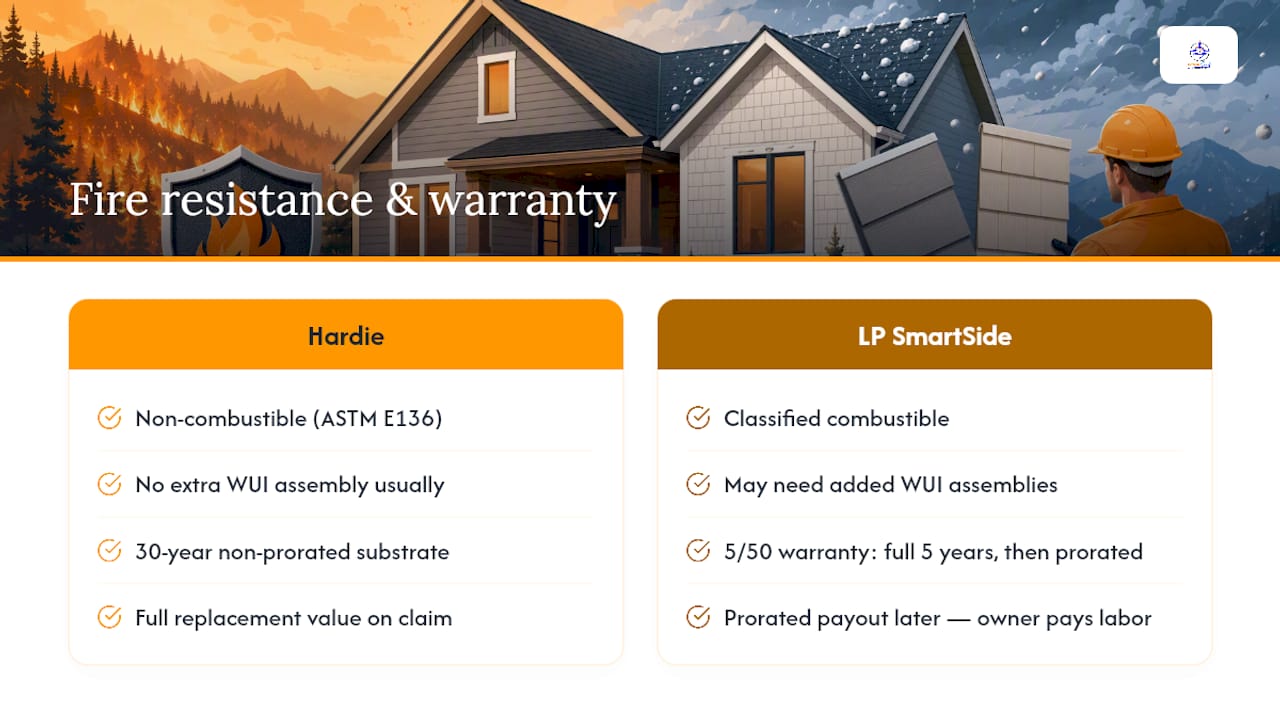
Fire code is where the two products diverge most sharply. James Hardie fiber cement is non-combustible when tested to ASTM E136, which is why it's the default recommendation in wildfire-prone regions and often required or strongly preferred in Wildland Urban Interface (WUI) code zones. LP SmartSide is classified as combustible; meeting some WUI listings requires additional assembly components, which can add cost and complexity that a straightforward Hardie install avoids.
Warranty structure matters as much as the fire rating, and it's the part homeowners skip past. Hardie backs its siding with a non-prorated 30-year warranty on the substrate plus a separate finish warranty, meaning full replacement value regardless of when a defect shows up. LP SmartSide uses a 5/50 warranty: full coverage for the first five years, then a prorated schedule for the remaining term, so a failure at year 20 pays out a fraction of replacement cost, not the whole job.
That distinction changes what a claim actually nets you. A prorated warranty still covers material, but you're paying most of the labor and removal cost out of pocket the longer you've owned the house. If you're planning to stay in a home for decades, that gap adds up.
Which Siding Holds Up Better to Hail and Cold?
Hail is where LP SmartSide usually wins, and freeze-thaw cycling follows the same pattern. Fiber cement is rigid and brittle; a hailstone that dents an aluminum gutter can crack a Hardie board, especially older or improperly primed sections. LP SmartSide's engineered wood substrate flexes on impact, and its rating under ASTM D5628 for cold-weather impact resistance reflects that it tends to hold up better in sub-freezing conditions than a cement product that gets more brittle as temperatures drop.
Regional guidance breaks down fairly cleanly once you factor in humidity and hazard type:
- Wildfire-prone regions: Hardie, for the non-combustible rating and WUI code alignment.
- Hail belt (Texas to the Dakotas): LP SmartSide, for impact flex.
- Humid coastal climates: Hardie, for rot resistance and long-term moisture stability.
- Severe freeze-thaw regions: LP SmartSide, for cold-flex performance.
Contractor surveys and regional installer data back up this split consistently: it's less about brand preference and more about which failure mode is more common in that zip code.
How Much Does Each Siding Cost Installed?
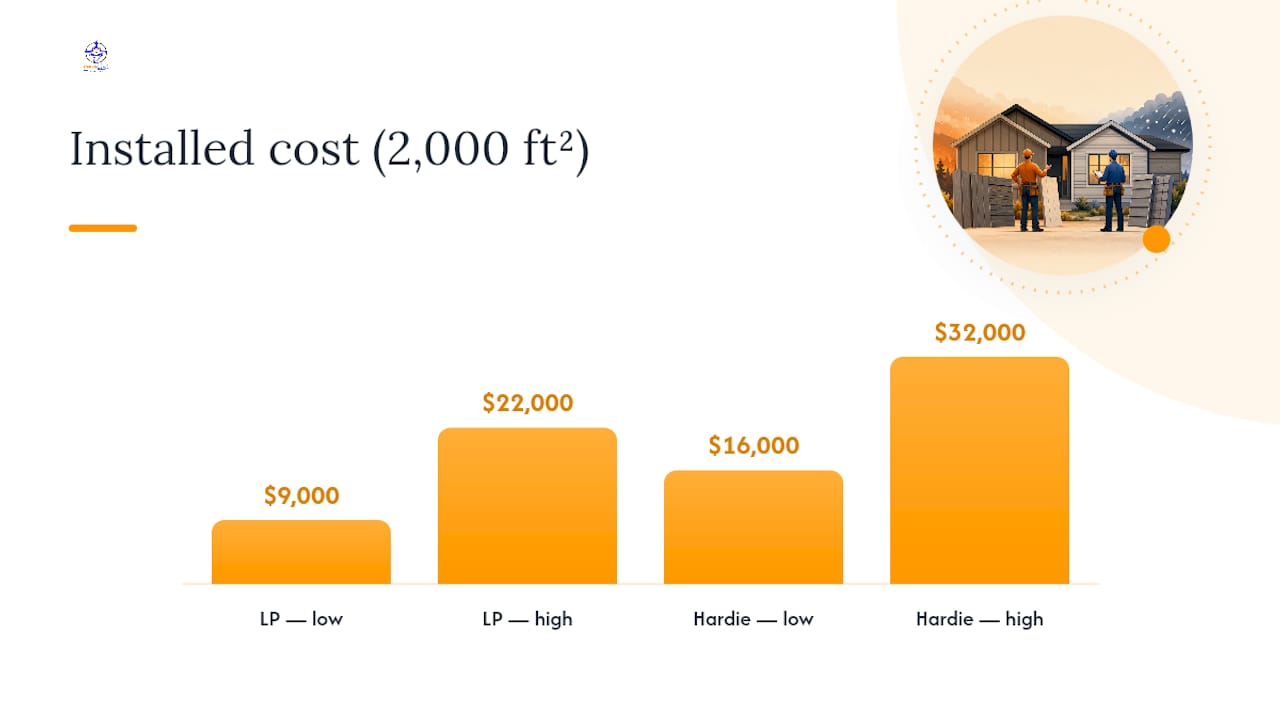
Installed pricing tells a straightforward story. LP SmartSide typically runs $4.50 to $11 per square foot installed, while Hardie runs $8 to $16. On an average 2,000 square foot home exterior, that's roughly $9,000 to $22,000 for LP versus $16,000 to $32,000 for Hardie, though finish choice and regional labor rates shift both ranges.
Labor is the real driver of the gap. Hardie is heavier to lift and set, and cutting it generates respirable crystalline silica dust, which OSHA regulates with mandatory dust control and respiratory protection requirements on job sites. That adds equipment costs, slows the cutting process, and requires a crew trained on the controls. LP SmartSide cuts with standard woodworking blades, weighs less per panel, and generally installs faster, which is part of why the labor line on an LP bid tends to run lower.
Cold-weather installs bring their own limits. Fiber cement has minimum temperature thresholds for cutting and painting, and LP has similar cold-weather handling guidance. Ask any contractor bidding a winter install how they're managing both.
How Often Do You Need to Repaint, and How Does Siding Affect Resale?
Factory-applied finishes on both products stretch repaint intervals well beyond what field-painted siding needs, often 15 years or more before a full repaint is due, though touch-ups at joints and trim come sooner. Where each material tends to fail tells you what to inspect annually: check Hardie for hairline cracks near fasteners and caulk failure at butt joints; check LP for soft spots or discoloration at cut edges and anywhere the factory finish has worn through.
On resale, Hardie generally returns stronger value in Cost vs Value comparisons, while LP's lower upfront cost can make more sense if you're not planning a decades-long hold. Ownership horizon is the variable that should drive this half of the decision, more than either product's marketing. For a broader look at which exterior projects move the needle at closing, Exterior Genie's breakdown of ROI fixes is worth a read, and the partner guide on home value upgrades covers similar ground from a different angle.
How Do You Choose Between LP SmartSide and Hardie?
Run through this checklist before you sign a bid:
- Ownership horizon. Staying 15+ years favors Hardie's non-prorated warranty and resale edge; a shorter hold favors LP's lower upfront cost.
- Primary hazard. Wildfire or humid coastal conditions favor Hardie; hail or severe freeze-thaw favors LP.
- Contractor experience. Ask how many jobs of that specific material the crew has completed in the last year.
- Finish choice. Factory-primed or prepainted options reduce your maintenance schedule regardless of material.
- Budget priority. Decide whether you're optimizing for lowest install cost or lowest lifetime cost first.
Three questions separate a solid bid from a risky one: is the installer certified or specifically trained on this product line, how do they seal cut edges and butt joints, and what's their dust control plan if they're cutting fiber cement on site?
Pro Tip: Watch for vague warranty language, a labor line with no detail, or a bid that skips flashing specifications entirely. Those are the three most common signs of a contractor who's guessing, not planning.
What We See on Real Siding Jobs
Brand matters less than workmanship. A Hardie job with unsealed cut edges fails faster than a well-installed LP job, and the reverse is just as true. Field practice like sealed cuts, six inches of grade clearance, and correct flashing is usually what separates a siding job that meets its warranty from one that doesn't.
The company is veteran-owned and holds Owens Corning Platinum Preferred Contractor status, serving areas in South Carolina. Hiring a crew with real certification and a documented track record reduces your long-term risk more than any spec sheet comparison ever will.
— Ebben
Get a Siding Bid Built Around Your Climate, Not a Sales Script
This contractor handles siding installation and repair for both fiber cement and engineered wood, with crews knowledgeable about flashing, cut-edge sealing, and dust control details.
When you request a bid, ask for the same things this article flagged: installer certification for the specific product, a written plan for sealing cut edges, and a labor breakdown that shows how the crew handles dust control or cold-weather cutting. If your home already has storm or hail damage on existing siding, insurance claims assistance can help you recover replacement costs before you even pick a new material. For homeowners specifically weighing a fiber cement upgrade, Exterior Genie's Hardie board siding installation and repair service in Lexington covers everything from the first estimate to final trim work. Reach out for a bid, and bring the checklist from this article with you.
Where to Verify the Technical Details
For warranty fine print and current test standards, go straight to the source: James Hardie's product pages cover fire ratings and warranty terms, LP's SmartSide pages detail the 5/50 warranty and installation specs, and Exterior Genie's material options guide rounds out regional context.
Sources
- James Hardie vs LP SmartSide: Cost, Fire & Warranty
- LP SmartSide product pages (LP)
- HardieBoard vs LP SmartSide 2026: Cost & Durability
FAQ
What Are the Disadvantages of LP SmartSide?
LP SmartSide is combustible rather than fire-rated, carries a prorated warranty after the first five years, and, as an engineered wood product, needs sealed cut edges and proper clearance from grade to avoid moisture damage.
Is James Hardie or LP SmartSide More Expensive?
James Hardie typically costs more installed, running roughly $8 to $16 per square foot versus $4.50 to $11 for LP SmartSide, largely because of Hardie's weight and required silica dust controls during cutting.
What Are the Downsides of Hardie Board Siding?
Hardie board is heavier and more brittle under sharp impact, meaning hailstones can crack it, and cutting it generates silica dust that requires OSHA-mandated dust control and respiratory protection on the job site.
What Is the Most Durable Siding for a House?
There's no single answer. Hardie is more durable against fire and long-term moisture exposure, while LP SmartSide is more durable against hail and cold-impact stress, so "most durable" depends on which hazard your home actually faces.