

Water sitting on a flat roof for more than 48 hours is officially "ponding," and it means your drainage system has failed at its one job. Go check your drains right now, clear any visible debris, and time how long the water has been sitting. If it's still there after two days, or the puddle is deep, wide, or keeps coming back, stop guessing and get a professional evaluation scheduled.
TL;DR:
- Most ponding issues are caused by clogged or undersized drains, which are simple to fix and account for about 30% of cases.
- Design problems like insufficient slope and structural deck deflection require professional correction with insulation or structural assessments, not just drain cleaning.
- Documenting ponding with timestamped photos, measurements, and area estimates within 48 hours is crucial for warranty and insurance claims.
- Minor ponding under one inch and small areas often resolve with monitoring, but persistent or severe ponding needs urgent professional evaluation.
- Regular inspections every quarter, after storms, and before the first freeze help prevent minor issues from worsening into structural damage.
Table of Contents
- What Counts as Ponding Water on a Flat Roof?
- Why Does Water Pool Instead of Draining Off?
- Is the Ponding on Your Roof Dangerous or Just Annoying?
- How Do You Check and Fix Ponding Yourself First?
- What Do Professional Fixes Cost, and Which One Do You Need?
- How Often Should You Inspect a Flat Roof for Ponding?
- How Exterior Genie Diagnoses and Fixes Ponding Issues
- Field Notes: What Actually Slows Down a Ponding Repair
- Get a Ponding Roof Evaluation Scheduled
- Where to Read More on Codes and Drainage Standards
- Sources
- FAQ
What Counts as Ponding Water on a Flat Roof?
The Asphalt Roofing Manufacturers Association and the National Roofing Contractors Association both draw the same line: water that remains on a roof surface for 48 hours or longer after rain stops is ponding, not just normal runoff delay. A properly drained roof should shed water fast enough that nothing is left standing two days later. Below that threshold, you're fine. Above it, the membrane is sitting in a bathtub it wasn't designed for.
Documenting ponding is simple and worth doing before you call anyone:
- Note the exact time rain stopped, then check the same spot at 24 and 48 hours.
- Measure depth with a ruler or tape measure pushed straight down to the deck.
- Estimate the surface area in square feet, even roughly.
- Take smartphone photos with timestamps enabled. Insurers and contractors both want this record.
That log becomes your evidence if a warranty claim or insurance question ever comes up.
Why Does Water Pool Instead of Draining Off?
Four culprits show up again and again, and telling them apart matters because the fix for one does nothing for another.
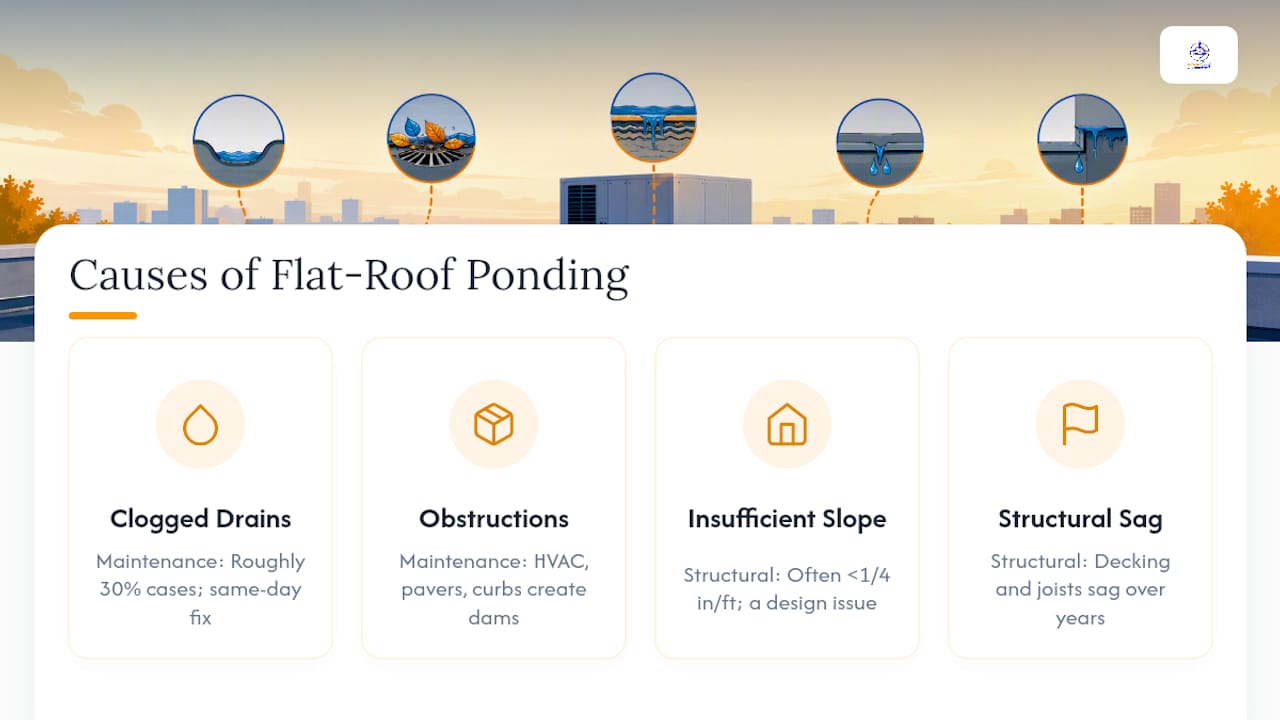
Clogged or undersized drains are the most common cause by a wide margin. Blocked strainers and debris-choked drains cause roughly 30% of all ponding cases, and clearing them is often a same-day fix. Blocked scuppers cause the same problem from a different angle: overflow openings packed with leaves or roofing debris.
Insufficient slope is a design problem, not a maintenance one. Roofs built before the 1990s were often finished with slopes as shallow as 1/8 inch per foot, well under the 1/4 inch per foot minimum most roofing standards now require. No amount of drain clearing fixes a deck that was never pitched correctly.
Structural deflection develops over years as roof decking and joists sag under repeated loading, creating a low spot where none existed originally. This is progressive: the more water collects, the more weight bears down, and the deeper the low spot gets each season.
Obstructions round out the list. HVAC units, parapet curbs, pavers, and rooftop equipment installed without regard for water flow create dams. In cold climates, frozen drain outlets add a seasonal wrinkle. Ice can block internal drains completely, and in bad cases the trapped water pressure has caused drains to burst once thawing begins.
Pro Tip: If ponding shows up in the exact same spot every time it rains, that's a structural or slope issue. If the location shifts depending on which drain got clogged, it's almost always maintenance.
Is the Ponding on Your Roof Dangerous or Just Annoying?
Not all ponding carries the same risk, and figuring that outcomes down to three questions: how deep is it, how much area does it cover, and how often does it happen?
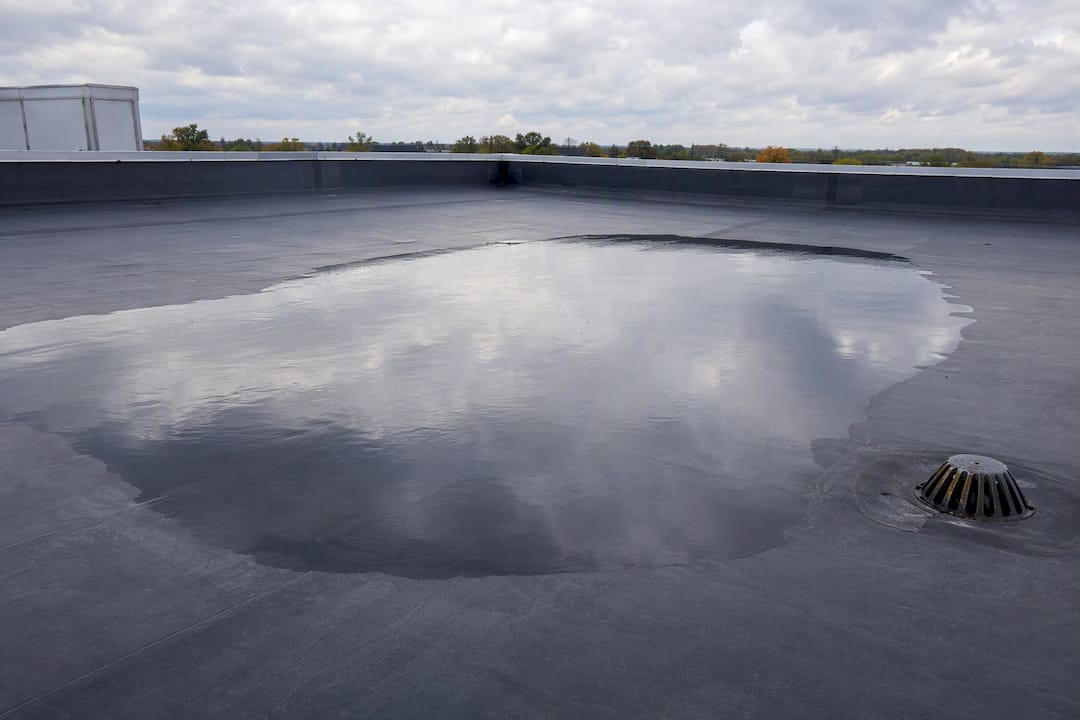
The weight math is worth knowing cold. Water weighs about 5.2 pounds per square foot for every inch of depth. A modest pond, say 20 feet by 10 feet at 2 inches deep, adds over 2,000 pounds of unplanned dead load. That weight doesn't just sit there. It pushes the deck down slightly, which deepens the low spot, which invites more water next time. That feedback loop is exactly how a minor ponding issue becomes a structural referral two years later.
There are contract implications too. Most membrane manufacturers write ponding exclusions into their warranties, and documented recurring ponding can void coverage entirely. Insurance carriers ask the same questions after a claim: was this pre-existing, and was it neglected?
| Condition | Depth / Area / Frequency | Recommended action |
|---|---|---|
| Minor, recent | Under 1 inch, small area, first occurrence | Monitor and recheck at 48 hours |
| Persistent | Any depth, still present after 48 hours | Schedule a professional drainage evaluation |
| Severe | Over 2 inches deep, large area, or recurring every rain | Urgent: contractor plus structural engineer review |
How Do You Check and Fix Ponding Yourself First?
Before anyone climbs a ladder with a quote pad, there's a short list of things you can check safely from ground level or a stable roof access point.
- Run the drain flow test. Pour a few gallons of water near each drain and watch how fast it clears. Slow or standing water means a blockage somewhere in the line.
- Clear strainers by hand. Leaves, granules, and small debris cause most clogs. Wear gloves and don't force anything metal into the drain body.
- Check scupper openings for the same debris buildup, and confirm HVAC condensate lines are routed to a drain, not dumping onto the roof surface.
- Use a tarp or a small submersible pump only as a stopgap while you wait for a contractor, never as a fix. Standing water under a tarp still weighs the same.
- Stop and call a professional if you notice a soft or spongy deck underfoot, the pond keeps growing between visits, or the same spot floods every single time it rains.
Pro Tip: Photograph the drain before and after clearing it. If the ponding returns within a week, that photo proves the clog wasn't the real problem, which saves you a second diagnostic visit.
What Do Professional Fixes Cost, and Which One Do You Need?
Contractor fixes fall into three tiers, and picking the right one depends entirely on what's actually causing the water to sit.
Drain-level fixes address the most common cases. Professional drain clearing typically runs $200 to $400 and resolves clogging issues outright. Adding a second drain, a scupper, or a cricket (a small triangular structure built behind curbs and units to redirect flow) costs more but solves obstruction-driven ponding permanently rather than temporarily.
Slope corrections fix the design problem. Tapered polyiso insulation gets installed over the existing deck to build in the pitch that was missing from the start, generally running $2.50 to $5.50 per square foot installed. For roofs where the membrane itself is also failing, a full re-roof with new tapered insulation and membrane addresses both problems in one project rather than layering a patch on top of a dying roof.
Interim measures buy time without solving the root cause. Silicone coatings are generally the only category manufacturers endorse for actual ponding tolerance; acrylic and other coatings tend to degrade faster under standing water and shouldn't be treated as a long-term answer.
Before you accept a quote, ask the contractor these questions:
- What's the root cause you're diagnosing, not just the symptom you're treating?
- Does this fix meet code minimum slope, or does it just patch the surface?
- What photos or measurements do you need from me before the visit?
- Is a structural engineer referral warranted here, or is this purely a drainage fix?
Building codes back up the drain-level fix specifically. IPC Section 1106 requires secondary or overflow drainage, set at least two inches above the primary drain, so a clogged main drain can't turn into a flooded roof deck. If your building lacks that overflow path, adding one should be part of any repair scope, not an afterthought.
How Often Should You Inspect a Flat Roof for Ponding?
A quarterly check schedule, plus one inspection after any major storm and one before the first freeze, catches most ponding before it becomes a structural conversation.
- Clear strainers and scuppers on every visit, not just when something looks clogged.
- Run a quick drain flow test rather than relying on a visual check alone.
- Walk the roof for new debris, especially near HVAC units and parapet walls.
- Check condensate lines and flashing seals, both common secondary sources of standing water.
- Keep a photo log with timestamps and depth notes every time ponding shows up, along with receipts from any maintenance visit.
That paper trail does double duty. It speeds up contractor diagnosis on future visits and gives you the documentation an insurer or warranty administrator will ask for if a claim ever gets filed. If you manage several properties, a written maintenance checklist turns this from a memory exercise into a repeatable routine your whole team can follow. Understanding how drainage slopes function on any property also helps when you're evaluating whether a contractor's proposed fix actually solves the pitch problem or just moves it.
How Exterior Genie Diagnoses and Fixes Ponding Issues
A veteran-owned crew treats a ponding call the same way every time, and that consistency is what keeps a diagnosis from turning into a guessing game. The company holds Owens Corning Platinum Preferred Contractor status and handles both the roofing work and the insurance-claims side when storm damage is involved.
A typical evaluation follows this sequence:
- Document existing ponding with timestamped photos and depth measurements.
- Run a drain flow test to confirm whether the blockage is at the strainer, the line, or the outlet.
- Measure total ponding area to calculate approximate added roof load.
- Diagnose whether the root cause is drainage, slope, or deck deflection, and bring in a structural engineer when deflection is suspected.
- If the damage traces back to a storm event, HAAG-certified inspectors handle the insurance documentation so the claim reflects what's actually happening on the roof.
Field Notes: What Actually Slows Down a Ponding Repair
The clog you can see is rarely the whole story. Downspouts hidden behind parapet walls, insulation compressed from years of standing water, and undocumented roof overlays from a previous owner all tend to surface once a crew opens things up. A straightforward drain-clearing job can turn into a slope correction the moment someone finds the deck already sagging underneath.
Timelines from first call to finished repair usually run longer than homeowners expect, mostly because of permitting on structural work, roof access logistics, and tapered insulation lead times that can stretch several weeks. The single best thing a property owner can do to speed that process along is exactly what the 48-hour rule already asks for: timestamped photos taken the moment ponding is confirmed. That documentation moves faster through both contractor scoping and insurance review than anything written after the fact.
— Ebben
Get a Ponding Roof Evaluation Scheduled
This company fixes the drainage problem instead of just patching the symptom, which matters here because a coating slapped over an undersized drain will pond again next season. Depending on what a technician finds, that might mean clearing and re-sizing drains, adding scuppers or a cricket behind rooftop equipment, installing tapered insulation to correct decades-old slope, or emergency tarping if water is actively getting inside.

Before the visit, gather what you already have: timestamped photos of the standing water, a rough depth and area estimate, and notes on how often it recurs. That log turns a first visit into an actual diagnosis instead of a second data-gathering trip. If a storm caused the damage, Exterior Genie's HAAG-certified inspectors can also handle the insurance-claim paperwork alongside the repair itself.
Ready to get eyes on the problem? Schedule a roof repair evaluation and get a straight answer on whether you're looking at a drain clear, a slope fix, or something bigger.
Where to Read More on Codes and Drainage Standards
For the technical backbone behind these recommendations, see ARMA's ponding water research and drainage slope and scupper code guidance.
Sources
- Effects of Ponding Water on Low-Slope Asphalt Roofing Systems – Asphalt Roofing Manufacturers Association (ARMA)
- Flat roof drainage: Slope, scuppers, drains | The Roofing Brief
- Ponding water on flat roofs | Flat Roof Report
- Flat roof drainage repairs and ponding — InspectApedia
FAQ
How Much Ponding Is Acceptable on a Flat Roof?
Water that clears within 48 hours after rain is considered normal drainage delay. Anything still standing past that mark meets the industry definition of ponding and warrants a closer look.
What Is the Best Filler or Fix for Ponding on a Flat Roof?
There's no single "filler" that solves ponding long-term. Drain clearing fixes the most common cause outright, while tapered insulation corrects slope problems and silicone coatings are the main option manufacturers endorse for ongoing ponding tolerance.
How Long Can Water Sit on a Flat Roof Before It's a Problem?
Past 48 hours, standing water starts to count as ponding rather than normal runoff, which is the point most roofing warranties and inspection standards use as their trigger.
How Do You Stop Ponding on a Roof for Good?
Start by clearing drains and scuppers, since that resolves a large share of cases on its own. If ponding returns in the same spot after clearing, the issue is almost always insufficient slope or deck deflection, which needs a tapered insulation retrofit or a structural evaluation rather than another drain cleaning.