

A handful of shingle granules in gutters after a rain is normal shingle aging, especially in the first two months after a new roof install or on a roof past year ten. What separates a routine gutter cleanout from a real problem is quantity, timing, and pattern: sudden heavy loss after a storm, granule piles concentrated under a specific roof slope, or visible bald spots on the shingles themselves. Photograph what you find, note your roof's age, and check whether a storm rolled through recently before deciding your next move.
TL;DR:
- Granule loss from gutters is normal during the first two months after installing a new roof but should not be heavy or concentrated in one area after ten years.
- Loss caused by hail produces a sudden surge of granules right after a storm, while gradual loss over years is typical due to asphalt aging.
- Regular inspection using binoculars and photos, focusing on distribution rather than volume, helps differentiate between aging and storm damage.
- Heavy or uneven granule piles, bald patches, and fading shingles indicate potential problems that require professional evaluation, especially if observed on a roof under two years old or after a storm.
- Routine gutter cleaning with a scoop and garden hose prevents clogs, but professional inspection and thorough documentation are essential if damage is suspected for insurance claims.
Table of Contents
- What Shingle Granules Are and Why They Matter
- Why Granules Show Up in Gutters in the First Place
- When Granule Loss Is Normal vs. a Red Flag
- Common Causes of Heavy or Abnormal Granule Loss
- How to Inspect Your Gutters and Roof to Diagnose the Cause
- How to Remove Granules From Gutters and Avoid Clogs
- When to Call a Professional and How to Document for Insurance
- Routine Maintenance to Slow Granule Loss
- Exterior Genie: What a Professional Inspection Looks Like
- The Real Lesson Buried in Gutter Debris
- Sources
- FAQ
What Shingle Granules Are and Why They Matter
Those little colored specks aren't dirt or sand. They're ceramic-coated crushed rock, embedded into the asphalt layer during manufacturing, and they do more work than most homeowners realize.
Granules serve three jobs on an asphalt shingle:
- Block UV rays that would otherwise cook the asphalt underneath
- Add impact resistance against hail, debris, and foot traffic
- Provide the color and texture that make shingles look uniform across a roof
Once granules wear away, the asphalt underneath is exposed directly to the sun and moisture. That's not a cosmetic issue. Bare asphalt dries out, cracks, and curls far faster than granule-covered asphalt, and a bald patch tends to spread once it starts. According to FreshRoof's breakdown of granule function, exposed asphalt accelerates shingle aging in a way that's difficult to reverse. A shingle that's lost its granule coat in one spot is usually a shingle on a shortened clock, not a shingle that's simply "getting old gracefully."
Why Granules Show Up in Gutters in the First Place
Most granules that land in your gutters got there through completely ordinary means. Manufacturing and installation leave loose granules sitting on the shingle surface that aren't fully bonded to the asphalt, and the first few good rains wash them straight into your gutter system.
Common, benign pathways include:
- Loose granules from the factory or install crew rinsing off during the first one to two months of rain
- Runoff naturally carrying granules downhill toward downspout openings and elbows
- Gradual, even wear distributed across the whole roof surface, spread out over 15 to 20 years
InterNACHI's inspection guidance on asphalt composition shingles notes that this early wash-off is expected behavior, not a defect, and that granule loss which stays consistent over many years typically points to ordinary aging rather than a failing roof. The pattern to watch for is the opposite: loss that's sudden, uneven, or concentrated in one area.
When Granule Loss Is Normal vs. a Red Flag
Roof age is your single best diagnostic tool here, and it's one most homeowners overlook entirely.
In the first zero to two months after a new roof goes on, a light dusting of granules in the gutters is normal. This is loose factory residue finishing its wash-off, not a sign anything went wrong.
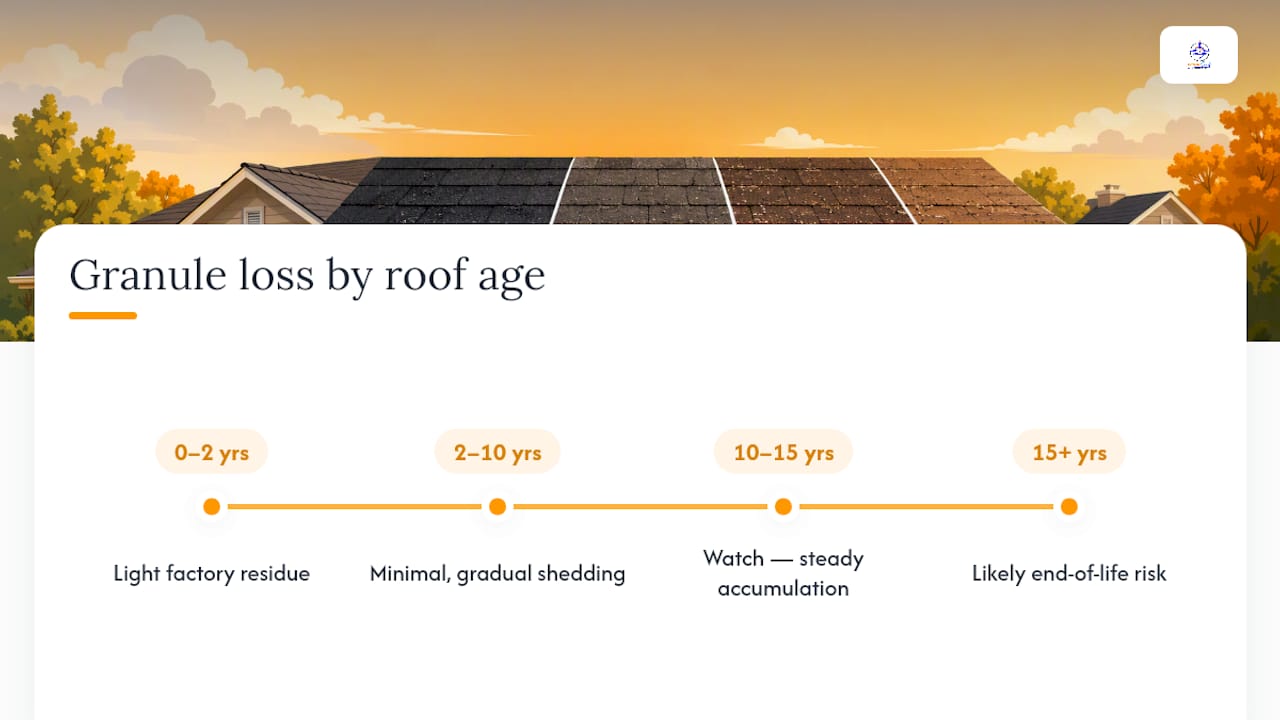
Between roughly two and ten years, granule loss should be minimal and gradual. Some background shedding is normal, but you shouldn't see visible bald patches or heavy accumulation during a routine gutter cleaning.
From about ten to fifteen years, granule loss picks up as the asphalt binder starts to age. This is a watch period. Moderate, steady accumulation is expected, but it's worth tracking whether the rate is increasing.
Past fifteen years, according to The Roofing Brief's diagnostic guide, steady granule loss often signals a roof approaching the end of its service life, and it's reasonable to start budgeting for a reroof rather than waiting for a leak.
Outside those age bands, watch for the actual red flags: sudden heavy loss right after a storm, granule piles concentrated under a specific roof slope instead of spread evenly, bald spots you can see from the ground, shingle color that looks patchy or faded in blotches, and curling or blistering shingle edges. Any one of those on its own is worth a closer look. Two or more together mean stop guessing and call someone.
Common Causes of Heavy or Abnormal Granule Loss
Not all granule loss comes from the same source, and the cause changes what you should do next.
- Hail leaves round, bruise-like impact marks and typically produces a sudden granule surge in the gutters right after the storm passes
- Wind tends to cause linear tearing or partial shingle lift, sometimes pulling whole tabs loose rather than just stripping granules
- UV exposure and heat dry out the asphalt binder gradually, producing steady granule thinning that builds over years rather than overnight
- Manufacturing or adhesion defects show up as heavy granule loss on a roof that's only a few years old, with no storm to explain it
- Foot traffic and impact from ladders, satellite installs, or debris create localized bald patches rather than roof-wide loss
The tricky one is hail. A surge of granules after a storm doesn't automatically mean your roof failed, but it doesn't mean you're in the clear either. The NRCIA's hail damage guidance points out that hail bruising is often invisible from the ground, hiding beneath the very granules that got knocked loose.
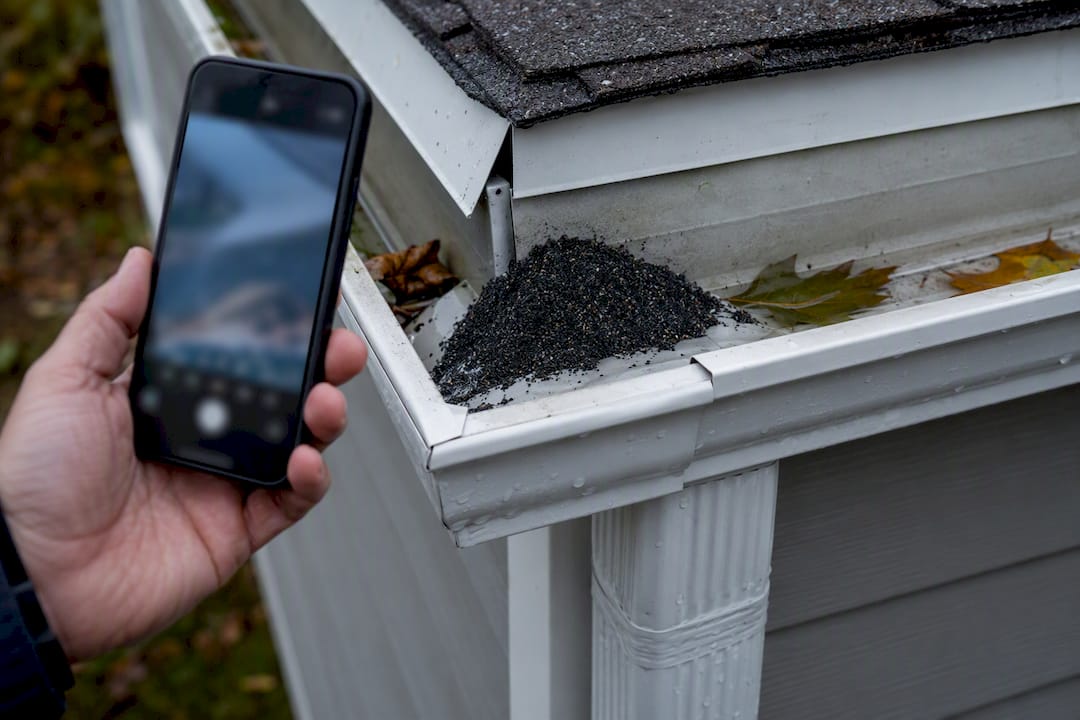
Pro Tip: If you notice a granule surge within 24 to 48 hours of a hailstorm, resist the urge to just clean the gutters and move on. Photograph the pile first, then get an inspection before you clear the evidence away.
How to Inspect Your Gutters and Roof to Diagnose the Cause
You don't need to climb onto your roof to gather useful evidence, and in most cases you shouldn't.
- Stay grounded unless you have real experience with roof access. Binoculars and a zoom lens do the job safely.
- Check the obvious collection points first: downspout openings, gutter elbows, splash blocks, and the driveway or patio directly below the roofline.
- Photograph systematically: a close-up of any granule pile, a wide shot of each roof slope, and a shot of the gutter interior. Timestamp every photo, either through your phone's metadata or by including a dated newspaper or note in frame.
- Compare downspouts against each other. Heavy accumulation under one downspout but not the others points to a localized problem on that slope, not roof-wide aging.
- Cross-reference recent weather. A quick search of your zip code and the past 30 days will tell you if a hail or wind event lines up with what you're seeing.
A single downspout with a noticeably heavier granule pile than its neighbors is one of the more reliable field signs of localized shingle damage. Roof-wide, evenly distributed granules across every downspout usually points to age instead.
If your photos show even distribution and your roof falls inside the two to ten year age band, keep monitoring. If you see concentration under one slope, bald spots, or your roof is under two years old with heavy loss, it's time to move past DIY inspection and get a professional read on it.
How to Remove Granules From Gutters and Avoid Clogs
Once you've documented what you're seeing, clearing the granules out is a straightforward maintenance job, provided you use the right tools.
- A plastic gutter scoop (like the FrostKing gutter scoop) clears bulk debris without scratching the gutter lining
- A wet/dry shop vacuum with a gutter attachment pulls out fine granule sediment that a scoop leaves behind
- A hand trowel works for tight corners near end caps and downspout openings
- A garden hose flushed through the downspout after cleaning confirms water flows freely all the way to the splash block
Avoid aggressive scraping tools on the gutter itself, and never use a wire brush or anything abrasive directly against the shingle edge overhanging the gutter. It's easy to knock loose granules that were still bonded, which makes the problem look worse than it is and can nick the shingle's protective edge.
Pro Tip: Once your downspouts are clear, run water through for a full minute and watch the splash block. If water backs up or overflows the gutter lip, you likely have a blockage further down the downspout, not just surface granules.
If your roof is actively shedding a visible amount each season, plan on cleaning gutters at least twice a year, spring and fall, so granules and leaf debris don't compound into a full clog.
When to Call a Professional and How to Document for Insurance
Some situations call for more than a hose and a scoop. Bring in a roofing professional when you see sudden or heavy granule loss with no obvious age explanation, piles concentrated under a single slope, visible bald spots from the ground, or heavy shedding on a roof under two years old.
If hail is a possibility, ask specifically for a HAAG-certified inspection. HAAG certification trains inspectors to spot the kind of hidden bruising that causes shingles to fail months after the storm, long after the visible granule surge has washed away.
Before that inspection, or right alongside scheduling one, pull together:
- Timestamped photos of gutter accumulation and any visible shingle damage
- Local weather or hail reports from NOAA covering the date in question
- Roof age and original installation records or receipts
- A written assessment from the inspecting professional
Depending on what the inspection finds, the outcome ranges from a minor repair to spot shingle replacement to a full reroof. Documenting thoroughly before you file a claim, rather than after an adjuster asks questions, tends to move the process along faster. If you're at this stage, Exteriorgenie's insurance claims assistance walks homeowners through exactly what an insurer expects to see.
Routine Maintenance to Slow Granule Loss
You can't stop shingles from aging, but you can slow the rate and catch problems before they compound.
- Clean gutters at least twice a year, more often if overhanging trees drop debris
- Trim back branches that scrape roof surfaces during wind
- Improve attic ventilation and insulation, since trapped heat accelerates asphalt aging from underneath
- Walk the perimeter after every significant storm and glance at gutters and downspouts for new granule buildup
- Limit unnecessary roof traffic from ladders, holiday lights, or satellite work
Restorative coatings that claim to rebind loose granules exist, and some genuinely extend shingle flexibility for a few more years. But FreshRoof's analysis of these treatments is clear that they're not a fix for shingles that are already structurally failing.
Pro Tip: Before investing in a restorative treatment, get a professional opinion on whether your shingles are candidates. Applying a coating to shingles already past their structural life just delays a decision you'll need to make anyway.
Exterior Genie: What a Professional Inspection Looks Like
Exteriorgenie is a veteran-owned general contracting company built around military-grade discipline and attention to detail, and roofing is where that shows up most. The company holds Owens Corning Platinum Preferred Contractor certification, a distinction reserved for contractors meeting recognized standards for installation quality and customer service.
When you schedule an inspection, expect a full walk of every slope, close documentation of granule patterns and any bald spots, and a straightforward explanation of whether what you're seeing is age, storm damage, or something else. Exteriorgenie's process is built on transparency, backed by a track record of five-star ratings from homeowners across South Carolina. If the inspection turns up storm damage, the same team handles roof repair and insurance claims paperwork under one roof, so you're not juggling separate contractors and adjusters on your own.
The Real Lesson Buried in Gutter Debris
Most homeowners treat gutter granules as a binary alarm: either it's nothing, or the roof is failing. That framing is backwards. Granule loss is a spectrum that only makes sense against roof age, and the industry's own inspection literature backs that up repeatedly. A pile of grit under one downspout means something entirely different on a two year old roof than it does on an eighteen year old one.
What gets underestimated is how much the pattern matters compared to the amount. Homeowners fixate on volume, scooping out a cup of granules and panicking, when the far more useful question is distribution: one slope or all of them, one downspout or every one. That distinction is what separates a five minute gutter cleaning from a call to a HAAG-certified inspector.
If there's one habit worth adopting, it's the timestamped photo routine after every storm, before cleaning anything out. Evidence collected in the moment is worth more to an insurance adjuster, and to your own peace of mind, than any amount of after-the-fact recollection.
— Ebben
Sources
- Mastering Roof Inspections: Asphalt Composition Shingles, Part 34 - InterNACHI®
- Roof Granules in Gutter: New, Aging or Hail Damage? | TRB
- How Granules Work — And Why Your Roof Is Losing Them
- NRCIA: Hail damage roof inspection and insurance guidance
FAQ
Should I clean granular loss out of my gutters?
Yes. Leaving granules in place risks clogging downspouts and trapping moisture against the gutter, but photograph the accumulation first if you suspect storm damage, before you clear it out.
Does insurance cover granule loss?
Insurance typically covers granule loss only when it's tied to a specific covered event like hail or wind, not gradual aging; a HAAG-certified inspection and documented storm history are usually required to support a claim.
How do I get shingle grit out of gutters?
Use a plastic gutter scoop or a wet/dry vacuum to remove the debris, then flush each downspout with a garden hose to confirm water flows freely to the splash block.
How much granule loss is too much?
Heavy or sudden loss after a storm, granule piles concentrated under one roof slope, or visible bald spots on the shingles at any roof age are signs of a real problem rather than normal wear.