

Synthetic underlayment is the better default for most roof replacements, thanks to stronger tear resistance, lighter rolls, and longer permitted exposure to weather. Felt still earns its place on tight budgets, short-exposure jobs, or when a roofing manufacturer's warranty specifically calls for it. The right choice really depends on your roof's ventilation, insulation, and how long the deck will sit exposed before shingles go on.
TL;DR:
- Synthetic underlayment generally provides longer exposure tolerance and better tear resistance than felt, making it suitable for most full reroofs.
- For roofs with limited ventilation and spray foam insulation, vapor-permeable felt is preferable to prevent moisture trapping, especially in cold, humid regions.
- Each product’s specific exposure limits and fastening requirements must be verified with the manufacturer’s data sheet to ensure proper installation and warranty coverage.
- Felt remains the more cost-effective option for short-term repairs with quick deck coverage, typically lasting around two weeks if exposed to rain or sun.
- Proper assessment of roof ventilation, insulation, and expected exposure duration is critical to selecting the right underlayment to avoid moisture issues and maximize lifespan.
Table of Contents
- Synthetic vs Felt Underlayment: Weighing the Pros and Cons
- Why Vapor Permeance and Roof Assembly Design Matter
- How Installation and Exposure Time Affect Your Project
- Cost and Lifecycle: When the Extra Spend Pays Off
- A Decision Checklist Before You Sign a Contract
- What Exterior Genie Has Learned Installing Both Materials
- One Roofer's Take on Getting This Right
- Get a Professional Underlayment Recommendation for Your Roof
- Standards and Research Behind This Guide
- Sources
- FAQ
Synthetic vs Felt Underlayment: Weighing the Pros and Cons
Roofers have argued about felt versus synthetic underlayment for two decades, and the honest answer is that both materials do their job when installed correctly. The differences show up in how they handle water, sun, foot traffic, and time.
Felt underlayment, the asphalt-saturated paper that's covered roofs since before your grandparents bought their first house, comes in two ASTM-recognized grades: Type I and Type II, commonly called No. 15 and No. 30. Those "15-pound" and "30-pound" labels are historic holdovers from old manufacturing weights, not a reliable measure of today's product performance. What actually matters is the ASTM D226 specification the roll meets, not the number printed on the wrapper.
Synthetic underlayment is a woven or non-woven polymer sheet, usually polypropylene or polyethylene, engineered to shed water and resist tearing. Products that qualify as mechanically attached polymeric underlayments are measured against ASTM D8257, which sets performance benchmarks for tear strength and water resistance on steep-slope roofs.
Here's how the two stack up on the factors that matter most to homeowners:
- Durability: Synthetic resists tearing and foot traffic damage far better than felt, which can rip during installation on windy days.
- Moisture resistance: Felt absorbs water and can wrinkle or buckle if rain hits before shingles go down; synthetic sheds water and stays flat.
- UV exposure: Felt degrades quickly in sunlight, while many synthetics tolerate weeks of exposure without breaking down.
- Traction: Synthetic often includes textured walking surfaces, though wet conditions can still make any underlayment slick.
- Cost: Felt remains the cheaper material per square, which matters on tight-budget repairs.
- Vapor permeance: Some low-permeance synthetics can trap moisture in certain roof assemblies, a problem felt rarely causes.
Pro Tip: Never assume a printed "high-traction" surface means safe footing in wet weather. Test it yourself or have your crew treat every underlayment as slippery until proven otherwise.
Why Vapor Permeance and Roof Assembly Design Matter
A roof underlayment doesn't just keep rain out. It also affects whether moisture trapped in your roof deck can escape, and that's where synthetic products can create problems felt rarely does.
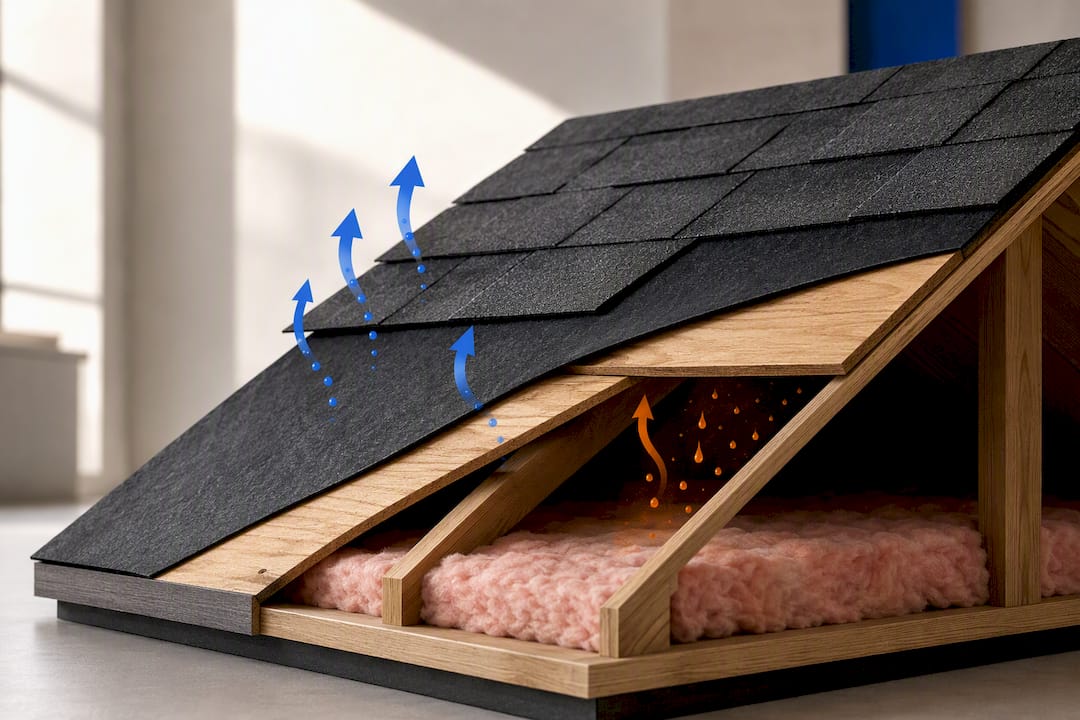
Vapor permeance measures how easily water vapor passes through a material. Felt is moderately permeable, letting a certain amount of trapped moisture migrate out of the sheathing over time. Many synthetic underlayments are far less permeable, which is great for keeping water out but can trap moisture inside the assembly if the roof lacks adequate ventilation.
Building America and Department of Energy research on unvented roofs found that low-vapor-permeance underlayments can limit upward drying of the roof deck, raising the risk of moisture problems in the wrong assembly.
Low-permeance materials aren't inherently bad. They're wrong for the wrong assembly. A roof with spray foam insulation against the deck and no ventilation path behaves very differently than a traditional vented attic with fiberglass batts, and the underlayment needs to match that reality.
Technical literature on underlayment permeance backs this up: a strong, waterproof synthetic membrane can still trap moisture if the assembly beneath it can't dry through another path.
The practical signals to watch: if your attic has spray foam insulation and no ridge or soffit ventilation, lean toward a vapor-permeable underlayment or confirm the synthetic product's perm rating with the manufacturer. If your roof is a standard vented assembly with fiberglass or cellulose insulation, most synthetic products work fine without permeance concerns. Climate zone matters too. Cold, humid regions see more moisture-related failures than dry, mild ones. A proper ventilation strategy often matters as much as the underlayment choice itself.
How Installation and Exposure Time Affect Your Project
Underlayment choice changes how your crew works, how long your deck can sit exposed, and what your contractor needs to put in writing, which is crucial information highlighted in this contractor growth plan.
Felt has a well-defined exposure window. ASTM D4869 specifies that asphalt-saturated felt should resist wrinkling and damage for roughly two weeks of exposure. Push past that window, especially with rain or intense sun, and felt starts to degrade before shingles ever go on.
Synthetic exposure limits vary by manufacturer and product line. Trade guidance on steep-slope underlayment notes that many synthetics generally allow significantly longer exposure than felt, though specific durations vary by product, but that figure isn't universal. Here's what actually shapes the installation:
- Exposure limit — Get the written permitted exposure time from the product data sheet, never a verbal estimate.
- Fastening pattern — Mechanically fastened synthetics need a specific nail or cap-nail pattern; adhesive-back products change wind performance and warranty terms.
- Roll weight and coverage — Synthetic rolls typically cover more square footage per roll and weigh less, which speeds up crew time on larger roofs.
- Traction on the deck — Surface texture varies by brand; don't assume a walkable claim survives morning dew or a light rain.
Pro Tip: Ask your contractor for the exact product name and its data sheet before the crew shows up. "Synthetic underlayment" isn't a product. There are dozens on the market with different exposure ratings.
Cost and Lifecycle: When the Extra Spend Pays Off
Felt costs less per roll upfront, but the math changes once you factor in exposure risk and how long the roof needs to last.
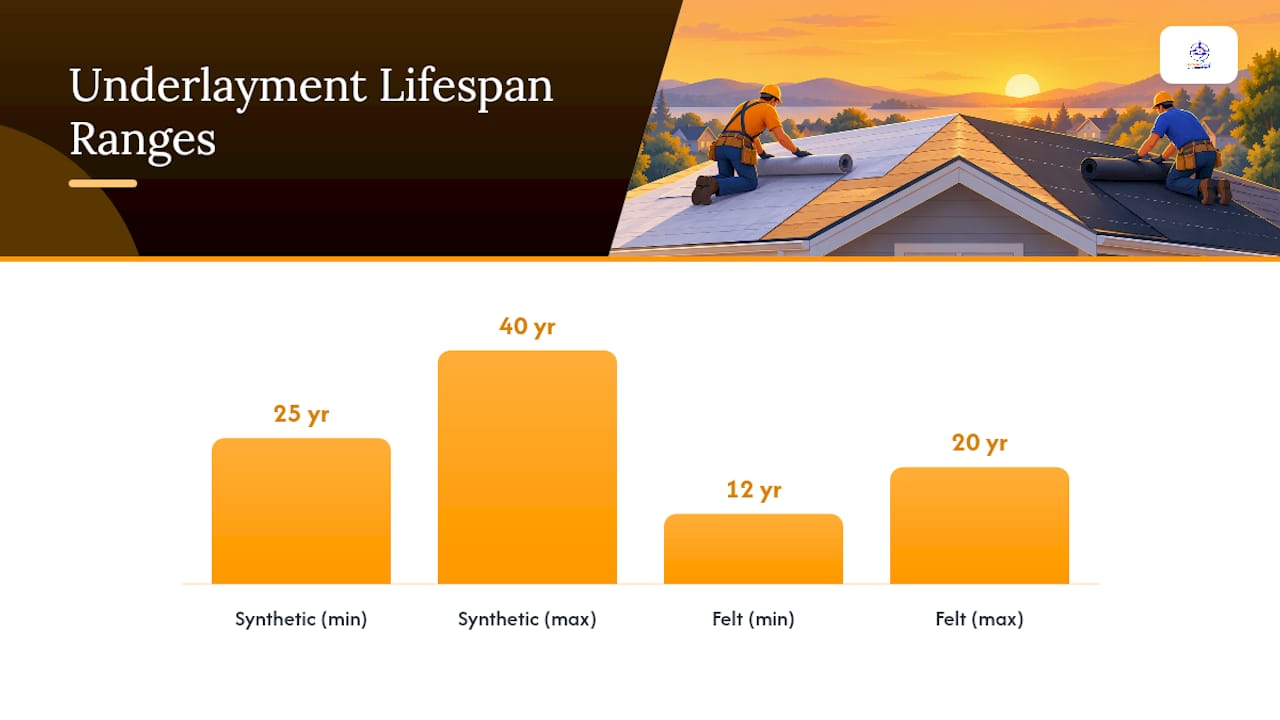
Some manufacturers and industry sources report synthetic products lasting 25 to 40 years compared to felt's typical 12 to 20 year range, though those figures depend heavily on UV exposure, installation quality, and the specific product. Treat them as a general signal, not a guarantee for any one roof.
Where does the extra cost of synthetic actually pay off?
- Full reroofs meant to last decades: the material cost difference is small relative to total project price, and durability matters over that timeframe.
- High-exposure jobs: additions, complex rooflines, or projects where weather delays are likely benefit from synthetic's longer exposure tolerance.
- Storm-damage repairs on a tight schedule: felt's lower cost and adequate short-term performance can make sense when the deck will be covered within days.
Matching underlayment lifespan to your roofing material's expected lifespan avoids paying for 40-year underlayment under a 20-year roof covering, or the reverse.
A Decision Checklist Before You Sign a Contract
Before you approve any roofing bid, work through these questions with your contractor.
- What's the roof's ventilation and insulation type? Spray foam and no ventilation points toward vapor-permeable products; standard vented attics give you more flexibility.
- How long will the deck sit exposed? Short timelines favor either material; long or unpredictable timelines favor synthetic's exposure tolerance.
- What ASTM standard does the product meet? Ask for D226 or D4869 compliance for felt, D8257 for synthetic.
- Does the underlayment choice affect your shingle warranty? Some manufacturers require specific underlayment brands or types to keep the warranty valid.
- What's the fastening pattern, in writing? A verbal answer isn't enough if a wind claim comes up later.
| Red flag | What it signals |
|---|---|
| No product name given, just "synthetic" or "felt" | Contractor may be using whatever is in the truck |
| No exposure limit stated | Risk of deck damage if the job stalls |
| No written fastening pattern | Warranty and wind-performance risk |
| No product data sheet available | You can't verify ASTM compliance |
What Exterior Genie Has Learned Installing Both Materials
On a storm-damaged repair with a two-day turnaround, felt made sense: the deck would be covered fast, and the budget favored it. On a full reroof with a complex hip design and a 40-year architectural shingle. Synthetic was the clear call, matching the longer material lifespan and giving the crew more flexibility if weather pushed the timeline.
Every project gets the same vetting steps: confirm ASTM compliance, pull the manufacturer's permitted exposure time from the product data sheet, test traction on the actual deck surface, and confirm the underlayment choice doesn't void the shingle warranty.
When a low-permeance synthetic is the right call for wind performance but the assembly has drying concerns, we address it directly, improving attic ventilation or specifying a more permeable product rather than hoping it works out.
One Roofer's Take on Getting This Right
My honest view: synthetic is the right default for most reroofs, but I've seen too many homeowners get sold on "premium synthetic" language without anyone checking the assembly underneath.. The fix is simple. Before you sign anything, ask for the exact product name, its data sheet, and the written exposure limit. That one request filters out a lot of bad bids fast.
— Ebben
Get a Professional Underlayment Recommendation for Your Roof
Choosing between synthetic and felt underlayment gets a lot easier when someone actually inspects your roof deck, ventilation, and insulation before recommending a product. Exterior Genie is an Owens Corning Platinum Preferred Contractor, a distinction held by a small percentage of contractors nationally, and that status comes with access to manufacturer-backed warranty programs most roofers can't offer.
Professional roofing crews handle roof replacement, roof repair, and storm damage restoration, and estimates ideally include the product data sheet, the written exposure limit, and a clear answer on warranty implications for underlayment changes. If your roof needs storm-damage repair, our storm damage restoration team can walk you through the same checklist used above. For a full reroof, start with a roof repair and replacement consultation and get a written recommendation before any contract goes to signature.
Standards and Research Behind This Guide
Felt underlayment performance traces back to ASTM D226 and ASTM D4869, which set felt-type definitions and exposure expectations. Synthetic underlayment performance is measured against ASTM D8257. Roof assembly and ventilation guidance comes from Building America and DOE research on unvented roofs, and code-level requirements sit in IRC Chapter 9.
Sources
- D226/D226M Standard Specification for Asphalt-Saturated Organic Felt Used in Roofing and Waterproofing
- Moisture safe, unvented roofs (Building America/DOE research)
FAQ
What Are the Disadvantages of Synthetic Roof Underlayment?
Synthetic underlayment can cost more upfront than felt, and some low-vapor-permeance products can trap moisture in roof assemblies that lack adequate ventilation. Product performance also varies significantly between manufacturers, so checking the ASTM D8257 compliance and data sheet matters more than assuming all synthetics perform the same.
Which Roofing Underlayment Is Best?
Synthetic underlayment is generally the better choice for most full roof replacements due to its tear resistance, lighter rolls, and longer permitted exposure time. Felt remains a reasonable, budget-friendly option for short-exposure repairs or when a shingle manufacturer's warranty specifically requires it.
What Are the Pros and Cons of Synthetic and Felt Underlayment?
Felt costs less and has a long track record but absorbs moisture and degrades quickly in UV exposure, typically within two weeks per ASTM D4869. Synthetic resists tearing and sun damage better and often allows longer exposure, but some low-permeance products need careful matching to the roof's ventilation and insulation.
Is 30-Pound Felt Better Than Synthetic Underlayment?
Not necessarily. The "30-pound" label refers to a historic weight designation rather than a reliable performance measure, and ASTM D226 compliance matters more than the number on the wrapper. Synthetic underlayment generally outperforms No. 30 felt on tear resistance and exposure tolerance, though felt can still be adequate for short-term, budget-conscious repairs.
How Do I Know If My Roof Needs a Vapor-Permeable Underlayment?
If your attic uses spray foam insulation against the roof deck with limited ventilation, a vapor-permeable underlayment reduces the risk of trapped moisture, based on Building America research on unvented roofs. Standard vented attics with fiberglass or cellulose insulation typically have more flexibility with either material.
Does Exterior Genie Recommend Synthetic or Felt Underlayment?
Exterior Genie recommends synthetic underlayment for most full roof replacements based on durability and exposure tolerance, while reserving felt for short-timeline repairs or manufacturer-specific warranty requirements. Every recommendation follows an inspection of the roof's ventilation, insulation, and expected exposure window, available through a roof repair consultation.