

For most standard commercial roofs, TPO delivers the better upfront value. Pick PVC instead when grease, hydrocarbons, solvents, or a 25-plus-year hold period make chemical resistance and longevity worth the premium. Installer quality and seam testing often decide the outcome more than the membrane brand itself.
TL;DR:
- Chemical resistance is the main factor, with PVC better suited for roofs exposed to oils, fuels, and solvents typically found near kitchens or industrial processes.
- Installer quality and seam testing are more decisive for lifespan than membrane brand, especially in complex or cold-weather conditions.
- TPO costs are generally lower upfront, but PVC's longer lifespan and superior chemical resistance often justify its premium for chemical-heavy or long-term projects.
- Proper maintenance, including annual inspections and seam QA, can significantly extend the service life of either membrane type.
- Selecting a certified installer and obtaining detailed warranty and seam documentation is essential to ensure maximum durability and performance.
Table of Contents
- TPO vs PVC Roofing: What Each Membrane Is Made Of
- Where TPO and PVC Roofing Perform the Same
- TPO vs PVC Roof Membrane Performance Under Real Conditions
- Installed Cost and 30-Year Lifecycle Math
- Why Installation Quality Determines TPO and PVC Roofing Lifespan
- A Maintenance Checklist for TPO and PVC Roofs
- Decision Checklist for TPO vs PVC Roofing Procurement
- How Exterior Genie Approaches Membrane Roofing Projects
- Bottom Line on Choosing Between TPO and PVC
- Why the Membrane Debate Misses the Real Decision
- Get a Site-Specific Roofing Estimate From Exterior Genie
- Sources
- FAQ
TPO vs PVC Roofing: What Each Membrane Is Made Of
The chemistry behind these two membranes explains almost every performance gap you'll read about later in this guide. TPO is a blend of polypropylene and ethylene-propylene rubber, formulated without plasticizers. PVC is a vinyl membrane that relies on plasticizers to stay flexible and to resist oils and chemicals over time.
That single difference, plasticizers or none, drives most of the practical contrast between pvc vs tpo roofing systems:
- TPO's plasticizer-free formula means nothing to leach out over time, but its polymer backbone is more vulnerable to fats, oils, and certain solvents.
- PVC's plasticizers give it flexibility and chemical resistance, though older formulations sometimes lost plasticizer over decades and became brittle.
- Newer PVC systems use polymeric or KEE-based plasticizers that resist migration, which is why modern PVC formulations outperform older generations on long-term flexibility.
- Both weld with heat guns, but the underlying polymer affects how forgiving that welding process is, which matters more once your crew hits a cold morning or a complicated flashing detail.
None of this is academic. It's the reason a restaurant roof and a warehouse roof often call for different membranes even though both look identical from the parking lot.
Where TPO and PVC Roofing Perform the Same
Before getting into where these membranes diverge, it helps to know where they don't. Both are thermoplastic single-ply systems, both heat-weld into monolithic seams instead of relying on adhesives or tape, and both come in reflective white finishes that can qualify for ENERGY STAR or LEED credit.
- Both are typically available in 45 to 80 mil thicknesses, with polyester scrim reinforcement standard on commercial-grade sheets.
- Both are mechanically attached, fully adhered, or ballasted depending on the roof deck and wind uplift requirements.
- Both offer comparable short-to-medium-term energy savings when specified in a high-reflectivity white, since reflective membranes reduce rooftop heat gain in similar ways regardless of the base polymer.
- Both handle standard foot traffic, minor ponding, and typical wind exposure without issue when installed to spec.
If your roof has no unusual exposures and a normal service life expectation, this is where TPO earns its reputation as the practical default. The differences that actually matter show up under stress, not on a spec sheet comparison of two white membranes sitting side by side.
TPO vs PVC Roof Membrane Performance Under Real Conditions
This is the section that actually decides your purchase order. Chemical exposure is the single biggest fork in the road between TPO and PVC, and it's not close. PVC resists hydrocarbons, oils, solvents, and grease far better than TPO, while TPO is notably vulnerable to animal fats and certain solvents that PVC shrugs off for decades.
A rooftop kitchen exhaust is the classic failure trigger. Grease-laden vapor settles on TPO, softens the membrane surface, and accelerates seam degradation years before it should fail. That's why restaurants, food processing plants, labs, airports, and fueling stations default to PVC despite the higher installed cost rather than risk premature TPO failure.
Beyond chemistry, a few other performance variables matter for procurement decisions:
- Puncture resistance: heavy rooftop traffic, HVAC servicing, or frequent equipment moves call for 80-mil sheets or dedicated walkway pads rather than relying on 45 or 60-mil standard sheets alone.
- Fire performance: PVC's inherent flame resistance gives it an edge in system designs where fire rating drives the specification, particularly on adjacent-structure roofs.
- Cold-weather welding: PVC tends to stay more workable in lower temperatures, while TPO's narrower welding window can slow installation schedules on late-fall or early-spring projects.
Pro Tip: If your building has any rooftop kitchen exhaust, generator fuel vent, or chemical process exhaust within line of sight of the membrane, treat that alone as grounds to default to PVC, regardless of what the rest of the spec looks like.
Installed Cost and 30-Year Lifecycle Math
Sticker price tells you almost nothing about which membrane actually costs less over the life of your roof. TPO installed costs typically run $7 to $12 per square foot for a standard 60-mil system, with adders for 80-mil sheets, adhesives, or added insulation layers pushing the top end higher. PVC standard systems run roughly $9 to $15 per square foot, with premium branded systems climbing to $12 to $18 per square foot.
- TPO: $7 to $12/sq ft installed (60-mil), higher with 80-mil or added adhesives.
- PVC: $9 to $15/sq ft installed (standard), $12 to $18/sq ft for premium systems.
- Expected service life: PVC typically 25 to 35 years versus TPO's typical 15 to 25 years.
- The lifecycle math flips in PVC's favor once you're planning to hold the building past 20 years or facing chemical exposure that would shorten TPO's real-world life anyway.
Here's the scenario that actually matters for your budget: a 20,000 square foot warehouse with no chemical exposure and a 10 to 15 year hold plan almost always comes out ahead on TPO. The same building with a rooftop kitchen exhaust, or an owner planning to hold for 30 years, usually justifies the PVC premium once you account for one fewer re-roof cycle over that horizon. Choosing purely on the lower upfront number is one of the more common procurement mistakes property managers make on this decision.
Why Installation Quality Determines TPO and PVC Roofing Lifespan
Membrane selection matters less than most spec sheets suggest once you factor in who's actually welding the seams. PVC's welding window is more forgiving of temperature swings and minor operator inconsistency, which helps on complex roofs with heavy flashing detail. TPO's narrower window demands tighter process control, especially in cold or windy conditions where heat dissipates fast.
- Require manufacturer-certified installers for whichever membrane you spec. Certification programs exist precisely because welding technique affects roof longevity more than brand selection.
- Demand daily seam probe testing with documented reports, not a verbal assurance that "it looked fine."
- Read the warranty's fine print before signing off. Look for non-prorated NDL (no dollar limit) coverage, and confirm the warranty length is actually tied to the mil thickness you're paying for, not a generic boilerplate number.
Pro Tip: Ask any bidding contractor for their manufacturer certification number and a sample seam probe log from a recent job. A contractor who can't produce either is telling you something about how the rest of the project will go.
A Maintenance Checklist for TPO and PVC Roofs
Neither membrane is maintenance-free, and skipping inspections is the fastest way to turn a 25-year membrane into a 12-year replacement job. A simple, documented cadence catches most problems while they're still cheap to fix.
- Walk the roof annually for a visual inspection, checking seam integrity, membrane discoloration, ponding water, and any new penetrations from rooftop equipment.
- Schedule a documented minor-repair pass every 3 to 5 years, even if nothing looks obviously wrong, since small seam separations and flashing gaps rarely announce themselves early.
- Increase inspection frequency near kitchen exhausts or high-traffic zones, since grease deposits and foot traffic wear both accelerate failure faster than age alone.
- Log everything: seam condition, grease buildup, discoloration patterns, and penetration count, so you can track trends instead of reacting to a leak call.
- Install walkway pads and check flashing details at every service point before they become the next leak. A structured maintenance checklist keeps this from falling through the cracks between capital projects.
Decision Checklist for TPO vs PVC Roofing Procurement
A structured screening process removes most of the guesswork from this decision and gives you language you can drop directly into an RFP.
- Step 1: Screen for chemical and grease exposure. Any rooftop kitchen exhaust, fuel storage, solvent venting, or industrial process nearby moves you toward PVC immediately, following the industry's standard screening order of exposure first, everything else second.
- Step 2: Establish your expected hold period and budget tolerance. A short hold with tight upfront budget favors TPO; a 25-plus-year hold favors PVC's premium.
- Step 3: Assess traffic and climate factors. Heavy rooftop traffic calls for 80-mil membranes or walkway pads regardless of which polymer you choose.
- Step 4: Build installer qualifications into the RFP, not just the spec sheet. Require certified installer endorsement and daily seam probe documentation as bid conditions, not optional add-ons.
- Sample RFP language to require: non-prorated NDL warranty length tied explicitly to mil thickness, daily seam probe reports submitted with pay applications, and a named certified installer of record before mobilization.
Property managers who need a deeper technical primer on the TPO side of this decision can review TPO roofing membrane fundamentals before finalizing a spec.
How Exterior Genie Approaches Membrane Roofing Projects
Exterior Genie is a veteran-owned general contractor with core services spanning roofing repairs, remodeling, and insurance claim assistance across residential and commercial projects. That military discipline shows up in the details this article has been arguing for: certified installation, documented seam quality, and warranty terms that hold up when you actually need them.
The company's Owens Corning Platinum Preferred Contractor designation and its run of five-star ratings reflect the same standard, elite craftsmanship backed by a transparent, verifiable process rather than a verbal promise. The blog library, including a TPO membrane guide, gives property managers a resource for comparing membrane options before committing to a spec, and the PVC membrane roofing service page documents direct experience installing the chemical-resistant systems restaurants and industrial buildings often require.
Bottom Line on Choosing Between TPO and PVC
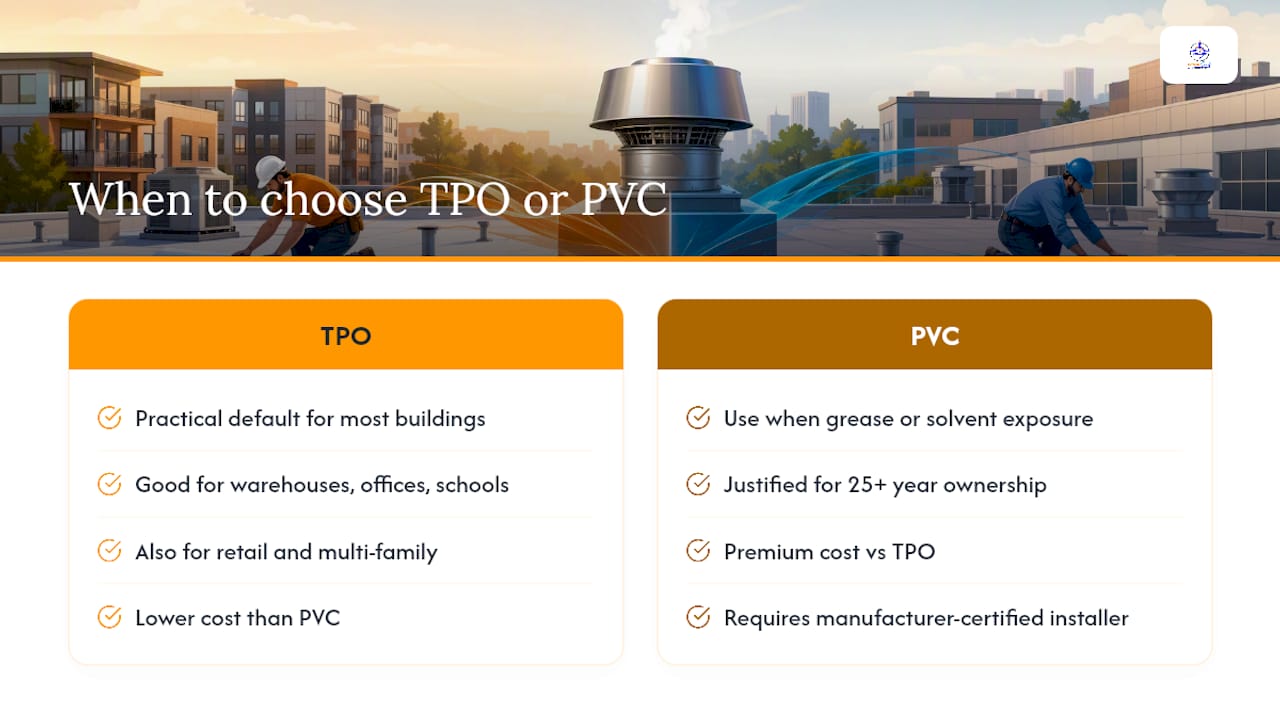
For most warehouses, offices, schools, retail buildings, and multi-family properties, TPO remains the practical default. Buildings with grease exposure, solvent venting, or a 25-plus-year ownership horizon justify PVC's premium. Before you sign anything, take three steps: check for chemical exposure sources near the roof, request sample specs and full warranty language in writing, and require seam QA documentation from a certified installer. A manufacturer-certified contractor can turn those three checks into an actual site assessment within days, not weeks.
Why the Membrane Debate Misses the Real Decision
Most articles on this topic treat TPO and PVC as a brand rivalry, complete with charts ranking one "better" than the other. That framing misleads property managers. The material choice is really a single yes-or-no exposure test dressed up as a complicated decision.
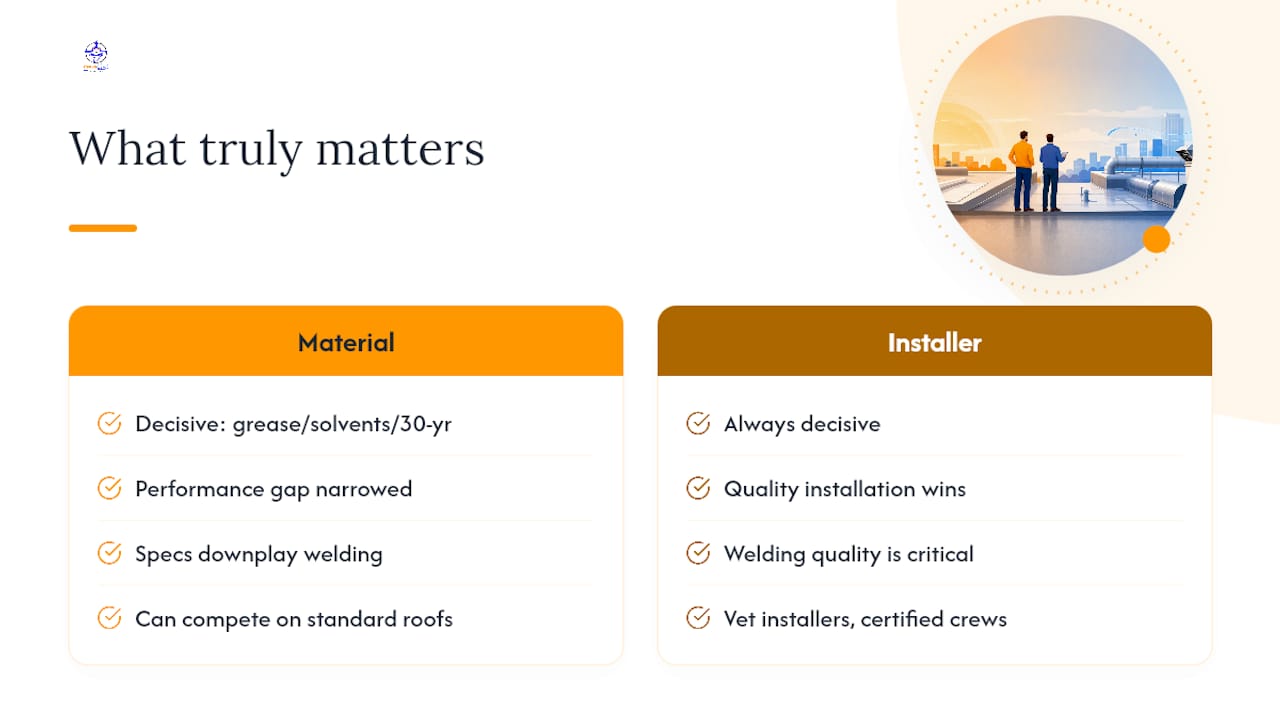
If there's no grease, no solvent venting, and no 30-year hold plan, arguing over TPO versus PVC wastes time that would be better spent vetting installers. The gap between older and newer TPO formulations has narrowed enough that a well-installed, well-maintained TPO roof on a standard building competes fine with PVC on realistic timelines.
Where I'd push back hardest on conventional advice: too many spec sheets treat welding quality as a footnote under "installation" instead of what it actually is, the single biggest variable in whether either membrane hits its rated lifespan. A mediocre PVC installation with sloppy seams will lose to a disciplined TPO job with daily seam probes and a certified crew, every time. Property managers who spend their diligence budget on installer vetting instead of material debates end up with the better roof, regardless of which polymer is underfoot.
— Ebben
Get a Site-Specific Roofing Estimate From Exterior Genie
Reading about membrane chemistry only gets you so far. What actually protects your building is a contractor who inspects your specific exposures, welds seams correctly, and backs the work with warranty language you can hold them to. Exterior Genie brings HAAG-certified inspection experience and hands-on installation work on both TPO and PVC systems, so the recommendation you get reflects your roof's actual conditions, not a generic sales pitch.

If your building sits near a kitchen exhaust, a fueling area, or you're simply due for a re-roof evaluation, request a roof repair assessment from Exterior Genie's team. For property managers weighing storm damage or an active insurance claim alongside a re-roof decision, Exterior Genie's insurance claims assistance can help you navigate coverage before committing to a membrane spec. Commercial owners planning a broader tenant improvement or facility upgrade alongside the roof work can also loop in Exterior Genie's commercial remodeling services for a single point of contact on the full project.
Sources
FAQ
Is PVC roofing better than TPO?
Neither is universally better. PVC outperforms on chemical resistance and lifespan (typically 25 to 35 years versus TPO's 15 to 25), while TPO usually wins on installed cost for standard buildings with no grease or solvent exposure.
What are the disadvantages of a PVC roof?
PVC costs more upfront, roughly $9 to $15 per square foot versus TPO's $7 to $12, and older PVC formulations were prone to plasticizer migration and brittleness over decades, though modern polymeric and KEE-based formulations have largely addressed that issue.
What are the disadvantages of TPO roofing?
TPO is more vulnerable to grease, animal fats, and certain solvents than PVC, and its narrower welding window demands tighter installer control, especially in cold weather or on complex flashing details.
How can you tell if a roof is TPO or PVC?
Both look similar as white reflective membranes, but manufacturer labeling on the seam tape or sheet edge typically identifies the polymer, and a contractor can confirm through a simple welding test since PVC and TPO don't fuse together during heat welding. If you're unsure, a certified roofing inspection can identify the existing membrane before any repair or replacement work begins.