
A roofing contractor estimate is the single most important document you can have when filing an insurance claim for roof damage. Insurance adjusters produce a policy-driven cost snapshot, not a construction plan. That gap between what the insurer calculates and what a licensed contractor actually needs to complete the job is where homeowners lose money. Understanding why roofing contractor estimate accuracy matters for claims gives you the leverage to close that gap and get a fair settlement.
How does a roofing contractor estimate differ from an insurance adjuster's estimate?
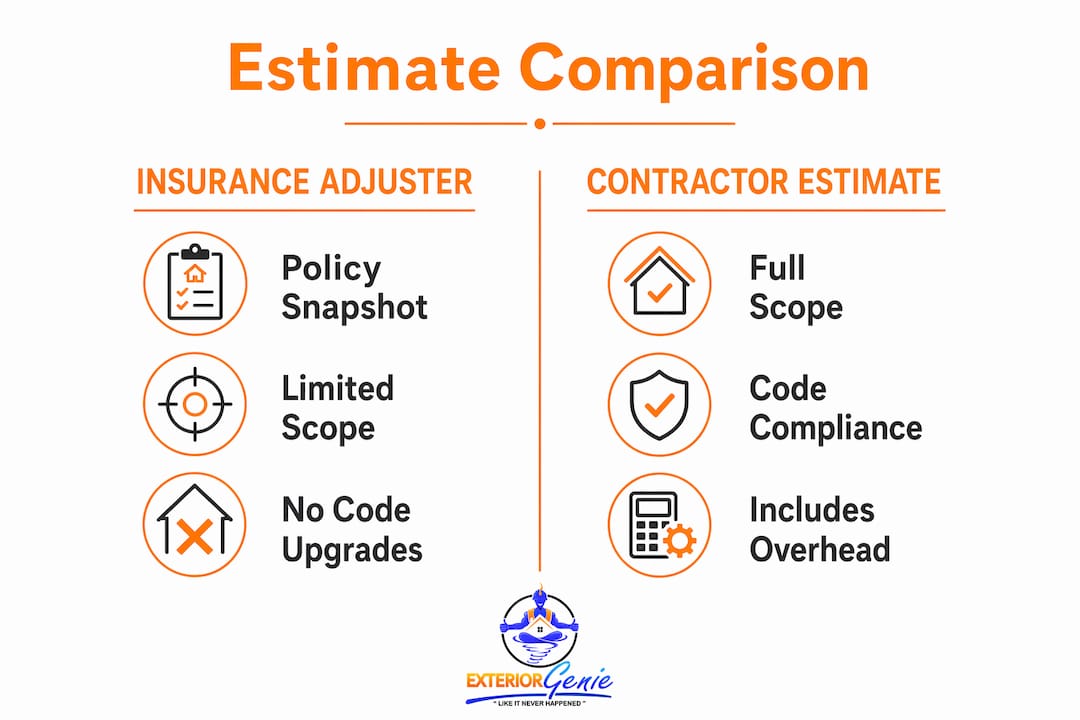
Insurance estimates provide a limited, policy-driven cost snapshot, not a full construction plan. Adjusters are generalists. They often work from satellite imagery or spend limited time on the roof, which means they can miss hidden damage, code-required upgrades, and items like ventilation or flashing that a contractor must address to pass inspection.
A contractor's estimate is a detailed construction plan. It accounts for labor, materials, permits, code compliance, warranties, and overhead and profit (O&P). Disagreements between insurance and contractor estimates are normal and expected in the industry. The two documents serve different purposes, and treating the adjuster's number as the final word is one of the most common and costly mistakes homeowners make.
Common items missing from insurance estimates include:
- Ventilation upgrades required by current building codes
- Flashing replacement around chimneys, skylights, and valleys
- Code compliance costs for decking and underlayment standards
- Overhead and profit (O&P) for the general contractor managing the project
- Permit and inspection fees that vary by municipality
These omissions are not necessarily bad faith on the insurer's part. Satellite estimating tools reduce field time but miss hidden issues like rotted decking or inadequate ventilation. The fix is a supplement, which is a formal request to the insurer to add missing line items to the approved claim amount.
Pro Tip: Request your contractor's estimate before sharing your insurance paperwork. Contractors who see insurance documents first may align their bid to the insurer's number rather than the actual scope of work, which can leave critical items unfunded.

Why should you get multiple contractor estimates before or during a claim?
Homeowners should collect at least three roofing contractor estimates to benchmark costs and identify outliers. One estimate gives you a number. Three estimates give you a market baseline, and that baseline is a powerful tool when negotiating with your insurer.
Here is what a thorough, line-item estimate should include:
- Labor costs, which typically represent 35–45% of the total project cost
- Material costs broken down by product type, quantity, and unit price
- Permit and inspection fees, which commonly range from $100 to $500 depending on your municipality
- Decking and underlayment specified by type and thickness
- Warranty terms including both manufacturer and workmanship coverage
- Flashing, ventilation, and accessory materials listed individually
A single-number bid with no breakdown is a red flag. Vague or single-number roofing estimates may hide missing scope or set the stage for costly change orders once work begins. Legitimate estimates typically run four to eight pages.
Comparing estimates also helps you decide whether filing a claim is financially worthwhile. If three contractors all estimate $8,500 and your deductible is $2,500, the math is clear. If one contractor bids $4,000 with no itemization, that low number likely reflects missing scope, not a better deal.
| Estimate type | What it includes | What it often misses |
|---|---|---|
| Insurance adjuster estimate | Documented visible damage, policy-covered items | Code upgrades, O&P, hidden damage, ventilation |
| Detailed contractor estimate | Full scope, labor, materials, permits, warranties | Nothing, when done correctly |
| Vague single-number bid | Total cost only | Itemized scope, permits, warranty terms |
How do contractor estimates impact insurance claim outcomes?
A detailed contractor estimate does more than price a job. It establishes the baseline for every supplement you file to recover costs the insurer initially missed. Supplements can recover 20–40% of total project revenue often overlooked in initial insurance estimates. That is a significant amount of money on any residential roof replacement.
Clear, itemized estimates also reduce disputes during the project itself. Ambiguity in estimates leads to disputes and costly change orders that delay completion and strain the relationship between homeowner and contractor. When every line item is defined upfront, both parties know exactly what is included and what triggers an additional cost.
The practical impact on your claim looks like this:
- Supplement filing: Your contractor compares their estimate to the insurer's scope and formally requests payment for missing items.
- Negotiation support: A detailed estimate gives your contractor specific line items to defend, rather than a vague total.
- Payment releases: Many insurers release depreciation holdbacks only after documented completion of specific scope items.
- Code compliance documentation: Permits and inspection records prove the work meets local standards, which protects your warranty.
Pro Tip: Ask your contractor to walk you through their estimate line by line before you sign anything. Understanding how to read detailed estimates before authorizing work helps you catch missing scope and prevents surprises when the final invoice arrives.
The timing of information sharing matters too. Give your contractor the opportunity to produce an independent estimate first. Once they have assessed the roof on their own terms, sharing the insurance paperwork allows them to identify gaps and build a supplement without the conflict of interest that comes from seeing the insurer's number first.
What should you watch for in roofing estimates to avoid surprises?
The difference between a good estimate and a bad one is specificity. Labor assumptions are the biggest risk factor in roofing estimates and the most common source of cost overruns. A contractor who vaguely lists "labor" as a single line item has not accounted for field conditions, crew size, or project complexity.
Watch for these red flags before signing any contract:
- "As needed" or "TBD" language for decking, flashing, or underlayment. These are predictable costs that should be specified upfront.
- No permit line item. Every permitted roofing job in South Carolina requires a permit. If it is not on the estimate, ask why.
- Missing warranty details. A legitimate estimate names the manufacturer, the product line, and the warranty duration.
- No contractor license or insurance number listed. Reputable contractors include their license number and proof of liability insurance on every estimate.
- Extremely low total with no breakdown. Cheap bids often hide omitted scope items critical for warranty and code compliance.
Manufacturer certifications matter too. Contractors certified by manufacturers like GAF or Owens Corning can offer extended system warranties that uncertified contractors cannot. That certification should appear on the estimate or be verifiable on the manufacturer's website.
Pro Tip: Compare estimates line by line, not just by total cost. A $9,000 bid that includes permits, ice and water shield, ridge ventilation, and a 10-year workmanship warranty is a better value than a $7,500 bid that omits all of those items.
You can also use resources like the Exteriorgenie guide to accurate roofing quotes to understand what a complete estimate looks like before you start collecting bids. Knowing what to ask for puts you in a much stronger position with both contractors and your insurer.
Key Takeaways
A roofing contractor estimate is not a formality. It is the document that determines whether your insurance claim covers the full cost of a proper repair.
| Point | Details |
|---|---|
| Estimates differ from adjuster reports | Contractor estimates include code compliance, labor, permits, and warranties that insurance snapshots routinely miss. |
| Get at least three estimates | Three bids establish a market baseline and help identify low bids that hide missing scope. |
| Supplements close the gap | Detailed estimates support supplement filings that can recover 20–40% of project costs missed in initial claims. |
| Specificity protects you | Estimates with vague language like "as needed" or single totals are red flags for future disputes and change orders. |
| Share insurance docs strategically | Let your contractor assess the roof independently before seeing the insurer's number to avoid bid inflation. |
Estimating is risk management, not just paperwork
I have seen homeowners hand a contractor the insurance estimate on day one and assume the job is covered. That single decision has cost people thousands of dollars more times than I can count. The insurer's number is a starting point, not a ceiling, and a contractor who builds their bid around it is not working in your interest.
The best contractors treat estimating as risk management, not just pricing. Every line item they write down is a commitment. When the scope is vague, the risk shifts entirely to you. Disputes, change orders, and incomplete work almost always trace back to an estimate that did not define the job clearly enough.
My honest advice: insist on a detailed, itemized estimate from every contractor you consider. Read it carefully. Ask about anything labeled "allowance" or "TBD." Check that permits, ventilation, and warranty terms are spelled out. Then compare those estimates side by side, not just the bottom line. The contractor who takes the time to document everything thoroughly is the one who will take the same care with your roof.
— Ebben
Exteriorgenie provides estimates built for insurance claims

Exteriorgenie is a veteran-owned roofing company based in Lexington, SC, with 25 years of field experience and HAAG-certified inspectors on staff. Every estimate Exteriorgenie produces is fully itemized, code-compliant, and structured to support insurance claim negotiations and supplement filings. If your insurer's number does not match what your roof actually needs, Exteriorgenie's team knows how to document the gap and advocate for the full scope of repairs. For homeowners managing storm damage claims or planning a full replacement, roofing financing options are also available to help manage out-of-pocket costs. Contact Exteriorgenie for a detailed estimate that works for your claim and your roof.
FAQ
What is a roofing contractor estimate used for in a claim?
A roofing contractor estimate documents the full scope and cost of repairs, giving your insurer the detail needed to approve a fair settlement. It also serves as the basis for supplement filings when the initial insurance payout falls short.
Why do contractor and insurance estimates usually differ?
Insurance adjusters produce policy-driven snapshots that often miss code upgrades, overhead and profit, and hidden damage. Contractor estimates reflect actual construction requirements, which almost always exceed what the adjuster initially approves.
How many roofing estimates should I get before filing a claim?
Collect at least three detailed, line-item estimates. Three bids establish a market baseline and help you identify bids that are missing scope or underpriced in ways that could cause problems during the project.
What does a legitimate roofing estimate include?
A complete estimate covers labor, materials, permits, decking, flashing, ventilation, warranty terms, and the contractor's license and insurance information. Estimates that omit these items are incomplete and carry real financial risk.
Can a contractor help me recover more from my insurance claim?
Yes. A contractor experienced in supplement filing can compare their estimate to the insurer's scope and formally request payment for missed items. Supplements recover 20–40% of project costs that initial insurance estimates routinely leave out.