
Yes, roofing material choice directly affects home value, and the gap between the right call and the wrong one can run into five figures. A new asphalt shingle roof adds roughly $15,000 to a home's resale price on average, while a broader range is typical depending on material, home price, and local market. The catch: you rarely recoup the full replacement cost. Asphalt shingles recoup around 52% of cost at sale nationally, and that figure swings dramatically by region and material.
The practical takeaway is straightforward. If your roof is worn, actively leaking, or within a year of listing, replacing it before you sell almost always makes financial sense. Buyers routinely request $5,000–$15,000 in credits for roofs near end of life, and replacing before listing removes that negotiation leverage entirely. If the roof has solid remaining life and no visible defects, selling as-is with a documented inspection report is often the smarter play.
Table of Contents
- How roofing material choice affects home value: the mechanisms
- Roofing materials compared: what each one means for resale
- How to pick the roofing material that maximizes your resale value
- What to expect on cost, ROI, and timing before you sell
- Roof problems that kill deals: what inspectors and appraisers flag
- What 25 years of roofing work teaches you about repair vs. replace
- Key Takeaways
- The mistake most homeowners make when choosing a roof before selling
- Exteriorgenie can handle the inspection, replacement, and insurance claim
- Sources and further reading
How roofing material choice affects home value: the mechanisms
Understanding why material choice moves the needle helps you make a smarter decision than simply picking the most expensive option.
Curb appeal and first impressions
A roof covers roughly 40% of a home's visible exterior from the street. That makes it one of the most powerful curb-appeal levers you have. Color and style matter more than most homeowners expect. Neutral tones like charcoal, dark gray, and weathered wood appeal to the widest buyer pool. Trendy or high-contrast colors can polarize offers and add days on market. A clean, well-matched roof signals that the home has been maintained, which shapes buyer perception before they ever step inside.
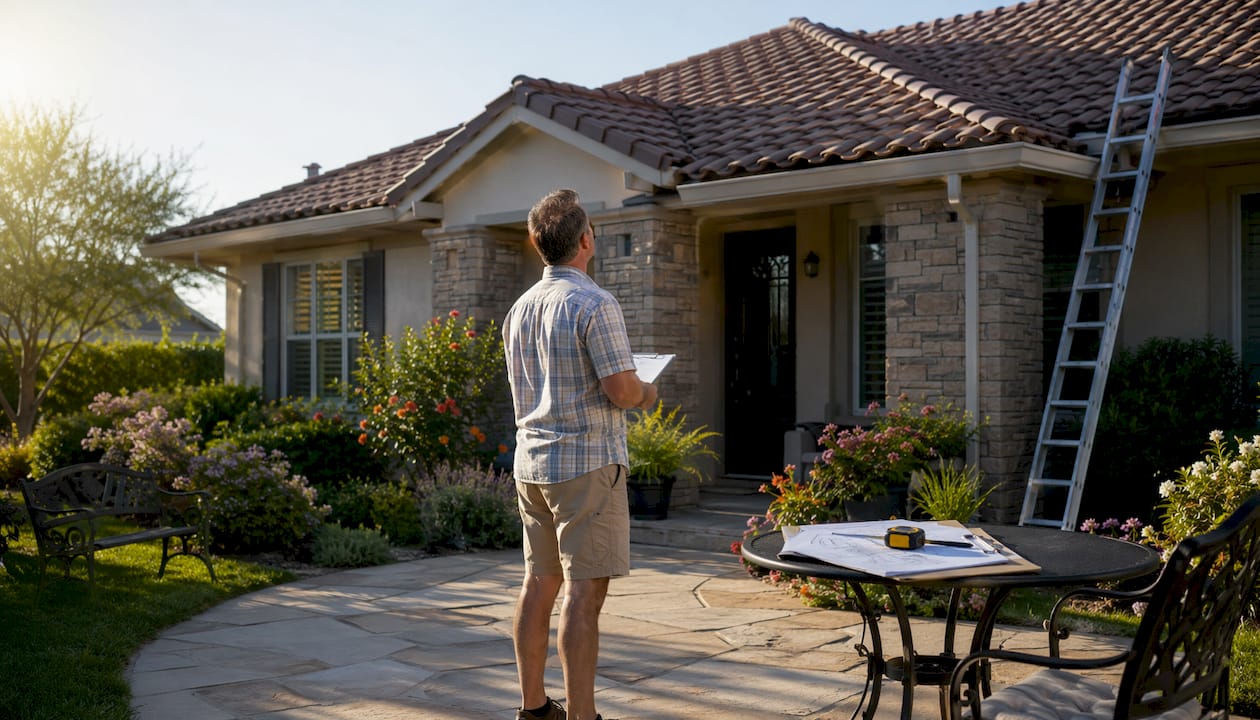
Pairing a new roof with other exterior updates compounds the effect. Fresh paint or siding, for example, can amplify curb-appeal gains that a roof alone starts.
Remaining useful life and how appraisers treat it
Appraisers don't add the full replacement cost to a home's value. Instead, they reclassify the home's condition rating based on remaining useful life and structural integrity, which then affects how the home compares to nearby sales. A roof with 20 years of life left puts the home in a better condition bracket than one with 3 years left, and that bracket shift is what moves the appraised number.
For loan underwriting, FHA and VA lenders typically require at least 2–3 years of remaining roof life. A roof that fails that threshold can kill a sale outright, not just reduce the price.
Energy performance and utility costs
Cool roofs, reflective metal panels, and light-colored tile can meaningfully cut attic temperatures and reduce HVAC load. High-performance materials can reduce attic temperatures by up to 30 degrees, which translates into lower monthly utility bills. In markets where energy costs are high, buyers factor that into their offers. California buyers, for instance, actively seek energy-efficient roofing as a way to reduce carrying costs.
Pro Tip: If you install a cool roof or impact-resistant shingles, document the energy and insurance benefits in writing. Listing agents can highlight these as tangible buyer benefits, not just marketing language.
Insurance implications and risk profile
- Impact-resistant shingles (Class 4 rating) and Class A fire-rated materials can lower homeowner's insurance premiums in many markets.
- In hurricane-prone states like Florida, a new roof is often a prerequisite for obtaining insurance coverage at all.
- Metal roofing with a Class 4 hail rating is increasingly appearing as a listing highlight in hail-prone regions.
- Buyers in high-risk weather zones compare insurance costs between homes, and a documented discount is a real financial differentiator.
Local climate and building codes
Climate shapes which materials actually hold their value. Wood shakes perform poorly in humid climates where moisture accelerates rot. Clay tile excels in hot, dry regions but can crack under freeze-thaw cycles. Metal handles snow loads well and resists coastal salt air better than most alternatives. Local building codes in wildfire zones often mandate Class A fire-rated materials, which narrows your options and raises the floor on what buyers expect.
Roofing materials compared: what each one means for resale
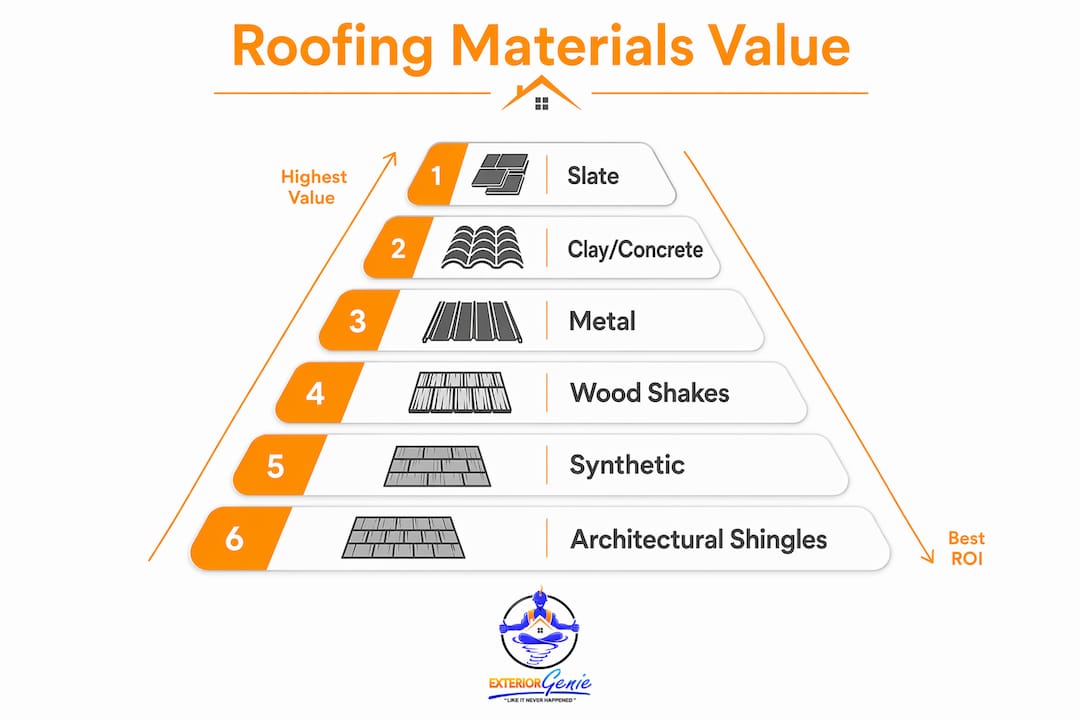
Here is how the six most common roofing materials stack up on the dimensions buyers and appraisers notice most. Cost ranges reflect typical U.S. installed prices; ROI figures are national estimates and vary by region.
| Material | Installed Cost (US) | Expected Lifespan | Maintenance | Energy Performance | Curb Appeal / Buyer Preference | Typical ROI / % Recouped | Insurance / Hail & Wind Resistance | Weight / Structural Needs | Best Climate / Region |
|---|---|---|---|---|---|---|---|---|---|
| Architectural asphalt shingles | — | around 30 years | Low | Moderate (reflective options available) | High — universal appeal | about 52% nationally (ranges higher regionally) | Moderate; Class 4 upgrade available | Light — no structural changes needed | All climates; universal |
| Metal (standing seam / steel) | — | 40–70 years | Very low | High — reflects solar heat | Growing; strong in modern/contemporary homes | 48–54% | Excellent; Class 4 hail, Class A fire | Moderate — most homes handle it | Snow, hail, coastal, wildfire zones |
| Clay / concrete tile | — | — | Low | High in hot climates | High in Southwest / Mediterranean styles | around 40–52% | Good; heavy but durable | Heavy — may need structural reinforcement | Hot, dry climates; Southwest, Florida |
| Slate | — | 75–100+ years | Low (if installed correctly) | Moderate | Premium — estate-level appeal | ~40% | Excellent — Class A fire | Very heavy — structural upgrade often required | Northeast, premium estate markets |
| Wood (cedar) shakes | around $15,000 | 20–40 years | High — needs treatment | Low–moderate | High in rustic / craftsman styles | around 40% | Poor — Class C fire unless treated | Light | Dry climates; avoid humid or wildfire zones |
| Synthetic / composite | — | 40–— | Low | Moderate–high | Growing — mimics slate/wood without weight | Not widely benchmarked | Good; Class 4 options available | Light — no structural changes needed | All climates; versatile |
Material cards: who each option fits
Architectural asphalt shingles are the right call for the vast majority of homeowners. They satisfy buyer expectations in nearly every neighborhood, carry the highest ROI percentage of any material, and qualify for Class 4 impact-resistant upgrades that can reduce insurance premiums. For a homeowner selling within 1–3 years, this is the default answer.
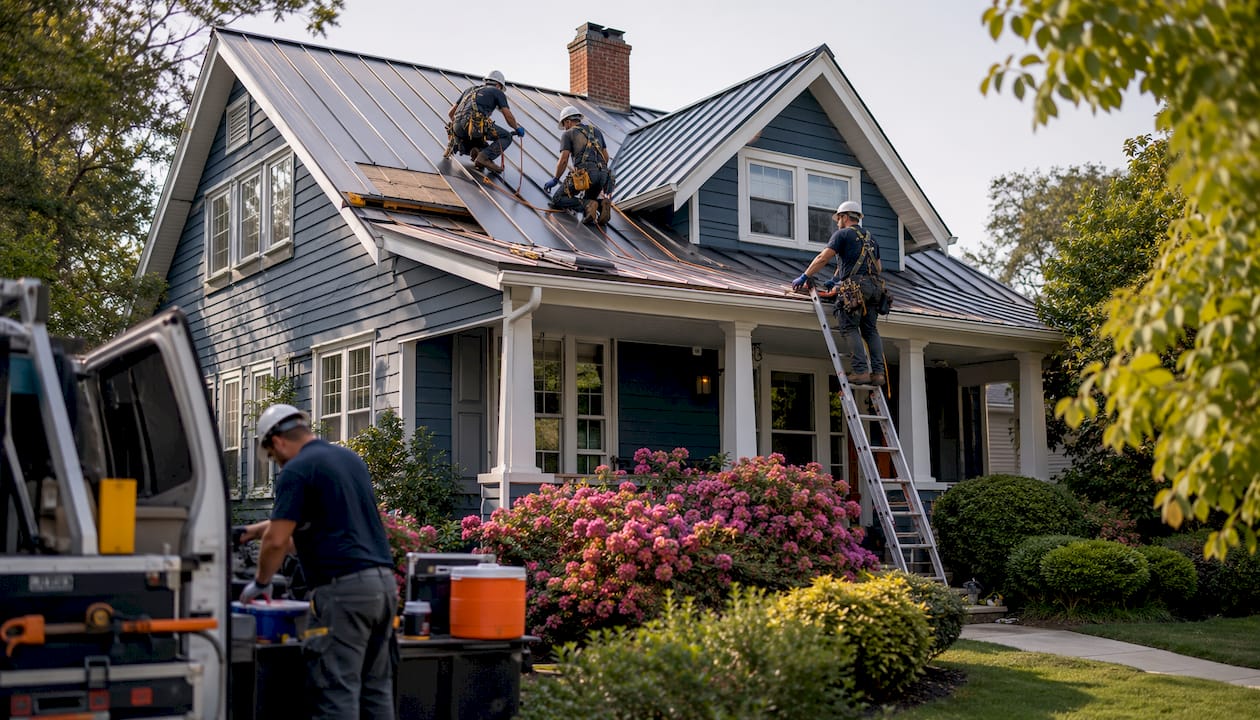
Metal roofing makes sense when you plan to stay 10 or more years, or when you want to eliminate any future roof-related inspection risk permanently. The 40–70 year lifespan means the home will never fail a roof inspection again, which is a compelling listing point. ROI runs 48–54%, lower than asphalt in percentage terms, but the permanence argument resonates with buyers in hail-prone or coastal markets.
Clay and concrete tile belong on homes where the architectural style calls for them. A Mediterranean or Spanish Colonial home in Arizona or Florida with clay tile looks right; the same tile on a Cape Cod in South Carolina looks wrong and won't recoup its cost. Structural reinforcement is often required, which adds to the installed price.
Slate is an estate-level investment. On a $600,000+ home where buyers expect premium materials, slate signals quality and permanence that no other material matches. At roughly 40% ROI, it is not a financial play. It is about matching buyer expectations at the top of the market.
Wood (cedar) shakes carry real maintenance demands and fire risk. In dry climates with the right architectural style, they add character. In humid regions or wildfire zones, they are a liability. Buyers in those markets will discount the home, not pay a premium.
Synthetic / composite is the fastest-growing category for good reason. It mimics the look of slate or wood without the weight or maintenance, qualifies for Class 4 ratings, and works in virtually any climate. Verified ROI benchmarks are still limited, so treat it as a premium differentiator rather than a financial investment with a known recoup figure.
For a deeper look at how these materials compare on installation specifics, the residential roofing materials guide from Exteriorgenie covers lifespan, pros and cons, and regional suitability in detail.
How to pick the roofing material that maximizes your resale value
The best roofing material for resale is the one that matches neighborhood expectations. Premium materials only pay off where comparable homes already feature them. Here is a prioritized decision framework.
-
Assess your roof's current condition. Get a professional inspection to establish remaining useful life. If the roof has fewer than 5 years of life left or shows active leaks, replacement is almost always the right call before listing.
-
Pull neighborhood comps. Walk the block and check recent listings. What material do comparable homes have? If every home in the neighborhood has architectural shingles, installing slate will not recoup its cost. If comparable homes have metal or tile, a shingle roof may look like deferred maintenance.
-
Check HOA rules and local building codes. Some HOAs mandate specific colors or materials. Wildfire-zone codes may require Class A fire-rated products. Confirm before you buy materials.
-
Estimate installed cost vs. remaining life. If the roof has 10 or more years of life left and no visible defects, a full replacement before sale may not pencil out. A targeted repair to remove inspection red flags is often the better investment. See the repair vs. replacement guide for the contractor criteria that drive this decision.
-
Factor insurance and energy impacts. In hail-prone or hurricane-risk markets, a Class 4 impact-resistant upgrade or a Class A fire-rated material can reduce insurance premiums and serve as a documented buyer benefit. Ask your contractor for the specific rating before installation.
-
Choose a neutral color. Charcoal, dark gray, and weathered wood tones appeal to the broadest buyer pool. Avoid colors that clash with the home's siding or trim, and skip anything trendy that may feel dated in two years.
-
Match timeline to material. Selling within 1–3 years? Architectural asphalt shingles deliver the best ROI. Staying 10 or more years? Metal or tile's longevity justifies the higher upfront cost. Estate home priced above $500,000? Slate or high-end tile may match buyer expectations and support the price point.
-
Ask your contractor the right questions. Before signing a contract, confirm: What is the estimated remaining life of the current roof? What warranty comes with the new installation? Will the replacement require any ventilation or insulation changes? What insurance rating does the chosen material carry?
Exterior upgrades beyond the roof, like entry doors and home value improvements, can compound curb-appeal gains when buyers compare homes side by side.
What to expect on cost, ROI, and timing before you sell
Replacement cost and recoup percentage vary enough by material and region that national averages are a starting point, not a guarantee. The table below gives typical installed cost ranges and ROI benchmarks.
| Material | Typical Installed Cost (US) | Typical % Cost Recouped at Sale |
|---|---|---|
| Architectural asphalt shingles | — | about 52% nationally |
| Metal (standing seam) | — | 48–54% |
| Clay / concrete tile | — | around 40–52% |
| Slate | — | ~40% |
| Wood (cedar) shakes | around $15,000 | around 40% |
| Synthetic / composite | — | Not widely benchmarked |
Regional variation is significant. Recoup rates for asphalt roofing range from roughly 21.6% in some markets to 86.5% in others, depending on local labor costs, home price tiers, and buyer expectations. A $15,000 shingle roof in a $500,000 home in a competitive market will recoup a much larger share than the same roof on a $150,000 home in a slow market.
The effective ROI of replacement often exceeds the headline recoup percentage once you account for avoided buyer credits, faster time on market, and lower carrying costs. Buyers routinely request $5,000–$15,000 in credits for roofs near end of life. Replacing before listing eliminates that negotiation pressure entirely and can speed the sale.
Timing guidance:
- Replace 3–6 months before listing. This gives time for permits, installation, and a clean inspection report before the home hits the market.
- Replace if the roof has fewer than 5 years of remaining life. Appraisers and lenders will flag it; buyers will use it for leverage.
- Sell as-is with a credit if the roof has 10+ years of life and no defects. Document the remaining life with a professional inspection report and price accordingly.
- Avoid replacing in the final 30 days before listing. Rushed installations create quality risks and may not allow time for a follow-up inspection.
For homeowners weighing the cost of replacement, the replacement cost value guide from Exteriorgenie breaks down financing options and cost-recapture math in detail.
Roof problems that kill deals: what inspectors and appraisers flag
A roof in poor condition is one of the most common deal-killers in residential real estate. Knowing what inspectors look for lets you address problems before they become buyer leverage.
Common red flags that trigger buyer credits or deal fallthrough:
- Active leaks or water stains on attic sheathing or interior ceilings
- Missing, curling, or cracked shingles covering more than a small area
- Significant sagging or visible structural deflection along the ridge or deck
- Ponding water on flat or low-slope sections
- Failed or improperly installed flashing at chimneys, skylights, and valleys
- Visible rot, mold, or algae growth indicating moisture intrusion
- Evidence of repeated temporary repairs
- Granule loss in gutters indicating shingles near end of life
What homeowners can check themselves before calling an inspector:
- From the curb: look for missing shingles, obvious sagging, and gutters pulling away from the fascia.
- From the attic: check for daylight penetration, water stains, and soft spots in the sheathing.
- In the gutters: heavy granule accumulation signals shingles are aging out.
How lenders treat roof condition:
FHA and VA loans require at least 2–3 years of remaining roof life as a condition of underwriting. A roof that fails this threshold can prevent a buyer from using their preferred loan type, which shrinks your buyer pool. Conventional lenders are more flexible, but appraisers still reclassify the home's condition based on roof status, which affects comparable selection and final value.
Buyers who discover roof issues during inspection typically request $5,000–$15,000 in credits, and in some cases walk away entirely. A targeted repair to address specific red flags, rather than a full replacement, can remove inspection risk at a fraction of the cost. The roof repair services Exteriorgenie offers in Lexington, SC are specifically designed for situations where targeted work removes a sale obstacle without the cost of full replacement.
What 25 years of roofing work teaches you about repair vs. replace
Exteriorgenie's HAAG-certified inspectors see the same patterns repeat across hundreds of roofs in the Lexington, SC area. Here is the practical framework the team uses when a homeowner is weighing repair against full replacement before a sale.
Replace when:
- The roof is 20 or more years old with no documentation of prior replacement
- There are three or more active leak points, or leaks in different sections of the roof
- Storm damage covers more than 30% of the surface area
- The underlayment has failed (visible during inspection; common after repeated hail events)
- Ventilation or insulation deficiencies require opening the deck anyway
Repair when:
- Damage is isolated to one section with a clear cause (single storm event, flashing failure)
- The roof has 8 or more years of remaining life and passes a full inspection
- The repair cost is less than 25–30% of full replacement cost
- The goal is to remove a specific inspection red flag, not address systemic aging
On insurance claims:
A HAAG-certified inspection provides the documentation that insurers and appraisers need to process a claim accurately. Without it, adjusters often underestimate damage scope, and homeowners leave money on the table. Exteriorgenie's team documents damage to the standard insurers recognize, which means fewer supplemental claims and faster resolution. For storm-damaged roofs, getting a HAAG-certified inspection before filing is the single most effective step a homeowner can take to protect claim value.
Exteriorgenie has provided insurance claims assistance for homeowners across South Carolina for 25 years, with 24/7 emergency tarping available when a storm creates an immediate risk to the home's interior.
Key Takeaways
Roofing material choice affects home value primarily through condition, neighborhood fit, and the avoided cost of buyer credits at negotiation.
| Point | Details |
|---|---|
| Asphalt shingles lead on ROI | Architectural shingles have strong recoup rates nationally, leading among common materials. |
| Match your neighborhood | Premium materials only pay off where local comps and buyer expectations support them. |
| Condition beats material | A 5-year-old shingle roof outperforms a 25-year-old slate in any inspection or appraisal context. |
| Replace to remove negotiation risk | Buyers often request credits for aging roofs; replacing before listing eliminates that leverage. |
| Exteriorgenie for local guidance | Exteriorgenie's HAAG-certified inspectors help Lexington, SC homeowners determine repair vs. replace and navigate insurance claims before listing. |
The mistake most homeowners make when choosing a roof before selling
Most homeowners shopping for a pre-sale roof ask the wrong question. They ask, "Which material adds the most value?" The better question is, "Which material removes the most risk at the lowest cost?"
A roof's primary job at resale is to pass inspection and not give buyers a reason to negotiate. The material matters far less than the condition. A charcoal architectural shingle roof installed six months before listing will outperform a 20-year-old slate roof in every appraisal and inspection context, regardless of which material is theoretically more prestigious.
The second mistake is over-investing in premium materials on a home that doesn't support them. Slate on a $250,000 ranch in a neighborhood of asphalt-shingled homes will not recoup its cost. The buyer pool for that home is not shopping for slate. They are shopping for a clean, move-in-ready house that passes inspection and doesn't surprise them with a $15,000 repair bill in year two.
Budget discipline matters here. The money saved by choosing architectural shingles over metal or tile can go toward landscaping, an entry door, or exterior paint, all of which have strong per-dollar curb-appeal returns. Spend where buyers look first, and spend enough on the roof to make sure it never comes up in the inspection report.
Exteriorgenie can handle the inspection, replacement, and insurance claim
Replacing a roof before selling is one of the highest-leverage moves a homeowner can make, but only when the work is done right and documented properly. Exteriorgenie is a veteran-owned roofing company with 25 years of experience serving homeowners and commercial property owners in Lexington, SC. The team offers full residential roof replacement, HAAG-certified damage inspections, targeted repairs, seamless gutter work, and 24/7 emergency tarping when storm damage creates an immediate risk.
For homeowners navigating an insurance claim after storm damage, Exteriorgenie's HAAG-certified inspectors document damage to the standard insurers recognize, protecting claim value from the start. For homeowners planning a pre-sale replacement, the team can walk through material options, color choices, and timing to match your listing schedule. Financing options are available for homeowners who need to spread the cost of replacement before closing. To schedule an inspection or get a project estimate, visit Exteriorgenie's residential roofing page or call the team directly.
Sources and further reading
The statistics and guidance in this article draw from the following sources. Each is worth bookmarking if you want to dig deeper into the data behind roofing ROI and resale value.
-
Redfin: Does a New Roof Increase Home Value? — National market analysis with dollar-range uplift figures and recoup percentages for asphalt shingles. Useful for grounding the financial case for replacement.
-
The Roofing Brief: Roof Replacement ROI & Resale Value Report — The most detailed publicly available breakdown of recoup rates by material and region, including the wide variance between low- and high-recoup markets. Essential reading before making a material decision.
-
Opendoor: Does a New Roof Increase Home Value? — Covers appraisal mechanics, buyer perception, and lifespan data by material. Good context for understanding how appraisers treat roof condition.
-
What Does a Roof Cost: Roof Cost vs. Home Value — Explains how appraisers reclassify condition rather than adding full replacement cost, and provides recoup percentage ranges by material.
-
LGM Roofing: How a New Roof Increases Home Value — Practical contractor perspective on buyer credits, inspection red flags, and color choices for broad resale appeal.
-
U.S. Department of Energy: Cool Roofs — Primary source on reflectance, thermal emittance, and energy savings for cool-roof materials. Useful when evaluating energy performance claims.
-
Exteriorgenie: Residential Roofing Materials Guide — Local contractor perspective on material selection, lifespan, and regional suitability for South Carolina homeowners.
-
Exteriorgenie: Replacement Cost Value for Roofing — Detailed cost discussion and financing options for homeowners planning a pre-sale replacement.