

An underpaid roof claim is a settlement that skips or shrinks standard, code-required, or "paid when incurred" line items, leaving you to cover the difference out of pocket. The fastest way to check yours: scan the adjuster's scope for these commonly missing pieces such as ridge cap shingles, ice and water shield, drip edge and starter strip, overhead and profit (O&P) on multi-trade jobs, and permit and dump/disposal fees
These aren't rare oversights. CMS Law Group lists exactly these items among the most commonly omitted in underpaid claims, and state insurance departments across the country field complaints about them every storm season.
Key Takeaways
Most underpaid roof claims come down to a handful of missing line items and math errors that a careful line-by-line review can catch and reverse.
| Point | Details |
|---|---|
| Check the usual suspects first | Ridge cap, ice/water shield, drip edge, and O&P are the line items most often missing from initial scopes. |
| Verify the math | Total loss minus depreciation minus deductible should equal your net payment exactly. |
| Track "paid when incurred" items | Permit and dump fees often reimburse later, but only if you submit final invoices. |
| Document before repairs | Photos and independent contractor estimates before permanent repair work protect your supplement claim. |
| Get a professional inspection | Exteriorgenie's HAAG-certified inspectors build itemized Xactimate estimates to identify scope gaps and support supplements. |
Table of Contents
- Common Examples of Underpaid Roof Claims Homeowners Miss
- How Insurers End Up Underpaying Roof Claims
- How to Read Your Settlement Statement for Errors
- Steps to Dispute an Underpaid Roof Claim
- Real Recovery Examples: Before and After Supplements
- Documentation Checklist and Demand Letter Basics
- When We Bring in a Public Adjuster or Attorney
- Get a Second Opinion on Your Roof Settlement
- Sources
- FAQ
Common Examples of Underpaid Roof Claims Homeowners Miss
Ridge cap shingles cap the roof's peak and prevent water intrusion at the most vulnerable seam on the structure. Adjusters sometimes price them as standard three-tab shingles instead of the dedicated ridge cap product, shorting the line by a meaningful margin per linear foot.
Ice and water shield is often required by local building code in valleys and eaves, yet it gets left off estimates entirely when the adjuster doesn't check code requirements for your municipality. Drip edge and starter strip run the entire perimeter of the roof. Skip them and water finds its way under the shingles within a season or two.
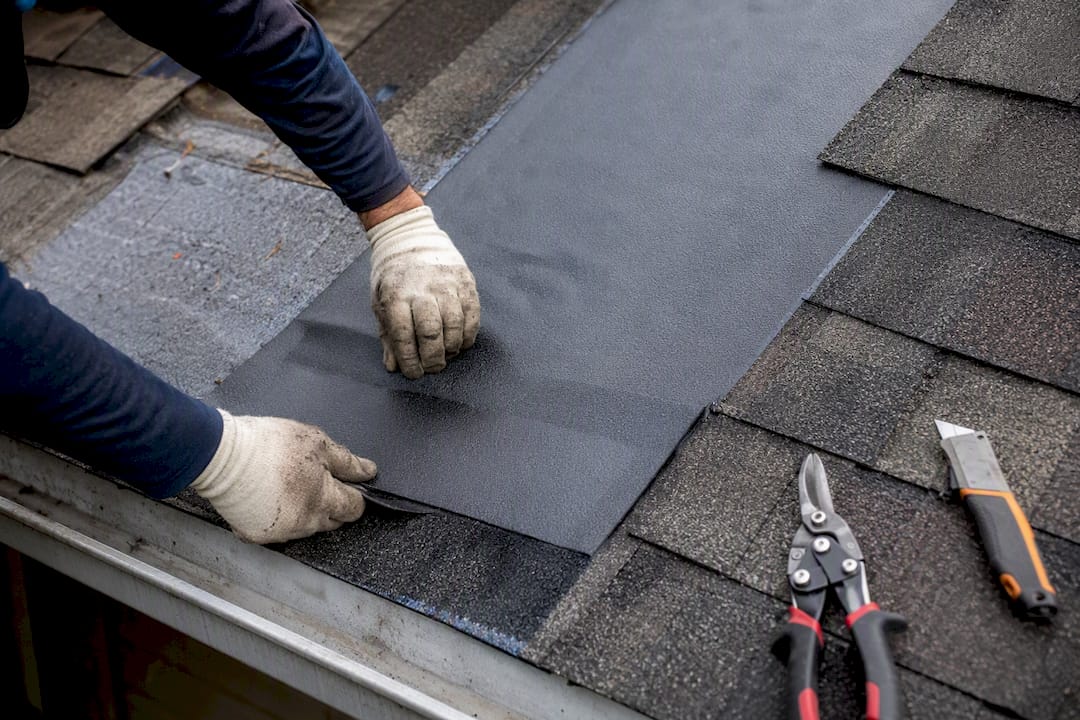
Step flashing and pipe boots protect every wall intersection and roof penetration, as outlined in this post-storm roof inspection checklist for South Florida homes. They're cheap individually but expensive in aggregate when a scope has a dozen penetrations and only counts three.
Permit fees and dump/disposal fees are frequently marked "paid when incurred," meaning the insurer won't cut a check until you submit the actual invoice. That's not a denial. It's a delayed reimbursement that many homeowners never collect because nobody told them to ask.
Overhead and profit deserves its own line whenever more than one trade touches the job (roofing plus gutters, siding, or interior repair). Insurers frequently drop O&P from claims that clearly qualify for it.
How Insurers End Up Underpaying Roof Claims
Underpayment usually isn't one dramatic error. It's a string of small ones that add up.
- ACV depreciation applied more aggressively than the roof's actual age and condition justify
- Wear-and-tear labeling used to shift storm damage into a non-covered category
- Rushed inspections that miss damage a thorough walk would catch
- Incorrect quantities entered into Xactimate, undercounting roof squares or linear footage
- Lump-sum payouts with no line-item breakdown to audit
- Out-of-state adjusters unfamiliar with local building code requirements
A classic example: an adjuster prices architectural shingles at three-tab rates, or measures 28 squares on a roof that's actually 32. Both errors shave real dollars off the payout without ever showing up as a denial. Payne Law, PLLC notes that adjuster inspections often run 20 to 30 minutes, compared to roughly two hours for a thorough contractor walkthrough. That time gap is where most missed damage hides.
How to Read Your Settlement Statement for Errors
Your net payment should equal total loss (RCV) minus depreciation minus your deductible. If that math doesn't check out, or the statement doesn't show its work, you're looking at a red flag, not a final number.
Run this quick check before you sign anything:
- Does "total loss" minus "depreciation" minus "deductible" actually equal the "net payment" listed?
- Is there an unexplained lump sum with no line-item support?
- Are material quantities (squares, linear feet) suspiciously low compared to your roof's actual size?
- Is O&P missing despite multiple trades being involved?
- Is the deductible type correct, flat versus a percentage-based hurricane deductible?
Depreciation that seems unusually high on a roof under 15 years old is worth questioning, according to Payne Law's breakdown of common adjuster errors. RoofPolicy's claim settlement analyzer walks through exactly how RCV, ACV, and depreciation holdback should reconcile on paper, which makes it a useful gut check against your own statement.
Steps to Dispute an Underpaid Roof Claim
Treat your insurer's first number as an opening offer, not a final verdict. CMS Law Group frames it exactly that way, and the data backs it up. Here's the order that works.
- Document everything before repairs start. Wide shots of the whole roof, close-ups of damage, attic and interior photos if there's water intrusion. Temporary repairs (tarping, emergency leak stops) are fine; don't move to permanent replacement until the scope is settled.
- Get at least two independent contractor estimates, ideally in Xactimate format so they compare line by line against the adjuster's scope.
- Compare line by line. Circle every item your contractor listed that the insurer's scope skipped or undercounted.
- Write a supplement or demand letter stating the shortfall amount, listing missing items with photo evidence attached, and requesting a specific re-inspection date.
- Request re-inspection with a senior adjuster, and have your contractor present on-site if the insurer allows it.
- Escalate if needed. An independent inspector or public adjuster typically works for 10 to 15% of the recovered increase. An attorney usually works on contingency, and becomes worth calling when you suspect bad faith or the insurer stonewalls a legitimate supplement.
Pro Tip: Tear-off often reveals hidden damage, rotted decking, unseen flashing failures, that wasn't visible during the initial inspection. Photograph it immediately and add it to your supplement before the crew closes up the roof. Also track every "paid when incurred" item separately; those reimbursements require you to submit final invoices, and they're easy to forget once the job is done.
Real Recovery Examples: Before and After Supplements
Numbers make this concrete. Three cases show how specific missing items translate into real dollars.
Residential reroof, warranted replacement. Original RCV came in at $13,412.98. A detailed line-item supplement, built by comparing the contractor's Xactimate estimate against the adjuster's scope, pushed the final RCV to $22,774.71. That's a $9,361.73 increase, roughly 70%, recovered even though the insurer had already approved a full replacement.
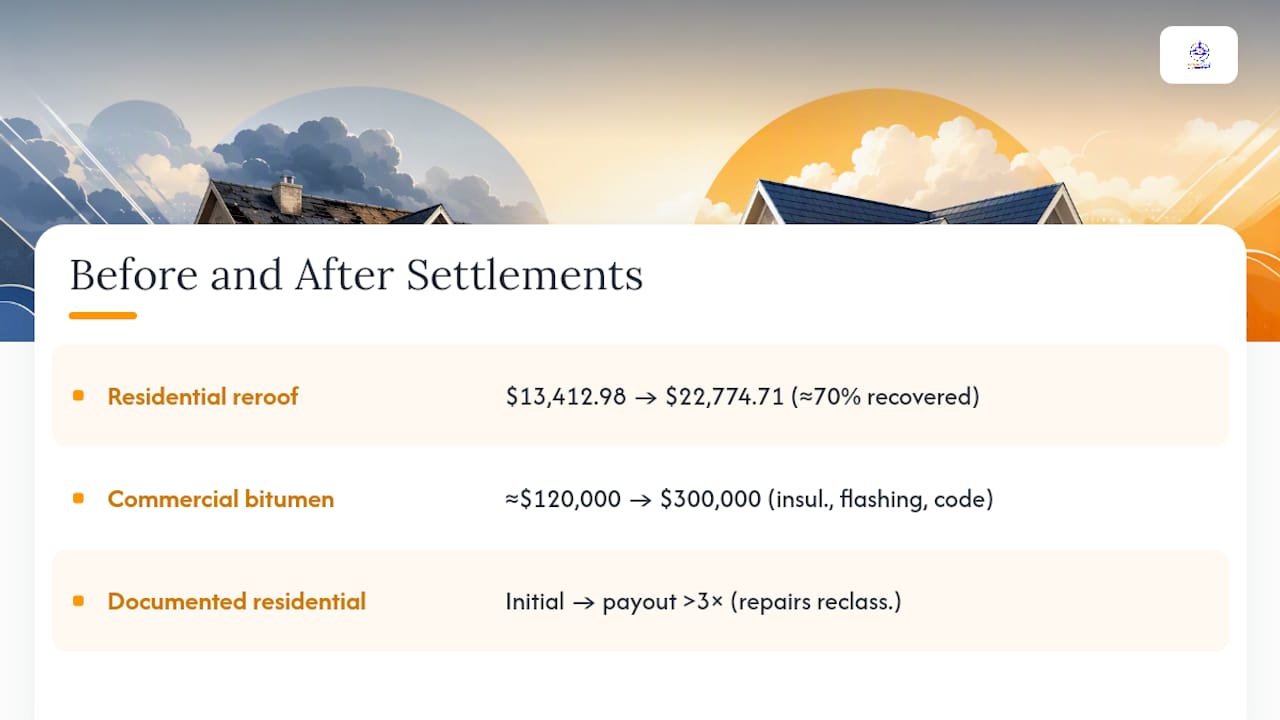
Commercial bitumen roof, 13,000 square feet. The initial estimate ignored current insulation and code-required upgrades. After a supplement documenting those items, the payout climbed from roughly $120,000 to $300,000, a gap driven almost entirely by insulation, flashing, and code compliance items the first scope skipped.
Documented residential claim. One case tracked by ClaimWarriors recovered a payout more than three times the initial settlement after the homeowner pushed back on an initial scope that had classified major repairs as cosmetic.
The pattern repeats: insulation, flashing, code items, and O&P are the easiest categories to document and the most commonly missed.
Documentation Checklist and Demand Letter Basics
Before you file a supplement, gather:
- Full-roof wide-angle photos plus close-up damage shots
- Attic and interior photos if there's active leaking
- Aerial or drone measurements of the roof
- A contractor estimate in Xactimate or equivalent line-item format
- Manufacturer spec sheets for the materials involved
- Permit cost estimates and dump/disposal receipts
Your demand letter should state the exact shortfall dollar amount, list every missing line item with its supporting photo or document attached, request a specific re-inspection date, and close with a clear numeric ask rather than a vague request for "more money."
- Submit the supplement with all attachments in one package
- Request written confirmation of receipt
- Follow up in writing if you hear nothing within two weeks
- Escalate to re-inspection or appraisal if the insurer denies the supplement without explanation
A contractor estimate built around accurate measurements is what makes this whole process credible to an insurer instead of easy to dismiss.
When We Bring in a Public Adjuster or Attorney
Twenty-five years in this trade, and HAAG-certified inspections on every claim, means we can usually spot and document a scope gap, missing ridge cap, an uncounted permit line, ourselves. That covers most cases.
We recommend escalating to a public adjuster or attorney when there's an outright coverage denial, a suspected bad-faith pattern, or a complex commercial system beyond a standard reroof. Know the difference, and you save time and legal fees you didn't need to spend.
Get a Second Opinion on Your Roof Settlement
If your settlement doesn't add up, the fastest fix isn't a lawyer, it's a proper inspection before you sign off. Exteriorgenie sends HAAG-certified inspectors to walk your roof, build an itemized estimate in Xactimate format, and flag every line item your insurer's scope missed, at no cost to find out where you stand.
That inspection becomes the backbone of your supplement package: photos, measurements, and a line-by-line comparison against the insurer's scope, plus support preparing the demand letter and coordinating your re-inspection date. Twenty-five years in the field and a veteran-owned crew mean we've seen most of the ways insurers shortchange a scope, and we build claim materials that hold up when a senior adjuster looks them over. We also install Owens Corning shingles on every reroof we handle, so your replacement material matches or exceeds what your policy actually owes you.
Ready to find out if your claim was underpaid? Schedule a free roof inspection and get an itemized estimate before you accept a final settlement.
Sources
- How to Tell If Your Roof Damage Insurance Claim Was Underpaid | CMS Law Group
- What to Do if an Insurance Company Underpaid Your Roof Claim | Payne Law, PLLC
- Claim settlement analyzer | RoofPolicy
This article is general information, not a substitute for advice from a qualified lawyer. Consult a qualified legal professional about your own circumstances before acting on anything here.
FAQ
What counts as an underpaid roof claim?
It's a settlement missing standard or code-required items, like ridge caps, ice and water shield, or O&P, that leaves you paying the difference yourself.
How much can a supplement actually recover?
What's the difference between RCV and ACV?
RCV is the full replacement cost; ACV subtracts depreciation, and the gap between them is held back until repairs are completed and invoiced.
When should I hire a public adjuster instead of handling it myself?
Consider one when the insurer denies coverage outright, stonewalls a documented supplement, or the claim involves a complex commercial roof system; typical fees run 10 to 15% of the recovered increase.
Can Exteriorgenie help if I already accepted a low settlement?
Yes. A HAAG-certified inspection and itemized Xactimate estimate can still support a supplement request even after an initial payout, as long as permanent repairs haven't erased the evidence.