
A Haag roof inspection is a standardized, test-square based forensic assessment that documents hail or wind damage in a format insurance adjusters recognize and rarely dispute. It replaces guesswork with counted, extrapolated data. If a storm just hit your roof, the fastest useful step is finding a Haag Certified Inspector or requesting a Haag-method report before you file or dispute a claim.
TL;DR:
- Haag inspections rely on a test square method, requiring inspectors to count damage within a 10 by 10 foot area on each roof slope for accurate damage assessment.
- Certification demands documented field experience and an audit-backed record, not just a framed certificate, with courses lasting around 12 to 14 hours followed by an exam.
- The report format is standardized, including slope-specific damage counts, photographs, and detailed calculations, making it more defensible in claims disputes.
- Using a Haag-certified inspector promptly after a storm ensures collateral damage evidence remains fresh and strengthens insurance claim support.
- Combining Haag forensic reports with repair services from certified contractors can expedite claims approval and reduce vendor management risks.
Table of Contents
- What "Haag Certified" Actually Means
- Course Format, Exam Rules, and Who Qualifies
- Inside the Test Square: How the Inspection Actually Works
- How Insurers Actually Respond to a Haag Report
- Finding and Vetting a Haag Certified Inspector
- Why Haag Methodology Changes How Claims Actually Play Out
- Get a Haag-Method Inspection Backed by Real Repair Capacity
- Where to Verify the Method Yourself
- Sources
- FAQ
What "Haag Certified" Actually Means
Haag Education, the training arm of Haag Global, issues the Haag Certified Inspector (HCI) credential after candidates pass a proctored exam and prove field experience. The certification carries weight with insurers because the underlying method has been published and reviewed in engineering circles for decades, not because a marketing team invented it last year.
The HCI family splits by property type and career level:
- HCI-R (Residential): Covers asphalt shingle, wood shake, and tile roofs on homes.
- HCI-C (Commercial): Covers low-slope membranes, metal panels, and built-up roofing on commercial buildings.
- HCI-W (Wind): Focuses specifically on wind uplift and wind-driven damage patterns.
- HCI-Master: An advanced credential open only to inspectors who already hold an active individual HCI certification, requiring an 80% score on a proctored online exam, according to Haag Education's Master-level program.
Adjusters and engineers trust the output because it follows a repeatable format they already speak, not because of who is holding the clipboard.
Course Format, Exam Rules, and Who Qualifies
Haag runs its HCI courses on-demand rather than in a classroom, which matters if you're vetting a contractor's credential or considering the course yourself. The Residential track runs roughly 12 hours and the Commercial track roughly 14 hours, each ending in a 100-question exam that candidates must pass at a set threshold, per the Residential HCI on-demand course page.
Field experience is not optional paperwork. It's a hard gate:
- HCI-R requires documentation of numerous residential roof inspections.
- HCI-C requires 50 commercial inspections, or three years of commercial adjuster experience, as Haag's own HCI FAQ spells out.
- Haag performs random audits of claimed experience, so applicants should keep inspection records that hold up to scrutiny.
- Recertification and annual maintenance requirements keep the credential active; letting it lapse means losing the designation.
That verification step is worth remembering later when you're hiring someone. A framed certificate means less than an active, audit-backed record.
Inside the Test Square: How the Inspection Actually Works
Everything that makes a Haag report defensible traces back to one technique: the Test Square. An inspector marks off a 10 by 10 foot section on each roof slope, then counts damage inside that fixed area instead of eyeballing the whole roof.
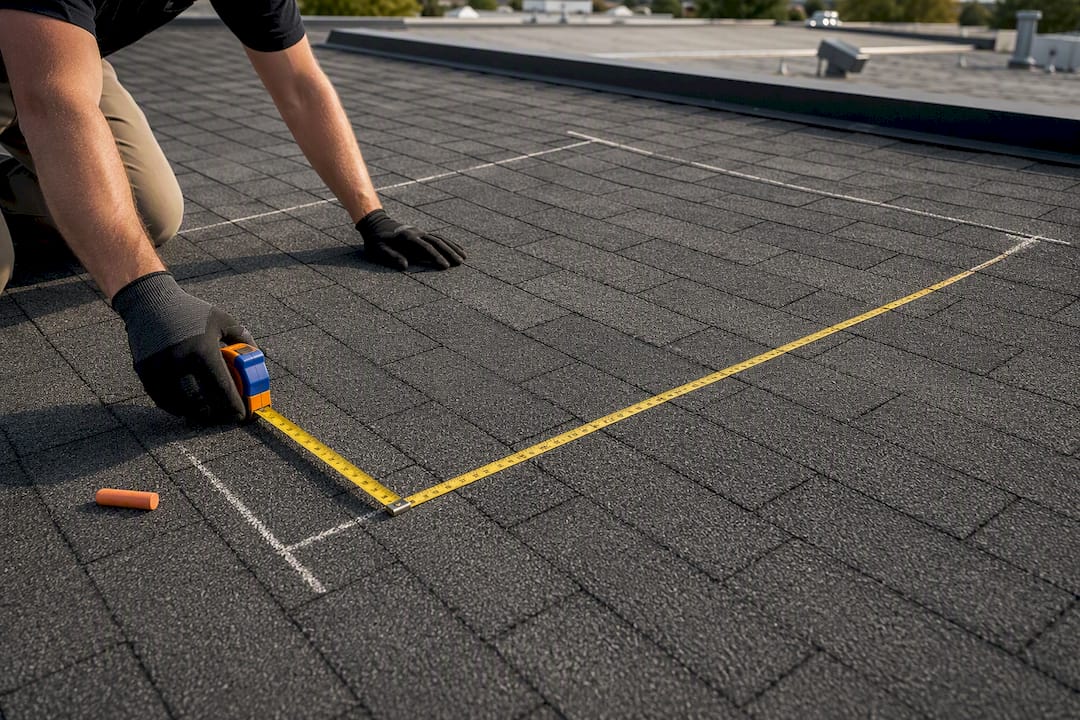
Pro Tip: Ask any inspector where they placed their test squares. A square set under a tree overhang or a high-traffic walkway skews the count, and Haag's own guidance says to avoid both when selecting a representative sample.
The workflow generally runs in this order:
- Collateral survey first. Before touching the roof, the inspector checks gutters, air conditioner fins, and siding for hail evidence, confirming that hail capable of damaging the roof actually fell on the property, per Haag's hail inspection protocol.
- Square placement. At least one test square goes on each major slope, with additional squares added where roof conditions differ, following the practice detailed in Haag's Test Square Method.
- Damage counting. The inspector counts functional damage units inside each square rather than across the whole roof face.
- Extrapolation. Counts from the sample squares get extrapolated across the full roofing area to estimate total damaged units.
- Cost calculation. Many reports apply a Damage × Units × Rate × Area style calculation so an adjuster can trace exactly how the repair estimate was built, line by line.
A complete report should include slope-by-slope extrapolations, macro and microphotographs (especially where bruising is suspected but not visually obvious), and a documented sample calculation an adjuster or engineer could reproduce independently. If a report you receive skips straight to a dollar figure with no counted sample behind it, that's a red flag, not a shortcut. For more on what damage patterns typically show up on a roof after a storm, see this guide to types of storm roof damage.
How Insurers Actually Respond to a Haag Report
Adjusters don't accept Haag-method findings because the name is familiar. They accept them because the method is shared. When an inspector's counts, photos, and extrapolation math follow the same protocol an insurance company's own engineers use, there's less to argue about.
- Reports built on standardized counts speak the same language insurers already use internally, which cuts down on back-and-forth disputes, according to Haag's collateral-damage guidance.
- A well-documented test square inspection can shift a claim from "cosmetic denial" to full replacement approval when the counted damage supports it.
- The same documentation gives homeowners real ammunition to reopen a claim that was denied or underpaid the first time around, a point covered in more depth in this piece on how roof inspections support insurance claims.
Pro Tip: Commission the inspection soon after a storm, while collateral evidence like gutter dents and A/C fin damage is still fresh. That evidence ages fast, and its absence weakens even a well-executed test square count.
Fees vary by market and property size, and a Haag-method report is a documentation tool, not a guarantee of a specific claim outcome.
Finding and Vetting a Haag Certified Inspector
Start with the source, not a search engine. Haag Education runs its own Haag Certified Inspector Search, letting you look up active HCIs by name or postal code and confirm certification status directly.
Once you have a name, run through this checklist before hiring:
- Confirm active status. Verify the certification hasn't lapsed and that recertification is current.
- Ask about square placement. A qualified inspector should explain, unprompted, how many test squares they used and why.
- Request a sample report. A real Haag-method report includes slope-by-slope counts and photos, not just a summary paragraph.
- Ask how their field experience was verified. Given Haag's random audit practice, an inspector should be comfortable answering this directly.
- Clarify whether the inspection is standalone or bundled. Some contractors offer the inspection as part of a repair package; others sell it as an independent forensic service.
Fees depend on property size, roof complexity, and whether the inspection is bundled with repair work or sold independently. A contractor offering a Haag-method inspection alongside actual repair capacity, like the residential roofing services in Lexington and Columbia, can save you a second hiring cycle if the roof does need work. Walk away from anyone who won't name their certification level or show a sample report.
Why Haag Methodology Changes How Claims Actually Play Out
Most homeowners assume any roof inspection is basically the same. It isn't, and the difference shows up exactly when it matters most: at the negotiating table with an insurer. A test square count with extrapolated math is hard to wave away with a generic "wear and tear" denial. A verbal walk-through with a phone camera is easy to dismiss.
The tradeoff worth understanding is speed versus independence. A contractor-bundled Haag inspection moves fast and rolls straight into repair work if damage is confirmed. A standalone third-party forensic report costs more and takes longer, but carries more weight if a claim is already contested or heading toward litigation. Exterior Genie leans on Haag-trained inspectors specifically because insurance work rewards documentation that doesn't need defending after the fact.
— Ebben
Get a Haag-Method Inspection Backed by Real Repair Capacity
Some contractors offer a combined service where HAAG-certified inspectors provide the forensic report and construction teams handle the repair, minimizing the need to manage multiple vendors and timelines.

A homeowner working with us gets a documented Haag-method report, complete with photos and slope-by-slope findings, plus direct help getting that report in front of your insurer through our insurance claims assistance. We'll give you an honest repair-versus-replace call based on what the test squares actually show, not what's easiest to sell. If a storm already hit your roof, start with our storm damage restoration page or request an inspection through our main services page to get a Haag-certified inspector scheduled.
Where to Verify the Method Yourself
For primary reading beyond this guide, Haag Education's course pages cover HCI program details and prerequisites directly. Haag Global publishes technical articles on the Test Square protocol. For related damage patterns, see how hail damage affects shingles.
Sources
FAQ
Is Haag Certification Worth It?
For roofing professionals and adjusters, yes. It's built on a peer-reviewed, standardized method that insurers already recognize, which cuts down on claim disputes compared to an informal or purely visual inspection.
What Is a Haag Certified Roof Inspector?
A Haag Certified Inspector (HCI) is someone who has completed Haag Education's training and exam requirements and met documented field-experience minimums. You can confirm anyone's active status through the Haag Certified Inspector Search.
How Much Does It Cost to Get Haag Certified?
Course pricing is listed directly on Haag Education's product pages for each track (Residential, Commercial, and Master level), and it varies by course type rather than a single flat fee. Check the Residential HCI on-demand course page for current pricing.
How Much Does a Roof Inspection Report Cost?
Fees vary by property size, roof complexity, and whether the inspection is standalone or bundled with repair services. Exterior Genie's current pricing for inspections tied to storm damage restoration and roofing work is available directly through our services page.