
Asking the right questions before a roof replacement is the single most effective way to protect your investment and avoid costly surprises. Homeowners who skip this step often end up with mismatched materials, hidden fees, or contractors who disappear mid-project. The key topics to cover before signing anything include contractor credentials, material choices, warranty coverage, project scope, and written estimates. This guide gives you the exact questions to ask roofing contractors so you walk into every conversation prepared and confident.
What questions should you ask before a roof replacement?
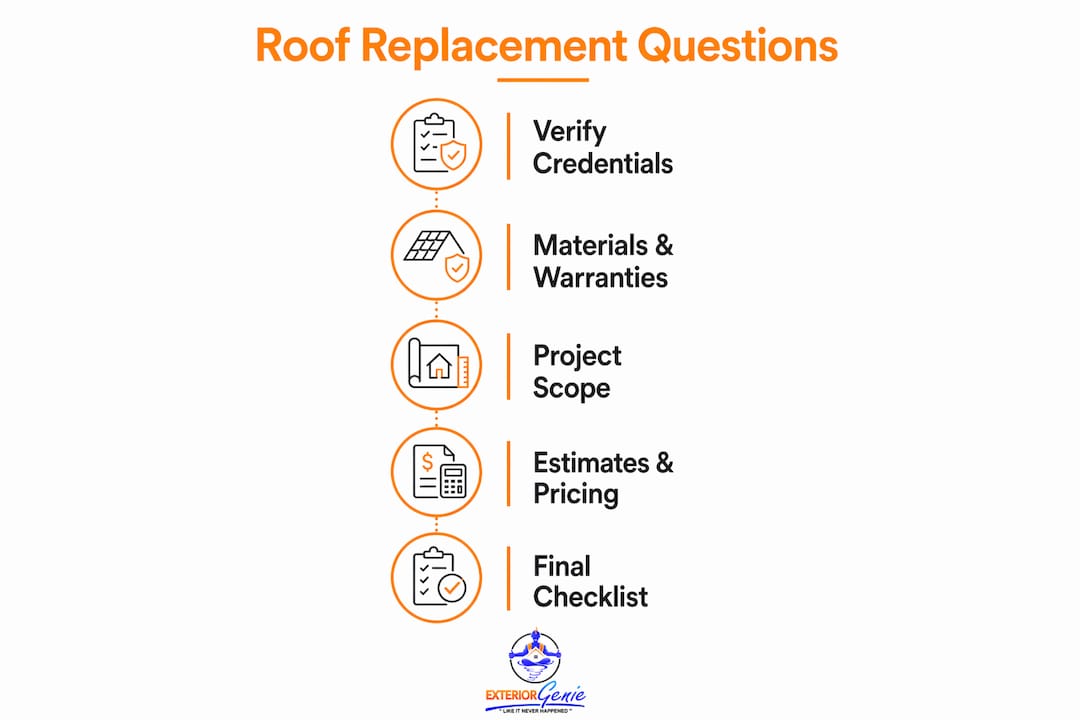
The most important questions to ask before a roof replacement fall into four categories: contractor legitimacy, materials and warranties, project logistics, and pricing. Skipping any one of these leaves you exposed to financial risk or poor workmanship. Knowing what to ask also signals to contractors that you are an informed homeowner, which tends to produce more honest bids.
Roof replacement is a major investment. National replacement costs typically range from $20,000 to $30,000, depending on materials, roof size, and region. That price range alone makes thorough vetting non-negotiable.

How do you verify a roofing contractor's credentials?
Licensing and insurance proof is the single most critical question to ask any roofing contractor. Verifying licenses, insurance, and references before hiring protects you financially and legally from day one. A contractor who hesitates to provide these documents is a contractor you should not hire.
Start with these specific credential questions:
- Is the company licensed in South Carolina? Ask for the license number and verify it with the state contractor licensing board.
- Do you carry general liability insurance? Request a certificate showing coverage limits. Anything under $1,000,000 per occurrence is a red flag.
- Do you carry workers' compensation insurance? Proof of workers' compensation protects you from liability if a worker is injured on your property.
- What is the company's legal business name and physical address? A P.O. box is not a physical address. A real office signals a legitimate operation.
- Can you provide three recent references from local projects? Call them. Ask about communication, cleanup, and whether the final bill matched the estimate.
Pro Tip: Request Certificates of Insurance directly from the contractor's insurance agent, not from the contractor. This prevents you from accepting a forged or expired certificate that looks legitimate but offers no real protection.
For a deeper look at the full vetting process, the roofing contractor vetting guide from Exteriorgenie covers every step in detail.
What roofing materials and warranties should you ask about?
Material selection affects your roof's lifespan, energy performance, and curb appeal for decades. The right choice depends on your climate, budget, and home style. Asphalt shingles remain the most common option for residential homes in the Southeast due to their cost and performance balance. Metal roofing, architectural shingles, and impact-resistant shingles are worth comparing if you live in a storm-prone area like Lexington, SC.
Warranties are where most homeowners get caught off guard. There are two separate warranties on every roof replacement project.
| Warranty Type | What It Covers | Typical Duration |
|---|---|---|
| Manufacturer warranty | Defects in the roofing material itself | 25 years to lifetime |
| Workmanship warranty | Installation errors by the contractor | 1–10 years (varies widely) |
| Enhanced manufacturer warranty | Materials and some labor, requires certified installer | 25–50 years |
Certified installer programs like GAF Master Elite unlock enhanced warranties that cover both materials and a portion of labor. Ask every contractor whether they hold a certified installer designation and which manufacturer programs they qualify for. A standard contractor can only offer the basic manufacturer warranty. A certified installer can offer significantly broader coverage.
Pro Tip: Ask for written warranty documents before work begins, not after. A verbal promise of a "lifetime warranty" means nothing without a signed document specifying what is covered, what voids coverage, and how to file a claim.
What project scope and logistics questions should you ask?
Understanding exactly what the project includes prevents budget shock and scheduling conflicts. Most residential roof replacements take 1 to 8 days, with standard homes often completed in 1 to 2 days. Larger roofs, steep pitches, and complex designs extend that timeline considerably.
Ask these scope questions before any contract is signed:
- Does the estimate include full tear-off of the existing roof? Some contractors layer new shingles over old ones to save time. This shortcut voids most manufacturer warranties and hides existing damage.
- Will you replace all flashing, or just the shingles? Flashing around chimneys, skylights, and valleys is a common failure point. Reusing old flashing on a new roof is a false economy.
- Will you inspect and repair the roof decking? Contractors must inspect attic ventilation and deck integrity for a complete estimate. Any contractor who skips attic access is giving you an incomplete quote.
- Who pulls the permits? The contractor should pull all required permits. If they ask you to pull permits yourself, that is a serious warning sign.
- How is unexpected decking damage priced? Require defined per-sheet decking pricing and photo documentation before any additional repairs are approved. Open-ended repair agreements are a common source of inflated final bills.
Additional logistics questions worth asking:
- Who is the primary contact during the project, and how do you communicate updates?
- How will you protect landscaping, windows, and siding during tear-off?
- Who handles cleanup and debris removal, and how quickly after completion?
- Will the same crew complete the entire project, or do you use subcontractors?
That last question matters more than most homeowners realize. Asking whether the crew is company-employed or subcontracted is key for quality control. Subcontractors are not inherently a problem, but the contract must specify who is accountable for workmanship if issues arise.
How do you get and compare accurate written estimates?
Getting a single quote and accepting it is one of the most expensive mistakes a homeowner can make. Homeowners should seek 3 to 5 written, itemized estimates to compare costs and scope line by line. Verbal or ballpark quotes give you nothing to compare and nothing to hold a contractor to.
Follow this process to get estimates that are actually useful:
- Request itemized bids only. Each estimate should break out materials, labor, permit fees, disposal costs, and any contingency pricing for decking repairs separately.
- Use a baseline cost calculator first. Knowing the rough cost per square foot for your area before you meet contractors gives you a reference point and reduces the chance of being anchored by the first number you hear.
- Compare scope, not just price. Two bids at different prices may include completely different scopes of work. A lower bid that excludes flashing replacement or ventilation work will cost more in the long run.
- Ask each contractor to explain their price. A contractor who cannot walk you through their estimate line by line is a contractor who does not fully understand the project.
- Watch for the low-ball bid. An estimate significantly below the others usually signals cut corners, inferior materials, or a plan to add charges once work begins.
Pro Tip: Ask for firm pricing that includes a contingency allowance for decking repairs rather than an open-ended agreement. A reputable contractor will price per sheet of decking replaced and document damage with photos before proceeding.
For guidance on whether your roof actually needs full replacement or just repairs, the Exteriorgenie article on replacement vs. repair decisions is a useful starting point before you request any estimates.
Key Takeaways
Asking detailed questions before a roof replacement protects your budget, ensures quality workmanship, and gives you clear recourse if something goes wrong.
| Point | Details |
|---|---|
| Verify credentials first | Confirm licensing, liability insurance, and workers' compensation before any other conversation. |
| Get written warranties | Request warranty documents before work starts, covering both materials and workmanship. |
| Require itemized estimates | Collect 3–5 written bids and compare scope line by line, not just total price. |
| Clarify scope in writing | Confirm tear-off, flashing, decking inspection, and permit responsibility before signing. |
| Ask about the crew | Know whether workers are company employees or subcontractors and get accountability terms in the contract. |
What I always tell homeowners who think they've asked enough
Most homeowners ask about price and timeline, then stop. Those are the two least predictive questions for project success. The questions that actually determine whether a roof replacement goes well are the ones nobody thinks to ask until something goes wrong.
The attic inspection question is the clearest example. A contractor who quotes your roof without going into the attic has not seen your decking condition or your ventilation setup. That quote is a guess. When rotted decking or a ventilation imbalance shows up mid-project, you have no leverage because you never locked in contingency pricing upfront.
Ventilation is the other issue I see homeowners consistently overlook. A new roof installed over an unbalanced ventilation system will fail prematurely. Intake and exhaust must be in balance. Ask your contractor specifically how they plan to address ventilation as part of the replacement, not as an add-on.
The subcontractor question also deserves more attention than it gets. I am not saying subcontractors do bad work. The problem is accountability. If the contract does not name who is responsible for workmanship defects, you may find yourself arguing with two companies who each point at the other. Get the accountability terms in writing before the first nail goes in.
The homeowners who have the smoothest projects are the ones who treated the estimate phase like an interview. They asked hard questions, compared detailed answers, and walked away from anyone who got defensive. That approach works every time.
— Ebben
Exteriorgenie makes roof replacement straightforward in Lexington, SC
Exteriorgenie is a veteran-owned roofing company with 25 years of experience serving residential and commercial clients in Lexington, SC. Their HAAG-certified inspectors handle everything from initial assessment to insurance claim assistance, and their team is available 24/7 for emergency repairs.

Transparent pricing and clear project communication are built into every Exteriorgenie project. If cost is a concern, their roofing financing options make it easier to move forward without delaying a replacement that your home needs now. Contact Exteriorgenie to get a detailed, itemized estimate from a contractor who will answer every question on this list without hesitation.
FAQ
How long does a roof replacement typically take?
Most residential roof replacements take 1 to 2 days for a standard home, though larger or more complex roofs can take up to 8 days. Factors like roof pitch, weather, and decking repairs affect the final timeline.
What insurance should a roofing contractor carry?
Every roofing contractor should carry both general liability insurance and workers' compensation insurance. Requesting proof of both protects you from financial liability if a worker is injured or property is damaged during the project.
How many estimates should I get for a roof replacement?
Get at least 3 to 5 written, itemized estimates before choosing a contractor. Itemized bids let you compare materials, labor, and scope directly rather than just comparing total prices.
What does a roof replacement typically cost?
National average costs for residential roof replacement generally range from $20,000 to $30,000, though the final price depends on roof size, materials, and your region.
Should I ask if a contractor uses subcontractors?
Yes. Knowing whether the crew is subcontracted helps you understand who is accountable for workmanship. Require the contract to specify responsibility for defects regardless of who performs the work.