
Roofing contractor vetting is the process of verifying credentials, insurance, and qualifications before you hire anyone to work on your roof. A poorly vetted contractor can void your warranty, fail a building inspection, or disappear after taking your deposit. This guide covers every step of the contractor qualification process, from license checks to final payment, using 2026 standards. Whether you are dealing with storm damage in Lexington, SC or planning a full commercial replacement, the same core verification steps apply.
What credentials should a roofing contractor have in 2026?
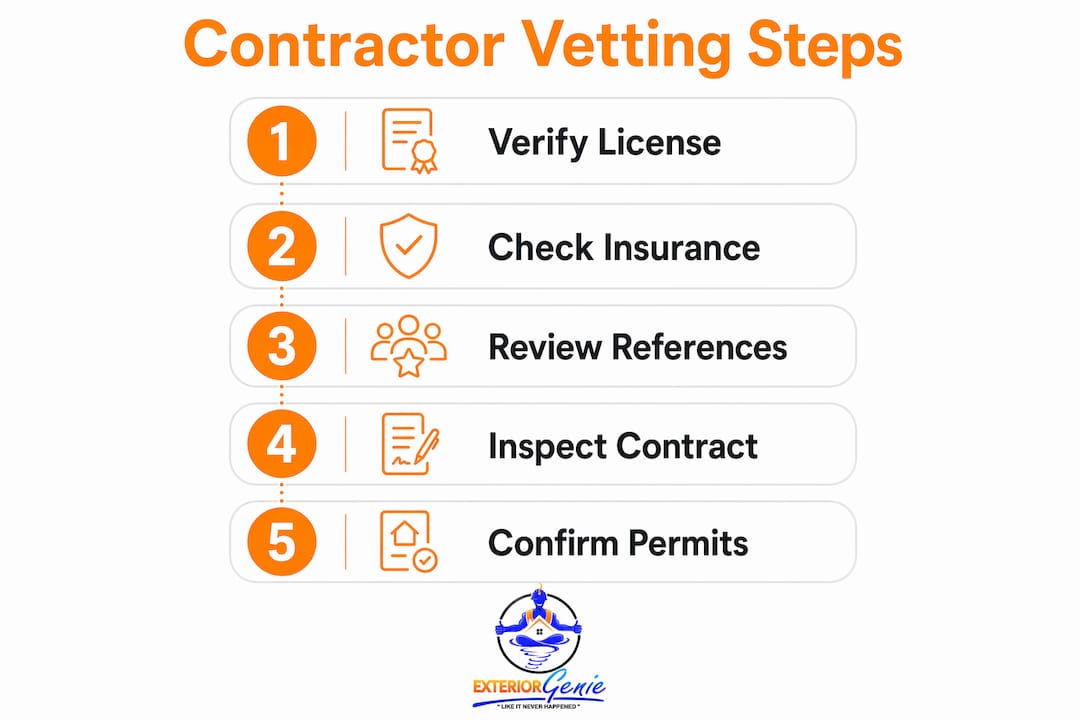
A qualified roofing contractor must carry a valid state license, general liability insurance, and workers' compensation coverage before setting foot on your property. These are not optional extras. They are the legal baseline that protects you from financial liability if a worker is injured or your property is damaged.
General liability insurance for residential roofing carries a minimum of $1,000,000 per occurrence in 2026. That number matters because a single roofing accident can easily exceed that threshold in medical costs and property damage. Do not accept a certificate of insurance at face value. Call the carrier directly to confirm the policy is active and covers the scope of your project.
Workers' compensation is equally non-negotiable. If a roofer falls on your property and the contractor has no workers' comp, your homeowner's insurance may be on the hook. Ask for the policy number and verify it the same way you verify general liability.
For commercial projects, OSHA compliance documentation and proof of safety training are additional vetting requirements. A commercial contractor who cannot produce safety records is a liability risk for your building and your tenants.
Pro Tip: Ask the contractor for their license number and classification, then verify it through your state's contractor licensing board website. Most states offer a free public lookup tool.
| Credential | What to verify | How to verify |
|---|---|---|
| State contractor license | License number and active status | State licensing board website |
| General liability insurance | $1,000,000+ per occurrence, active policy | Call the insurance carrier directly |
| Workers' compensation | Active coverage for all crew members | Call the insurance carrier directly |
| OSHA safety training (commercial) | Documented training records | Request certificates from contractor |
| Manufacturer certification | GAF, Owens Corning, or equivalent | Check manufacturer's website by contractor name |
A qualified roofing contractor should meet at least 80% of established professional criteria, including licensing, insurance, references, and a written warranty. Use this table as your minimum checklist before any conversation about price.
How to get and compare multiple roofing estimates
Collecting multiple bids is not just about finding the lowest price. It is your best tool for spotting quality gaps and hidden costs before work begins.
- Request at least three written, itemized estimates. Three or more bids give you a realistic price range and reveal outliers on both ends. A single bid gives you nothing to compare against.
- Require full itemization. Each estimate should list materials by brand and grade, labor costs, tear-off and disposal fees, flashing work, and a projected timeline. Vague line items like "roofing work" are a warning sign.
- Check the material brands. A bid using generic underlayment versus one specifying GAF Feltbuster or Owens Corning WeatherLock is not an apples-to-apples comparison. Insist on brand names in writing.
- Confirm who is providing the estimate. The person giving you a quote may be a commissioned salesperson, not a licensed roofer. Ask directly whether the estimator holds a license and whether the crew will be company employees or named subcontractors.
- Watch for suspiciously low bids. A bid that comes in significantly below the others usually means cut-rate materials, unlicensed labor, or both. The savings disappear fast when the work fails in two years.
Pro Tip: Use a resource like the Exteriorgenie blog on accurate roofing quotes to understand what a fair itemized bid looks like before you start collecting estimates.
Payment terms belong in the estimate too. Standard practice limits upfront deposits to a range of 10–30% of the total project cost. Any contractor demanding 50% or more before work starts is a red flag worth taking seriously.
What questions should you ask when vetting roofing contractors?
The right questions separate professional contractors from those who will cause problems. Ask these before signing anything.
- How long have you been licensed in this state, and what is your license number?
- Are your workers direct employees or subcontractors, and are all subcontractors covered by your insurance?
- What material brands do you use, and why?
- Do you hold a manufacturer certification from GAF, Owens Corning, or a comparable brand?
- What warranties do you offer on workmanship, and how long do they last?
- Can you provide references from projects completed in the last three years?
- Who pulls the permits, and how do I confirm they have been approved?
- What is your process if unexpected damage is found during the project?
Manufacturer certifications from brands like GAF and Owens Corning are valuable credentials that unlock extended warranties and verify contractor skill. A GAF Master Elite contractor, for example, represents roughly the top 3% of roofing contractors in the country. That certification is not just a badge. It means the manufacturer will back the installation with a warranty that goes beyond what the contractor alone can offer.
When checking references, ask for contacts from completed projects over several years, not just recent jobs. Consistent workmanship over time tells you far more than a single glowing review. Call at least two references and ask specifically about how the contractor handled problems, not just whether the job was completed.
Five signs of a trustworthy contractor: they provide documentation without being asked, they encourage you to verify their license, they name their material brands upfront, they give you a written warranty, and they do not pressure you to sign on the spot.
What should a roofing contract include?
A roofing contract is your legal protection. Every detail agreed upon verbally must appear in writing before work begins.
The contract must include the full scope of work, the specific materials and brands being used, a start and completion date, a payment schedule tied to project milestones, and a process for handling change orders. Vague contracts lead to disputes. If the contract says "standard shingles," you have no recourse when the contractor installs the cheapest option available.
Permits must be pulled before work begins, and the contractor is responsible for obtaining them. Do not assume this is happening. Contact your local building department directly to confirm the permit has been issued and that inspections are scheduled. A roof installed without permits can create serious problems when you sell the property or file an insurance claim.
Pro Tip: Never release the final payment until you have received a signed lien waiver from the contractor. Lien waivers at final payment protect you from mechanic's liens if the contractor fails to pay their subcontractors or suppliers.
Standard upfront deposits run 10–30% of the total project cost. Progress payments should be tied to specific milestones, such as material delivery, tear-off completion, and installation sign-off. Final payment releases only after a walkthrough and your written approval.
| Contract element | What to confirm |
|---|---|
| Scope of work | Detailed description of all tasks, not general terms |
| Materials | Brand names, product lines, and grades specified |
| Timeline | Start date, completion date, and milestone schedule |
| Payment schedule | Deposit capped at 10–30%, milestone-based payments |
| Warranty terms | Workmanship warranty length and what it covers |
| Lien waiver | Required at final payment to protect your property |
| Permit responsibility | Contractor named as responsible party for permits |
How do you spot roofing contractor scams and red flags?
Scam contractors follow predictable patterns. Knowing the signs protects your money and your property.
- Pressure to sign immediately. High-pressure sales tactics and demands for same-day contract signing signal a lack of professionalism. Give yourself at least 48 hours to review any contract.
- No physical address or local presence. Storm chasers often appear after severe weather with no local office, no established reputation, and no accountability once they leave town.
- Cash-only payment demands. Legitimate contractors accept checks and credit cards and provide receipts. Cash-only arrangements leave you with no paper trail.
- Refusal to provide documentation. Any contractor who hesitates to share their license number, insurance certificates, or references is hiding something.
- Suspiciously perfect online reviews. A contractor with 200 five-star reviews and no negative feedback is worth scrutinizing. Check the Better Business Bureau and your state licensing board for complaints.
A roofing project is a partnership. Pressure to sign a contract immediately signals a lack of professionalism and should send you to the next contractor on your list.
For emergency situations, the vetting process still applies. Exteriorgenie's guide on emergency contractor qualities outlines what separates a reliable emergency roofer from an opportunist. Speed matters in an emergency, but not at the cost of verification.
If you encounter a contractor who exhibits multiple red flags, walk away and report them to your state contractor licensing board and the Better Business Bureau. Other homeowners in your area will benefit from that report.
Key Takeaways
Hiring a reliable roofing contractor requires verifying licenses, insurance, references, and contract terms before any work begins, not after problems arise.
| Point | Details |
|---|---|
| Verify credentials directly | Confirm license status and insurance with the state board and carrier, not just the contractor. |
| Collect three or more estimates | Itemized bids from multiple contractors reveal price gaps and material quality differences. |
| Ask the right questions | Ask about subcontractors, material brands, permits, and manufacturer certifications before signing. |
| Protect yourself with the contract | Require milestone-based payments, a permit clause, and a signed lien waiver at final payment. |
| Recognize red flags early | High-pressure tactics, cash-only demands, and missing documentation are reasons to walk away. |
What I have learned after 25 years of roofing work
The biggest mistake homeowners make is treating the vetting process as a formality. They get one or two bids, pick the lower number, and assume the contractor will handle the rest. That assumption costs people thousands of dollars every year.
The contractors who cause the most problems are not always the obvious scammers. They are often the ones who seem professional at first, provide a polished estimate, and then cut corners on materials or skip the permit. The only way to catch that is to verify everything in writing before the first nail goes in.
One thing I have noticed in 2026 is that manufacturer certifications are becoming more meaningful. GAF and Owens Corning have tightened their certification requirements, which means a certified contractor today has cleared a higher bar than five years ago. If a contractor claims certification, verify it on the manufacturer's website by name. It takes two minutes and tells you a lot.
My honest advice: do not let urgency override your process. Even after a storm, you have time to make one phone call to verify a license. The contractors worth hiring will respect that. The ones who push back are telling you exactly who they are.
— Ebben
Why Exteriorgenie makes the vetting process easier
Choosing a roofing contractor should not feel like a gamble. Exteriorgenie is a veteran-owned roofing company based in Lexington, SC, with 25 years of experience in residential and commercial roofing. Every project is backed by full licensing, HAAG-certified inspectors, and 24/7 emergency response.

Exteriorgenie also offers roofing financing options to help homeowners manage the cost of major repairs or full replacements without delaying necessary work. Transparent pricing, insurance claim assistance, and written warranties are standard on every job. If you want a contractor who meets every criterion in this guide, contact Exteriorgenie for a free, itemized estimate and see the difference that verified credentials and military-grade accountability make.
FAQ
What is the minimum insurance a roofing contractor should carry?
A roofing contractor should carry at least $1,000,000 per occurrence in general liability insurance, plus active workers' compensation coverage. Verify both policies directly with the insurance carrier before work begins.
How many roofing estimates should I get?
Get at least three written, itemized estimates. Multiple bids give you a realistic price range and help you identify contractors using inferior materials or padding labor costs.
Should a roofing contractor pull the permits?
Yes. The contractor is responsible for pulling all required permits before work begins. Confirm permit status directly with your local building department to avoid future insurance or resale complications.
What is a lien waiver and why does it matter?
A lien waiver is a document signed by the contractor confirming they have been paid and waiving the right to place a mechanic's lien on your property. Request one at final payment to protect yourself if the contractor has unpaid subcontractors or suppliers.
What does a manufacturer certification like GAF Master Elite mean?
A GAF Master Elite certification means the contractor has met GAF's licensing, insurance, and quality standards and represents a small percentage of all roofing contractors. It also unlocks extended warranty options that standard contractors cannot offer.