

A roofing scope of loss is the insurance carrier's official, line-by-line inventory and cost estimate of all storm or weather damage to your roof. It is not a contractor quote. It is the carrier's formal position on what they believe needs repair and how much they will pay. Understanding what is roofing scope of loss, and how to read it critically, is the single most important skill you can develop before settling any roof insurance claim.
The industry standard term for this document is "scope of loss," though you may also hear it called a "scope of work" or "insurance estimate." Both phrases refer to the same carrier-generated document. Estimating software like Xactimate generates these scopes using regional pricing databases updated quarterly to reflect local labor and material costs. That pricing detail matters because errors in region coding or outdated data can quietly undervalue your claim before you ever read the first line.
What is a roofing scope of loss and what does it include?
A roofing scope of loss is the insurance carrier's line-by-line damage inventory that includes measurements, material specifications, unit costs, depreciation calculations, and photographic documentation. Each of those elements plays a specific role in determining your final payout.

The main components you will see
Every scope of loss contains several standard sections. Knowing what each one means prevents you from accepting an underpayment without realizing it.
- Damage areas and measurements: Square footage of each affected roof section, calculated from aerial data or on-site measurement.
- Material specifications: The type, grade, and quantity of shingles, underlayment, and accessories required.
- Labor costs: Installation labor priced against the regional database for your ZIP code.
- Depreciation: A reduction applied to materials based on age and condition. This is often the largest source of confusion for homeowners.
- Overhead and profit (O&P): A line item covering the contractor's business costs. Carriers sometimes omit this, which is a negotiable point.
- Deductible: The amount subtracted from the total that you pay out of pocket.
- Code upgrades: Required building code improvements. These are frequently excluded from initial scopes and must be supplemented separately.
How a scope differs from a contractor estimate
A contractor estimate is a provisional pricing document. Legitimate insurance claim pricing flows from the carrier's scope, not the contractor's initial quote. The contractor's role is to review the scope, identify missing items, and work with you to supplement the claim. Reading both documents side by side is the fastest way to spot gaps.
What are common gaps in initial roofing scopes?
Initial roofing scopes routinely miss critical components. Commonly omitted items include ridge vents, starter strips, drip edge flashing, pipe boot flashings, and code-required upgrades. These omissions create a typical valuation gap of 35–50% between the initial scope and the actual cost of a full roof restoration.
That gap is not always intentional. Desk-trained adjusters review aerial imagery and field photos without physically walking your roof. They focus on the most visible damage, such as missing shingles or obvious punctures, and frequently miss secondary components that are just as necessary for a code-compliant repair.
Items most often left off the initial scope
- Ridge cap shingles and ridge vents
- Starter strip along eaves and rakes
- Drip edge and step flashing
- Pipe boot replacements
- Ice and water shield in required zones
- Overhead and profit for general contractor coordination
- Code upgrade costs under IRC Section R908
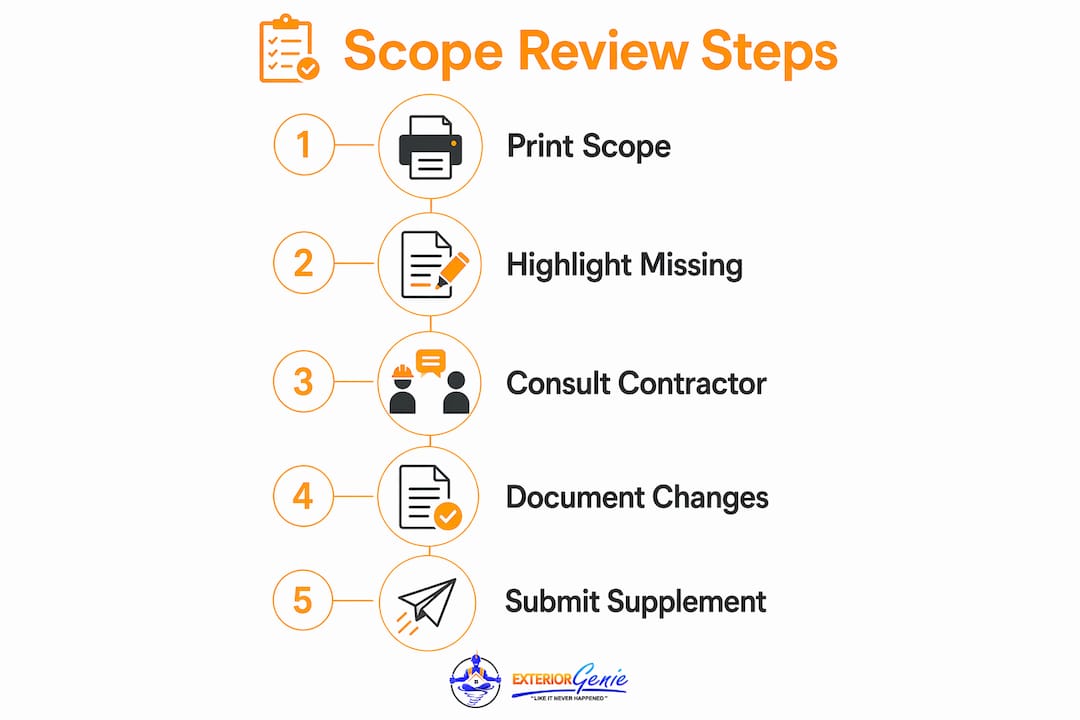
Pro Tip: Print your scope and go line by line with a highlighter. Mark every item your contractor says is required but does not appear in the scope. That list becomes your supplement request.
Missing even one of these items can shift hundreds or thousands of dollars onto your out-of-pocket costs. Reviewing your scope before signing any contractor agreement gives you time to address those gaps through the supplement process.
How does a professional roofing damage assessment support your claim?
A professional insurance-grade inspection is the foundation of a defensible roofing claim. It is not the same as a standard contractor walkthrough. An insurance-grade inspection documents every roof zone with labeled photographs, hail impact density maps, damage pattern analysis, and measurements that translate directly into scope line items.
Here is what a thorough inspection covers:
- Zone-by-zone documentation: Each section of the roof is photographed and labeled separately, showing damage type and location.
- Hail impact mapping: Impact density and size are recorded to establish storm severity and coverage eligibility.
- Penetration and flashing inspection: All pipe boots, vents, skylights, and flashings are checked and documented individually.
- Negative findings: Zones without damage are documented too. This prevents carriers from discounting the claim by arguing that skipped areas were undamaged.
- Date and storm correlation: Damage is tied to a specific weather event using storm data, which protects against claim denial on timing grounds.
Pro Tip: Ask your inspector for a written report, not just photos. A written report with labeled diagrams carries far more weight in a supplement negotiation than a folder of unlabeled images.
Insurance-grade inspections reduce disputes by showing damage patterns clearly, which removes guesswork from the adjuster's review. Exteriorgenie's HAAG-certified inspectors produce exactly this type of documentation, which is one reason their clients see fewer claim denials. You can also review how roof inspection supports your claim for a deeper look at the process.
What steps can homeowners take to review and supplement their scope?
The scope of loss is a starting point, not a final offer. Everything in the scope is negotiable, including what is missing from it. Homeowners who treat the initial document as settled leave real money on the table.
Follow these steps to manage your scope effectively:
- Check the region code: Confirm the pricing database reflects your actual location. A wrong ZIP code means wrong pricing.
- Verify depreciation calculations: Recoverable depreciation is released after repairs are complete. Know whether your policy is ACV (actual cash value) or RCV (replacement cost value).
- List every missing item: Compare the scope against your contractor's assessment and note every discrepancy.
- Request supplements in writing: Submit supplement requests with photographic evidence and line-item justification. Verbal requests rarely move claims forward.
- Track deadlines: Timely action on claims prevents loss of coverage eligibility and locks in accurate regional pricing before the quarterly database updates.
- Involve a qualified contractor early: A contractor experienced in insurance claim supplementing knows which line items carriers routinely omit and how to document the case for reinstatement.
Homeowners who work with a contractor familiar with the supplement process consistently recover more of their actual repair costs. The difference between a well-managed and a poorly managed claim can easily exceed $5,000 on a standard residential roof replacement.
For additional guidance on understanding your deductible's role in this process, the roofing insurance claim deductible guide from Exteriorgenie covers the key terms clearly.
What regulatory rules affect roofing scopes of loss?
Building codes directly shape what must appear in a scope of loss. The most consequential rule for homeowners is the 25% threshold under IRC Section R908. This rule states that if a repair covers more than 25% of the total roof area, the entire roof must be brought up to current building codes.
Here is how that rule plays out in practice:
- Repair under 25%: Only the damaged section requires repair. Code upgrades apply only to that section.
- Repair over 25%: The full roof must meet current code. This can require new underlayment grades, updated ventilation, ice and water shield in all required zones, and drip edge on all edges.
- Code upgrade costs: These costs are frequently excluded from the initial scope. They require a supplement backed by your local building department's requirements.
- Insurance coverage limits: Many policies exclude code upgrades unless you carry a specific code upgrade endorsement. Check your declarations page before assuming coverage.
Local jurisdictions in South Carolina, for example, may have additional requirements beyond the IRC baseline. Exteriorgenie's team reviews local code requirements as part of every inspection, which prevents surprises during the permit and installation phase. Understanding how roofers determine replacement vs. repair can help you anticipate which threshold applies to your damage.
Key Takeaways
A roofing scope of loss is a negotiable insurance document, and homeowners who review it carefully, document missing items, and supplement with evidence consistently recover more of their actual repair costs.
| Point | Details |
|---|---|
| Scope is not final | The initial scope is the carrier's opening position; missing items can be added through supplements. |
| Valuation gaps are common | Initial scopes routinely undervalue claims by 35–50% due to omitted components like flashings and ridge vents. |
| Inspection quality matters | An insurance-grade inspection with zone documentation and negative findings reduces disputes and supports supplements. |
| The 25% rule changes everything | Repairs exceeding 25% of roof area trigger full code compliance, which often requires a separate supplement. |
| Act quickly | Delays risk losing coverage eligibility and accurate regional pricing before quarterly database updates. |
The scope is a negotiation, not a verdict
I have reviewed hundreds of roofing insurance scopes over the years, and the pattern is consistent. Homeowners who receive their scope, glance at the total, and hand it to the first contractor who calls them almost always leave money behind. The ones who treat the document like a contract under negotiation, which it is, come out ahead.
The most common mistake I see is accepting depreciation without understanding whether it is recoverable. On an RCV policy, that money comes back to you after repairs are complete. On an ACV policy, it does not. That single distinction can represent thousands of dollars, and most homeowners never ask the question.
My honest advice: get an independent inspection before you agree to anything. Not a free estimate from a contractor chasing storm work, but a documented, insurance-grade inspection from a certified inspector. Pair that with a contractor who knows the supplement process, and you have a real shot at a fair settlement. The scope is written by people who are trained to price damage conservatively. Your job is to make sure every legitimate item gets counted. You can find useful context on insurance restoration roofing to understand the full picture before your next conversation with an adjuster.
— Ebben
Exteriorgenie is ready to review your roofing scope
Exteriorgenie is a veteran-owned roofing company based in Lexington, SC, with 25 years of experience handling storm damage roof repair and insurance claim support for homeowners across the Midlands. Their HAAG-certified inspectors produce insurance-grade documentation that supports supplements and reduces claim disputes from the first submission.

If your carrier has already issued a scope, Exteriorgenie can review it line by line and identify missing items before you sign off. Their team also assists with roof insurance claims from inspection through final payment, and financing options are available to cover deductibles or repair costs that fall outside your settlement. Call (803) 999-7663 or visit exteriorgenie.com to schedule your inspection.
FAQ
What is a roofing scope of loss?
A roofing scope of loss is the insurance carrier's official, line-by-line estimate of roof damage, generated using software like Xactimate and based on regional pricing databases. It represents the carrier's position on coverage, not a final settlement.
Can I dispute or add items to my roofing scope?
Yes. The initial scope is negotiable, and missing items can be added through a formal supplement request supported by photographic evidence and written documentation from a qualified contractor.
What items are most often missing from an initial scope?
Ridge vents, starter strips, drip edge flashing, pipe boot replacements, and code upgrade costs are the most commonly omitted items, often creating a 35–50% gap between the scope total and actual restoration cost.
What is the 25% rule in roofing insurance claims?
Under IRC Section R908, any repair covering more than 25% of the total roof area requires the entire roof to meet current building codes, which often adds costs that must be supplemented separately.
How does a professional inspection help my roofing claim?
An insurance-grade inspection documents damage by zone with labeled photos, hail impact maps, and negative findings, giving adjusters clear evidence that reduces disputes and supports supplement approvals.