
Commercial roofing systems are specialized multi-layer assemblies designed to protect non-residential buildings, with materials selected for durability, cost, and environmental exposure. The types of commercial roofing systems available today range from single-ply membranes like TPO, EPDM, and PVC to built-up roofing, modified bitumen, spray polyurethane foam, and metal panels. Single-ply membranes dominate the market at 81% of contractor usage as of Q2 2026, driven by their balanced ROI and fast installation. Choosing the wrong system for your building type, climate, or budget is one of the most expensive mistakes a business owner or construction professional can make.
1. what are the main types of commercial roofing systems?
Commercial roofing options fall into five primary categories: single-ply membranes, built-up roofing, modified bitumen, spray polyurethane foam, and metal roofing. Each category suits different building geometries, climates, and operational demands. Understanding the core characteristics of each system is the foundation of any sound roofing decision.
Single-Ply Membranes (TPO, EPDM, PVC) are the most widely installed commercial roofing materials today. TPO (thermoplastic polyolefin) reflects UV radiation and performs well on retail and warehouse roofs. EPDM (ethylene propylene diene monomer) is a synthetic rubber membrane known for cold-weather flexibility. PVC (polyvinyl chloride) resists chemicals and grease, making it the preferred choice for restaurants and food processing facilities.
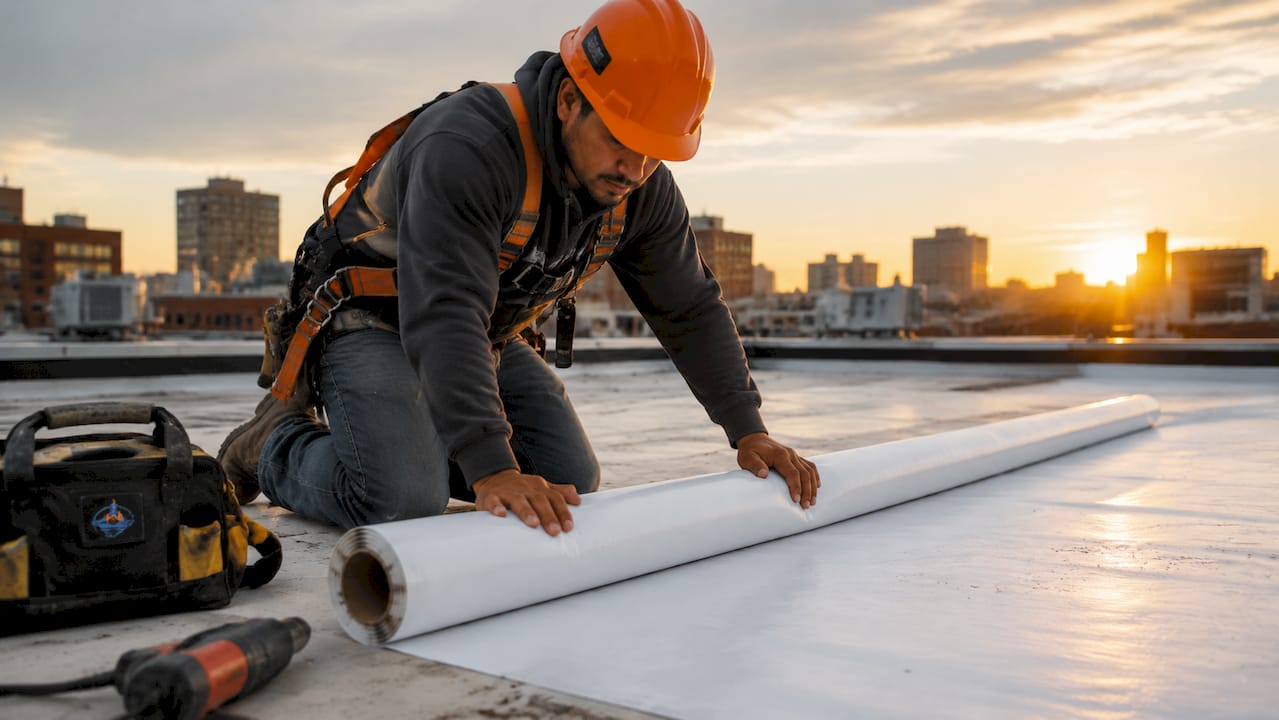
Built-Up Roofing (BUR) is a multi-ply asphalt and fabric system that has been in use for over a century. It handles ponding water better than most membranes but requires skilled labor and produces fumes during hot-applied installation. BUR remains a reliable choice for flat roofs with heavy foot traffic.
Modified Bitumen is an evolution of BUR that uses polymer-modified asphalt in sheet form. It installs faster than traditional BUR and tolerates moderate foot traffic well. Torch-applied and cold-applied versions are both available, giving contractors flexibility on job sites with fire restrictions.
Spray Polyurethane Foam (SPF) delivers seamless insulation and waterproofing in a single application. It conforms to irregular roof shapes and penetrations without seams, which eliminates a common leak point. SPF requires periodic recoating every 10–15 years to maintain its protective surface.
Metal Roofing includes standing seam panels and exposed-fastener systems. Standing seam metal roofs are the most durable commercial option available, with lifespans reaching 70 years on well-maintained buildings.
Pro Tip: Match your roofing system to the dominant stressor on your building. Chemical fumes from exhaust stacks? Choose PVC. High foot traffic from rooftop HVAC maintenance? Choose BUR or modified bitumen. Pure energy savings on a large flat roof? TPO is your starting point.
2. how commercial roofing systems compare on lifespan, cost, and maintenance
Roofing system comparisons come down to three variables: how long the system lasts, what it costs to install, and how much ongoing maintenance it demands. These three factors interact. A system with a low upfront cost but high maintenance frequency often costs more over 30 years than a premium system with minimal upkeep.
Standing seam metal roofs last 30–70 years and cost $10–$18 per square foot installed. That lifespan means a building owner may never replace the roof again after one installation. TPO, by contrast, carries a 20–30 year lifespan at $3.50–$14 per square foot, making it the most cost-accessible single-ply option for budget-conscious projects.
| Roofing System | Lifespan | Installed Cost (per sq. ft.) | Maintenance Level | Energy Efficiency | Best Application |
|---|---|---|---|---|---|
| TPO | 20–30 years | $3.50–$14 | Low | High (reflective) | Retail, warehouses |
| EPDM | 20–30 years | $4–$12 | Low to moderate | Moderate | Cold climates, offices |
| PVC | 20–30 years | $5–$15 | Low | High (reflective) | Restaurants, chemical exposure |
| BUR | 15–30 years | $4–$10 | Moderate | Low to moderate | Heavy foot traffic, flat roofs |
| Modified Bitumen | 15–25 years | $3–$8 | Moderate | Moderate | Moderate traffic, fast installs |
| SPF | 20–30 years (with recoating) | $4–$7 | Moderate (recoating) | High (insulating) | Irregular shapes, retrofits |
| Standing Seam Metal | 30–70 years | $10–$18 | Low | Moderate to high | Long-term ownership, steep slopes |
Metal roofing carries higher upfront cost but lower lifecycle cost due to minimal maintenance and a 40–70 year lifespan. For a building owner planning to hold a property for 30 or more years, metal frequently delivers the best total value.
Pro Tip: Calculate cost per year of service, not just installation price. A $15-per-square-foot metal roof lasting 50 years costs $0.30 per square foot per year. A $7-per-square-foot membrane lasting 20 years costs $0.35 per square foot per year before maintenance.
3. how installation quality shapes roof performance
The standard commercial roof assembly includes a structural deck, vapor barrier, rigid polyisocyanurate insulation, a cover board, and the waterproof membrane or metal panel on top. Each layer must be installed correctly for the system to perform as designed. Skipping or rushing any layer creates failure points that no membrane quality can compensate for.
"Improper installation and deferred maintenance cause most premature roof failures, more than material choice itself." — NRCA standards, May 2026
Flashing at penetrations, curbs, and wall transitions is where most leaks originate. A contractor who rushes flashing details on a premium TPO roof will produce worse results than a careful installer working with a mid-grade modified bitumen sheet. High-quality flashing and seam work consistently outweighs material grade in determining how long a roof actually lasts.
Ponding water from poor drainage is the leading cause of premature roof deterioration on flat and low-slope commercial buildings. Slopes, interior drains, and scuppers must be designed before a single membrane sheet is laid. A roof that holds water for more than 48 hours after rain is already on a shortened lifespan, regardless of the membrane type.
Regular maintenance extends roof life significantly. Twice-yearly inspections, prompt repair of small punctures or lifted seams, and keeping drains clear of debris are the three practices that separate a 20-year roof from one that fails at 12. Learn more about how routine repairs extend roof life and reduce total ownership cost.
4. how to choose the best commercial roofing system for your building
No single roofing system fits every building. System selection depends on operational needs: PVC for chemical exposure, TPO for retail energy savings, modified bitumen for heavy foot traffic. Matching the system to the building's actual stressors is the decision that determines 30-year performance.
Work through these factors before requesting any bids:
- Roof slope: Low-slope and flat roofs require membrane or BUR systems. Slopes above 2:12 open the door to metal panels and modified bitumen.
- Climate: EPDM handles freeze-thaw cycles better than TPO in northern climates. TPO and PVC outperform EPDM in high-UV, hot environments.
- Rooftop activity: HVAC technicians, solar installers, and maintenance crews walking a roof regularly need BUR or modified bitumen for puncture resistance.
- Chemical exposure: Restaurants and industrial facilities with grease-laden exhaust need PVC, which resists oils and chemicals that degrade TPO and EPDM.
- Ownership horizon: Short-term owners (under 15 years) favor lower upfront cost membranes. Long-term owners get better value from metal or SPF with recoating programs.
- Budget structure: If capital budget is tight but operating budget is flexible, a lower-cost membrane with a maintenance contract works. If capital is available, invest in metal for the lowest lifecycle cost.
- Building shape: Irregular roofs with many penetrations and transitions favor SPF, which eliminates seams at every odd angle.
For a detailed walkthrough of planning a full roof replacement, the commercial roof replacement guide from Exteriorgenie covers scope, sequencing, and contractor selection in depth. If you want to understand why TPO has become the default choice for so many commercial buildings, the TPO roofing membrane guide breaks down its energy performance and installation requirements clearly.
When vetting contractors, use a structured contractor questions checklist to verify licensing, warranty terms, and installation experience before signing any contract.
Key takeaways
The best commercial roofing system is the one matched to your building's specific slope, climate, traffic load, and ownership timeline, not simply the cheapest or most popular option.
| Point | Details |
|---|---|
| Single-ply membranes lead the market | TPO, EPDM, and PVC cover 81% of commercial installations due to cost and speed. |
| Metal roofs win on lifecycle value | A 30–70 year lifespan makes metal the lowest cost-per-year option for long-term owners. |
| Installation quality beats material grade | Proper flashing and seam work determines lifespan more than membrane brand or type. |
| Drainage design is non-negotiable | Ponding water accelerates membrane failure; slopes and scuppers must be planned first. |
| Match system to building stressors | Chemical exposure needs PVC; foot traffic needs BUR; energy savings favor TPO or SPF. |
What 25 years in commercial roofing actually teaches you
The conversation I have most often with building owners goes like this: they chose the cheapest membrane, skipped the maintenance contract, and now they're replacing a roof that should have lasted 25 years after only 11. The material was fine. The installation was rushed, the drainage was never corrected, and nobody walked the roof until water was coming through the ceiling.
The industry talks about roofing systems as if material selection is the primary decision. In my experience, it is the third most important decision. Contractor quality comes first. Drainage design comes second. Material selection comes third. A mediocre membrane installed by a disciplined crew with proper flashing details will outlast a premium membrane installed by a crew cutting corners on penetrations and seams.
The other misconception I see constantly is that business owners treat the roof as a cost center rather than a building envelope asset. A well-maintained commercial roof protects everything inside: inventory, equipment, tenant relationships, and the building's structural integrity. The math on preventive maintenance versus emergency repair is not close. Two inspections per year and prompt small repairs cost a fraction of what water intrusion does to a commercial interior over two or three years of slow deterioration.
My advice for anyone selecting a system right now: get three bids, ask each contractor to show you their flashing details on a comparable completed job, and verify that drainage is addressed in the scope before you compare prices. The cheapest bid that ignores drainage is the most expensive bid in the room.
— Ebben
How Exteriorgenie can help with your commercial roofing project
Exteriorgenie brings 25 years of field experience and HAAG-certified inspection credentials to every commercial roofing project in Lexington, SC and the surrounding area. Whether you need a full system replacement, storm damage repair, or a professional assessment of your current roof's condition, the team delivers transparent pricing and military-grade attention to installation detail.
Budget is one of the most common barriers to getting the right roof installed on time. Exteriorgenie offers flexible roofing financing options that let business owners move forward without delaying a project until the damage gets worse. If your building has taken storm damage, the 24/7 emergency response team and insurance claims assistance process are available to get you covered and back to business fast. Contact Exteriorgenie for an inspection and quote today.
FAQ
What is a commercial roofing system?
A commercial roofing system is a multi-layer assembly that protects a non-residential building from weather, moisture, and thermal loss. It typically includes a structural deck, vapor barrier, rigid insulation, and a waterproof membrane or metal panel as the top layer.
Which commercial roofing system lasts the longest?
Standing seam metal roofing lasts 30–70 years, making it the longest-lived commercial option available. It also carries the lowest maintenance requirements of any system over its full lifespan.
Is TPO or EPDM better for a commercial flat roof?
TPO performs better in hot, high-UV climates due to its reflective white surface, while EPDM handles cold climates and freeze-thaw cycles more reliably. Climate is the primary factor that separates the two systems in real-world performance.
How often should a commercial roof be inspected?
Commercial roofs should be inspected twice per year, typically in spring and fall, plus after any major storm event. Consistent inspections catch small seam lifts and flashing failures before they become interior water damage.
What causes commercial roofs to fail early?
Improper installation and deferred maintenance cause most premature commercial roof failures, more than material defects. Poor drainage design that allows ponding water is the second leading cause of early roof deterioration.