
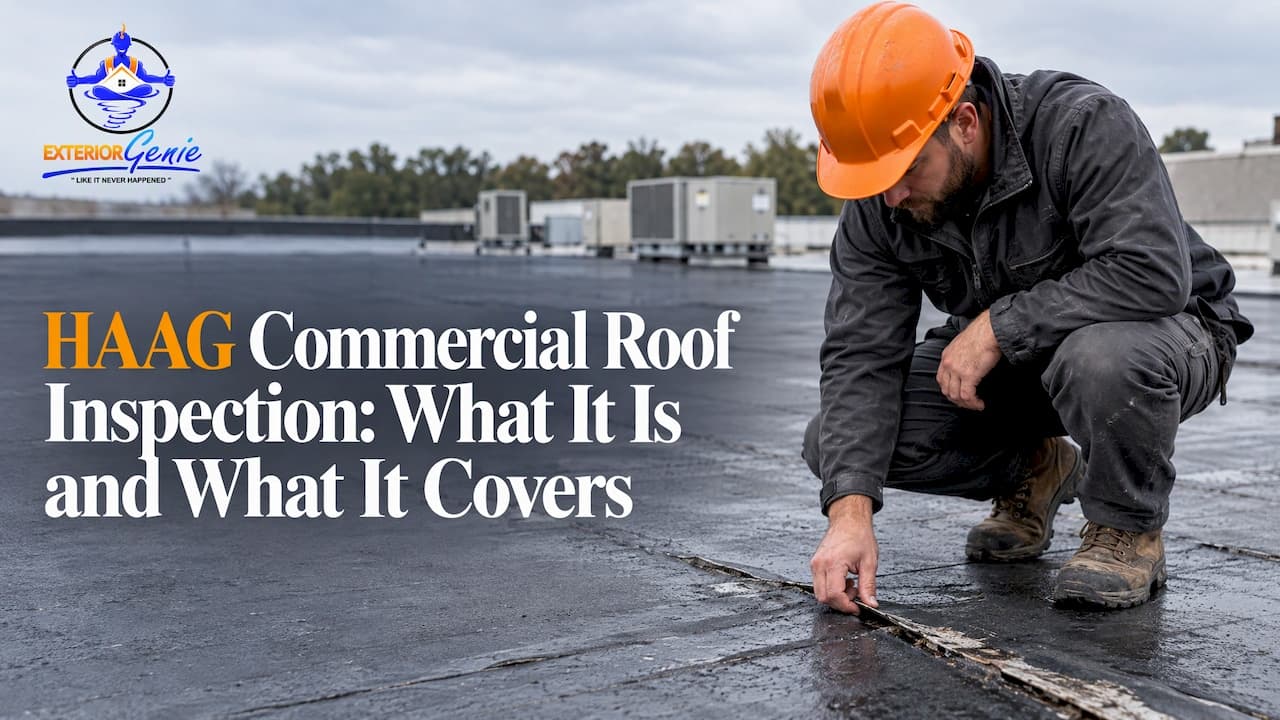
A HAAG commercial roof inspection is a damage assessment done by an inspector who holds the Haag Certified Inspector, Commercial Roofs credential (HCI-C). That inspector is trained to document hail, wind and wear on flat and low-slope roofs in a consistent, engineering-based way. For a building owner or property manager, it matters most after a storm, when a claim depends on a report that an insurance carrier will read closely.
This guide explains what the credential covers, what an inspector must do to earn it, how to check one, and where it helps and where it does not. We are Exterior Genie, a veteran-owned general contractor in Lexington and Columbia, SC, and we employ HAAG Certified inspectors. We wrote this from the owner's side of the table.
TL;DR
- HCI-C is a Haag Education credential for assessing damage on commercial roofs: built-up, modified bitumen, single-ply, metal, spray foam, green roofs and coatings.
- Initial certification comes from a course plus a proctored exam. Reported prerequisites include 50 flat roof inspections or three years of commercial claims experience.
- The credential shows how an inspector was trained. It does not decide coverage, and no law requires it.
- Verify a designation before you hire, and ask for the inspector's name and designation exactly as Haag lets it be written.
- After a storm, document first, inspect second, and give the report to your insurer with your claim.
Table of Contents
- What a HAAG commercial roof inspection actually is
- What the HCI-C course covers
- How an inspector earns the designation
- What HAAG certification does and does not tell you
- How to verify an inspector before you hire
- Storm damage on a commercial roof: what to do and in what order
- Where the inspection fits in your decision
- Our perspective
- Work with a team that inspects and builds
- FAQ
- Sources
What a HAAG commercial roof inspection actually is
Haag Engineering has worked in forensic roof inspection since 1924. Its training programs teach inspectors to find and record roof damage using a manufacturer-neutral, engineering-based method. The commercial version of that training leads to the HCI-C designation.
The word "commercial" changes the work. A flat roof is not a large shingle roof. According to one claims-industry guide, hail on a commercial roof does not look like hail on asphalt shingles. A single-ply membrane can show fractured reinforcement scrim with no obvious surface mark. A built-up roof can show displaced aggregate. An inspector who has only walked sloped roofs can miss both.
A proper inspection usually includes:
- A review of the roof type, age, and repair history.
- A walk of the field, seams, flashings, penetrations, drains and edges.
- Photo documentation tied to a roof diagram, so every finding has a location.
- A separation of storm damage from installation error, manufacturing defects and ordinary wear.
- A written report the owner can hand to an insurer, an engineer or a roofing contractor.
That last step is where the credential earns its value. Commercial claims are large, and a single replacement can reach six or seven figures. Carriers examine those files carefully, so a systematic, well-photographed report carries weight.
What the HCI-C course covers
For each roofing type, the course profiles how it is manufactured and installed, how it weathers, how hail and wind affect it, and how it is maintained and repaired. The systems covered include:
- Built-up roofing (BUR)
- Polymer-modified bitumen
- Thermoplastic single-ply (PVC and TPO)
- Thermoset single-ply (EPDM, CSPE, PIB)
- Spray polyurethane foam
- Metal roofing
- Vegetated (green) roofs
- Low-slope roof components and roof coatings
Case studies show real inspection scenarios. The program is offered in person and online, though availability varies, so confirm the current curriculum on the Haag Education program page before enrolling.
Those systems are the ones we install and repair across the Midlands. If your building has one of them, our pages cover PVC membrane, built-up roofing, EPDM rubber roofs, modified bitumen and flat roof coatings.
How an inspector earns the designation
Prerequisites
Haag asks for hands-on experience, not only a classroom seat. A 2026 credential comparison reports that HCI-C candidates need 50 flat roof inspections as the primary inspector, or three years of commercial lines adjusting or estimating. The same source notes that Haag asks for references and audits experience at random. Haag Education publishes the current requirements, so treat that page as the final word.

Course and exam
Initial certification comes through the Haag course and its final assessment. In the format reported by Canadian Underwriter, the proctored exam is given on the last day, allows four hours, requires a 70% or higher score, and permits one online retake. The comparison above describes the same structure: 100 multiple-choice questions, 70% to pass, one retake.
What it costs the inspector
Published figures vary with format. A professional-association guide puts Haag's multi-day, forensics-oriented course at roughly $2,000 to $3,000. The on-demand commercial course is listed at $925 for 14 hours as of October 2026. Either way, it is a real investment of time and money, which is part of why the credential is a reasonable signal.
Keeping it current
The designation is not a one-time badge. The comparison above describes an annual 10-question quiz and fee in years two through four, plus a five-year recertification course. Haag's own catalog lists an 8-hour online recertification course for commercial roofs for holders at the five-year mark. Ask any inspector whether their status is active, not just whether they once passed.
What HAAG certification does and does not tell you
A HAAG credential tells you how the inspector was trained. It does not tell you the outcome of any particular claim.
- It is a private training credential. No statute requires it, and there is no federal license for roof inspectors. A professional guide notes that, with no license to point to, buyers fall back on whatever standard an inspector can show.
- It does not decide coverage. The insurer's adjuster applies your policy. A report supports your claim with evidence. It does not replace the adjuster's decision.
- It does not replace a state license. Where a state licenses a trade, you still need that license for the work being done.
In South Carolina, check the contractor's state license separately from any training credential. A good inspector welcomes both questions.
How to verify an inspector before you hire
Before anyone walks your roof, run through this list:
- Ask for the full designation. Haag publishes usage guidelines. An inspector may write "HCI-C" or "Haag Certified Inspector, Commercial Roofs" after their name. A vague "HAAG trained" or "HAAG certified company" is not the same thing, because the credential belongs to a person.
- Look the person up. Haag keeps a certified inspector search. Confirm the name, the commercial designation and that the status is active. We cover this in more detail in our guide to verifying a Haag Certified Inspector.
- Match the designation to the roof. A residential designation is for sloped roofs. Your flat or low-slope roof calls for the commercial one.
- Ask who writes the report and who signs it. The person on the roof should be the person named on the report.
- Ask what the report will contain. Expect roof type, age, findings by location, photos, and a clear statement of what is storm-related and what is wear.
Storm damage on a commercial roof: what to do and in what order
After hail or a wind event in the Midlands, these steps protect both the building and the claim.
- Stop active leaks. Temporary tarping or patching limits interior damage. Keep your receipts, because policies generally expect you to protect the property.
- Photograph everything before repairs. Take wide shots of the roof, close shots of damage, and interior stains or wet ceiling tiles with dates.
- Report the loss to your carrier promptly. Read your policy for notice deadlines and the deductible that applies to wind or hail.
- Get a credentialed inspection. A commercial inspector can tell hail bruising from blistering or age, and can document it in a form a carrier recognizes.
- Keep the adjuster's visit informed. Share the inspection report, photos and repair history before or at the adjuster's visit.
- Repair or replace to a written scope. Compare the contractor's scope to the adjuster's. If they differ, the documentation is how you close the gap.
Our storm damage restoration team handles emergency tarping around the clock and works with property owners through the insurance process. For the thinking behind this approach, see our article on why Haag certification matters for commercial roofing.
Where the inspection fits in your decision
Owners often ask whether the inspection should come before or after a contractor quote. Do the inspection first. It tells you what the roof actually needs: a repair, a coating, a partial replacement or a full one. A quote written from an unverified guess can be too big or too small.

It also keeps you honest with your carrier. If the inspector finds old wear and no storm damage, you learn that before you file and argue. If the inspector finds fresh hail fractures, you file with evidence in hand.
Our perspective
We have watched the same pattern after every hailstorm in the Midlands. A property manager finds a leak, calls three vendors, and receives three different stories. The roof is the same. The difference is how carefully someone looked and how well they wrote it down.
That is why we put HAAG Certified inspectors on our team. A commercial roof is not a big residential roof. Membranes, aggregate, seams and coatings fail in their own ways, and the report that explains them has to be specific enough for an adjuster to act on.
We also believe in honest repair-versus-replacement guidance. If a section can be repaired, we say so. If the system has reached the end of its life, we show you the evidence and the options. Our military discipline shows up in the process: clear communication, one coordinated project plan, and no surprises.
Our work is backed by a lifetime workmanship warranty, and we are an Owens Corning Platinum Preferred Contractor. Put those together with insurance-claim expertise and you have one team handling the inspection, the paperwork and the build.
Ebben
Work with a team that inspects and builds
Exterior Genie handles commercial roofing from the first inspection through the final repair. That includes commercial roofing in Lexington and Columbia, emergency response, and help with the insurance claim. We also take on commercial construction and build-outs, so one contractor can manage related work on the same property.
If your roof has taken a storm hit or you simply want to know where it stands, contact us through our site and we will arrange an inspection. For a closer look at how a contractor-backed inspection supports a claim, read our guide to the Haag roof inspection process.
FAQ
What does HCI-C stand for?
HCI-C means Haag Certified Inspector, Commercial Roofs. Haag's usage guidelines say it may be written after a name as "HCI-C" or spelled out in full. It identifies a person who passed the commercial certifying exam, not a company.
Is a HAAG inspection required to file a commercial roof claim?
No. Haag certification is a private training credential, and no statute requires it. Many owners still choose it because the documentation method is consistent and carriers recognize it. Your insurer applies your policy to the facts either way.
How long does a HAAG commercial certification last?
Based on a 2026 credential comparison, holders pay a fee and take a short quiz annually in years two through four, then complete a five-year recertification course. Because status can lapse, always confirm that it is active in Haag's inspector search.
What experience does an inspector need to take the commercial course?
The reported prerequisite is 50 flat roof inspections as the primary inspector, or three years of commercial lines adjusting or estimating. Haag Education lists the current requirements, so check there for any change.
Does a HAAG report guarantee my claim will be paid?
No. The report documents what is on the roof and why. The adjuster decides coverage under your policy. What a strong report does is give that decision accurate, well-organized evidence to work from.
Sources
- HAAG Certification Certification Guide, CapOut
- HAAG Certified Commercial Roof Inspector Certification, CapOut
- HAAG Commercial Roof Inspector Certification, Legion Claims
- Touch, Feel, and Inspect, Canadian Underwriter
- Roof inspector course cost, NRCIA
- Certified Roof Inspector: Every Credential Compared (2026), The Roofing Brief