
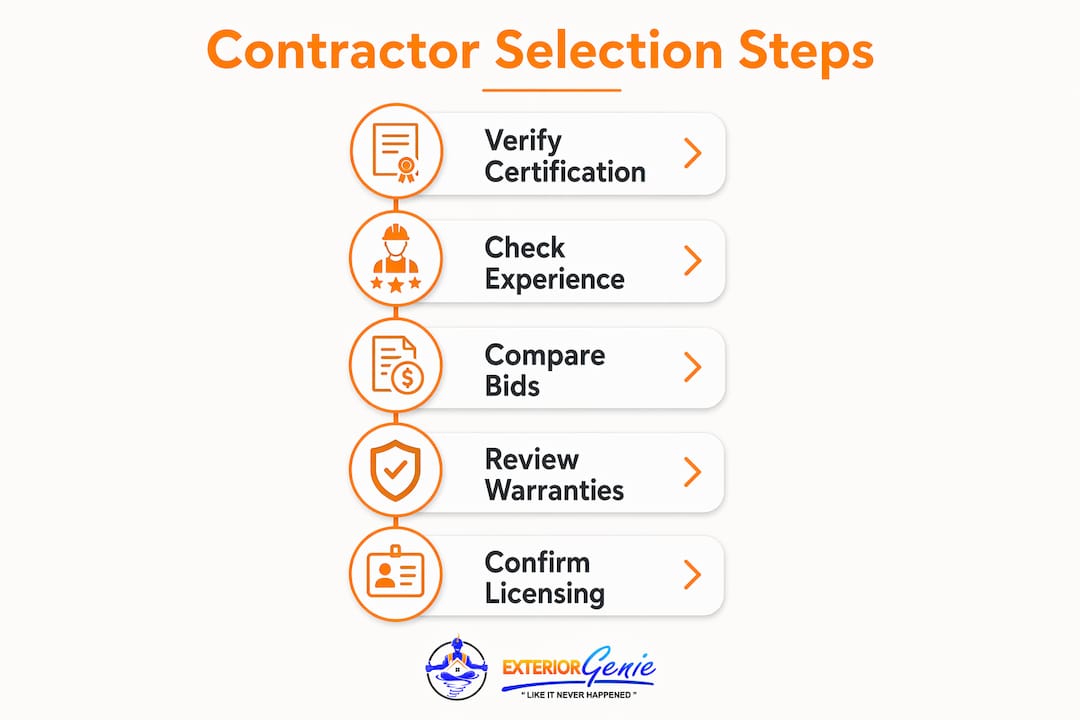
Choosing a commercial roofing contractor is defined by one non-negotiable standard: manufacturer certification. Property owners and managers who skip this step risk voiding warranties worth tens of thousands of dollars and accepting substandard workmanship that fails within years. The difference between a reliable contractor and a costly mistake comes down to three factors: verified credentials from manufacturers like GAF, Carlisle, and Firestone; documented commercial roofing experience; and bids evaluated for total value rather than lowest price. This guide walks you through each step so you hire with confidence, whether you're recovering from storm damage or planning routine maintenance.
What credentials must a commercial roofing contractor have?
Manufacturer certification is the single most important credential to verify when you select a roofing contractor for a commercial project. Without it, you cannot obtain a No Dollar Limit (NDL) warranty, which covers both labor and materials for 15–30 years. Certified installation is required for NDL warranty eligibility, and skipping this check can expose you to repair costs exceeding $100,000.
Certifications from GAF, Carlisle, and Firestone are not interchangeable. Each manufacturer trains and audits contractors separately. A contractor certified by GAF can install GAF TPO systems with full warranty backing, but that same contractor cannot offer a Carlisle NDL warranty unless Carlisle has separately certified them. Contractors with multiple manufacturer certifications give you better system choices rather than locking you into a single brand.

Beyond manufacturer credentials, verify the contractor holds a commercial roofing license. A general business license is not sufficient. Commercial roofing involves low-slope drainage design, membrane welding, and code compliance that require state-issued specialty licenses in most jurisdictions. Call your state contractor licensing board directly to confirm the license is active and in good standing.
The Experience Modification Rate, known as EMR, is a safety metric you should request from every candidate. An EMR below 1.0 signals a safer, more professional operation. Many general contractors require subcontractors to carry an EMR below 0.85. A high EMR means more workplace accidents, which translates directly to project delays and liability exposure on your property.
Key credentials to request from every contractor:
- Manufacturer certification letters from GAF, Carlisle, Firestone, or Johns Manville
- Active commercial roofing license verified through your state licensing board
- Current EMR documentation from their insurance carrier
- General liability, workers' compensation, and commercial auto insurance certificates
Pro Tip: Ask each contractor to provide their manufacturer certification number. Call the manufacturer directly to confirm it is current. Certifications expire and contractors do not always volunteer that information.
How do you evaluate a contractor's commercial experience?
Commercial roofing experience and residential roofing experience are not the same skill set. A contractor focused on residential work lacks the drainage design knowledge and low-slope logistics required for reliable commercial roofs. Asking a residential roofer to handle a flat TPO membrane on a 20,000 square foot warehouse is like asking a house painter to coat a steel bridge.
When evaluating candidates, request references from at least three commercial projects completed within the last two years that are similar in size and system type to yours. A contractor who replaced a 5,000 square foot EPDM roof on a strip mall is not an equivalent reference for a 50,000 square foot metal panel project on a distribution center. The scale and system type must match.
- Request project-specific references. Ask for the property owner's name, the building size, the roofing system installed, and the project completion date. Vague references are a red flag.
- Call the references directly. Ask whether the project finished on schedule, whether the crew maintained a clean and organized site, and whether any warranty claims arose after completion.
- Visit an active job site. Accessing an ongoing project site gives you real-world insight into workmanship and site management that no paper reference can replicate. Watch how the crew handles material staging, safety protocols, and daily cleanup.
- Confirm system-specific experience. If your building needs a TPO system, verify the contractor has installed TPO specifically, not just EPDM or modified bitumen. Each membrane type requires different tools and techniques.
- Check for commercial-only red flags. If a contractor's portfolio shows only residential shingle work or cannot name a single commercial client willing to provide a reference, move on.
Contractors who hold certifications from multiple manufacturers signal broader experience. They have been trained, tested, and audited across different systems, which means they can recommend the right solution for your building rather than defaulting to the only system they know.
How do you compare bids without just chasing the lowest price?
Commercial roof costs vary significantly by system type. TPO systems run $5–$11 per square foot, EPDM runs $4–$9 per square foot, and metal roofing runs $8–$15 or more per square foot. For a 10,000 square foot building, that means total project costs ranging from $65,000 to $130,000 before contingency. Understanding these ranges lets you spot outliers immediately.
| System Type | Cost Per Sq Ft | 10,000 Sq Ft Estimate | Best For |
|---|---|---|---|
| TPO | $5–$11 | $50,000–$110,000 | Energy efficiency, flat roofs |
| EPDM | $4–$9 | $40,000–$90,000 | Durability, low-slope roofs |
| Metal | $8–$15+ | $80,000–$150,000+ | Longevity, steep-slope commercial |
Bids 15–25% below the average from competing proposals almost always indicate compromises. Thinner membranes, skipped flashings, inadequate insurance coverage, or unlicensed labor are the most common culprits. A low bid that saves you $15,000 upfront can cost you $80,000 in premature failure and uninsured damage within five years.
Break every proposal into line items: labor, materials, tear-off and disposal, flashings, and contingency. Detailed proposal breakdowns allow you to identify anomalies and negotiate from an informed position. If a contractor refuses to itemize, that is a warning sign. You cannot compare two bids fairly if one bundles everything into a single number.
Lifecycle cost evaluation over 25 years consistently outperforms upfront price comparison. A TPO system installed correctly at $9 per square foot with a 30-year NDL warranty costs far less over its life than a $6 per square foot installation that requires major repairs every five years. Factor in energy savings, maintenance frequency, and warranty coverage when comparing proposals.
Always budget a 10–20% contingency for hidden conditions discovered after tear-off begins. Insulation saturation, deck rot, and failed vapor barriers are invisible until the old membrane comes off. Contractors who do not mention contingency in their proposals are either inexperienced or not being transparent with you.
Pro Tip: Ask each contractor to provide accurate roofing quotes broken down by labor, materials, and contingency. This single request separates professional contractors from those cutting corners.
What warranties and financial stability factors should you check?
An NDL warranty is the gold standard in commercial roofing. It covers both labor and materials, meaning if the roof fails due to installation error or material defect, the manufacturer pays for the repair. NDL warranty eligibility requires certified installation, which is why manufacturer certification is non-negotiable. A workmanship-only warranty from an uncertified contractor leaves you exposed to material failure costs.
Verify the contractor's financial stability before signing anything. A contractor who goes out of business six months after completing your roof cannot honor a 10-year labor warranty. Request proof of operating history, ask for trade references from material suppliers, and check for any open liens or judgments through your county courthouse records.
Insurance minimums for commercial roofing projects:
- General liability: $1,000,000 per occurrence minimum
- Workers' compensation: Required in all states for crews working on your property
- Commercial auto: Covers vehicles and equipment on your site
- Umbrella policy: Recommended for projects over $500,000
"The contractor's insurance certificate should name your property as an additional insured. This protects you directly if a claim arises during the project. Never accept a certificate that does not include this endorsement."
Confirm that warranty enforcement is written into the contract. Verbal assurances mean nothing. The contract should specify the warranty term, what voids coverage, the process for filing a claim, and the contractor's response time obligation for warranty repairs.
What mistakes do property managers make when hiring a roofer?
The most expensive mistake property managers make is selecting the lowest bidder without verifying credentials. Price is visible immediately. Credential gaps only become apparent when a warranty claim is denied or a roof fails prematurely.
- Accepting residential experience as equivalent. A contractor with 20 years of residential shingle work does not automatically qualify for a commercial flat roof project. Verify commercial-specific project history before proceeding.
- Skipping manufacturer certification verification. Assuming a contractor is certified because they claim to be is a common and costly error. Call the manufacturer directly to confirm.
- Ignoring EMR and insurance documentation. Contractors without current certificates of insurance expose you to liability for injuries on your property. Request updated certificates dated within 30 days of project start.
- Skipping reference calls and site visits. Written references are easy to fabricate or cherry-pick. A phone call to a past client or a visit to an active job site reveals the truth about workmanship and professionalism.
- Failing to budget for contingency. Property managers who approve a fixed-price contract without contingency language often face difficult conversations when hidden damage is discovered mid-project.
Pro Tip: When finding reliable roofing contractors, check the contractor qualification factors that matter most before the first meeting. Knowing what to ask saves hours of back-and-forth.
Key takeaways
Choosing the right commercial roofing contractor requires verified manufacturer certifications, documented commercial experience, and bids evaluated for lifecycle value rather than lowest upfront cost.
| Point | Details |
|---|---|
| Verify manufacturer certification | Confirm GAF, Carlisle, or Firestone certification directly with the manufacturer before signing. |
| Check EMR and insurance | Require an EMR below 1.0 and current certificates naming your property as additional insured. |
| Compare bids by line item | Break proposals into labor, materials, tear-off, and contingency to spot anomalies. |
| Budget a 10–20% contingency | Hidden conditions like deck rot are common and only visible after tear-off begins. |
| Prioritize lifecycle cost | A higher upfront bid with an NDL warranty almost always costs less over 25 years. |
What i've learned after 25 years of commercial roofing projects
The single biggest mistake I see property managers make is treating a roofing bid like a commodity purchase. They collect three numbers, pick the lowest, and assume the work will be equivalent. It never is.
Manufacturer certification is not a marketing badge. It represents real training, real audits, and real accountability. When a GAF-certified contractor installs a GAF system, GAF has skin in the game. They will inspect the installation before issuing the NDL warranty. That inspection alone catches errors that would otherwise become your problem in year three.
I have seen bids come in 20% below the competition and watched property managers take them. In almost every case, the savings evaporated within two years through emergency repairs, denied warranty claims, or full re-roofing. The math is not complicated. A $15,000 savings on a $100,000 project means nothing if you spend $40,000 fixing it five years later.
My honest advice: treat the EMR number like a credit score for safety. A contractor with an EMR of 1.3 has a documented history of workplace accidents. That history does not stay on their job sites. It follows them to yours. Require an EMR below 1.0 as a non-negotiable threshold, not a preference.
Negotiate the contingency budget before you sign, not after hidden damage appears. A contractor who resists a 15% contingency line item is telling you something important about how they handle surprises.
— Ebben
How Exteriorgenie supports property managers in lexington, SC
Exteriorgenie is a veteran-owned commercial roofing company serving property managers in Lexington, SC with 25 years of field experience and HAAG-certified inspectors on staff. Whether you are dealing with storm damage roof repair after a severe weather event or planning a full commercial roof replacement, Exteriorgenie brings military-grade discipline to every project.
Exteriorgenie offers transparent pricing, itemized proposals, and personalized insurance claim assistance so you never face a denied claim alone. For property managers who need flexible payment options, roofing financing options are available to keep your project moving without straining your operating budget. Contact Exteriorgenie today to get a certified inspection and a fully itemized commercial roofing proposal from a team that treats your building like their own.
FAQ
What certifications should a commercial roofing contractor have?
A qualified commercial roofing contractor should hold active manufacturer certifications from companies like GAF, Carlisle, or Firestone. These certifications are required to issue NDL warranties covering both labor and materials for up to 30 years.
How many bids should i get for a commercial roofing project?
Solicit at least three bids and compare them line by line across labor, materials, and contingency. Bids 15–25% below the average signal compromises in materials, labor quality, or insurance coverage.
What is an NDL warranty in commercial roofing?
An NDL (No Dollar Limit) warranty covers the full cost of labor and materials if the roof fails due to installation error or product defect. It requires certified installation by a manufacturer-approved contractor to remain valid.
How do i verify a contractor's commercial roofing license?
Contact your state contractor licensing board directly and search by the contractor's business name or license number. Confirm the license is active, covers commercial roofing specifically, and has no disciplinary actions on record.
What does EMR mean and why does it matter?
EMR stands for Experience Modification Rate and measures a contractor's workplace safety history relative to industry averages. An EMR below 1.0 indicates a safer operation, and many general contractors require subcontractors to carry an EMR below 0.85.