
Insurance bad faith in roofing is defined as an insurer's unreasonable or dishonest refusal to honor a valid roof damage claim, breaching its contractual duty to deal fairly with you. Understanding what is insurance bad faith roofing separates homeowners who recover full compensation from those who accept pennies on the dollar. Insurers engage in bad faith through denial without investigation, deliberate delays, and lowball settlement offers. State laws like Florida's SB 2A and Georgia's O.C.G.A. 33-4-6 impose strict penalties on insurers who cross this line. Exteriorgenie's HAAG-certified inspectors work directly with homeowners in Lexington, SC to document damage and counter these tactics before they cost you money.
What is insurance bad faith in roofing claims?
Insurance bad faith is legally defined as an insurer's failure to act fairly and promptly on a legitimate claim. It goes beyond a simple disagreement over repair costs. Bad faith involves conduct such as denying claims without valid investigation, stalling payments, or deliberately underpaying settlements. That distinction matters because it determines whether you can sue for damages far beyond the original claim amount.
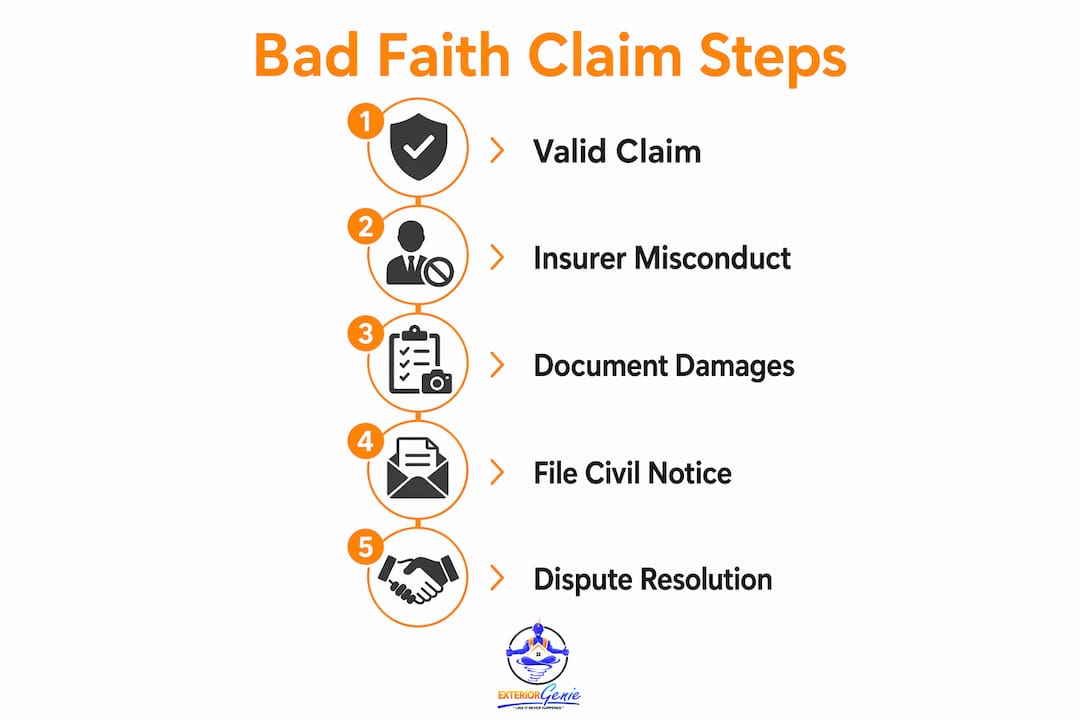
Most states require three elements to prove bad faith. First, you must have a valid, covered claim under your policy. Second, the insurer must have acted unreasonably or unfairly in handling it. Third, you must show financial damages that resulted from that conduct. Coverage must exist first; without an underlying covered loss, bad faith claims fail regardless of how poorly the insurer behaved.
Bad faith is not triggered by a routine denial or a valuation disagreement. Bad faith requires proof of unreasonable, unfair conduct, not just an outcome you disagree with. A low estimate alone does not meet the legal threshold. The insurer's process, not just its conclusion, is what courts examine.
What legal damages can you recover in a bad faith roofing case?
The financial stakes in a bad faith case are significantly higher than a standard claim dispute. Recoverable damages can exceed the original claim by 3–10x, including consequential harm, statutory interest, and penalties ranging from 12%–50%. That multiplier effect is why insurers take formal bad faith notices seriously.
Damages available in a bad faith roofing case typically include:
- Unpaid claim amount plus interest from the date payment was due
- Consequential damages such as interior water damage caused by the insurer's delay
- Statutory penalties ranging from 12%–50% of the unpaid loss, depending on the state
- Attorney's fees awarded when the insurer's conduct triggers statutory bad faith provisions
- Punitive damages in cases of especially egregious or willful insurer misconduct
The difference between a normal dispute and a bad faith claim is the insurer's conduct during the claims process. If an adjuster skips a physical inspection, ignores your documentation, or denies your claim with a form letter citing "wear and tear" without supporting evidence, that conduct can cross into bad faith territory. Courts in 2026 continue to scrutinize insurer investigation quality, not just the final coverage decision.
How do insurers commonly commit bad faith in roofing disputes?
Insurers use several recurring tactics to deny or minimize roofing claims. Recognizing these patterns is the first step toward challenging them effectively.
The most common bad faith practices in roofing claims include:
- Denial without investigation: Rejecting a claim before conducting a physical inspection of the roof
- Classifying storm damage as wear and tear: Labeling hail or wind damage as age-related deterioration to invoke a policy exclusion
- Relying on aerial imagery alone: Using satellite photos instead of sending an adjuster to the property
- Unreasonable delays: Sitting on a claim past statutory deadlines without explanation
- Lowball settlements: Offering repair estimates far below actual contractor costs without justification
Roughly 95% of roof claim denials classify damage as wear and tear, age-related, or the result of insufficient documentation, often without valid basis. That pattern violates Unfair Claims Settlement Practices Acts adopted in most states. The frequency of this tactic tells you it is a deliberate strategy, not an honest mistake.
Anti-concurrent causation clauses add another layer of complexity. These clauses allow insurers to deny claims when both a covered peril, such as a hailstorm, and an excluded peril, such as gradual deterioration, contribute to the damage. The insurer argues the excluded cause voids coverage entirely. Homeowners who can prove the storm caused the specific damage, separate from any pre-existing wear, can neutralize this tactic with the right documentation.
Pro Tip: Request a written explanation for every denial. Insurers are required by law in most states to provide specific reasons. A vague or boilerplate denial letter is itself evidence of bad faith conduct.
What procedural tools help homeowners fight back against bad faith?
State law gives homeowners real leverage when insurers act in bad faith. Two of the most powerful tools are the Civil Remedy Notice in Florida and the 60-day demand letter framework in Georgia.
Civil Remedy Notices and statutory deadlines
Filing a Civil Remedy Notice puts the insurer on a 60-day clock to cure the violation. If the insurer fails to respond or resolve the claim within that window, it opens the door to a full bad faith lawsuit with statutory penalties attached. Florida's SB 2A and Georgia's O.C.G.A. 33-4-6 both create financial consequences that make delay expensive for insurers.
| State | Procedural tool | Deadline | Penalty range |
|---|---|---|---|
| Florida | Civil Remedy Notice (CRN) | 60 days to cure | Statutory damages plus attorney's fees |
| Georgia | 60-day demand letter | 60 days to pay | Full loss plus 50% penalty and attorney's fees |
Statutory penalty thresholds typically range from 12%–50% of the unpaid loss. Georgia law specifically allows recovery of the full loss plus a 50% penalty on top, along with attorney's fees. That combination makes ignoring a demand letter a costly choice for any insurer.
Appraisal clauses as a dispute resolution tool
Most homeowner policies include an appraisal clause. This provision lets both sides hire independent appraisers to evaluate the damage, with an umpire resolving any disagreement. Invoking appraisal does not require proving bad faith, but it forces the insurer to engage with an independent valuation. Proper procedural demands and timely documentation activate enforcement rights that often drive claim resolution before litigation becomes necessary.
Pro Tip: Send all formal notices, including Civil Remedy Notices and demand letters, via certified mail with return receipt. That timestamp becomes critical evidence if the case proceeds to litigation.
How can homeowners build a strong case against a bad faith denial?
Documentation is the foundation of every successful bad faith roofing claim. The stronger your evidence, the harder it is for an insurer to justify a denial or low offer.
Follow these steps to build a record that supports your claim:
- Take date-stamped photos immediately after the storm. Photograph every damaged area from multiple angles. Include wide shots showing the full roof and close-ups of specific impact points, missing shingles, or dented flashing.
- Hire an independent roofing contractor for a written inspection report. This report directly counters the insurer's desk adjuster assessment. Independent contractor reports effectively rebut low-effort insurer investigations that rely on aerial imagery alone.
- Separate storm damage from pre-existing wear. A qualified inspector can document which damage is sudden and event-related versus gradual. Sudden storm damage to aging roofs is covered if the damage results from the storm event, not gradual deterioration. That distinction defeats the wear-and-tear exclusion argument.
- Request the insurer's complete claim file. Most states give you the right to this file. It reveals what investigation the adjuster actually conducted and whether the denial had any factual basis.
- Demand a re-inspection in writing. If the initial adjuster used only aerial imagery, formally request a physical inspection. Document the request and the insurer's response.
- Consult a bad faith attorney before accepting any settlement. An attorney can assess whether the insurer's conduct meets the legal threshold and advise on whether a Civil Remedy Notice or demand letter is appropriate.
Homeowners who provide date-stamped photos and independent reports can overturn denials in more than 70% of contested cases. That reversal rate shows documentation is not just helpful. It is decisive. Learning how to document storm damage correctly from the start prevents the insurer from building a denial around gaps in your evidence.
Pro Tip: Keep a written log of every phone call with your insurer. Record the date, time, representative's name, and what was said. This log becomes a timeline of delay or misconduct if you pursue a bad faith claim.
Key Takeaways
Proving insurance bad faith in roofing requires a valid claim, documented insurer misconduct, and financial damages, and state-specific tools like Civil Remedy Notices give homeowners real leverage to force fair settlements.
| Point | Details |
|---|---|
| Bad faith defined | Insurers commit bad faith by denying, delaying, or underpaying valid claims without reasonable basis. |
| Three legal elements | You must prove a valid claim, unreasonable insurer conduct, and resulting financial damages. |
| Documentation wins cases | Date-stamped photos and independent contractor reports overturn denials in more than 70% of contested cases. |
| State tools create leverage | Florida CRNs and Georgia demand letters trigger 60-day deadlines and penalties of 12%–50% of unpaid losses. |
| Bad faith exceeds normal disputes | Recoverable damages can reach 3–10x the original claim, including penalties, attorney's fees, and consequential losses. |
What I've learned after 25 years of watching insurers work roofing claims
The biggest misconception homeowners carry into a roofing dispute is thinking the insurer is a neutral party. It is not. The adjuster works for the insurance company, and the company's financial interest runs opposite to yours. That is not cynicism. It is the structural reality of the claims process.
What I have seen repeatedly is that homeowners who wait to get help lose ground fast. The insurer builds its file early, and a denial based on aerial imagery becomes harder to overturn once it is locked in. The homeowners who fare best are the ones who treat the claim like a legal matter from day one, not an administrative task.
The wear-and-tear tactic has become more aggressive in 2026. Insurers are leaning harder on anti-concurrent causation language to deny storm claims on roofs that show any age-related wear. The counter to that is a thorough, written inspection from a qualified contractor who can separate event-caused damage from background deterioration. That report is worth more than any amount of phone calls with the claims department.
My honest advice: get an independent roof inspection report before you accept any settlement offer. And if the insurer's conduct looks unreasonable, consult a bad faith attorney before you sign anything. The statutory penalties in states like Florida and Georgia exist precisely because legislators recognized that insurers needed a financial reason to behave fairly.
— Ebben
Exteriorgenie is ready to help when your insurer is not
When a roofing insurance dispute turns into a fight, having the right documentation makes the difference between a reversal and a dead end. Exteriorgenie's HAAG-certified inspectors provide independent roof damage assessments that directly counter insurer denials based on aerial imagery or blanket wear-and-tear classifications.

Exteriorgenie serves homeowners and property managers throughout Lexington, SC with 25 years of roofing experience and a process built around military-grade accountability. From insurance claims assistance to full storm damage repairs, the team documents every detail your insurer needs to see. If repair costs are a concern after a disputed claim, roofing financing options are available to keep your project moving. Call Exteriorgenie before your claim deadline passes.
FAQ
What is insurance bad faith in a roofing claim?
Insurance bad faith in roofing is when an insurer unreasonably denies, delays, or underpays a valid roof damage claim, breaching its duty to deal fairly. It requires proof of unreasonable conduct, not just a denial you disagree with.
How is bad faith different from a normal claim dispute?
A normal dispute involves a disagreement over damage value or coverage interpretation. Bad faith requires evidence that the insurer acted unreasonably or dishonestly, such as denying a claim without any investigation.
What damages can I recover in a bad faith roofing case?
You can recover the unpaid claim amount, consequential damages, statutory penalties of 12%–50%, attorney's fees, and in serious cases, punitive damages. Total recovery can reach 3–10x the original claim value.
What should I do if my roofing claim is denied?
Request a written denial reason, hire an independent contractor for an inspection report, and consult a bad faith attorney. In Florida and Georgia, filing a formal notice triggers statutory deadlines that pressure insurers to resolve the claim. You can also review why insurance denies roof claims to understand the most common denial patterns.
Does an old roof disqualify me from a storm damage claim?
No. Sudden storm damage to aging roofs is covered when the damage results from the storm event rather than gradual deterioration. Proper documentation separating storm damage from pre-existing wear defeats the wear-and-tear exclusion argument.