

Insurance restoration roofing is the process of repairing or replacing a damaged roof using funds provided by your homeowner's insurance policy after a covered loss event. The industry term for this work is "insurance-funded roof restoration," and it applies whenever wind, hail, or storm damage triggers a claim under a standard homeowner's policy. Unlike a simple repair call to a contractor, insurance restoration roofing involves damage documentation, insurance adjuster inspections, Actual Cash Value (ACV) or Replacement Cost Value (RCV) payment structures, and a formal claims process that can span weeks. Understanding how this works before damage hits your home puts you in a far stronger position to recover the full value of your roof.
What is insurance restoration roofing and how does it work?
Insurance restoration roofing is defined as the complete process of restoring a roof to its pre-loss condition using insurance claim proceeds. The process begins the moment damage occurs and ends when your insurer releases the final payment after verified completion of the work. Most homeowners encounter this process after a major storm, but it applies to any covered peril including fire, falling objects, or ice damming.
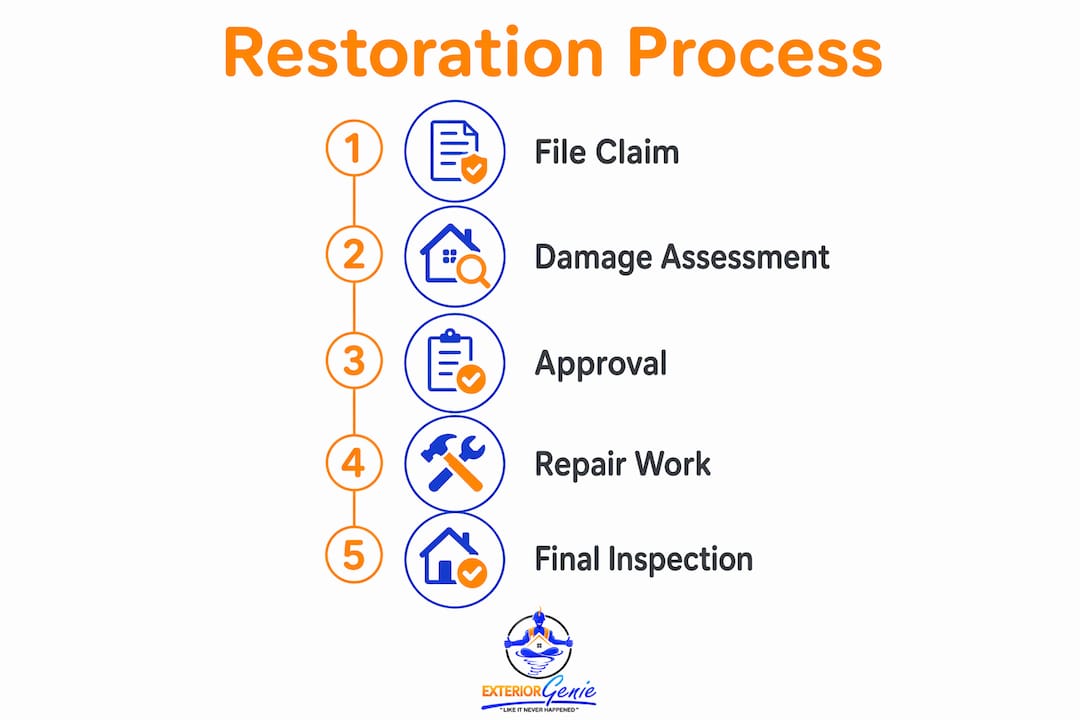
The roof restoration process follows a predictable sequence. First, you file a claim with your insurance carrier and document the damage with photos, videos, and written notes. Second, the insurer sends an adjuster to inspect the roof and produce an estimate, typically using software like Xactimate to price the scope of work. Third, you receive an initial payment based on ACV, which is the replacement cost minus depreciation. Fourth, a licensed roofing contractor completes the restoration work. Fifth, you submit the final invoice to your insurer to receive the recoverable depreciation, bringing your total payout up to RCV.

The claim timeline runs between 30 and 120 days from filing to final payment, depending on claim complexity, adjuster availability, and contractor scheduling. Simple wind damage claims on newer roofs tend to close faster. Hail claims involving full replacement on older roofs, or claims with disputed scope, push toward the longer end of that range.
Pro Tip: Document damage within 24 hours of a storm event. Time-stamped photos tied to a specific weather event are among the strongest evidence you can submit with an insurance roofing claim.
How does insurance restoration differ from a simple roof repair?
The distinction between insurance restoration and repair is not just about scale. Restoration goes beyond repair by including mitigation, comprehensive damage assessment, moisture mapping, and code compliance work that a standard repair call never touches. A repair patches a specific problem. Restoration returns the entire affected system to its pre-loss condition.
Insurance carriers expect restoration work to meet specific standards. When a storm damages 30% or more of a roof's surface, most policies require full replacement rather than spot repairs. Code compliance items such as drip edge installation, ice and water shield in valleys, and updated ventilation are often required by local building codes and must be included in the restoration scope, even if the original roof lacked them.
The table below summarizes the key differences between insurance restoration and standard repair:
| Aspect | Insurance restoration | Standard repair |
|---|---|---|
| Scope | Returns roof to pre-loss condition | Fixes a specific defect or leak |
| Insurance involvement | Required; adjuster-reviewed scope | Typically not involved |
| Code compliance | Required by building permit | Not always addressed |
| Documentation | Detailed; photos, Xactimate scope | Minimal |
| Timeline | 30 to 120 days | Days to one week |
| Goal | Full structural recovery | Stop immediate damage |
Pro Tip: Ask your contractor to review replacement vs. repair criteria before accepting any adjuster scope. Contractors with insurance restoration experience often identify covered items the adjuster missed.
Prompt mitigation after damage is also a legal obligation under most homeowner's policies. Placing tarps, removing debris, and preventing water intrusion are not optional steps. Failing to act quickly can give your insurer grounds to deny coverage for secondary damage that develops after the initial event.
What challenges come up during insurance restoration roofing claims?
Claim denials and underpayments are the most common obstacles homeowners face in the insurance restoration roofing process. Insurers deny roofing claims most often due to insufficient documentation, misclassification of damage as cosmetic rather than structural, or disputes over whether the damage was caused by a covered peril versus pre-existing wear and tear.
The strongest claims clearly document sudden, accidental damage caused by a covered peril rather than gradual deterioration. This distinction matters enormously. A hail strike that fractures shingles is a covered event. Shingles that have been slowly degrading for a decade are not. Adjusters are trained to identify the difference, and their initial scope often reflects the most conservative interpretation of the damage.
Common items that get left out of initial adjuster scopes include:
- Drip edge replacement (required by most current building codes)
- Ice and water shield in valleys and around penetrations
- Pipe boot replacements and flashing upgrades
- Starter strip shingles and ridge cap materials
- Permit fees and disposal costs
Supplements are the standard tool for correcting these omissions. A supplement is a formal addition to the claim scope that adds missing line items, corrects underpriced materials, or includes code-required work the adjuster did not capture. Supplements are routine in insurance restoration roofing and are not adversarial. They are simply the mechanism for aligning the adjuster's scope with the actual cost of restoring the roof to code.
When a denial is based on policy coverage rather than documentation, the path forward changes. Policy coverage denials require the involvement of a public adjuster or an insurance attorney, not just additional photos. Public adjusters work on a percentage of the final settlement and have the authority to negotiate directly with the insurer on your behalf.
Pro Tip: Never accept the first adjuster estimate as final. Homeowners who understand when to submit supplements after a denial consistently recover more money from their insurance than those who accept the initial offer.
How does insurance typically cover roofing restoration costs?
How insurance covers roofing restoration depends primarily on whether your policy pays ACV or RCV. ACV policies pay the depreciated value of your roof at the time of loss. RCV policies pay the full cost to replace the damaged roof with materials of like kind and quality, regardless of the roof's age.
The payment structure works in two stages. Your insurer releases an initial advance based on ACV after the adjuster's inspection. This check often arrives within two to three weeks of the inspection. Once your contractor completes the work and submits a final invoice, the insurer releases the recoverable depreciation, which is the difference between ACV and RCV. On a 15-year-old roof, that gap can represent thousands of dollars.
Your deductible comes directly off the top of the claim payout. If your deductible is $2,500 and your adjuster's scope totals $18,000, your insurer pays $15,500 before depreciation. The average wind and hail claim in 2026 runs approximately $14,747, which means deductibles represent a meaningful share of the total payout for most homeowners. Planning for that out-of-pocket cost before the storm season is a practical financial step.
| Payment type | When it is paid | What it covers |
|---|---|---|
| ACV advance | After adjuster inspection | Depreciated value of damaged materials |
| Recoverable depreciation | After verified completion | Gap between ACV and full replacement cost |
| Supplement payment | After scope revision | Added items, code upgrades, missed materials |
| Deductible | Paid by homeowner | First portion of any claim |
Roughly 1 in 36 insured homes files a wind or hail claim each year. That frequency means most homeowners will navigate this process at least once during their time in a home, making it worth understanding before you need it.
Key takeaways
Insurance restoration roofing requires documentation, prompt mitigation, and an understanding of ACV versus RCV payment structures to recover the full value of a covered roof loss.
| Point | Details |
|---|---|
| Define the process early | Insurance restoration roofing returns a roof to pre-loss condition using insurance claim proceeds, not just patch repairs. |
| Know your payment structure | ACV policies pay depreciated value; RCV policies pay full replacement cost after verified completion. |
| Supplements correct underpayments | Missing scope items like drip edge and ice shield can be added through formal supplements after the initial adjuster estimate. |
| Mitigation protects your claim | Failing to act quickly after damage can give your insurer grounds to deny coverage for secondary losses. |
| Denials are not final | Documentation-based denials can be reversed with supplements; policy denials require a public adjuster or attorney. |
What I've learned after years of insurance restoration roofing work
The single biggest mistake I see homeowners make is treating the adjuster's first estimate as a finished document. It is not. It is a starting point, and in my experience working alongside HAAG-certified inspectors on storm damage claims across Lexington, SC, the initial scope misses covered items on the majority of jobs. Drip edge, pipe boots, and code-required underlayment upgrades disappear from estimates constantly. Homeowners who do not know to look for these omissions leave real money on the table.
The second mistake is waiting too long to act after a storm. I have watched claims get complicated because a homeowner delayed tarping a damaged section, and water intrusion spread into the decking and attic. Your insurer will argue that secondary damage is your responsibility if you did not mitigate promptly. A temporary repair placed within 24 to 48 hours of a storm is not just good practice. It is claim protection.
My honest advice: work with a contractor who has direct experience with insurance restoration roofing, not just general roofing. The difference in outcome between a contractor who understands Xactimate pricing and supplement strategy versus one who does not is often thousands of dollars in your final settlement. Ask any contractor you consider hiring how they handle scope discrepancies with adjusters. The answer tells you everything you need to know about their experience level.
— Ebben
How Exteriorgenie helps homeowners with insurance restoration roofing

Exteriorgenie is a veteran-owned roofing company based in Lexington, SC, with 25 years of experience in insurance restoration roofing for both residential and commercial properties. Their HAAG-certified inspectors document storm, wind, and hail damage to the standard insurance carriers require, and their team provides hands-on assistance through every stage of the claims process. From the initial roof insurance claim filing to supplement negotiations and final invoice submission, Exteriorgenie handles the complexity so you do not have to. If your roof has sustained storm damage in the Lexington area, contact Exteriorgenie for a free inspection and find out exactly what your policy should cover.
FAQ
What is insurance restoration roofing?
Insurance restoration roofing is the process of repairing or replacing a roof to its pre-loss condition using homeowner's insurance claim proceeds after a covered damage event such as wind, hail, or storm damage.
How long does an insurance roofing claim take?
The typical insurance roofing claim takes between 30 and 120 days from filing to final payment, depending on claim complexity and contractor scheduling.
What is the difference between ACV and RCV in a roof claim?
ACV (Actual Cash Value) pays the depreciated value of your roof at the time of loss, while RCV (Replacement Cost Value) pays the full cost to replace the damaged roof. RCV policies release the recoverable depreciation only after the restoration work is verified as complete.
Why do insurance companies deny roofing claims?
Insurers most often deny roofing claims due to insufficient documentation, damage classified as cosmetic rather than structural, or disputes over whether the damage resulted from a covered peril versus pre-existing wear and tear.
What is a supplement in an insurance roofing claim?
A supplement is a formal addition to the claim scope that corrects missing line items, underpriced materials, or code-required work the adjuster did not include. Supplements are a routine part of insurance restoration roofing and can reverse partial denials or underpayments.