

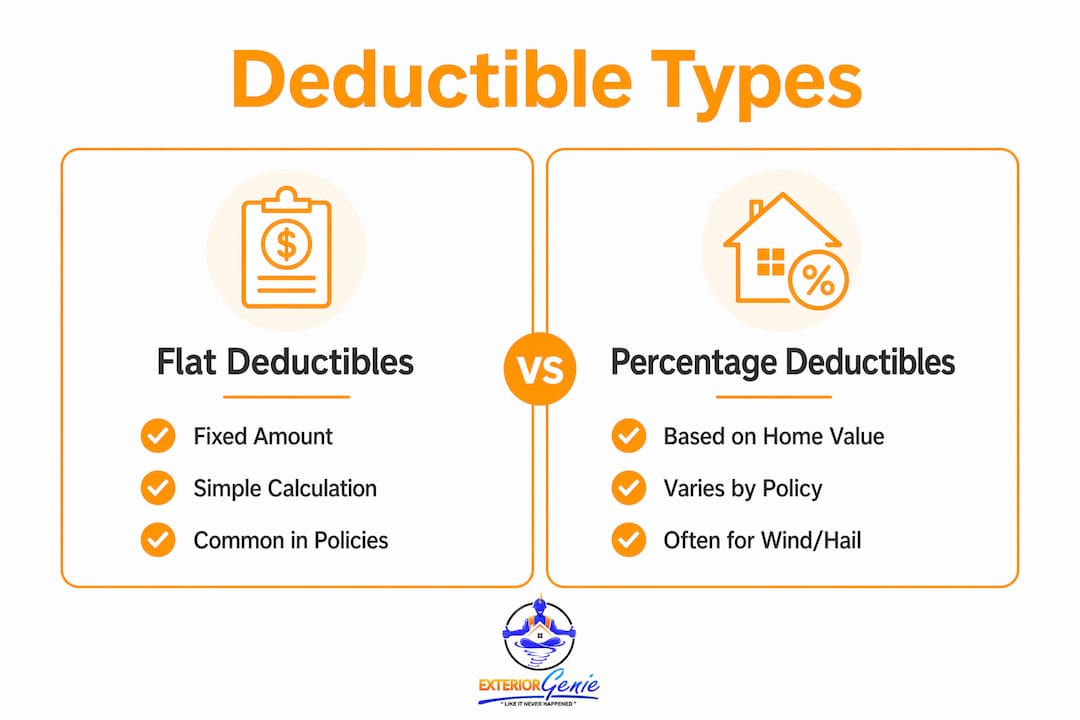
A roofing insurance claim deductible is the specific dollar amount you pay out of pocket before your insurer covers any roof repair or replacement costs. Most homeowners don't realize their deductible can take two very different forms: a flat dollar amount like $1,000 or a percentage of your home's insured value. A 2% deductible on a $400,000 home means you owe $8,000 before your insurer writes a single check. Knowing your deductible type before storm damage hits is the difference between a manageable repair bill and a financial shock.
What is an insurance claim deductible for roofing?
A roofing deductible is the portion of a covered loss you absorb before your insurance policy pays out. According to State Farm, deductibles reduce claim payments and can be structured as a fixed dollar amount or a percentage of your Coverage A (dwelling coverage) value. The industry standard terms are "flat deductible" and "percentage deductible," and understanding which one your policy uses changes everything about how you plan for a claim.
Flat deductibles are straightforward. If your policy carries a $1,000 flat deductible and your roof replacement costs $12,000, your insurer pays $11,000. Percentage deductibles work differently. They calculate your out-of-pocket share based on your home's insured value, not the repair cost. That same $12,000 roof job on a $300,000 home with a 2% deductible leaves you paying $6,000 out of pocket regardless of the repair total.

Many policies also carry a separate wind and hail deductible that applies specifically to storm-related roof damage. This is the deductible most homeowners in storm-prone states like South Carolina and Texas encounter after a major weather event. The Texas Department of Insurance confirms that wind/hail deductibles are commonly set between 1% and 2% of home value, which can dramatically increase what you owe compared to a standard flat deductible.
How do deductibles affect your roofing insurance claim payout?
Your deductible is subtracted directly from the insurer's payment before you receive any money. The type of policy you hold, Actual Cash Value or Replacement Cost Value, determines how much that subtraction actually hurts.
Actual Cash Value (ACV) policies depreciate your roof based on age and condition before calculating the payout. A 15-year-old roof with a 20-year expected lifespan may have lost roughly 75% of its value in depreciation. Your insurer then subtracts your deductible from that already-reduced number. On a $15,000 replacement, the depreciated value might be $3,750. Subtract a $1,000 deductible and you receive $2,750. You cover the remaining $12,250 yourself.
Replacement Cost Value (RCV) policies are more generous but work in two steps. Your insurer first sends an initial check for the depreciated value minus your deductible. Once repairs are complete, they release the "recoverable depreciation," which is the withheld portion that brings your payment up to the full replacement cost. The Texas Department of Insurance explains that RCV policies pay in two steps: an upfront ACV check and a final reimbursement after the work is done.
Here is a side-by-side comparison of how deductible impact differs between policy types:
| Scenario | ACV Policy | RCV Policy |
|---|---|---|
| Roof replacement cost | $15,000 | $15,000 |
| Depreciation applied | $11,250 (75%) | $0 after completion |
| Deductible | $1,000 | $1,000 |
| Initial insurer payment | $2,750 | $5,000 (ACV minus deductible) |
| Final insurer payment | None | $10,000 (recoverable depreciation) |
| Your total out-of-pocket | $12,250 | $1,000 |
One common misconception is that you pay your deductible directly to your insurance company. You don't. You pay it to your roofing contractor. The insurer simply deducts it from their payment, and you cover the gap.
Pro Tip: Compare the adjuster's approved damage scope with your contractor's detailed estimate before signing any release. This protects you from having the deductible applied incorrectly or missing covered damage.
What policy details should you check before filing a roof claim?
Your insurance declarations page is the single most important document you own when roof damage occurs. It lists your deductible type, amount, and any special conditions that apply to wind or hail events. Reviewing it before you call your insurer prevents surprises and helps you decide whether filing a claim even makes financial sense.
Here is what to look for on your declarations page:
- Deductible type: Flat dollar or percentage-based. If percentage, note the base value used (Coverage A or total insured value).
- Separate wind/hail deductible: Many policies list a standard deductible for most claims and a higher, separate deductible for wind and hail. Knowing which applies to your damage is critical.
- Deductible stacking risk: Some policies apply multiple deductibles when damage falls under more than one classification. A wind event that also causes water intrusion could trigger both a wind/hail deductible and an all-perils deductible, increasing your costs unexpectedly.
- Claim filing deadlines: Most policies require you to file claims promptly, typically within 90 days to one year of the damage event. Missing this window can result in denial.
- Roof age and coverage type: Older roofs are more likely to be covered under ACV terms, which means depreciation will reduce your payout significantly before the deductible is even applied.
Pro Tip: If your policy has a percentage-based wind/hail deductible, calculate your exact out-of-pocket amount before filing. If the deductible exceeds the repair cost, filing the claim may raise your premium without any financial benefit.
Understanding whether wind and hail have a separate deductible is one of the most overlooked steps in the claims process. Homeowners who skip this check often discover mid-claim that their out-of-pocket costs are two or three times what they expected.
Can contractors pay or waive your roofing deductible?
No. Contractors paying or waiving your deductible is illegal in many states and constitutes insurance fraud. Texas Insurance Code Section 27.02 makes this explicit: waiving deductibles is illegal for contractors, with violations carrying fines and license revocation. South Carolina and most other states carry similar prohibitions.
The reason insurance companies require you to pay your deductible is structural. The deductible is your financial stake in the claim. It discourages frivolous claims and keeps premiums lower for everyone. When a contractor absorbs your deductible, they typically inflate the invoice to your insurer to recover the cost. That is fraud, and your insurer can deny the entire claim if they discover it.
The Texas Department of Insurance reinforces this point: deductible waivers by contractors can result in fines or loss of contractor licensing, and homeowners who accept these offers face their own legal exposure.
"If a contractor offers to waive your deductible or says they'll 'work it into the bid,' walk away. That offer is not a deal. It is a liability."
What you should do if a contractor makes this offer:
- Decline immediately and document the conversation.
- Report the offer to your state's department of insurance.
- Find a licensed contractor who operates transparently.
- Verify contractor credentials through your state's licensing board before signing any contract.
How to prepare and manage your deductible during the claims process
Managing your roofing deductible well starts before you ever call your insurer. The steps you take in the first 48 hours after damage occurs directly affect how smoothly your claim moves and how accurately your deductible is applied.
- Document the damage immediately. Take dated photos and video of every affected area, including interior water damage if present. Thorough documentation prevents disputes about what was covered and when.
- Review your declarations page. Confirm your deductible type and amount before contacting your insurer. Know whether a separate wind/hail deductible applies.
- Request a HAAG-certified inspection. A certified inspector produces a detailed damage report that aligns with insurer standards, reducing the chance of underpayment.
- Get a contractor scope of work before the adjuster visit. Having an independent contractor assessment gives you a comparison point when the adjuster's estimate arrives. Discrepancies between the two are common and negotiable.
- Understand the two-check process for RCV policies. Do not spend the first check assuming it covers everything. The second check arrives after repairs are complete and verified.
- Balance your deductible choice for future policies. Choosing a higher deductible lowers premiums but increases your cost at claim time. Homeowners with newer roofs and strong emergency savings can often absorb a higher deductible. Those with older roofs or tighter budgets benefit from lower deductibles despite the higher premium.
Pro Tip: Ask your insurer to walk you through the deductible calculation in writing before repairs begin. A written explanation prevents misunderstandings about what you owe and what they will pay.
Working with a reputable contractor who understands the insurance claims process is not optional. The right contractor helps you identify all covered damage, ensures the scope matches the adjuster's report, and guides you through the two-payment process without shortcuts.
Key takeaways
Your roofing insurance deductible is the out-of-pocket amount subtracted from every claim payment, and its type, flat or percentage, determines how much you actually owe after storm damage.
| Point | Details |
|---|---|
| Deductible types matter | Flat deductibles are fixed amounts; percentage deductibles scale with your home's insured value. |
| ACV vs. RCV changes everything | RCV policies reimburse full replacement cost minus deductible; ACV policies apply depreciation first. |
| Wind/hail deductibles are separate | Storm damage often triggers a higher, separate deductible not visible in your standard policy summary. |
| Contractor waivers are illegal | Accepting a deductible waiver from a contractor constitutes insurance fraud in most states. |
| Document before you file | Dated photos, contractor scopes, and a declarations page review protect your payout and deductible accuracy. |
What I've learned after 25 years of roofing claims in the South
Most homeowners I talk to after a storm have no idea what their deductible actually is until the adjuster's check arrives. That gap between expectation and reality is where the real stress lives. The number one mistake I see is homeowners assuming their deductible is the flat $1,000 they vaguely remember from signing their policy, when in fact they have a 2% wind/hail deductible that kicks in for exactly the kind of storm that just hit their roof.
The second mistake is waiting. Policies have filing windows, and storm seasons in South Carolina are not forgiving. I have seen homeowners lose valid claims because they waited three months to call their insurer, thinking the damage was minor. By the time they got a contractor out, the window had closed or secondary damage had muddied the original cause.
My honest advice: pull your declarations page out today, before anything happens to your roof. Know your deductible type. Know whether wind and hail carry a separate deductible. Know your filing deadline. That 15 minutes of reading will save you thousands of dollars and weeks of frustration when you actually need to file. And when you do file, work with a contractor who has done this before, someone who knows how to determine repair versus replacement and can back up every line item in the scope.
— Ebben
Get expert roofing and claims help in Lexington, SC

Exteriorgenie is a veteran-owned roofing company serving homeowners in Lexington, SC, with 25 years of experience handling storm damage, insurance claims, and deductible guidance. Their HAAG-certified inspectors document damage to insurer standards, and their team walks you through every step of the insurance claims process so your deductible is applied correctly and your payout reflects the full scope of covered damage. Whether you need emergency repairs after a storm or a full roof replacement, Exteriorgenie brings military-grade discipline and transparent pricing to every job. Contact them today to get a certified inspection and a clear picture of what your claim is worth.
FAQ
What is a roofing insurance deductible?
A roofing insurance deductible is the amount you pay out of pocket before your insurer covers the remaining cost of a roof repair or replacement. It can be a flat dollar amount or a percentage of your home's insured value.
How does a percentage deductible work on a roof claim?
A percentage deductible is calculated based on your home's Coverage A value, not the repair cost. A 2% deductible on a $400,000 home means you owe $8,000 before your insurer pays anything toward the claim.
Does my deductible apply differently for wind and hail damage?
Many policies carry a separate, higher deductible specifically for wind and hail events. This deductible applies instead of your standard deductible when storm damage is the cause of your roof claim.
Can a roofing contractor pay my deductible for me?
No. Contractors paying or waiving deductibles is illegal in most states and classified as insurance fraud. Texas Insurance Code Section 27.02 specifically prohibits this practice, and homeowners who accept such offers risk claim denial and legal liability.
What is the difference between ACV and RCV for roof claims?
Actual Cash Value policies depreciate your roof before calculating the payout, resulting in a smaller check. Replacement Cost Value policies reimburse the full replacement cost minus your deductible, typically paid in two installments once repairs are complete.