
A roofing contractor contract is a legally binding agreement that defines every detail of your new roof installation, from materials and labor to warranties and payment terms. Skipping a thorough new roof contractor contract review is one of the most expensive mistakes homeowners make. A legitimate roofing estimate runs 4–8 pages and covers roughly 10 itemized sections, including scope of work, materials, labor, permits, decking allowances, and warranties. Anything shorter is a warning sign. This guide walks you through every clause that belongs in a quality roofing contract, how to verify contractor credentials, and what red flags to reject before you sign.
What key elements should you expect in a new roof contractor contract?
A professional roofing contract is not a one-page summary. It is a detailed document that protects you if anything goes wrong during or after the project.
Scope of work
The scope section must describe every physical step of the job. That includes tear-off of existing shingles, disposal of old materials, installation sequence, and final cleanup. Vague language like "install new roof" gives the contractor room to cut corners without technically breaching the agreement.

Materials and specifications
The contract must name the exact manufacturer, product line, color, and weight of every material used. Shingles, underlayment, ice and water shield, ridge cap, and starter strips all need to be listed by brand and specification. A roofing contract breakdown that only says "architectural shingles" is not specific enough to hold a contractor accountable.
Labor costs and breakdown
Labor typically represents 50–70% of total roofing costs. That percentage reflects a long list of tasks most homeowners never see: tear-off, haul-away, flashing installation, valley work, ridge ventilation, and final cleanup. Your contract must break labor into line items so you can see exactly what you are paying for and dispute any surprise charges.
Payment schedule
The contract must tie every payment to a verified milestone, not a calendar date. Standard practice is a deposit of 10–25%, with the remaining balance due after the job passes municipal inspection. Deposits over 30% are an industry red flag and a common indicator of fraud.
Permits and inspections
The contract must state who pulls the permit and who is responsible for scheduling inspections. In most jurisdictions, the contractor carries this responsibility. If the contract leaves this blank or assigns it to you, ask for a written amendment before signing.
Warranties
Two separate warranties belong in every roofing contract. The workmanship warranty covers the contractor's installation quality, typically for 2–10 years. The manufacturer warranty covers the materials themselves, often for 25–50 years. Enhanced manufacturer warranties require factory-certified installers and timely post-installation registration. If your contractor is not certified, you may not qualify for the enhanced coverage even if the shingles are installed correctly.
Decking replacement allowance
Damaged decking is discovered only after tear-off. Your contract must define a fixed per-sheet price for any replacement required. Typical decking replacement costs run $80–$120 per sheet. Without a written allowance, a contractor can charge whatever they want once the old shingles are off.
Pro Tip: Ask the contractor to include a maximum decking replacement cap in writing. This protects you from open-ended charges if the decking damage turns out to be extensive.
| Contract Element | What to Verify |
|---|---|
| Scope of work | Tear-off, disposal, installation steps all listed |
| Materials | Manufacturer, product line, and specs named |
| Labor breakdown | Line-item detail for each labor task |
| Payment schedule | Milestone-based, deposit under 30% |
| Permits | Contractor responsibility stated explicitly |
| Warranties | Both workmanship and manufacturer terms included |
| Decking allowance | Fixed per-sheet price defined |
How to verify the contractor's credentials and insurance
Accepting a contractor's word on licensing and insurance is not enough. You need written proof in the contract and independent verification.
-
Look up the license number. Every state maintains a public contractor license database. Search the contractor's license number before signing anything. In states like Minnesota, Statute 326B.805 mandates this verification step. Most other states have equivalent requirements. If the number does not appear in the database, walk away.
-
Request a Certificate of Insurance. The contract must list the contractor's General Liability and Workers' Compensation policy numbers. Then call the insurer directly to confirm those policies are active. A certificate can be outdated or forged. A phone call takes two minutes and eliminates that risk.
-
Confirm Workers' Compensation coverage. If a worker is injured on your property and the contractor lacks Workers' Compensation insurance, you can be held liable. This is not a technicality. It is a real financial exposure that homeowners face every year.
-
Watch for illegal clauses. Some jurisdictions prohibit contractors from waiving insurance deductibles as a sales incentive. If a contractor offers to cover your deductible in exchange for the job, that clause may be illegal in your state and signals broader ethical problems.
-
Verify HAAG certification or equivalent credentials. Inspectors with HAAG certification are trained to assess storm damage to industry standards. Exteriorgenie's HAAG-certified inspectors bring that level of rigor to every project assessment, which matters when insurance claims are involved.
Pro Tip: Ask for a contractor vetting checklist before your first meeting. Having a written list of required documents forces the conversation early and filters out unqualified contractors fast.
What red flags should you watch for in a roofing contract?
Most contract problems are visible before you sign. You just need to know what to look for.
- One-line total quotes. A number without itemization is not a contract. A one-line price is not an estimate. It is a number. It gives you no basis for comparison and no protection if the contractor cuts scope.
- Vague material descriptions. "Architectural shingles" without a manufacturer name or product line means the contractor can install the cheapest option available and still claim they delivered what was promised.
- "As needed" decking language. This phrase gives the contractor unlimited authority to charge for decking replacement at whatever price they choose after tear-off.
- Excessive upfront deposits. Asking for more than 30% before work begins is outside industry norms and a common fraud pattern.
- Missing permit details. A contract that does not address permits leaves you exposed to code violations and failed inspections that become your problem to resolve.
- Pressure to sign immediately. Legitimate contractors give you time to review. Pressure tactics are designed to prevent you from reading the fine print.
- Flashing reuse clauses. Reusing existing flashing can void your shingle manufacturer's warranty. The contract must state that all flashing will be replaced with new material.
"Bids that come in 30–40% lower than competitors usually omit critical scope or specify lower-quality components. That gap is not a deal. It is a preview of the disputes and extra charges that follow."
Unlimited price increase clauses are another trap. Some contracts include language that allows the contractor to raise the total price without a formal change order. Reject any clause that does not require your written approval before costs increase.
Step-by-step process for reviewing and negotiating your contract
A structured review process takes less than an hour and can save you thousands of dollars.
-
Read the full contract against the original estimate. Every item on the estimate must appear in the contract. If something is missing, it is not included in the job.
-
Use a checklist. Confirm that scope, materials, labor, warranties, payment schedule, permits, decking allowance, and flashing replacement are all present and specific. The roof replacement process has defined stages, and your contract should mirror them.
-
Ask clarifying questions in writing. Email the contractor your questions so you have a record of their answers. Ask about the specific shingle product, the warranty registration process, and who handles the permit.
-
Negotiate the deposit and change order terms. Push for a deposit at or below 25%. Insist that any change order requires your written signature before work proceeds. This one clause prevents most mid-project disputes.
-
Confirm the final inspection requirement. The contract must state that final payment is due only after the job passes municipal inspection. This protects you from paying for work that does not meet code.
-
Never pay 100% upfront. Final balance is due after passing municipal inspections, not before. Any contractor who demands full payment before completion is not operating within industry standards.
Pro Tip: Compare at least three itemized bids before signing any contract. The comparison reveals which contractors are including full scope and which are cutting corners to win on price.
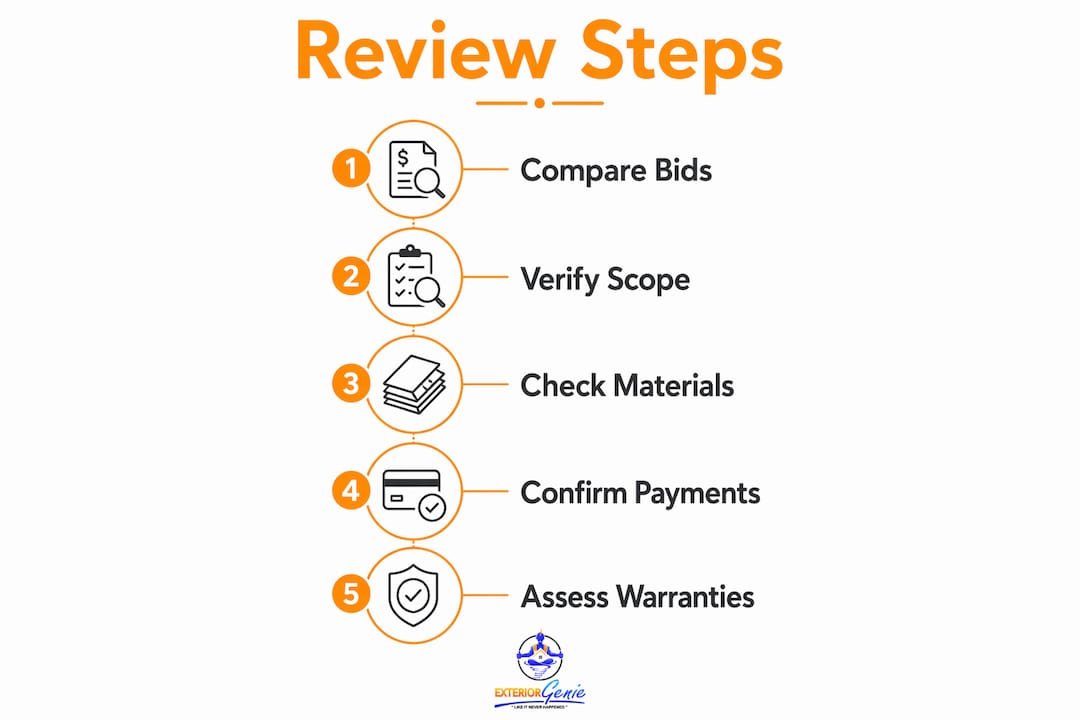
| Review Step | What You Are Protecting Against |
|---|---|
| Compare contract to estimate | Scope reductions or missing items |
| Verify material specs | Substitution of lower-grade products |
| Confirm warranty terms | Gaps in workmanship or manufacturer coverage |
| Negotiate change order clause | Unauthorized cost increases mid-project |
| Require inspection before final payment | Paying for non-compliant work |
Key Takeaways
A thorough roofing contractor agreement review protects your investment by confirming scope, materials, warranties, credentials, and payment terms before a single shingle is removed.
| Point | Details |
|---|---|
| Itemized contract required | Legitimate contracts cover 10 sections across 4–8 pages, not a one-line total. |
| Verify credentials independently | Confirm license numbers in state databases and call insurers to verify active policies. |
| Watch for flashing and decking gaps | Require new flashing and a fixed per-sheet decking price to avoid warranty voids and surprise charges. |
| Cap your deposit | Keep deposits at or below 25% and tie all remaining payments to verified milestones. |
| Distinguish warranty types | Workmanship and manufacturer warranties are separate; both must appear in the contract with registration terms. |
What I have learned from 25 years of roofing contracts
The detail that catches most homeowners off guard is the flashing clause. Homeowners focus on shingles, labor costs, and payment terms. They rarely read the flashing language. But reusing existing flashing can void the shingle manufacturer's warranty entirely. A contractor who reuses flashing saves maybe $300 in materials. You lose decades of warranty coverage. That trade is never worth it.
The second thing I see overlooked constantly is the difference between workmanship and manufacturer warranties. Homeowners assume one covers the other. They do not. If a shingle fails due to a manufacturing defect, the manufacturer warranty applies. If the installation caused the leak, the workmanship warranty applies. Both need to be in the contract, and the manufacturer warranty only activates if the contractor is factory-certified and registers the job on time.
Decking replacement surprises are the most common source of post-project disputes. The fix is simple: get a fixed per-sheet price in writing before the job starts. If the contractor refuses to name a price, that tells you something important about how they handle unexpected costs.
Finally, verifying insurance beyond accepting a certificate is not paranoia. It is basic due diligence. Policies lapse. Certificates get reused. A two-minute call to the insurer confirms what a piece of paper cannot.
— Ebben
Roofing contracts done right with Exteriorgenie
Signing a roofing contract should feel like clarity, not a gamble. Exteriorgenie brings 25 years of experience and military-grade discipline to every project in Lexington, SC, with contracts that itemize every cost, name every material, and spell out both workmanship and manufacturer warranty terms.

Exteriorgenie's HAAG-certified inspectors handle insurance claim documentation, and the team manages permits and inspections so nothing falls through the cracks. If upfront costs are a concern, roofing financing options are available to keep your project moving without financial strain. For residential roofing services backed by transparent contracts and real accountability, contact Exteriorgenie for a consultation today.
FAQ
What should a roofing contract include?
A roofing contract must include scope of work, exact material specifications, a line-item labor breakdown, a milestone-based payment schedule, permit responsibility, and both workmanship and manufacturer warranty terms. Legitimate contracts typically run 4–8 pages.
How much of a deposit is normal for a new roof?
The industry standard deposit is 10–25% of the total project cost. Any deposit over 30% is a red flag and a common indicator of contractor fraud.
Can a contractor reuse existing flashing?
Reusing existing flashing can void your shingle manufacturer's warranty. Your contract must explicitly state that all flashing will be replaced with new material.
How do I verify a roofing contractor's license?
Search the contractor's license number in your state's public contractor database before signing. Most states maintain free online lookup tools, and an unlisted number means the contractor is not legally authorized to work.
What is the difference between a workmanship warranty and a manufacturer warranty?
A workmanship warranty covers installation errors and is provided by the contractor, typically for 2–10 years. A manufacturer warranty covers material defects and can last 25–50 years, but often requires factory-certified installation and timely registration to activate.