

For most residential reroofs in the U.S., synthetic underlayment is the right default. It outperforms asphalt-saturated felt on tear strength, UV tolerance, crew safety, and warranty eligibility, typically at a modest cost premium that pays for itself over the life of the roof. The one mandatory exception: where outside design temperatures reach 0°F or below, or where ice damming is a documented risk, IRC R905.1.2 requires a self-adhering rubberized membrane (ice and water shield) running from the eave edge to at least 24 inches inside the exterior wall line. Exteriorgenie, with 25 years in residential and commercial roofing, specifies underlayment by brand and model on every project, not just by category, because that single detail is what separates a warranty-eligible install from one that isn't.
- Default choice: Synthetic underlayment for most shingle, metal, and tile applications
- Mandatory upgrade: Self-adhering rubberized membrane at eaves, valleys, and penetrations where IRC R905.1.2 applies
- Cost framing: Synthetic runs a small premium over felt but typically represents a minor share of total reroof cost while extending system lifespan
Table of Contents
- How do the three types compare across the decisions that matter?
- When is ice and water shield required by code?
- Does the cost premium for synthetic underlayment actually pay off?
- How do you choose the right underlayment for your project?
- Key Takeaways
- What the underlayment decision actually comes down to
- Exteriorgenie's roofing services in Lexington, SC
- Useful sources and references
How do the three types compare across the decisions that matter?
| Dimension | Felt (15-lb / 30-lb) | Rubberized self-adhered | Synthetic |
|---|---|---|---|
| Upfront cost | Lowest | Highest | Moderate premium over felt |
| Water resistance | Resistant, not waterproof | Fully waterproof | Highly water-resistant |
| Durability / service life | Shorter; can dry out and crack | Long under cover; limited UV life | Longest under cover |
| UV exposure tolerance | Days (15-lb); up to ~1 week (30-lb) | Limited; manufacturer-specific | Weeks to months |
| Slip resistance | Low (especially when wet) | Moderate | High (non-slip coating) |
| Fastening method | Staples or roofing nails | Self-adhering; no mechanical fasteners in field | Cap nails or manufacturer-specified fasteners |
| Code suitability (IRC ice zone) | Does not satisfy R905.1.2 | Required product for R905.1.2 compliance | Does not satisfy R905.1.2 alone |
| Warranty implications | May void top-tier shingle warranties | Required for full coverage in ice zones | Required for most premium warranty tiers |
Synthetic underlayment wins on most practical criteria; felt's only consistent advantage is lower per-square-foot cost. Rubberized membrane wins where waterproofing is the requirement, not just resistance.
Warranty implications are worth spelling out:
- Top-tier manufacturer warranties for asphalt shingles increasingly require synthetic underlayment for the highest coverage levels.
- Underlayment selection directly affects warranty eligibility; felt can disqualify a premium warranty tier even when the shingles themselves are top-grade.
- Documented installation (brand, model, coverage map) is what makes a warranty claim defensible.
When is ice and water shield required by code?
IRC R905.1.2 is the governing standard. The rule is straightforward: where the outside design temperature is 0°F or below, or where there is a documented history of ice damming, a self-adhering polymer-modified bitumen membrane is required. It must run from the eave edge continuously to a point at least 24 inches inside the exterior wall line, measured along the slope.
Code note: On steep-slope roofs, many inspectors and contractors extend coverage to 36 inches along the slope from the eave edge as a practical interpretation of the 24-inch-inside-wall requirement. Verify the local interpretation with your building department before the permit is pulled.
Practical checklist for compliance:
- Confirm your jurisdiction has adopted the 2021 IRC (or a comparable edition) by calling the local building department or checking the permit application.
- Specify "self-adhering polymer-modified bitumen membrane per IRC R905.1.2" in the contract, not just "ice shield."
- Verify coverage extends to valleys, penetrations, and any area with documented water intrusion history, even in warmer climates.
- Request the inspector's sign-off on underlayment before shingles are installed.
Does the cost premium for synthetic underlayment actually pay off?
Underlayment is the secondary water barrier and the line item most commonly downgraded in low bids. The cost difference between felt and synthetic is real but modest relative to total reroof cost, and the performance gap is not modest at all.
- Synthetic underlayment typically costs more per square than 15-lb felt, but underlayment is a small fraction of total reroof cost.
- Felt can dry out, crack, and lose water resistance years before the shingles above it fail, making it the system-limiting component.
- Synthetics hold up better under shingles over the long term and keep the deck protected if a shingle is lost in a storm.
- Premium warranty tiers that require synthetic can add meaningful resale value and reduce out-of-pocket exposure on a future claim.
The math is simple: paying a small premium for synthetic to qualify for a top-tier shingle warranty and extend the service life of the entire roof system is almost always the better financial decision on a full reroof.
How do you choose the right underlayment for your project?
Work through this checklist before accepting any bid:
- Climate: Is your area in a 0°F design-temperature zone or known for ice damming? If yes, self-adhering membrane at eaves and valleys is not optional.
- Slope: Low-slope roofs (below 2:12) may require full-deck self-adhering coverage per IRC R905.2.7.
- Roof covering: Metal panels need high-temp synthetic. Tile may specify #30 felt or a specific synthetic. Shingles work with synthetic or felt, but warranty tiers often require synthetic.
- Warranty requirement: Ask the shingle manufacturer which underlayment products qualify for their top warranty tier before specifying anything.
- Installation window: How long will the deck be exposed between tear-off and shingle installation? Felt's UV tolerance is days; synthetic buys you weeks.
- Budget: Synthetic costs more per square but is a small share of total project cost.
Questions to ask every contractor on a bid:
- Which underlayment brand and product model are you specifying?
- Is ice and water shield included at eaves, valleys, and penetrations?
- What fastening method and exposure limit does that product carry?
- Does this underlayment satisfy my shingle manufacturer's warranty requirements?
Red flags: A bid that says "code-compliant underlayment" with no brand or model named is a substitution risk. "15-lb felt" on a premium shingle job is a warranty disqualifier. No mention of ice shield in a cold-climate project is a code compliance problem.
Pro Tip: Ask for the brand name and product model number in writing before signing. "Synthetic underlayment" in a contract is not a specification. A contractor who won't name the product is leaving the door open to substitute a cheaper sheet mid-job.
Key Takeaways
Synthetic underlayment is the best default for most U.S. residential reroofs, with self-adhering rubberized membrane required by IRC R905.1.2 wherever ice damming risk or 0°F design temperatures apply.
| Point | Details |
|---|---|
| Default to synthetic | Synthetic wins on tear strength, UV tolerance, slip resistance, and warranty eligibility for most residential applications. |
| Peel-and-stick where code demands | IRC R905.1.2 requires self-adhering membrane from the eave edge to 24 inches inside the exterior wall line in ice-risk zones. |
| Specify brand and model | "Synthetic underlayment" in a contract is not a specification; name the product to prevent cheap substitutions. |
| Watch exposure limits | Felt degrades in days; synthetic buys weeks, but every product has a rated limit. Exceed it and you void the protection. |
| Exteriorgenie for local expertise | Exteriorgenie's HAAG-certified team in Lexington, SC specifies underlayment by brand and documents installations for warranty and insurance claims. |
What the underlayment decision actually comes down to
Most articles on this topic treat underlayment as a commodity choice. After 25 years of roofing projects, the pattern is clear: the underlayment decision is where cheap bids hide their savings, and it's the first thing that shows up in a denied warranty claim or a storm-damage dispute.
The shift to synthetic isn't just about performance data. Non-slip coatings on modern synthetics have made steep-slope work meaningfully safer for crews, and that safety factor has accelerated adoption faster than any product comparison chart. When a crew is more confident on the deck, they install more carefully. That's a real downstream benefit that never shows up in a spec sheet.
The rubberized membrane question gets misread constantly. Homeowners in South Carolina often assume ice and water shield doesn't apply to them because the climate is mild. But valleys, penetrations, and low-slope sections can trap water in any climate. Exteriorgenie routinely specifies self-adhering membrane at critical zones even on projects where IRC R905.1.2 isn't strictly triggered, because the cost difference is small and the protection is real.
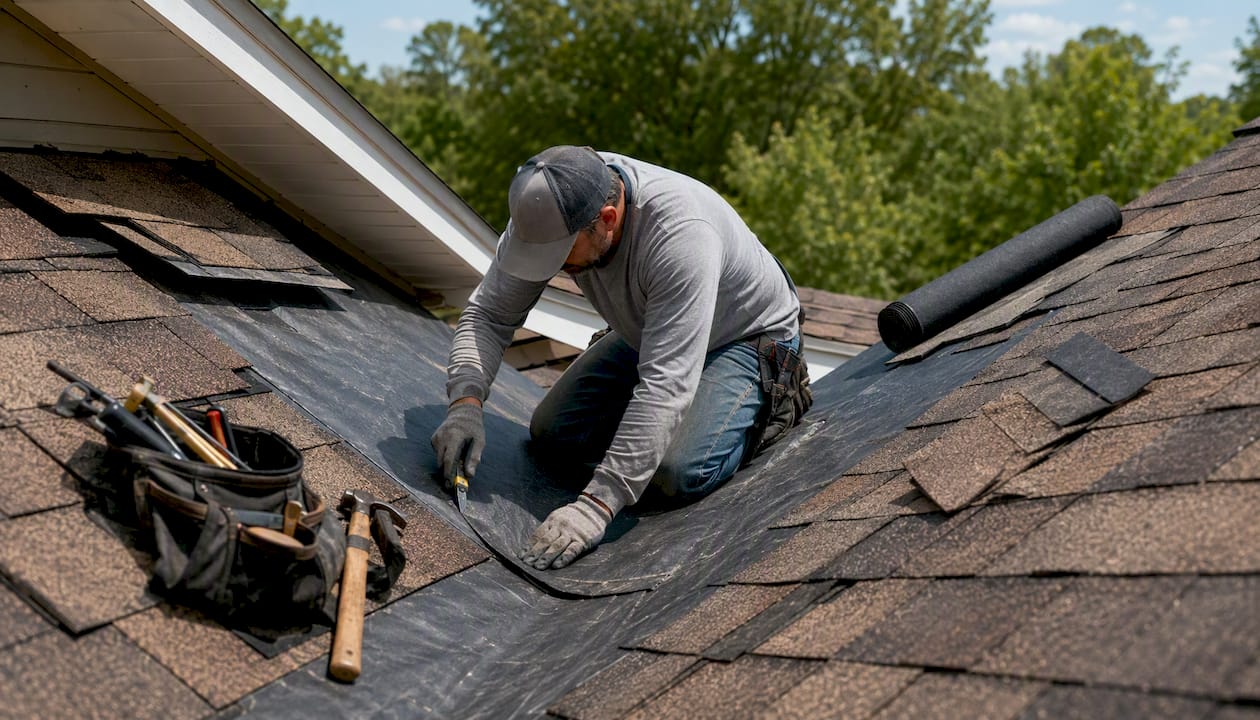
One more thing: the warranty angle is underused by homeowners. A top-tier shingle warranty that requires synthetic underlayment is worth reading before you approve a bid. If the contractor is specifying felt and the shingle manufacturer requires synthetic for the warranty tier you're paying for, you're buying a warranty you can't actually claim.
Exteriorgenie's roofing services in Lexington, SC
Choosing the right underlayment is one decision. Getting it installed correctly, documented for warranty, and backed by a contractor who can handle what comes next is another.
Exteriorgenie serves homeowners and commercial property owners across the Midlands of South Carolina with full roof replacement, storm and wind damage repair, and HAAG-certified insurance claim assistance that covers underlayment specification, coverage mapping, and documentation. Every estimate includes the underlayment brand and model, the coverage zone, and the exposure limit, so you know exactly what's going on your roof and why it qualifies for the warranty you're paying for. If a storm has already compromised your deck or existing underlayment, 24/7 emergency tarping is available to protect the structure until repairs begin. Financing options are available for homeowners upgrading to premium synthetic or full-coverage peel-and-stick systems. Contact Exteriorgenie at (803) 999-7663 or visit exteriorgenie.com to schedule your estimate.
Useful sources and references
The sources below were used in this article and are worth bookmarking for deeper reading on code requirements, product standards, and installation practices.
| Source | Best used for |
|---|---|
| IRC 2021 Chapter 9 — Roof Assemblies | Primary code reference for R905.1.2 ice-and-water shield requirements and slope-driven underlayment rules |
| NACHI — Underlayment Types and Guidance | Inspector-level primer on felt, rubberized asphalt, and synthetic; good for understanding common failure modes |
| The Roofing Brief — Felt vs. Synthetic Comparison | Side-by-side performance comparison across tear strength, UV tolerance, walkability, and cost |
| TMC Roofing — Underlayment Guide | Practical contractor perspective on secondary water barrier function and bid red flags |
| RoofingStuffs — Felt, Synthetic & Ice Shield Guide | Technical detail on ASTM D1970, self-adhering membrane thickness, and low-slope requirements |
| Build-Construct — Underlayment Selection Guide | Application-specific guidance matching underlayment to slope, climate, and finish material |
| National Roofing Authority — Underlayment Types | Overview of IRC and ASTM classification, warranty eligibility, and permit/inspection considerations |