
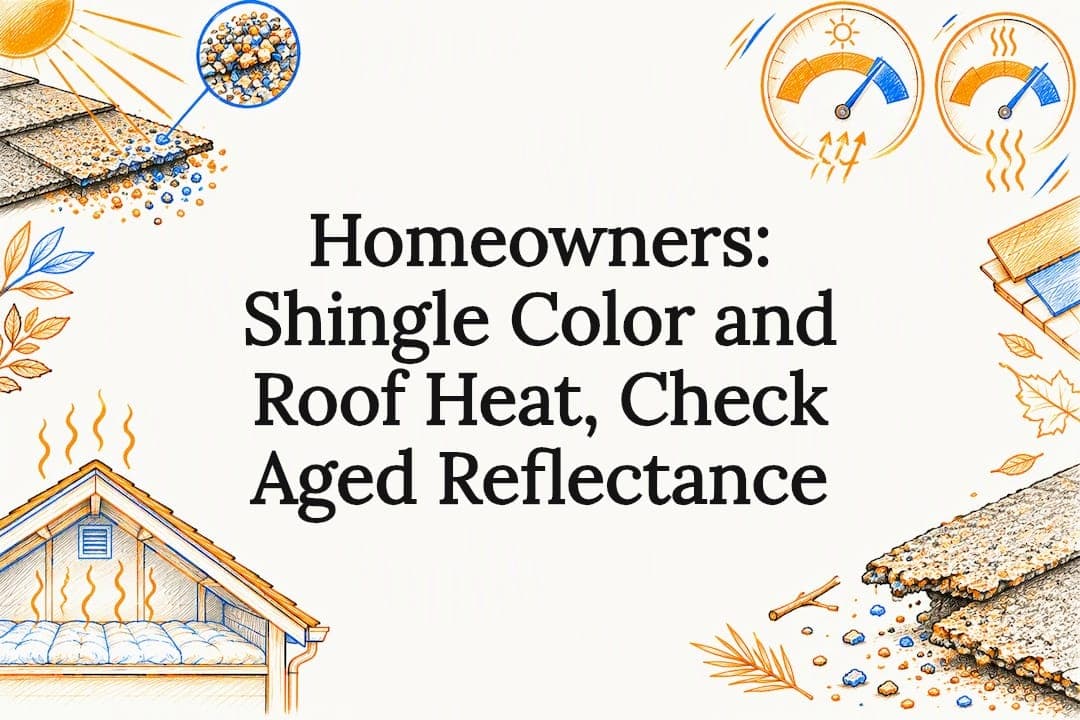
Yes, shingle color affects roof surface and attic heat, but visible color is only a proxy for what actually matters. Solar reflectance and thermal emittance predict indoor impact far better than whether a shingle looks light or dark. How much that translates into cooler rooms depends on your attic insulation, ventilation, and whether you run central air. If you're already replacing a roof, a cool shingle is worth a look. If your roof is sound, color alone isn't a reason to tear it off.
TL;DR:
- Aged solar reflectance and thermal emittance ratings are more reliable indicators of a shingle's cooling performance than visible color, especially as dirt and weathering reduce reflectance over time.
- Field studies show highly reflective roofs keep attic temperatures close to outdoor air, significantly reducing peak indoor temperatures and cooling energy use in hot, sunny climates.
- Proper attic insulation, ventilation, and duct placement have a larger influence on energy savings than shingle color alone, making these factors critical for maximizing roof efficiency.
- Dark-looking shingles engineered with reflective pigments can perform similarly to lighter shingles, emphasizing the importance of ratings over appearance when choosing roofing materials.
- Homeowners should request independent ratings, aging performance data, and attic experience assessments from contractors before selecting shingles for energy efficiency, not just curb appeal.
Table of Contents
- How shingle color and sunlight physics affect roof temperature
- The metrics that actually predict cool performance
- What the field data shows about attic and cooling savings
- When shingle color matters most (and when it barely registers)
- A homeowner's checklist for comparing shingle colors
- How contractors weigh heat performance when recommending shingles
- The real lesson buried under the marketing
- Get a roof assessment that looks past color
- Where to verify the numbers yourself
- Sources
- FAQ
How shingle color and sunlight physics affect roof temperature
Sunlight isn't just what you see. It includes visible light and near-infrared (NIR) radiation, and NIR carries a substantial share of the sun's energy even though your eyes can't detect it. This matters because two shingles that look identical in color can behave very differently on a roof, depending on how much NIR each one reflects versus absorbs.
When a shingle absorbs solar energy, its surface temperature climbs. That heat then conducts through the shingle into the roof sheathing, warming the attic air above the living space. A dark roof under full sun can run considerably hotter than the surrounding air, and that heat load pushes into the attic long after the shingle itself looks merely warm to the touch.
Here's the part most homeowners miss: manufacturers can engineer shingles with spectrally selective pigments and granule blends that reflect more NIR while keeping a dark, traditional look. According to LBNL research, these cool-color pigments let a shingle that reads as "dark brown" or "charcoal" perform closer to a lighter product, because the reflectance that matters most for heat isn't the reflectance your eye picks up. A related look at dark shingle styles that still save energy covers how that engineering shows up in actual product lines.
The metrics that actually predict cool performance
Two numbers matter more than color: solar reflectance and thermal emittance. Solar reflectance measures the fraction of sunlight a surface bounces back, scored from 0 to 1, where higher means more reflected energy and less absorbed heat. Thermal emittance measures how efficiently a surface releases absorbed heat rather than holding onto it. A shingle with high scores on both cools faster and stays cooler under the same sun than one with low scores on either.
According to DOE guidance on cool asphalt shingles, white or cool-colored roofing can reflect up to 90% of incident sunlight, while traditional cool asphalt shingles have historically topped out closer to 0.30 reflectance, with newer formulations targeting around 0.40 for meaningful energy gains.
Always ask for aged ratings, not initial ones. Reflectance drops as a roof weathers and collects dirt and organic growth, so the number on a fresh sample overstates real-world performance. ENERGY STAR and the Cool Roof Rating Council publish aged values alongside initial ones, and manufacturer data sheets should list both.
What the field data shows about attic and cooling savings
Laboratory numbers are one thing. Field data closes the gap between theory and your actual attic. In a Florida comparison, the FSEC field study found that an attic under a standard dark-shingle control reached roughly 40°F above outdoor air at peak, while highly reflective roofing stayed close to ambient temperature.
On the indoor side, the EPA's cool-roofs research reports that cool roofs can lower maximum indoor temperatures in homes without air conditioning by about 1.2 to 3.3 degrees Celsius (2.2 to 5.9°F), and cut peak cooling demand in air-conditioned homes by roughly 11% to 27%. A separate DOE consumer guide puts realistic cooling cost reductions at 5% to 20%, depending heavily on climate and how the rest of the roof assembly is built.

The range is wide because color is one variable among several. Insulation, ventilation, and duct placement all shift where that saved energy actually shows up.
When shingle color matters most (and when it barely registers)
Color has the biggest payoff in hot, sunny climates with long cooling seasons, minimal tree shade, and attics that are under-insulated or poorly ventilated. In that combination, a reflective shingle takes real pressure off the air conditioner.
In cold climates, the calculation flips. A roof that resists solar heat gain in July also resists helpful solar warmth in January, so any summer savings can be partly offset by a winter heating penalty. Homes with efficient furnaces and short cooling seasons see less benefit from chasing reflectance.
A few assembly factors decide how much color effects actually reach your thermostat:
- Attic insulation level determines how much roof heat migrates into living space below.
- Ventilation governs whether hot attic air gets flushed out or trapped against the ceiling.
- Duct location matters because ducts running through a hot attic pick up heat before it reaches your vents.
- Roof pitch and shading change how much direct sun the shingles actually absorb over a day.
A homeowner's checklist for comparing shingle colors
Skip the showroom guesswork and ask for the numbers that actually predict performance. Before signing off on a shingle color for energy reasons, request the following from your contractor or the manufacturer's data sheet:
- Aged solar reflectance and thermal emittance values, not just initial ratings.
- CRRC or ENERGY STAR listing status to confirm the numbers are independently rated.
- Warranty and aging data showing how reflectance holds up over the product's lifespan.
- Installation notes on ventilation and attic sealing, since these affect how much of any reflectance benefit reaches your living space.
When you talk to a roofer, three questions cut through most of the marketing noise: What are the aged reflectance and emittance numbers for this product? Will a cool-color option void or affect the shingle warranty? How will insulation and ventilation be handled as part of this job? Consider using specialized Roofer SEO Services to find trustworthy contractors who can answer these precisely. A guide to residential roofing materials can help you compare how different products handle these trade-offs before you commit.
Pro Tip: Cool-color shingles now come in shades that pass for standard neighborhood colors, so you don't have to choose between curb appeal and reflectance. Ask about maintenance, too. Periodic cleaning helps preserve reflectance as a roof ages.

How contractors weigh heat performance when recommending shingles
Exterior Genie is a roofing contractor with qualified inspectors for storm and insurance evaluations. That background shapes how a roofing recommendation gets made: not by color alone, but by checking roof condition, attic insulation, ventilation, and ductwork alongside a product's aged reflectance and emittance ratings. A shingle can have great specs on paper and still underperform if the attic beneath it is sealed poorly or under-insulated, so the full assembly gets evaluated before color becomes the deciding factor.
The real lesson buried under the marketing
The most overrated piece of advice in this space is "go light to save energy." It's not wrong, but it's incomplete enough to be misleading. Two shingles in the same visual color family can have meaningfully different reflectance and emittance scores, and a poorly ventilated attic can erase whatever benefit a reflective shingle offers. The conventional advice treats color as the lever. It's actually the insulation, ventilation, and duct placement doing most of the work, with shingle spec as a secondary multiplier.
If you take one thing from the research, let it be this: stop shopping by swatch. Ask for aged solar reflectance and thermal emittance numbers before you ask about shade names, then have your attic checked. A cool shingle on a leaky, under-insulated attic is a wasted upgrade. A modest reflectance gain paired with proper ventilation and insulation can outperform a "cool" shingle installed without either.
— Ebben
Get a roof assessment that looks past color
If you're planning a roof replacement anyway, this is the moment to get real numbers instead of guessing by shade. Exterior Genie's residential roofing services include evaluating roof condition, attic insulation, and ventilation alongside the shingle specs that actually predict heat performance, so you're not paying extra for a cool-color product your attic can't take advantage of.

Ask for a CRRC or ENERGY STAR comparison on any shingle you're considering, and request an attic inspection with a written recommendation before you pick a color. If storm damage or an aging roof is part of the decision, Exterior Genie's team can also walk you through insurance claim assistance as part of the same visit. Reach out to schedule an inspection and get a straight answer on whether a cool shingle makes sense for your home.
Where to verify the numbers yourself
For specs and product directories, check ENERGY STAR's cool roofs page and the Cool Roof Rating Council. For the underlying research, the DOE's cool asphalt shingle overview, EPA's cool-roofs findings, and FSEC's field study cover measured attic and cooling-energy effects. A savings calculator like roofcalc can help estimate payback for your specific climate before you commit to a product.
Sources
- Cool asphalt shingles (DOE)
- Using cool roofs to reduce heat islands (EPA)
- FSEC field study on roofing (Florida Solar Energy Center)
- Cool color roofing materials (LBNL)
FAQ
Does shingle color affect heat?
Yes, shingle color affects how much solar energy a roof absorbs, which changes surface and attic temperatures. The better predictors are a shingle's solar reflectance and thermal emittance, since two similarly colored shingles can perform very differently based on those ratings.
What color shingles are best for hot weather?
Lighter and cool-colored shingles with high aged solar reflectance and thermal emittance perform best in hot, sunny climates. Cool-color pigments now let dark-looking shingles reach improved reflectance too, so check the rated specs rather than judging by shade alone.
What roof color absorbs the least heat?
White and other highly reflective roofing absorbs the least solar heat, since it reflects the largest share of incoming sunlight. In field testing, highly reflective roofs stayed close to outdoor air temperature while a standard dark-shingle control ran roughly 40°F hotter in the attic.
Do lighter-colored shingles save energy?
Lighter and cool-rated shingles can reduce cooling costs, with the EPA reporting peak cooling demand reductions of roughly 11% to 27% in air-conditioned homes. The actual savings on your bill depend on your climate, attic insulation, and ventilation as much as the shingle itself.