
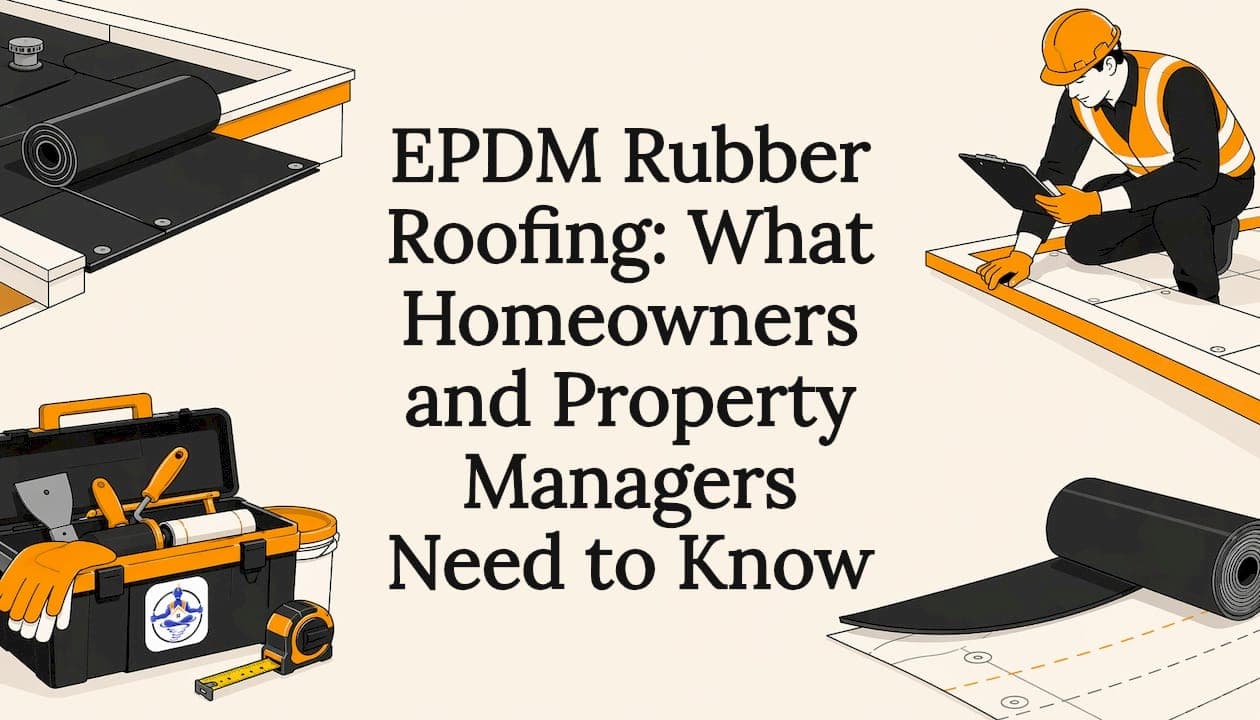
EPDM rubber roofing is a synthetic, cross-linked rubber membrane made from ethylene, propylene, and a diene monomer, installed on low-slope and flat roofs as a continuous waterproofing layer. It has been used commercially for more than six decades, and roughly 25–30% of the low-slope commercial roofing market in the U.S. relies on it.
A few quick facts before you read further:
- Thickness options: multiple standard thickness grades — thicker membranes offer better puncture resistance
- Colors: black, white, and gray; reflective options are available for warmer climates
- Typical service life: routinely 38–50+ years when properly installed and maintained, with laboratory projections exceeding 70 years under normal operating conditions
- Seam method: adhesive and primer-based, not heat-welded — which makes field repairs far simpler
- Best fit: low-slope roofs on commercial buildings, garages, and accessory structures, especially in cooler climates
If your building has a flat or low-slope roof and you're weighing options, EPDM is worth a serious look — particularly if repairability, long service life, and lifecycle cost matter more to you than aesthetics.
Table of Contents
- What EPDM rubber roofing is made of and why it behaves differently
- Where EPDM is commonly used and which buildings it suits best
- Advantages and disadvantages of EPDM roofing
- How EPDM is installed: three methods and when each fits
- How long does EPDM last and what warranties cover
- Routine maintenance and how EPDM repairs work
- Typical installed cost and how EPDM compares to TPO and PVC
- Why installation quality matters more than material choice
- When EPDM is the right choice for your building
- What your roof substrate needs before EPDM goes down
- Common EPDM roofing accessories you'll encounter
- Safety considerations during installation and maintenance
- Key Takeaways
- The detail work is what separates a 20-year roof from a 40-year roof
- Exteriorgenie handles EPDM roofing in Lexington, SC
- Useful sources and further reading
What EPDM rubber roofing is made of and why it behaves differently
EPDM stands for ethylene propylene diene monomer (technically a terpolymer). The two primary ingredients, ethylene and propylene, come from oil and natural gas. The diene component creates cross-linking during vulcanization, locking the polymer chains into a thermoset structure. That cross-linking is what gives EPDM its elasticity, UV resistance, and ability to flex through thousands of freeze-thaw cycles without cracking.
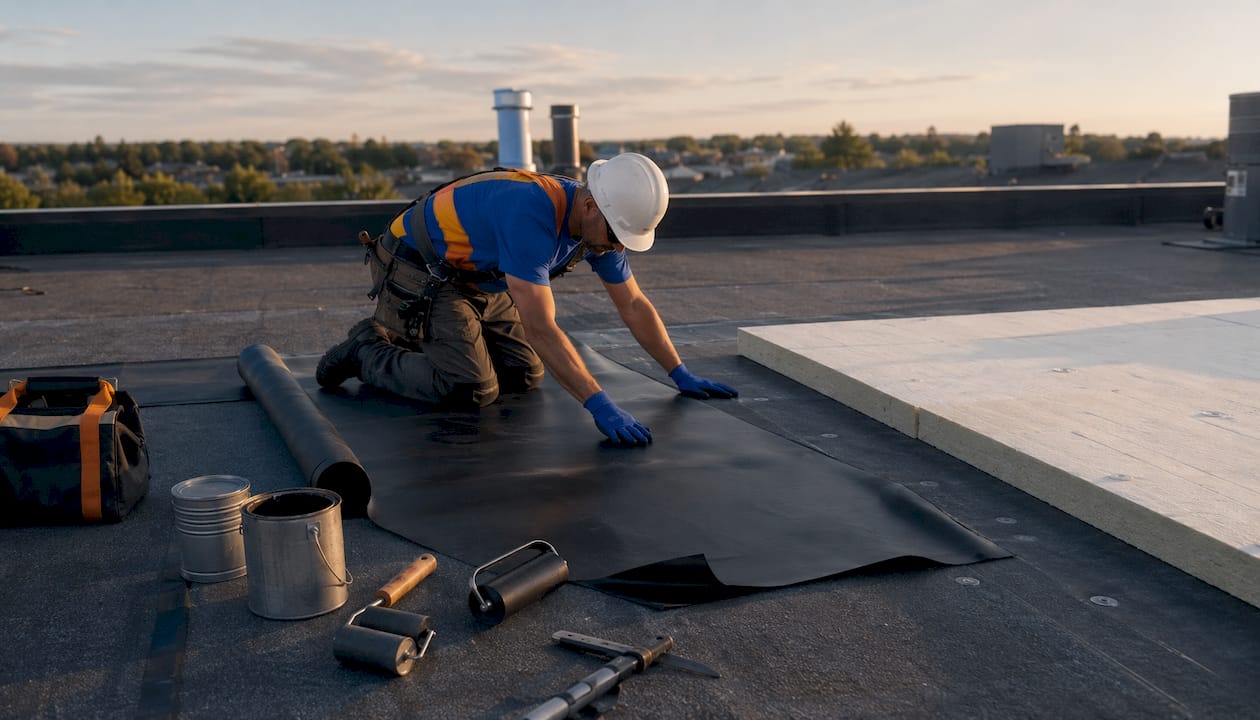
This thermoset chemistry is the key difference from thermoplastic membranes like TPO or PVC. Thermoplastics can be re-melted and heat-welded at seams. EPDM cannot. Its seams are sealed with primers and adhesives rather than a heat gun, which changes both installation practice and long-term repair strategy.
Common product specs at a glance:
| Specification | Options / Range |
|---|---|
| Thickness | 45 mil, 60 mil, 90 mil |
| Roll widths | 10 ft to 50 ft |
| Colors | Black, white, gray |
| Seam method | Primer + adhesive or seam tape |
| Quality listings | ASTM D4637, RoofNav, DORA, UL |
Thicker membranes cost more upfront but deliver meaningfully better puncture resistance and long-term durability on roofs with foot traffic or rooftop equipment. The 45-mil grade suits light-duty applications; 60-mil is the most common commercial choice; 90-mil is specified when the roof sees regular maintenance traffic or heavy mechanical equipment.
Independent testing through RoofNav, DORA, and UL confirms that properly specified EPDM assemblies meet recognized wind uplift, fire, and performance standards.
Where EPDM is commonly used and which buildings it suits best
EPDM's primary home is the low-slope commercial roof: warehouses, retail strip centers, office buildings, schools, and multifamily structures. On the residential side, it shows up on flat-roof garages, covered porches, additions, and tiny homes. Anything with a slope under 2:12 is a candidate.
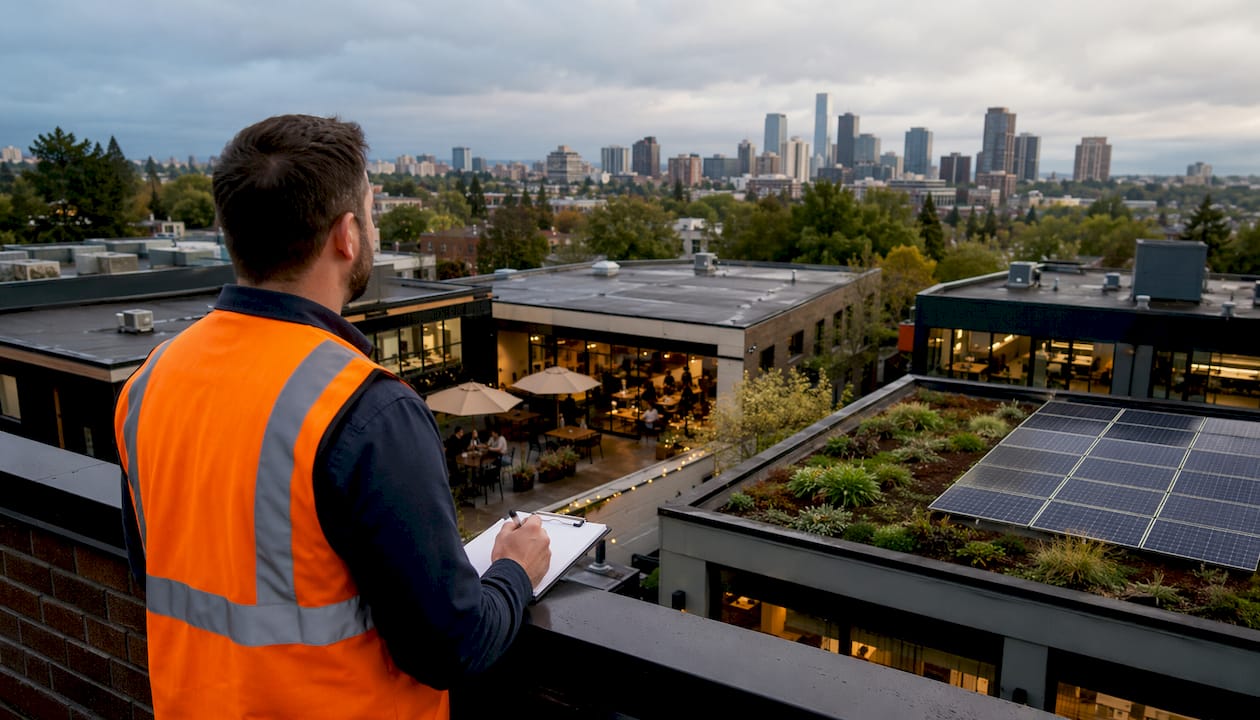
EPDM is widely recommended for ASHRAE Climate Zones 5 through 8 — the northern U.S. tier from the Great Lakes through New England and the upper Midwest. Cold-weather flexibility is the reason. At temperatures where some membranes stiffen and crack, EPDM stays elastic. That matters in freeze-thaw climates where a roof contracts and expands dozens of times each winter.
In hot, cooling-dominated climates (Zones 1–3), the calculus shifts. Black EPDM absorbs heat, which raises cooling loads. White or reflective EPDM addresses this, though Energy Star-certified roof products set the bar for solar reflectance in those markets. A simple rule: if your building is in the South and cooling costs are a concern, specify white EPDM or compare it against reflective single-ply alternatives.
Advantages and disadvantages of EPDM roofing
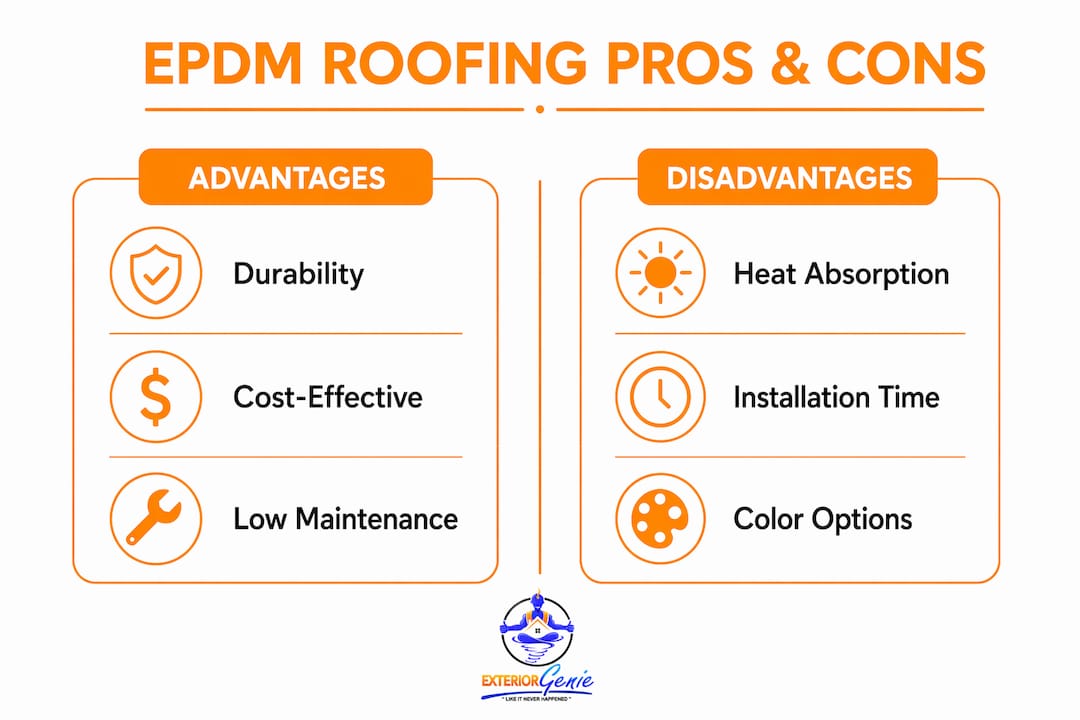
Core advantages:
- Elasticity and freeze-thaw resilience — stays flexible at low temperatures
- Long documented service life, routinely 38+ years
- Repairs don't require hot work; patch materials work on aged membranes without power tools
- Lower lifecycle cost relative to many alternatives
- Large sheet sizes reduce the number of seams, which reduces leak risk
Core disadvantages:
- Black EPDM absorbs heat — a real cooling penalty in warm climates
- Seam adhesive quality and application technique directly affect longevity
- Less visually appealing on roofs visible from street level
- Installation sensitivity: errors at flashings and penetrations are the leading failure cause
Environmental performance is a genuine EPDM strength. ERA lifecycle analysis puts EPDM at 6.93 kg CO₂ per square foot — compared to 11.31 for PVC, 11.80 for modified bitumen, and 20.74 for built-up roofing. That's a meaningful gap over a 40-year roof life.
Pro Tip: White or infrared-reflective EPDM makes sense when your building is in Climate Zones 1–3 or when local energy codes require a minimum solar reflectance index. The tradeoff: reflective membranes sometimes carry a small cost premium and may show dirt accumulation more visibly than black.
How EPDM is installed: three methods and when each fits
Fully adhered
The membrane is bonded directly to the insulation or substrate using bonding adhesive. This method offers the best wind uplift resistance when specified correctly and is preferred on roofs with irregular shapes or penetrations. It requires thorough substrate prep and controlled adhesive application — rushing either step creates problems.
Mechanically attached
Fasteners and stress plates secure the membrane through the insulation into the deck. It's faster and less labor-intensive than fully adhered, which lowers installation cost. Wind uplift performance depends on fastener spacing and deck type; specify tested assemblies for high-wind zones.
Ballasted
The membrane is loose-laid and held in place by river rock or concrete pavers. Installation is fast and can proceed in nearly any weather. No adhesive, no fasteners. The tradeoff is added roof load (pavers are heavy) and the need for a structurally adequate deck.
Installation method comparison:
| Method | Relative Cost | Wind Uplift | Best Use Case | Repairability |
|---|---|---|---|---|
| Fully adhered | Higher | Excellent | Complex roofs, high-wind zones | Good |
| Mechanically attached | Moderate | Good (assembly-dependent) | Simple commercial decks | Good |
| Ballasted | Lower | Moderate | Flat roofs with adequate structure | Easy access |
Seams in all three methods use primer plus adhesive or factory-formulated seam tape. No torch, no heat gun. That's a practical advantage in occupied buildings or facilities with hot-work restrictions.
Pro Tip: Before signing a contract, ask the installer three things: what seam width they use and how they prep the membrane edge, how they terminate the membrane at parapets and drains, and whether the assembly is listed on RoofNav or carries a manufacturer-backed system warranty. Vague answers to any of these are a red flag.
How long does EPDM last and what warranties cover
A 2025 survey of 569 roofing professionals confirmed EPDM membranes routinely deliver at least 38 years of service life, with many installations exceeding 40, 45, and 50 years. Laboratory testing by the SKZ laboratory in Germany, using High Pressure Autoclave Testing, projects service life exceeding 70 years under normal operating conditions.
Membrane thickness affects where in that range you land. A 45-mil roof on a lightly trafficked building can reach 30–40 years with good maintenance. A 90-mil system on a busy commercial roof with regular foot traffic is built for the longer end of that range.
Warranty types to understand:
| Warranty Type | What It Covers | What to Confirm |
|---|---|---|
| Material warranty | Membrane defects only | Duration, UV/ozone coverage |
| System warranty | Membrane + accessories + labor | Wind uplift rating, seam failure |
| Labor warranty | Contractor workmanship | Transferability, exclusions |
Common exclusions include ponding water beyond 48 hours, damage from rooftop traffic not specified in the design, and unauthorized repairs. Read the exclusions before you sign.
Routine maintenance and how EPDM repairs work
EPDM's maintenance demands are genuinely low compared to built-up or modified bitumen systems. Twice-yearly inspections, drain clearing, and debris removal cover most of it. A commercial roof maintenance checklist helps property managers stay on schedule.
Routine maintenance checklist:
- Inspect seams and flashings for lifting, bubbling, or separation
- Clear all drains and scuppers; check for ponding water after rain
- Remove debris, especially near penetrations
- Look for punctures, cuts, or biological growth on the membrane surface
- Document condition with photos at each inspection
Temporary patch steps (field triage):
- Clean and dry the damaged area thoroughly
- Apply EPDM primer to the membrane surface and the patch material
- Press a pre-cut EPDM patch (minimum 6-inch overlap on all sides) firmly into place
- Roll the patch edge with a hand roller to eliminate air pockets
- Schedule a permanent repair with a qualified contractor
Pro Tip: EPDM's adhesive-seam chemistry means most repairs don't require a torch or hot-work permit. That matters in hospitals, schools, and occupied office buildings where open-flame work triggers facility shutdowns. A qualified crew can often complete a repair during business hours with no disruption.
For preventive scheduling guidance, preventive roof maintenance practices from experienced contractors outline how to build a maintenance calendar that extends membrane life.
Typical installed cost and how EPDM compares to TPO and PVC
Installed EPDM typically runs $4–$8 per square foot, depending on thickness, attachment method, substrate condition, and local labor rates. Fully adhered 60-mil systems on a clean, accessible deck sit toward the middle of that range. Add rooftop equipment, steep access, or significant substrate repair and costs climb.
EPDM vs. TPO vs. PVC — key decision dimensions:
| Dimension | EPDM | TPO | PVC |
|---|---|---|---|
| Installed cost (approx.) | $4–$8/sq ft | $4–$8 per square foot | $4–$8 per square foot |
| Expected lifespan | 38–50+ years | 20–30 years | 20–30 years |
| Climate suitability | Excellent in cold zones | Better in hot/sunny climates | Good in chemical-exposure environments |
| Seam method | Adhesive/tape | Heat-welded | Heat-welded |
| Repairability | Easy, no hot work | Requires heat gun | Requires heat gun |
For a deeper look at TPO vs. EPDM for commercial roofs, the reflectivity and seam-strength differences matter most in southern markets. Over a 40-year building life, EPDM's longer documented service life often offsets a similar or slightly lower upfront cost compared to TPO or PVC, because you're not replacing it as soon.
Why installation quality matters more than material choice
Field and laboratory research consistently show that EPDM failures stem from installation errors at seams, flashings, and penetrations — not from membrane degradation. A well-specified 45-mil EPDM roof installed by a skilled crew will outlast a 90-mil system with sloppy flashing details.
Installer vetting checklist:
- HAAG certification for inspection and damage assessment
- Manufacturer-authorized installer status (check with the membrane brand)
- Portfolio of completed EPDM projects with references
- Written scope that specifies flashing details, substrate prep, and seam method
- System warranty backed by the manufacturer, not just the contractor
Ask specifically: "How do you handle the drain termination?" and "What substrate prep do you do before adhesive application?" A contractor who can answer both in detail has done this before. One who deflects or gives a generic answer probably hasn't done enough of it.
For broader guidance on choosing a commercial roofing contractor, the contract language around flashings and warranty transferability is where most owners get caught short.
When EPDM is the right choice for your building
EPDM earns its spot when your building checks most of these boxes:
- Low-slope or flat roof (under 2:12 pitch)
- Located in Climate Zones 4–8 (northern or transitional U.S.)
- Budget favors lifecycle value over lowest upfront cost
- Repairability matters (occupied building, limited hot-work access)
- Long service life is a priority over aesthetics
For homeowners and property managers: choose EPDM for low-slope roofs in cooler climates, or whenever repairability and lifecycle value outweigh reflectivity concerns. Get 2–3 bids, confirm each contractor's manufacturer authorization, and ask for a written scope that covers flashings and substrate prep before you sign anything.
What your roof substrate needs before EPDM goes down
Substrate prep is where many installations go wrong. EPDM adhesives require a clean, dry, structurally sound surface. Any soft spots, wet insulation, or contamination will compromise adhesion and create future leak points.
Standard prep steps include removing all existing roofing material down to a sound deck, replacing damaged or wet insulation boards, and verifying the deck is flat within manufacturer tolerances. For fully adhered systems, the substrate surface must be free of dust, oil, and moisture at the time of adhesive application. Mechanically attached and ballasted systems are more forgiving of minor surface irregularities, but the deck must still be structurally sound and properly sloped to drain.
Parapet walls, curbs, and penetration sleeves need to be clean and primed before flashing membrane is applied. Skipping primer at these transitions is one of the most common detailing errors.
Common EPDM roofing accessories you'll encounter
EPDM doesn't go down alone. A complete system includes several accessories, each with a specific function:
Bonding adhesive attaches the membrane to the substrate in fully adhered systems. Water-based and solvent-based versions exist; the right choice depends on substrate type and temperature at installation.
Seam primer prepares membrane edges before lap adhesive or seam tape is applied. Skipping primer is a leading cause of seam failure.
Lap adhesive bonds overlapping membrane edges at seams. Applied to both surfaces, allowed to tack, then pressed together — similar to contact cement.
Seam tape is a factory-formulated butyl-based tape used as an alternative to liquid lap adhesive at seams and flashings. It's faster to apply and less sensitive to temperature variation.
Flashing membrane is a thinner, more pliable EPDM sheet used at penetrations, drains, and parapet terminations. It conforms to complex geometry that a full-thickness membrane cannot.
Termination bars and caulk mechanically secure and seal the membrane edge at walls, curbs, and parapets. Termination bar without caulk, or caulk without bar, is a common shortcut that fails within a few years.
Safety considerations during installation and maintenance
EPDM installation is safer than torch-applied systems, but it's not without hazards.
Solvent-based bonding adhesives and primers are flammable and release VOCs. Work areas need ventilation, and open flames must be kept away during adhesive application. Workers should wear nitrile gloves and eye protection when handling adhesives and primers; prolonged skin contact causes irritation.
Working at height is the primary physical risk. Fall protection is required by OSHA for roof work above 6 feet, including personal fall arrest systems or guardrails at roof edges. Ladders must be secured and extend at least 3 feet above the roof edge.
During maintenance inspections, wet EPDM is slippery. Soft-soled shoes reduce slip risk and protect the membrane from puncture. Never walk on a ballasted roof without confirming the pavers are stable.
Heat stress is a real concern during summer installations. Adhesive application on a black EPDM surface in direct sun can expose workers to surface temperatures well above ambient air temperature. Schedule adhesive work for early morning when possible.
Key Takeaways
EPDM rubber roofing is the most durable and cost-effective choice for low-slope buildings in cooler U.S. climates, with a documented service life of 38–50+ years when installed correctly.
| Point | Details |
|---|---|
| Composition and seam method | EPDM is a thermoset rubber membrane sealed with adhesives and primer, not heat-welded. |
| Service life | Properly installed EPDM routinely delivers 38–50+ years; lab projections now exceed 70 years. |
| Climate fit | Best suited to ASHRAE Climate Zones 4–8; white or reflective options extend suitability to warmer climates. |
| Installation drives outcomes | Most failures trace to seam, flashing, and penetration errors — not membrane degradation. |
| Exteriorgenie | Exteriorgenie installs and repairs EPDM roofs in Lexington, SC, with HAAG-certified inspectors and 24/7 emergency service. |
The detail work is what separates a 20-year roof from a 40-year roof
Most owners focus on membrane brand or thickness when they're shopping for a new roof. Those choices matter, but they're not where the real risk lives. The research is unambiguous: EPDM failures are installation-related, concentrated at seams, flashings, and penetrations. A 45-mil membrane with meticulous flashing details will outlast a 90-mil membrane where the drain termination was rushed.
What I see repeatedly in this industry is owners who saved a few hundred dollars by choosing a contractor who skipped primer at the parapet or used a single termination bar without caulk. Three years later, they're paying for a full flashing replacement that costs more than the original savings. The membrane itself is fine. The detail work failed.
The practical takeaway: spend your vetting energy on the contractor's flashing process, not the membrane spec sheet. Ask for photos of completed drain details and parapet terminations from their last three jobs. If they can't produce them, keep looking.
Exteriorgenie handles EPDM roofing in Lexington, SC
Exteriorgenie is a veteran-owned roofing company with 25 years of experience installing and repairing EPDM membrane roofs for commercial and residential clients across Lexington, SC. Every inspection is performed by HAAG-certified inspectors who can document roof condition, identify installation deficiencies, and assist with insurance claims when storm or hail damage is involved. Emergency repairs are available 24/7 for urgent leaks.
Whether you're replacing an aging flat roof, repairing a failing seam, or navigating a storm damage claim, Exteriorgenie provides transparent pricing and written scopes that cover flashing details and substrate prep. Financing options are available for qualifying projects. For immediate storm or wind damage, the storm damage repair page has the fastest path to getting a crew on-site. Contact Exteriorgenie for a free inspection and written estimate.
Useful sources and further reading
- ERA Technical Bulletin 101 — EPDM LCA and Environmental Performance — lifecycle analysis comparing EPDM GWP to PVC, modified bitumen, and BUR
- ERA Service Life Summary of Research Evidence — full compilation of lab and field studies supporting the 38-year service life advisory
- ERA Announces New Service Life Advisory — 569-professional survey results and SKZ laboratory 70-year projection
- What Is EPDM? — EPDM Roofing Association — technical overview of composition, installation methods, and applications
- Professional Roofing: The Voice of Experience — 2025 field survey of roofing professionals on EPDM service life
- Roofing Contractor: Survey and Research Confirm 38-Year Service Life — summary of installation-failure research and professional survey findings
- Commercial Roof Guide: EPDM Roofing — climate suitability guidance and market share data
- Roof Observations: EPDM Roofing Introduction — practical overview of thermoset seam chemistry and field repair methods
- Energy Star Certified Roof Products — reflectance standards for roofing in cooling-dominated climates
- ERA Technical Bulletin — Resilience — wind, hail, and extreme weather performance data