

Licensed contractors are legally required for commercial roofing in most of the United States, and the reasons go far beyond paperwork. At least 33 states mandate a commercial roofing license before a contractor can legally touch a commercial building. The stakes are high: unlicensed work exposes property owners to full legal liability, voided insurance policies, and failed inspections that force costly tear-outs. Understanding why commercial roofing requires licensed contractors protects your investment, your tenants, and your bottom line.
Why commercial roofing requires licensed contractors by law
Commercial roofing is regulated at the state level, and the rules vary significantly. The Ohio Construction Industry Licensing Board, for example, oversees more than 10,000 licensed professionals in commercial construction trades alone. That scale reflects how seriously states treat commercial work compared to residential projects.
The thresholds that trigger licensing requirements differ by state. Louisiana requires a commercial license for any roofing project valued at $50,000 or more. Minnesota requires a licensed contractor for insurance claims, permits, or any tear-off exceeding 25% of the total roof surface area. These thresholds exist because commercial roofing failures carry consequences that extend well beyond a single homeowner.
A critical point many property owners miss: a general contractor license is rarely sufficient. A specific commercial roofing classification is required in most states, and that classification is what grants a contractor the legal authority to pull permits and schedule inspections. Without it, your project cannot legally proceed, and any work completed may be ordered remediated at your expense.
Pro Tip: Never assume a contractor's license covers commercial roofing. Search your state's licensing board portal directly, enter the contractor's license number, and confirm the classification listed matches commercial roofing specifically.
The table below shows how licensing requirements differ across three representative states:
| State | Licensing threshold | License type required |
|---|---|---|
| Ohio | All commercial projects | Commercial construction trade license |
| Louisiana | Projects $50,000 or more | Commercial contractor license |
| Minnesota | Insurance claims, permits, or tear-offs over 25% of roof area | Licensed roofing contractor |
How licensed contractors protect you from liability
Hiring an unlicensed roofer does not just risk poor workmanship. It transfers full legal and financial liability to you as the property owner. Unlicensed contractors carry no Workers' Compensation coverage and no General Liability insurance, which means any injury on your property becomes your legal problem.
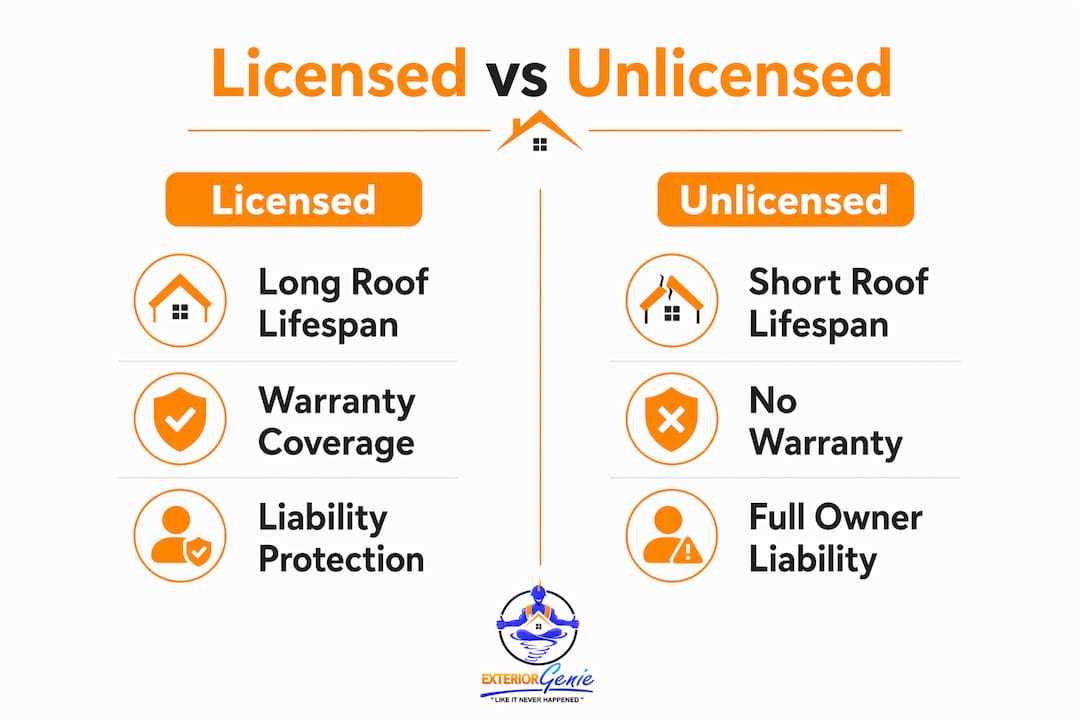
Licensed contractors are required to carry both. That requirement is not optional or cosmetic. It is the mechanism that transfers risk away from you and onto the contractor's policy. If a worker falls through a skylight or a subcontractor damages adjacent property, the contractor's insurance responds first.
The financial exposure from unlicensed work goes further than injury claims:
- Permit violations: Unlicensed contractors routinely bypass permit requirements. When inspectors discover unpermitted work, they can issue stop-work orders and require full remediation, often at the property owner's cost.
- Insurance claim denial: Your commercial property insurer may deny a claim if the roofing work that caused or failed to prevent damage was performed without a license.
- No recovery fund access: Many states maintain contractor recovery funds that compensate property owners for contractor fraud or abandonment. These funds are only available when the contractor was licensed.
- Voided manufacturer warranties: Most roofing system warranties require licensed installation. Unlicensed work voids coverage from day one.
Pro Tip: Ask your insurer directly whether unlicensed roofing work affects your commercial property coverage. Get the answer in writing before any project begins.
Licensing vs. manufacturer certifications: why both matter
State licensing sets the legal floor. Manufacturer certifications raise the ceiling. These two credentials serve different purposes, and confusing them is a common mistake that costs property owners money over the life of a roof.
A state license confirms that a contractor meets minimum legal requirements: insurance, bonding, and demonstrated competency. Manufacturer certifications provide eligibility for high-tier warranties, including No Dollar Limit (NDL) coverage. An NDL warranty covers both materials and labor with no cap on the claim amount. Without manufacturer certification, a contractor cannot offer that warranty even if the installation is technically correct.
Here is how the two credentials work together in practice:
- Verify state licensing first. Confirm the contractor holds an active, classified commercial roofing license through your state's portal. This is the non-negotiable legal baseline.
- Check manufacturer certification. Ask which roofing system manufacturers have certified the contractor. GAF, Firestone, and Carlisle all maintain online directories of certified installers.
- Match the certification to your system. A contractor certified for TPO membranes may not be certified for modified bitumen. Confirm the certification covers the specific system your building requires.
- Request warranty documentation. A certified contractor should provide the warranty registration process in writing before work begins, not after.
- Understand what each credential covers. Licensing protects you legally. Certification protects the long-term performance of the roof system itself.
Choosing a licensed but uncertified contractor for a specific roofing system is a common oversight. The work may pass inspection and still leave you without manufacturer warranty coverage, which is often the most valuable protection on a commercial roof.
How to verify a commercial roofing contractor's credentials
Verifying licensing upfront is the single most effective risk management step a property owner can take before signing a contract. Michael Baisden, an Ohio Contractor Administrator, states that this one step prevents the majority of costly code violations and project delays.
The verification process is straightforward when you know where to look:
- Go directly to the state licensing board website. Search by license number, not by name. Confirm the license is active, not expired or suspended, and that the classification matches commercial roofing.
- Request a current certificate of insurance. Ask to be listed as an additional insured on the contractor's General Liability policy. This gives you direct standing if a claim arises.
- Never accept a photocopy of a license. Photocopies can be altered or outdated. Active status must be confirmed through the state portal in real time.
- Check for disciplinary records. Most state licensing boards publish complaint histories. A pattern of complaints is a disqualifying signal, not a negotiating point.
- Confirm permit-pulling authority. Ask the contractor which local building department they will file permits with and verify they have done so before in your jurisdiction.
Valid documentation should be available within 24 hours of your request. A contractor who delays, deflects, or offers excuses is signaling non-compliance. Treat that as immediate disqualification, not a minor inconvenience.
Pro Tip: Pair credential checks with a call to your local building department. Ask whether the contractor has pulled permits in your area and whether any violations are on record. This takes ten minutes and can prevent months of legal headaches.
Licensed vs. unlicensed contractors: real cost comparison
The price difference between a licensed and an unlicensed contractor looks attractive on a bid sheet. The long-term math tells a different story.
Licensed commercial roofing work typically lasts 20 or more years. Unlicensed work often fails within 7–12 years, requiring full replacement. That means a property owner who saves 15% on installation may pay for two roofs in the time a licensed installation would have lasted once.
| Factor | Licensed contractor | Unlicensed contractor |
|---|---|---|
| Roof lifespan | 20+ years | 7–12 years typical |
| Annual cost per year of roof life | 30–50% lower | Higher due to early failure |
| Liability coverage | Contractor's insurance responds | Property owner absorbs all risk |
| Permit and inspection compliance | Required and managed | Often bypassed |
| Manufacturer warranty eligibility | Available with certified installers | Voided in most cases |
| Legal recourse if work fails | State licensing board, recovery funds | None in most states |
The misconception that unlicensed contractors offer equivalent work at lower prices ignores the accountability gap. Licensed contractors face license suspension, fines, and legal action if their work fails to meet code. Unlicensed contractors face none of those consequences. That accountability is what you are paying for when you hire licensed, and it is what protects your asset over the long term.
Key takeaways
Licensed commercial roofing contractors are legally required in most states, and hiring one is the only way to protect your property from liability, code violations, and premature roof failure.
| Point | Details |
|---|---|
| Licensing is a legal requirement | At least 33 states require a commercial roofing license; general contractor licenses rarely qualify. |
| Liability transfers with licensing | Licensed contractors carry Workers' Compensation and General Liability insurance, protecting property owners from on-site injury claims. |
| Certifications unlock warranties | Manufacturer certifications like NDL coverage require certified installers; licensing alone does not guarantee warranty eligibility. |
| Verification must be direct | Confirm license status through state portals in real time; never accept photocopies or verbal assurances. |
| Unlicensed work costs more long-term | Unlicensed roofs fail in 7–12 years versus 20-plus years for licensed work, negating any upfront savings. |
Licensing is a risk decision, not just a compliance checkbox
I have worked with property owners who treated the licensing question as a formality. They assumed that if a contractor showed up with a crew and equipment, the credentials were probably in order. That assumption has cost some of them tens of thousands of dollars.
The pattern I see most often: a property manager accepts a low bid, skips the verification step, and discovers the problem only when a leak reappears six months after installation or when an inspector flags unpermitted work during a sale or refinance. At that point, the unlicensed contractor is unreachable, and the property owner is holding the bill.
What I tell every business manager I work with is this: treat licensing verification the same way you treat a background check on a new hire. You would not skip that step to save time. Do not skip it here either.
The other mistake I see is treating a license as the finish line. A licensed contractor who has never installed the specific roofing system your building requires is still the wrong choice. Licensing confirms legal standing. Experience with your system, manufacturer certification, and a verifiable local track record confirm competency. You need all of it.
Regulations are also tightening. States that previously had minimal oversight are adding commercial roofing classifications and raising insurance minimums. Contractors who stay current with those changes are the ones worth hiring. Compliance is not a burden for good contractors. It is how they demonstrate they take the work seriously.
— Ebben
Exteriorgenie's licensed commercial roofing team in Lexington, SC

Exteriorgenie is a veteran-owned commercial roofing company serving Lexington, SC, with 25 years of field experience and a team of licensed, certified installers. Every commercial roofing project Exteriorgenie handles includes full permit management, code-compliant installation, and HAAG-certified inspection support for insurance claims. The team carries active General Liability and Workers' Compensation coverage, so your property is protected from the first day of work. If budget is a concern, Exteriorgenie offers roofing financing options to keep projects moving without compromising on licensed, warranty-backed workmanship. Contact Exteriorgenie for a consultation and get credentials verified before the first nail goes in.
FAQ
What states require a license for commercial roofing?
At least 33 states require a commercial roofing license in 2026, with requirements varying by project value, scope, and roof area affected. Check your state's contractor licensing board for the specific classification required in your jurisdiction.
Does a general contractor license cover commercial roofing?
No. A general contractor license rarely satisfies commercial roofing legal requirements and typically does not grant permit-pulling authority for roofing work. A specific commercial roofing classification is required in most states.
What happens if I hire an unlicensed roofer for a commercial building?
Hiring an unlicensed contractor shifts full liability to you as the property owner, voids most manufacturer warranties, and can result in mandatory remediation if the work fails inspection. You also lose access to state contractor recovery funds.
How do I verify a commercial roofing contractor's license?
Search your state's licensing board website using the contractor's license number, confirm the classification matches commercial roofing, and check for active status and any disciplinary history. Never rely on a photocopy or verbal confirmation.
What is a No Dollar Limit (NDL) warranty and who qualifies?
An NDL warranty covers both materials and labor on a commercial roof with no cap on claim value. Only manufacturer-certified installers can offer NDL warranties, making certification a critical factor beyond state licensing alone.