
Ordinance or law coverage is an insurance endorsement that pays the extra cost of rebuilding to current building codes after a covered loss. Standard homeowners policies restore your property to its pre-loss condition, but they stop there. When a fire, storm, or other covered peril triggers a local building department inspection, the code official may require upgrades that go far beyond simple restoration. That gap is what ordinance or law coverage closes.
Your first move: pull out your declarations page and look for an "ordinance or law" line item or endorsement. Note the percentage listed. Then call your agent and ask whether Coverage B and C have scheduled limits or whether the policy only carries a basic built-in allowance.
- Check your declarations page for an ordinance or law line and its percentage limit.
- Ask your agent whether it's a bundled allowance or a separate endorsement.
- Confirm Coverage B and C limits are scheduled, not just implied.
Key Takeaways
Ordinance or law coverage is the specific endorsement that pays code-upgrade costs after a covered loss, and a standard policy without it leaves most older homeowners exposed to significant out-of-pocket costs.
| Point | Details |
|---|---|
| Three-part structure | Coverage A, B, and C address different cost categories; B and C require scheduled limits. |
| Limit benchmarks | Common limits are 10%, 20%, or 25% of dwelling coverage; older homes typically need 20–25%. |
| The a damage threshold rule | Many jurisdictions require full code compliance when damage exceeds 50% of assessed value. |
| Exclusions to know | Voluntary upgrades, non-covered perils, and environmental remediation are typically excluded. |
| Exteriorgenie | Provides HAAG-certified inspections and line-item estimates that support ordinance claim documentation. |
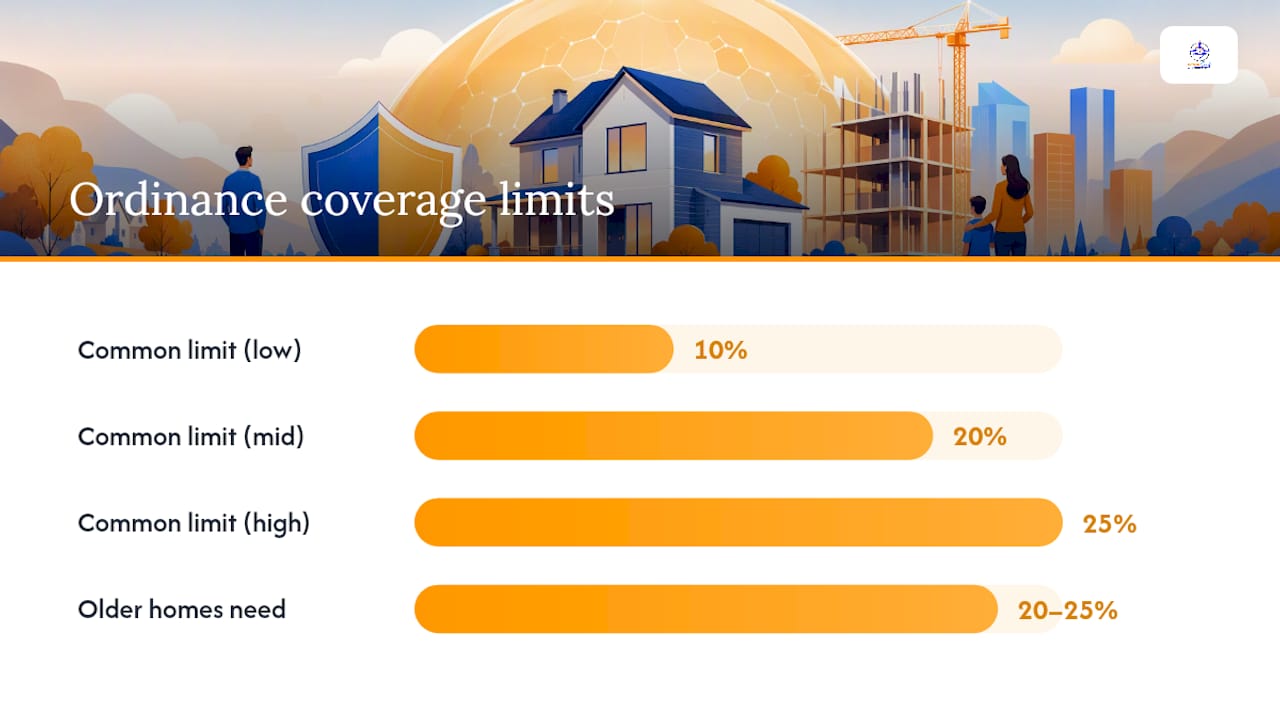
Table of Contents
- How ordinance or law coverage actually triggers
- The three components: Coverage A, B, and C
- Partial loss vs. total loss: two scenarios with real numbers
- What ordinance or law coverage does NOT cover
- How limits are set and why 10% often falls short
- Who should seriously consider increasing their ordinance limits
- How to get ordinance or law coverage and what to ask your agent
- What contractors want you to know when ordinance coverage is triggered
- Exteriorgenie helps you navigate ordinance-triggered repairs
- What I've seen on ordinance claims after 25 years in roofing
- Sources
- FAQ
How ordinance or law coverage actually triggers
The coverage doesn't activate on its own. Two things must happen first: a covered peril damages your property, and a local code official determines that reconstruction must meet current standards. Without both, the endorsement sits dormant.
Here's the typical claim flow. After a storm or fire, your insurer sends an adjuster to assess the damage. Separately, the local building department issues permits for the repair work. That's when a code official reviews the scope and may require upgrades: updated wiring, fire-rated assemblies, energy-efficient windows, or a compliant roof deck. Your contractor then prepares a detailed estimate that separates the like-for-like replacement costs from the code-required additions.
Documentation matters more here than in a standard claim. You'll need building permits, contractor line-item estimates that split pre-loss replacement from code-upgrade costs, and any written correspondence from the code official tying specific upgrades to permit conditions. Insurers use that paper trail to validate what falls under the ordinance endorsement versus what your base policy covers.
The three components: Coverage A, B, and C
Most building code insurance endorsements divide ordinance or law protection into three distinct pieces. Understanding each one helps you size your limits correctly.
- Coverage A — Loss to the undamaged portion. When code requires demolishing a structurally sound section of your home (say, a wing that wasn't touched by fire but must come down to bring the whole structure into compliance), Coverage A compensates for that lost value. It typically falls within your main dwelling limit rather than a separate sublimit.
- Coverage B — Demolition and debris removal. This pays the actual cost of tearing down and hauling away the undamaged portion. Coverage B usually requires a scheduled dollar limit, meaning you need to set it explicitly when you buy or endorse the policy.
- Coverage C — Increased cost of construction. Often the largest exposure of the three, Coverage C pays the difference between rebuilding to pre-loss standards and rebuilding to current code. Think upgraded electrical panels, sprinkler systems, or hurricane straps. Like Coverage B, it typically requires a scheduled sublimit.
Limit examples in dollars
Carriers commonly express ordinance limits as a percentage of your dwelling coverage. Here's how those percentages translate at different home values:
Policies may include small built-in allowances or offer endorsements to increase limits, and 20–25% is often closer to what older homes actually need.
Partial loss vs. total loss: two scenarios with real numbers
Seeing the math in context makes the coverage gaps obvious.
-
Partial loss: kitchen fire in a 1968 home. The fire damages your kitchen and part of the adjacent wall. Your adjuster values the direct damage at $45,000. During permitting, the building department flags that your home's knob-and-tube wiring throughout the affected zone must be replaced with modern wiring before the permit closes. That upgrade costs $18,000 and isn't part of the fire damage. Without ordinance coverage, you pay that $18,000 out of pocket. With a 20% ordinance limit on a $300,000 dwelling ($60,000 available), Coverage C absorbs the wiring cost entirely.
-
Total loss and a damage threshold rule. Many jurisdictions use a damage-threshold rule — commonly called the "damage threshold rule" — that requires full demolition and reconstruction to current codes when assessed damage exceeds that threshold. Say your home sustains $175,000 in storm damage on a $300,000 structure (roughly 58%). The building department declares it must be fully demolished and rebuilt to current code. Now all three coverages activate: Coverage A compensates for the undamaged portion's lost value, Coverage B pays demolition and debris removal, and Coverage C covers the code-upgrade premium on the rebuild. If your ordinance limit is only 10% ($30,000 total), you're absorbing the rest yourself. At 25% or a higher limit, you have meaningful protection.
Simple math to remember: Dwelling limit × ordinance percentage = your ordinance limit. If that number doesn't cover a realistic code-upgrade scenario for your home's age and local jurisdiction, the limit is too low.
What ordinance or law coverage does NOT cover
Knowing the exclusions prevents expensive surprises at claim time.
- Non-covered perils. If the damage originates from a flood or earthquake and those perils aren't endorsed on your policy, the ordinance endorsement won't activate. The covered-loss trigger must fire first.
- Voluntary upgrades. Deciding to add a second bathroom or upgrade your kitchen while you're at it? That's not a code-mandated cost. Insurers exclude voluntary improvements even when they happen during an ordinance-triggered rebuild.
- Routine maintenance and wear. A roof that was already failing before the storm doesn't become a covered code upgrade just because a permit gets pulled.
- Environmental remediation. Asbestos abatement, lead paint removal, and similar pollution costs are excluded in most standard forms, even when a code-compliant rebuild requires them.
- Pre-existing code violations. If your home was already out of compliance before the loss, some carriers will dispute coverage for those specific items. Disclosure matters.
Pro Tip: Document your home's pre-loss condition with dated photos and keep copies of any permits pulled for prior renovations. If a dispute arises over whether a code issue pre-existed the loss, that paper trail is your strongest defense.
Wondering whether HVAC system upgrades fall under ordinance coverage or a separate policy provision? The answer depends on whether the upgrade is code-mandated during reconstruction. A home insurance and HVAC coverage guide can help clarify how those lines get drawn.
How limits are set and why 10% often falls short
Carriers set ordinance limits based on several underwriting factors: the age of the structure, local code stringency, regional construction cost indexes, and the building's occupancy and materials. A newer home in a jurisdiction that adopted the 2021 International Building Code recently carries a smaller gap than a 1955 brick ranch in a city that just updated its electrical and fire-suppression requirements.
For a $400,000 home, that's $40,000. That sounds like a buffer until you account for permit fees, architectural or engineering drawings required by the building department, and the actual cost of bringing older systems up to code. Permit fees alone can run several thousand dollars on a major rebuild, and engineering fees for structural assessments add more.
Key stat: Many jurisdictions apply a damage threshold (frequently 50% of assessed value) that forces full-building code compliance. When that threshold is crossed, Coverage B and C claims can easily exceed a 10% ordinance limit on an older home.
Practitioners recommend reviewing your ordinance limits annually. Code adoption cycles, material cost inflation, and local building department rule changes can shift your exposure faster than your property's appraised value changes.
Who should seriously consider increasing their ordinance limits
Not every homeowner faces the same exposure.
Higher-risk indicators:
- Home built before 2000, especially pre-1980
- Outdated electrical (knob-and-tube, aluminum wiring, or undersized panels)
- Original plumbing (galvanized or cast iron)
- No fire sprinkler system in a jurisdiction that now requires them
- Location in a hurricane, tornado, or wildfire zone with updated wind or fire-resistance codes
- Property in a municipality that recently adopted a new building code cycle
Older homes not renovated in 20 or more years face the largest code-upgrade exposure because the gap between their construction standards and today's requirements is widest.
Occupancy factors that raise exposure:
- Accessory dwelling units (ADUs) subject to separate code requirements
- Mixed-use buildings where commercial code applies to part of the structure
- Rental properties where habitability codes are stricter
- Financed properties: Fannie Mae and HUD guidelines may require ordinance coverage for certain non-conforming or multifamily structures
If two or more of these apply to your property, a conversation with your agent about increasing limits is worth scheduling before the next storm season.
How to get ordinance or law coverage and what to ask your agent
Getting the right coverage takes about three steps and one focused conversation.
- Step 1: Check your declarations page. Find the ordinance or law line. Note the percentage and whether it's labeled as an endorsement or a built-in allowance.
- Step 2: Ask your agent the right questions. Use this checklist:
- Is ordinance or law coverage included, or do I need to add an endorsement?
- What exactly does my policy cover under Coverage A, B, and C?
- Are Coverage B and C scheduled with their own dollar limits?
- Does the policy include permit fees and design or engineering fees within Coverage C?
- How does the ordinance limit interact with my deductible?
- Can I increase the percentage, and what does that cost annually?
- Step 3: Get a contractor assessment. For older homes, a condition assessment or contractor estimate gives your agent and underwriter a realistic picture of your code-upgrade exposure. That estimate also becomes your baseline if you ever file a claim.
Documents to gather before that agent call: your current policy declarations, any permits pulled for prior renovations, and a recent contractor estimate or appraisal if you have one. Whether ordinance coverage is included or requires a paid endorsement varies by insurer and state, so confirming the specifics with your carrier is the only way to know where you stand.
What contractors want you to know when ordinance coverage is triggered
The claim process goes smoother when the contractor and the insurer are working from the same documented scope. Here's what experienced contractors see go wrong, and how to avoid it.
- Get a credentialed inspection early. For roof and storm claims, a HAAG-certified inspector produces a roof inspection report that documents damage in the format adjusters and underwriters expect. That report becomes the foundation for your ordinance claim.
- Secure the property before anything else. Emergency tarping and board-up protect the structure and prevent secondary damage that could complicate your claim scope.
- Request a line-item estimate. A contractor estimate that separates pre-loss replacement from code-required upgrades is what the insurer needs to authorize Coverage C payment. A lump-sum number won't cut it.
- Know your scope of loss. Before the adjuster visit, understand what a roofing scope of loss document should include: materials, labor, code-upgrade line items, and permit costs.
- Don't start non-emergency repairs without authorization. Contact your insurer and your contractor before any work beyond emergency stabilization. Unauthorized repairs can void coverage for that portion of the claim.
Pro Tip: Bring three things to your adjuster meeting: a contractor estimate with pre-loss and code-upgrade costs separated, photos of the pre-loss condition, and any prior renovation permits. That combination resolves most scope disputes before they start.
What to bring to the adjuster meeting:
- Contractor estimate with pre-loss vs. code-upgrade costs separated
- Dated pre-loss photos
- Prior renovation permits and inspection records
- Written code-official correspondence if already received
Exteriorgenie helps you navigate ordinance-triggered repairs
When ordinance or law coverage activates, the paperwork and coordination can feel like a second job. Exteriorgenie, a veteran-owned roofing and exterior contractor based in Lexington, SC, handles the contractor side of that process for homeowners and property owners across the area.

HAAG-certified inspectors produce detailed scope-of-loss reports that separate pre-loss replacement from code-required upgrades, the exact format your insurer needs to process Coverage C. Exteriorgenie also coordinates permits, provides emergency tarping within 24 hours, and works directly with adjusters to close scope gaps before they become disputes. If your ordinance limit doesn't fully cover the rebuild, financing options are available to bridge the gap between your policy payout and the final invoice. Ready to get a documented estimate before your next adjuster meeting? Request roof insurance claims assistance and get a HAAG-certified inspection scheduled.
What I've seen on ordinance claims after 25 years in roofing
Most homeowners find out they're underinsured for code upgrades at the worst possible moment: standing in front of a damaged house while a building inspector hands them a compliance list. After years of working ordinance-triggered claims alongside adjusters in South Carolina and beyond, the pattern is consistent. The homeowners who come out whole are the ones who checked their ordinance limits before the storm, not after.
The cost of discovering the gap mid-claim is not.
This article is general information, not a substitute for advice from a qualified financial advisor. Consult a qualified financial professional about your own circumstances before acting on anything here.
Sources
Authoritative references for building code and ordinance coverage rules:
- Building Code Upgrade Coverage for Properties
- Ordinance or law coverage (IRMI)
- What Is Ordinance or Law Coverage? - Progressive
- What is Ordinance or Law Coverage? - State Farm
FAQ
Should I get ordinance or law coverage?
Yes, especially if your home is more than 20 years old or located in a jurisdiction with active code updates. Standard policies don't cover the cost of bringing a structure up to current code during a rebuild.
What does the ordinance or law coverage endorsement cover?
It covers three things: the value lost when code forces demolition of an undamaged portion (Coverage A), the cost of demolishing and removing that portion (Coverage B), and the increased construction cost of rebuilding to current code (Coverage C).
Is ordinance or law coverage included in a standard homeowners policy?
Confirm with your agent whether your policy includes it and whether the limits are adequate for your home's age and local code requirements.
What is a damage threshold rule and how does it affect my claim?
When that threshold is crossed, all three ordinance coverage components can activate simultaneously, making adequate Coverage B and C limits critical.
Is an ordinance the same as a law for insurance purposes?
For insurance purposes, the terms are used interchangeably. "Ordinance or law" coverage applies to both local municipal ordinances and state or federal building statutes that require code-compliant reconstruction after a covered loss.