

Replacement cost value (RCV) is defined as the amount your insurer pays to replace your damaged roof with like materials at current market prices, without deducting for depreciation. Understanding replacement cost value explained roofing coverage is the difference between a check that covers your new roof and a check that leaves you holding a $10,000 gap. RCV stands in direct contrast to actual cash value (ACV), which deducts depreciation from your payout. Asphalt shingles depreciate at 2.5%–4% per year over a 20–25 year lifespan. On a 15-year-old roof, that math can wipe out 60%–80% of your claim before you see a dollar.
How does replacement cost value differ from actual cash value in roofing claims?
RCV and ACV are not just different numbers. They represent two fundamentally different philosophies about what insurance owes you after a loss.
RCV is designed to restore your roof to its pre-loss condition at today's prices. ACV compensates you for the market value of the roof at the time of loss, after accounting for age and wear. The gap between those two figures grows every year your roof ages.
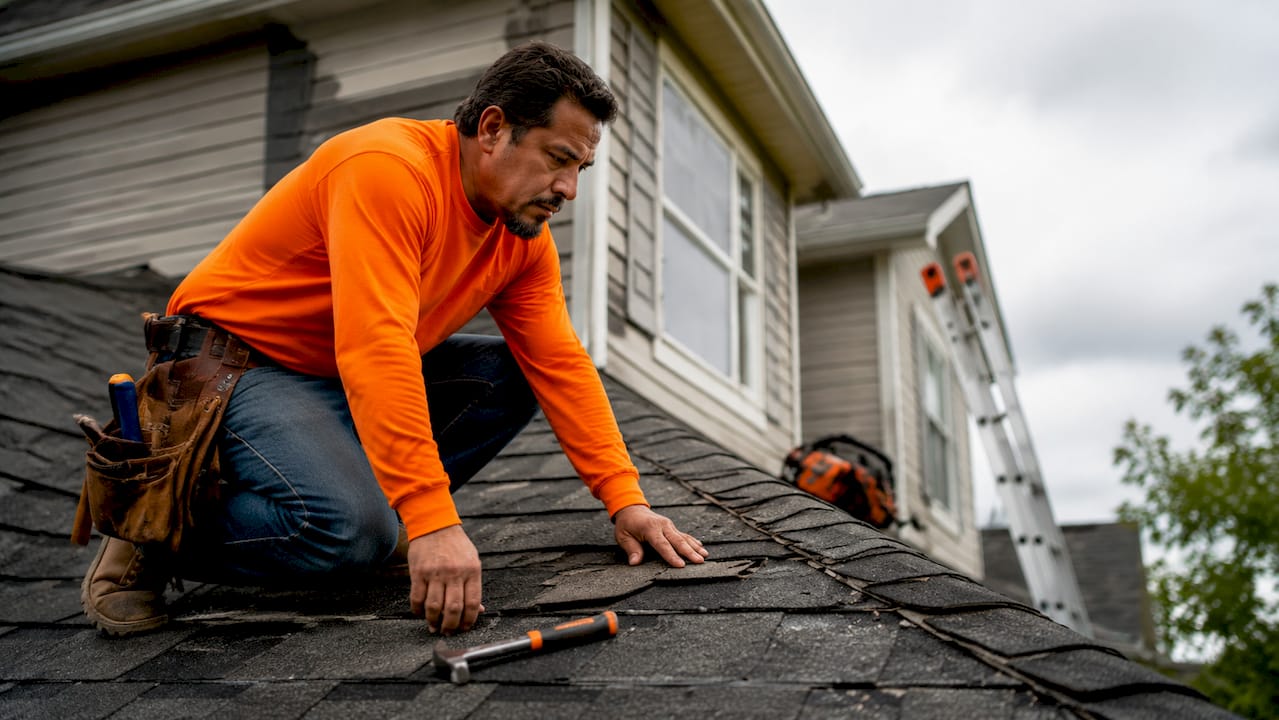
Here is a concrete example. Your roof needs full replacement and the job costs $15,000. Your roof is 15 years old, and the insurer applies 70% depreciation. Under ACV, your payout is $4,500. Under RCV, your payout is $15,000 minus your deductible. That is a difference of $10,500 coming out of your pocket under ACV.
| Coverage type | Depreciation deducted? | Homeowner out-of-pocket (example) |
|---|---|---|
| Replacement cost value (RCV) | No | Deductible only |
| Actual cash value (ACV) | Yes | Deductible + depreciated amount |
One misconception homeowners carry is that their entire homeowners policy is RCV. Many policies apply ACV to roofs once they pass the 15–20 year mark, even when the rest of the dwelling is covered on an RCV basis. That age threshold can catch homeowners completely off guard after a storm.
Pro Tip: Read your declarations page every year at renewal. The marketing language on your policy brochure means nothing. The declarations page is the only document that tells you whether your roof is covered on RCV or ACV terms.
What is the insurance claim process under replacement cost value coverage?
RCV claims do not pay out in a single lump sum. Insurers follow a two-step payment process that trips up many homeowners.
Step one: the insurer approves your claim and issues an initial payment equal to the ACV of the roof minus your deductible. This gives you money to start the project. Step two: once you complete the repairs or replacement and submit proof, the insurer releases the recoverable depreciation, which is the amount held back in step one.
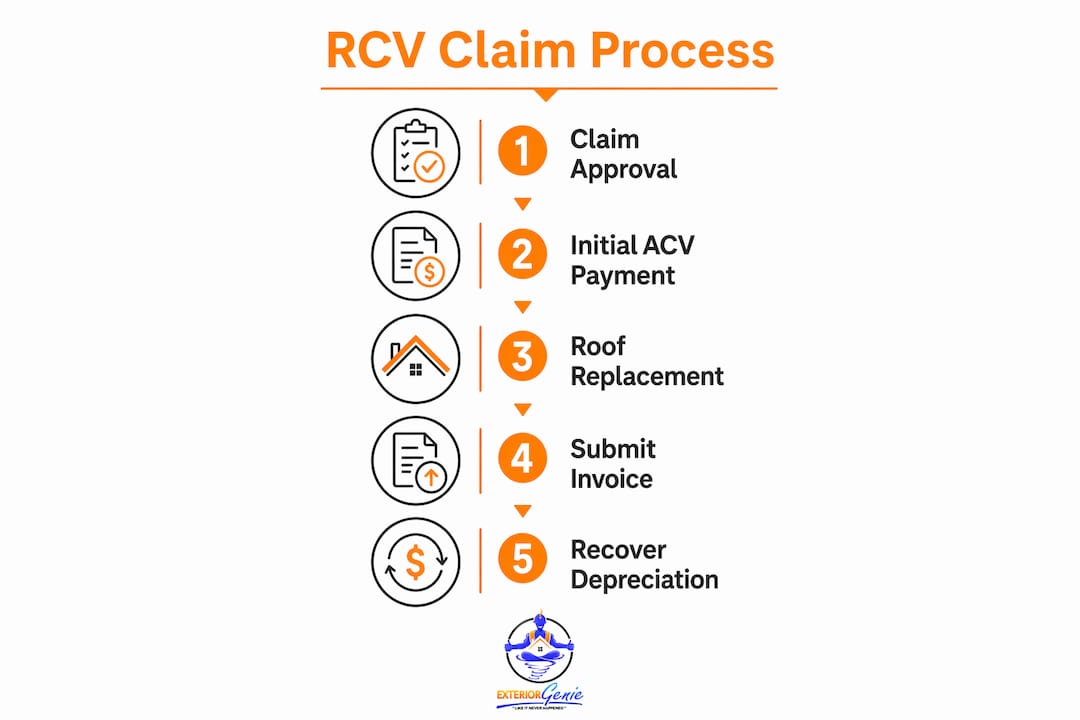
Here is how that looks in practice. Your roof replacement is valued at $22,500. The insurer applies 40% depreciation, bringing the ACV to $13,500. Your deductible is $2,000. Your first check is $11,500. After you submit your final invoice and completion photos, you receive the remaining $9,000 in recoverable depreciation.
The documentation you need to release that second payment is specific:
- Final contractor invoice showing the full scope of work completed
- Photographs of the completed roof from multiple angles
- A certificate of completion or signed contractor statement
- Any permits pulled for the project, if required by your municipality
Pro Tip: Never throw away your contractor's invoice or permit paperwork. Insurers can and do delay the recoverable depreciation payment when documentation is incomplete. Keep digital copies in cloud storage the day you receive them.
The deductible applies to your total claim, not just the first payment. If your deductible is $2,500 and your ACV payout is $2,000, you receive nothing on the first check and collect only after repairs are done and the recoverable depreciation exceeds your deductible balance.
When should you repair versus replace your roof under RCV coverage?
The industry uses a practical benchmark called the 30% rule to guide this decision. If the cost to repair your roof exceeds 30% of the full replacement cost, replacement is the financially sound choice.
The math is straightforward. If a full replacement costs $20,000, repairs that exceed $6,000 push you into replacement territory. Patching a roof that is already 80% of the way through its lifespan rarely makes economic sense, and insurers know it.
Typical repair costs give you a useful frame of reference:
- Minor leak repairs: $150–$1,500 for isolated flashing or shingle issues
- Moderate repairs: $1,500–$4,000 for larger sections of damaged decking or multiple leak points
- Major repairs: $4,000–$8,000 for widespread storm damage short of full replacement
- Full replacement: varies by material, roof size, and pitch
Roof age and damage severity both affect how your insurer classifies the claim. A 10-year-old roof with localized hail damage is a strong candidate for repair. A 22-year-old roof with widespread wind damage will almost certainly be assessed for full replacement. Exteriorgenie's HAAG-certified inspectors evaluate both scenarios with the same documentation standard, which matters when you are negotiating with an adjuster.
Delaying repairs on an older roof creates a compounding problem. Water intrusion accelerates structural damage, and insurers can deny claims for pre-existing deterioration if you wait too long. A contractor estimate from a licensed professional gives you a documented baseline that supports your claim and protects you from low adjuster assessments.
Understanding when full replacement is necessary versus a targeted repair is a decision that directly affects your RCV payout and your long-term coverage eligibility.
How do you verify and maximize your roofing insurance claim?
Your declarations page is the starting point for every claim conversation. The declarations page explicitly states whether your roof is covered on RCV or ACV terms. Marketing materials from your insurer are not binding. The declarations page is.
Check these items before you file any claim:
- Coverage type: RCV or ACV for the roof specifically, not just the dwelling
- Roof age restrictions: Any endorsements that shift older roofs to ACV regardless of overall policy terms
- Exclusions: Cosmetic damage, pre-existing wear, or specific storm types that your policy does not cover
- Deductible amount: Some policies carry separate wind or hail deductibles that are higher than your standard deductible
When the adjuster visits, your job is to document everything independently. Take your own photographs before any cleanup or temporary repairs. Write down the date, time, and weather conditions. Note every area of visible damage, not just the obvious ones.
Pro Tip: Request a copy of the adjuster's scope of loss report after the inspection. Compare it line by line against your contractor's estimate. Discrepancies between the two documents are your leverage for a supplemental claim.
Many insurers restrict RCV on older roofs as a cost-control measure, independent of the home's overall policy terms. If your roof is approaching 15 years old, call your insurer before your next renewal and ask directly whether your roof coverage will shift to ACV. Getting that answer in writing protects you.
Key Takeaways
Replacement cost value coverage pays for a full roof replacement at today's prices, but only if you understand your policy terms, document your claim thoroughly, and follow the two-step payment process correctly.
| Point | Details |
|---|---|
| RCV vs. ACV gap | On a $15,000 roof with 70% depreciation, ACV pays $4,500 while RCV pays the full amount minus your deductible. |
| Two-step payment | Insurers release recoverable depreciation only after you submit proof of completed repairs or replacement. |
| Age restrictions matter | Many policies shift roofs over 15–20 years to ACV coverage, even when the rest of the home is on RCV terms. |
| The 30% rule | If repair costs exceed 30% of full replacement cost, replacement is the financially sound choice. |
| Declarations page | Your declarations page, not marketing materials, is the authoritative source for your roof's coverage type. |
What I've learned after years of watching homeowners fight their own policies
Most homeowners I talk to after a storm have no idea whether their roof is covered on RCV or ACV terms. They assume RCV because they paid for a "good" policy. That assumption costs them thousands.
The part that frustrates me most is how avoidable it is. Your declarations page tells you everything. It takes five minutes to read. But most homeowners only look at it when they are filing a claim, which is exactly the wrong time to discover you have ACV coverage on a 17-year-old roof.
The two-step payment process is the second major source of confusion. Homeowners receive the initial ACV check, assume that is the full payout, and either do not complete the repairs or do not submit the required documentation. The recoverable depreciation sits uncollected. I have seen homeowners leave significant money on the table simply because no one explained that a second check exists.
My honest advice: treat your roof like a financial asset, not just a building component. Get it inspected every two years. Keep records of every repair. Know your policy terms before you need them. When storm damage hits, call a HAAG-certified inspector before you call your insurer. The inspection report shapes the entire claim.
— Ebben
Roofing solutions and financing options from Exteriorgenie
Exteriorgenie serves homeowners in Lexington, SC with 25 years of roofing experience, HAAG-certified inspectors, and 24/7 emergency response. Whether you are navigating a storm damage claim or planning a full replacement, the team handles the documentation, adjuster communication, and repair work under one roof.

Out-of-pocket costs after a claim can still add up, even with RCV coverage. Exteriorgenie offers roofing financing options to help homeowners manage deductibles and gaps between insurance payouts and project completion. For personalized insurance claims assistance or to schedule an inspection, contact Exteriorgenie directly and get a transparent estimate backed by real credentials.
FAQ
What does replacement cost value mean for a roof?
Replacement cost value means your insurer pays the full cost to replace your damaged roof with materials of like kind and quality at current prices, without deducting for age or wear.
How is RCV different from actual cash value for roofing?
RCV pays the full replacement cost while ACV deducts depreciation, which can reach 60%–80% on roofs over 15 years old, leaving homeowners with a significant out-of-pocket gap.
When does an insurer release the recoverable depreciation?
Insurers release recoverable depreciation only after you submit proof of completed repairs, including a final invoice, completion photos, and any required permits.
Does my RCV policy cover my roof if it is older than 15 years?
Not necessarily. Many insurers apply ACV-only coverage to roofs past 15–20 years old regardless of the home's overall RCV policy terms, so check your declarations page at every renewal.
Should I repair or replace my roof after storm damage?
Use the 30% rule: if repair costs exceed 30% of the full replacement cost, replacement is the better financial decision and the outcome most insurers will support under RCV coverage.