
When your roof starts showing damage, the first question most homeowners ask is whether they need a repair or a full replacement. The answer rarely comes from a quick look at the shingles. Understanding how roofers determine replacement vs repair means looking at age, damage coverage, building code limits, hidden structural issues, and long-term cost math. Get it wrong, and you either waste money patching a roof that's already failing or spend on a full replacement when a targeted fix would have done the job. This guide breaks down exactly how professionals reach that decision.
Table of Contents
- Key Takeaways
- How roofers determine replacement vs repair
- Building codes that force the decision
- What inspectors actually look for beneath the surface
- The cost math: when repair stops making sense
- How to get quotes and evaluate recommendations
- What I've learned from two decades of roof evaluations
- Get a roof assessment from Exteriorgenie
- FAQ
Key Takeaways
| Point | Details |
|---|---|
| Age changes everything | Roofs older than 15-20 years with damage often favor replacement over repeated patching. |
| The 30% damage threshold | Damage covering 30% or more of the roof surface almost always points toward full replacement. |
| Building codes set hard limits | IRC 2018 R907.3 caps asphalt shingle layers at two total, making tear-off mandatory in many cases. |
| Hidden damage drives decisions | Inspectors look under shingles and inside attics, not just at surface conditions. |
| Cost comparison is the tiebreaker | When repair quotes hit 25-50% of replacement cost, replacement becomes the smarter financial move. |
How roofers determine replacement vs repair
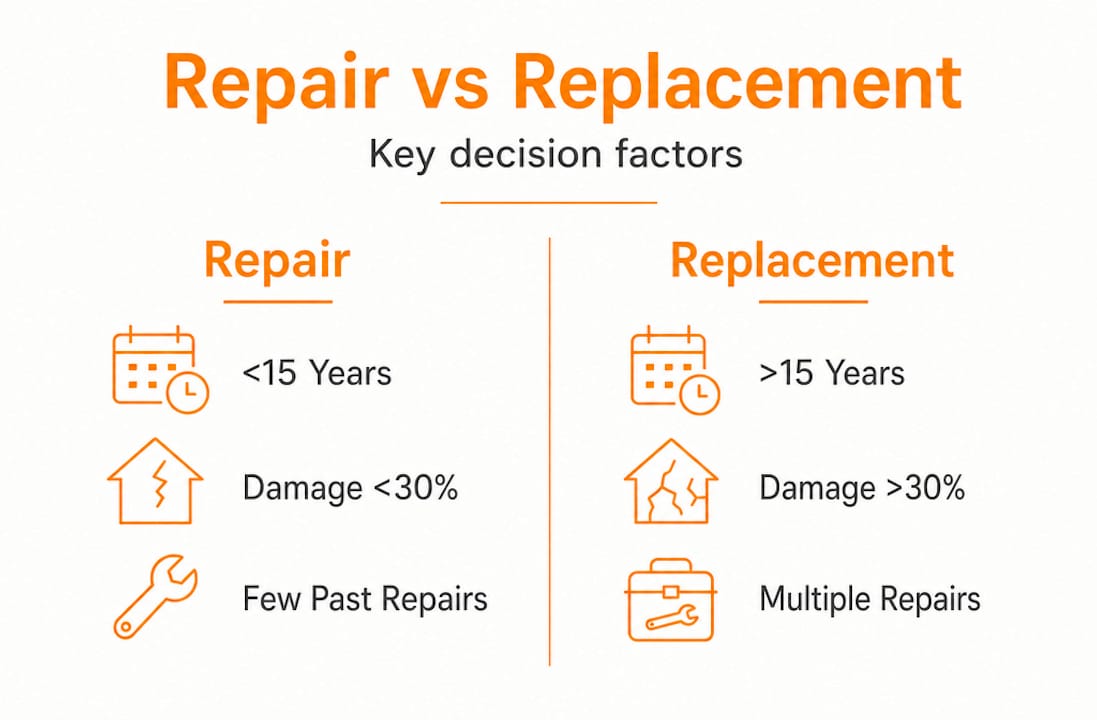
The professional evaluation process has a formal name in the industry: a roof condition assessment. It goes well beyond what you can see from the ground or even from your attic. GAF identifies four critical factors that guide this assessment: roof age, extent of damage, repair history, and comparative cost. Each one can independently push the decision toward replacement.
Age and expected lifespan
Most asphalt shingle roofs are rated for 20 to 30 years under normal conditions. But here's what most homeowners don't realize: once a roof passes the 15-year mark, its ability to accept repairs without further failure drops considerably. Old shingles become brittle, the underlayment degrades, and flashings start to pull away from seals. A contractor patching one section of a 22-year-old roof is often just delaying a larger problem by 12 to 18 months. Understanding residential roofing materials and their expected lifespan helps you frame that conversation with your contractor honestly.
Damage extent as a percentage
Roofers calculate damaged area as a percentage of total roof surface, not just by counting broken shingles. Damage covering 30% or more of the roof surface signals that replacement is the more viable path. A roof under 15 years old with less than 30% affected may still qualify for a targeted repair. But these numbers shift quickly when other factors are stacked against the roof.
Repair history and the "repair-and-repeat" trap
A roof that has been patched three times in five years is telling you something. Each patch represents a spot where the system failed. When roofers see a pattern of recurring repairs, they treat it as evidence that the system itself is compromised, not just individual sections. Asking a contractor to review your past repair records before giving a quote is one of the smartest moves you can make.
Pro Tip: Ask any contractor you're evaluating to walk you through the roof's repair history before they give you a quote. A good contractor will ask you for that information first.
Building codes that force the decision
This is the factor that surprises homeowners the most. Even if your roof looks repairable and the cost math leans toward patching, building code may take the choice out of your hands entirely.
| Scenario | Code Requirement | Outcome |
|---|---|---|
| One existing shingle layer, good deck | Overlay allowed | New layer installed over old |
| Two existing shingle layers | No overlay permitted | Full tear-off required |
| One layer, deteriorated decking | Overlay prohibited | Full tear-off required |
| Any layers, damaged structural deck | No overlay | Full tear-off and deck repair |
IRC 2018 R907.3 limits asphalt shingle roofs to a maximum of two total layers. If your home already has two layers of shingles, a full tear-off is required by code before any new material goes down. There's no workaround. Building inspectors enforce this at permit inspections, and contractors who ignore it put your home's certificate of occupancy at risk.
Deck condition is the other hard stop. Sheathing and deck integrity act as a gatekeeper for repair eligibility. If the decking beneath the shingles shows rot, water saturation, or structural softness, no overlay is permitted regardless of how the surface looks. This is one reason why what appears to be a minor repair job sometimes becomes a full replacement once work begins. The deck condition was only discovered after the old shingles came up.
Warranty coverage adds another layer to this. Manufacturers require full tear-off for a new warranty to be valid. Installing over existing shingles, even where code allows it, typically voids or significantly reduces the material warranty. That shifts the long-term cost math even further toward replacement in many cases.
Pro Tip: Before signing any contract, ask the contractor to pull the permit and confirm how many shingle layers are currently on your roof. This one question can save you from surprise costs mid-project.
What inspectors actually look for beneath the surface
Visible damage is only the starting point. Experienced inspectors distinguish cosmetic damage from system-wide failure by checking conditions that aren't visible from the outside. Professional inspections probe under shingles and examine attic conditions including ventilation, mold growth, water staining on rafters, and prior patching patterns.
Here's what a thorough roof inspection covers:
- Attic moisture and ventilation — Poor ventilation traps heat and moisture, accelerating shingle deterioration from below. A leaking roof and an over-heated attic are two different problems, but both affect the repair-or-replace decision.
- Deck and sheathing integrity — Soft spots, discoloration, and delamination all indicate water infiltration that has reached the structural layer.
- Flashing condition at transitions — Around chimneys, valleys, and skylights, failing flashings account for a significant share of leak calls. Flashing repair is often a targeted fix. But if flashings have been resealed multiple times, the underlying substrate may be failing too.
- Interior water stains and wall damage — Inspectors look for stains inside walls and along ceiling lines, which reveal how long water has been entering and whether mold has begun to take hold. Mold in the attic is a separate remediation problem, but it also signals long-term moisture intrusion that a patch won't solve. Understanding why mold remediation fails can help you see why fixing the water source matters first.
- Prior patching patterns — Multiple patches concentrated in one area show a persistent leak that has never been fully resolved. That pattern almost always points toward replacement.
Licensed roofing contractors catch these conditions because they know where to look. A homeowner walking across the roof or looking at it from a ladder simply won't see what a trained inspector finds in 20 minutes with the right tools and access.
The cost math: when repair stops making sense
Repair costs often look attractive until you run the numbers honestly. The GAF 25% rule states that when repair costs exceed 25% of what a full replacement would cost, replacement becomes the financially smarter choice. The broader industry benchmark sets that threshold at 50%, but either way, the logic holds.
| Scenario | Repair Cost | Replacement Cost | Recommendation |
|---|---|---|---|
| Isolated flashing repair | $400 | $14,000 | Repair |
| Multiple section repairs | $2,800 | $14,000 | Borderline (20%) |
| Widespread shingle damage | $5,500 | $14,000 | Replace (39%) |
| Storm + deck damage | $8,000 | $14,000 | Replace (57%) |
What the table above doesn't capture is the compounding effect. Repeated repairs can exceed replacement cost over a five-year period with none of the warranty protection a new roof would carry. A $2,500 repair this year, followed by $1,800 the next, followed by $3,200 the year after, totals $7,500 spent on a roof that is still aging and still unwarranted. A replacement done after the first repair would have cost less overall and bought 20 to 30 years of coverage. You can get a clearer sense of how repair costs accumulate by reviewing how repair extends roof life in different damage scenarios.
Pro Tip: When comparing repair and replacement quotes, ask each contractor to give you their 5-year projection. What do they expect you'll need to spend on this roof over the next five years if you choose repair? That single question changes the conversation entirely.
How to get quotes and evaluate recommendations
Getting the decision right starts long before any contractor gets on your roof. Here's a practical approach for navigating the process:
- Get at least three written quotes. One contractor's opinion is not a data point. Three quotes let you see whether the recommendations align or diverge. If two say replace and one says repair, ask the outlier to explain their reasoning specifically.
- Require itemized line-item breakdowns. A quote that says "roof repair: $3,200" tells you nothing. You need to know what materials are being used, what labor is included, what warranties apply, and what happens if hidden damage is found during the work.
- Ask about licensing and insurance directly. In South Carolina and most states, roofing contractors must carry general liability and workers' compensation coverage. Verified, licensed contractors provide documentation without hesitation. If a contractor is slow to produce these, that's an answer in itself.
- Ask specifically about the deck condition. "Will you inspect the decking before finalizing the scope?" If the answer is no, you're getting a quote based on incomplete information.
- Understand the warranty terms. Labor warranties differ from material warranties. A contractor offering a 10-year labor warranty on a repair is telling you something different than one offering a 1-year warranty on the same work.
- Review their contractor hiring approach carefully. Checking references and past project reviews is worth more than any sales pitch.
If a contractor pushes hard for replacement on a relatively young roof with limited damage and can't explain the reasoning in detail, that's a red flag. Equally, if a contractor dismisses your concerns about a 24-year-old roof with repeated leaks and tells you a patch will handle it, that's just as concerning.
What I've learned from two decades of roof evaluations
I've watched homeowners make the same mistake over and over. They focus entirely on the repair quote and never ask about the bigger picture. A $600 repair sounds like a win compared to a $15,000 replacement. But when that same roof gets repaired four more times over three years, the math inverts, and they still end up replacing it anyway. Only now they've also spent $4,000 in patch costs they'll never get back.
What I've found is that the roof itself usually tells you what it needs, if someone takes the time to listen. Hidden mold, soft decking, and a history of recurring leaks in the same spot are not repair problems. They're replacement indicators wearing a repair disguise. The homeowners who make the best decisions are the ones who invest in a thorough inspection first and treat the quote conversation as separate from the inspection conversation.
I'll also say this: the pressure to choose repair comes from both directions. Some contractors favor replacement because the margin is higher. Others favor repair because it's a faster sale and a lower barrier to close. Neither motivation serves you. What serves you is a contractor who will walk your attic with you, show you what they found, and explain exactly why the numbers point where they do.
— Ebben
Get a roof assessment from Exteriorgenie

If you're weighing roof repair or replacement for your home in Lexington, SC, Exteriorgenie brings 25 years of hands-on experience to every inspection. As a veteran-owned company with HAAG-certified inspectors, they look beyond the surface to evaluate decking integrity, ventilation, and system-wide condition before making any recommendation. Whether you're dealing with storm damage, a slow leak, or a roof that keeps needing repairs, Exteriorgenie provides transparent, itemized quotes and handles insurance claims directly. For homeowners who want straight answers from a licensed, insured contractor, visit Exteriorgenie's roofing services to schedule your inspection today.
FAQ
How do roofers decide between repair and replacement?
Roofers evaluate four main factors: roof age, the percentage of damaged area, the history of prior repairs, and how repair cost compares to replacement cost. When any of these factors crosses a key threshold, such as 30% damage coverage or repair costs exceeding 25% of replacement cost, replacement becomes the recommended path.
What percentage of roof damage requires replacement?
Damage covering 30% or more of the roof surface typically means replacement is required. Roofs under 15 years old with less than 30% damage may still qualify for targeted repair.
Can a roofer add new shingles over old ones?
Only under specific conditions. IRC 2018 R907.3 allows one new layer over one existing layer, but prohibits overlay if two layers already exist or if the deck is deteriorated. Violating this code requires a full tear-off to correct.
When does repairing a roof stop making financial sense?
Industry guidelines suggest that when repair costs reach 25% to 50% of the total replacement cost, full replacement becomes the better investment. Repeated repairs often exceed replacement cost over time without providing any warranty protection.
What do roof inspectors look for that homeowners miss?
Inspectors check attic ventilation, deck condition, water staining on rafters, mold growth, and patterns of prior patching. These hidden conditions, not just surface damage, are what determine whether a roof can be repaired or needs full replacement.