
An emergency roof inspection is a rapid, safety-focused evaluation conducted immediately after roof damage to identify urgent threats and prevent further property loss. Unlike a routine annual checkup, this assessment targets active leaks, structural compromise, and exposed decking before they escalate into full interior rebuilds. According to 12 Stones Roofing, the goal is to stabilize the property and stop a repair situation from becoming a catastrophic loss. Exteriorgenie, a HAAG-certified roofing company serving Lexington, SC, recommends scheduling this type of assessment within 24–72 hours of any damaging weather event to protect both your property and your insurance claim.
What is emergency roof inspection and how does it work?
An emergency roof inspection is the industry's term for what professionals also call an urgent roof evaluation or emergency roof assessment. It differs from a standard inspection in one critical way: speed and scope are driven by immediate safety, not scheduled maintenance. A routine inspection checks for wear and aging. An emergency assessment hunts for conditions that could cause your ceiling to collapse or your electrical system to short out before the week is over.
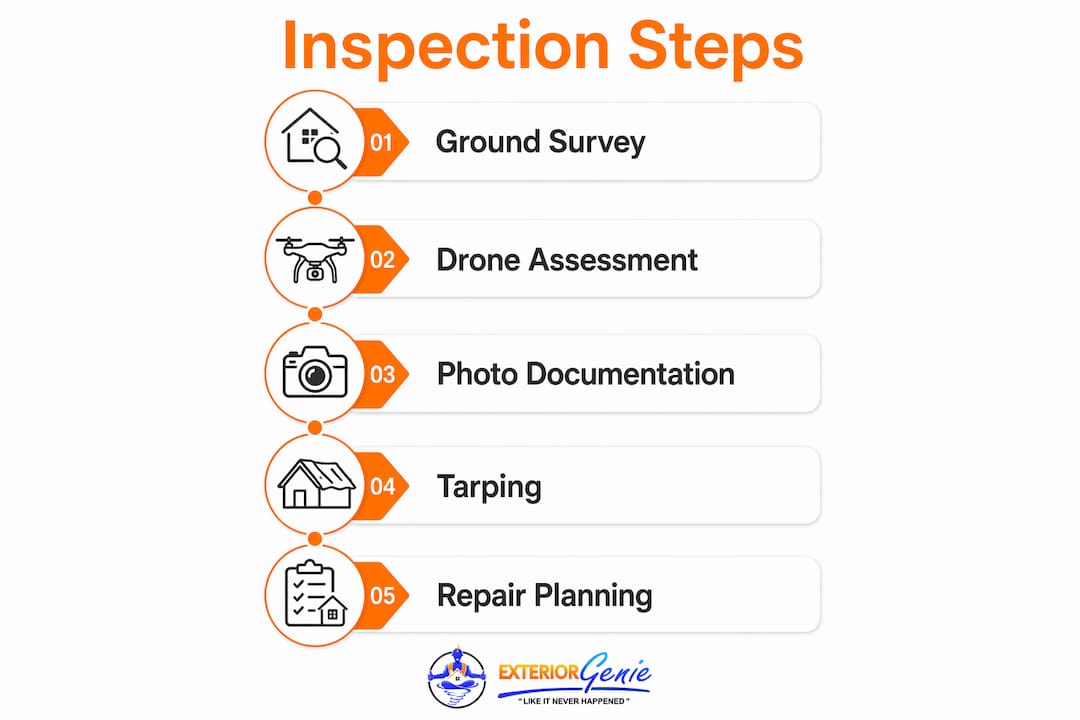
The process follows a three-part sequence. First, the inspector conducts a ground-level survey to identify obvious structural shifts, missing shingles, or debris impact zones. Second, the inspector moves onto the roof and works zone by zone, using chalk to map hail impact points and high-resolution photography to document every failure. Third, the inspector enters the attic to trace active leaks back to their source. This three-part systematic approach produces documentation that holds up under insurance adjuster scrutiny.
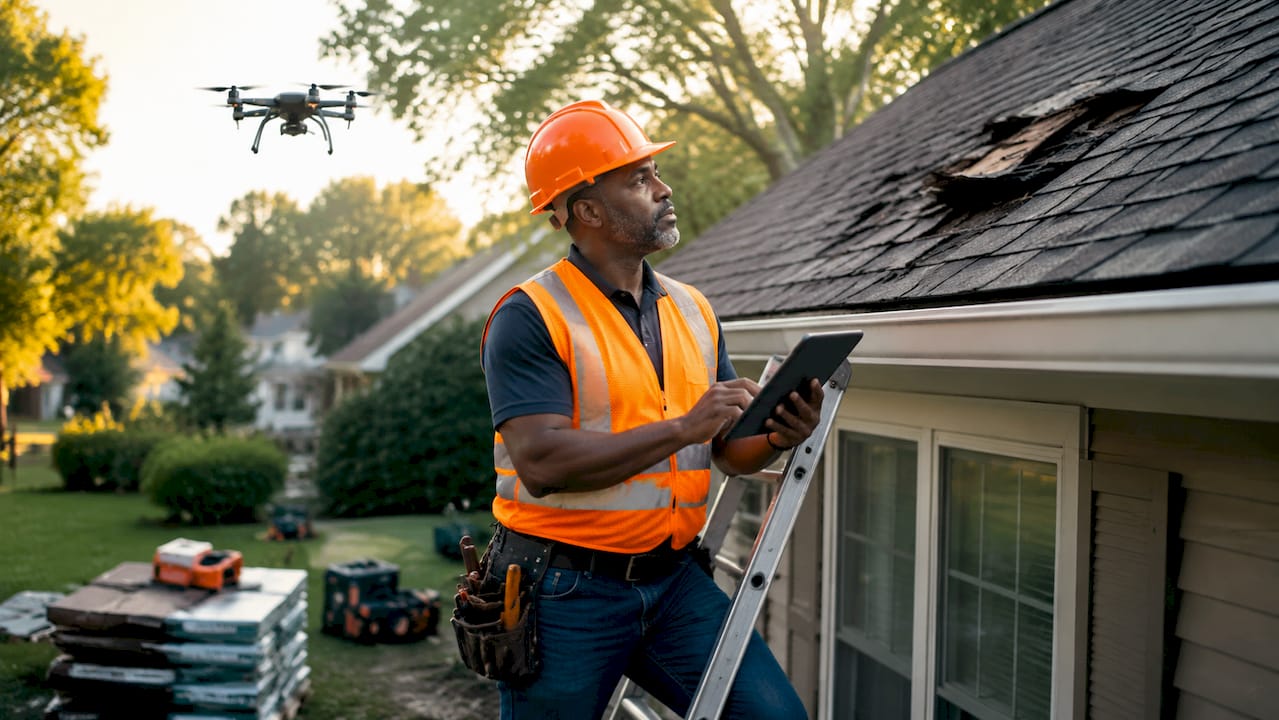
Drone technology has become standard in this process. Drones allow inspectors to safely assess steep or structurally compromised roofs without adding weight or risk. The result is a complete photographic record with native digital metadata, which insurance companies require for defensible claims.
Pro Tip: Never delete or edit photos taken during or after a storm. Native digital metadata in photos is critical legal proof in insurance claims, and altered or unstamped images can invalidate your evidence entirely.
The roof inspection checklist professionals use
A thorough emergency roof inspection covers these zones in order:
- Perimeter and gutters — Check for granule loss, bent gutters, and fascia damage from wind or debris.
- Field shingles — Identify missing, cracked, or bruised shingles across the entire roof surface.
- Flashings — Inspect around chimneys, vents, and skylights. Flashing failure is the most common source of hidden water entry damage that homeowners miss entirely.
- Ridge and hip caps — These take the most wind force and are often the first to fail.
- Attic and interior — Trace staining, wet insulation, or daylight penetration back to the roof surface.
| Inspection zone | What inspectors look for | Why it matters |
|---|---|---|
| Shingles | Bruising, cracks, missing pieces | Direct water entry point |
| Flashings | Separation, rust, lifted edges | Most common hidden leak source |
| Gutters | Granule buildup, bends, detachment | Signals shingle wear and wind force |
| Attic | Staining, wet insulation, daylight | Confirms active water intrusion |
| Decking | Soft spots, rot, delamination | Indicates structural compromise |
Signs you need an urgent roof evaluation right now
Certain conditions require you to call a roof inspector the same day, not next week. Active leaks, sagging ceilings, missing shingles, and debris impact are the four clearest signals that your roof has crossed from damaged to dangerous. Water near electrical fixtures is a fire risk, not just a water damage issue.
Weather events that most commonly trigger emergency assessments include:
- Hailstorms — Even quarter-sized hail can bruise shingles and crack flashings without leaving obvious holes visible from the ground.
- High winds — Winds above 50 mph routinely lift ridge caps and peel back shingle edges, creating open channels for water.
- Fallen trees or large branches — Impact damage often penetrates the decking, creating structural failure points that are invisible until the next rain.
- Tornadoes or microbursts — These can remove entire roof sections in seconds, leaving exposed decking with no protection at all.
Delays carry real financial consequences. Waiting weeks or months after a storm allows insurers to argue that subsequent weather events caused the damage, which can result in claim denial or significant underpayment. The longer you wait, the harder it becomes to prove what one storm actually did to your roof.
Water intrusion also compounds quickly. A small leak that soaks insulation for two weeks creates mold, weakens ceiling joists, and can destroy drywall across an entire room. What started as a $1,500 shingle repair can become a $15,000 interior restoration if left unaddressed.
How an emergency roof assessment protects your property and claim
An emergency roof assessment delivers two distinct benefits: it stops active damage from spreading, and it builds the documentation foundation your insurance claim depends on. Emergency roofing companies prioritize rapid damage stabilization first, using temporary measures to prevent interior loss before planning permanent repairs.
The documentation benefit is where most homeowners underestimate professional inspections. Insurance companies require timestamped photos with native metadata for defensible claims. A professional inspector produces a structured report designed to pass adjuster scrutiny, not just a set of casual snapshots.
"Homeowners often assume the insurance adjuster's inspection is sufficient. An independent professional inspection ensures no damage is overlooked and gives you a competing evaluation that strengthens your position if the adjuster misses something." — Roof Damage Assessment Guide
The benefits of a professional emergency inspection include:
- Independent damage record — Your inspector's report exists separately from the adjuster's, giving you leverage if the adjuster undervalues the damage.
- Hidden damage identification — Professionals find flashing failures and decking soft spots that adjusters routinely miss on quick walkthroughs.
- Claim timeline support — A report dated within 24–72 hours of the event directly links damage to that specific storm, which is the single most important factor in claim approval.
- Repair scope clarity — You know exactly what needs fixing before any contractor starts work, which prevents scope creep and surprise costs.
For a deeper look at how inspection documentation affects your claim outcome, the Exteriorgenie blog covers roof inspection and insurance claims in detail.
Emergency roof tarping: temporary protection, not a permanent fix
Emergency roof tarping is the first physical response after an inspection confirms exposed or compromised areas. Its sole purpose is to prevent water from entering the structure while permanent repairs are scheduled. Tarping is a strictly temporary stop-gap; it does not restore structural integrity or replace damaged materials.
The limitations of tarping are real and worth understanding before you rely on one.
| Factor | Tarping | Permanent repair |
|---|---|---|
| Wind resistance | Fails above 30 mph | Rated for local wind codes |
| Water protection | Partial, seams can leak | Complete, sealed system |
| Insurance coverage | Covered under emergency provisions | Covered under standard claim |
| Duration | Days to weeks | Years to decades |
| Structural value | None | Full restoration |
Proper installation matters significantly. A tarp fastened with insufficient anchor points or draped loosely over a ridge will fail in the next moderate wind event, leaving your interior exposed again. Professional installers use weighted boards, proper fastening hardware, and overlap techniques that comply with insurance emergency repair provisions.
Pro Tip: Document the tarping installation with timestamped photos before and after. Properly documented tarping supports insurance coverage under emergency repair provisions and proves you took reasonable steps to mitigate further damage.
Understanding your temporary roof repair options before a storm hits puts you in a much stronger position when you actually need them.
Key Takeaways
An emergency roof inspection is the fastest and most reliable way to stop storm damage from becoming a total loss, and its documentation directly determines your insurance claim outcome.
| Point | Details |
|---|---|
| Act within 24–72 hours | Inspections in this window link damage to the event and protect your claim from dispute. |
| Three-part inspection process | Ground survey, zone-by-zone roof assessment, and attic tracing produce defensible documentation. |
| Flashings fail first | Chimneys, vents, and skylights are the most common hidden water entry points inspectors prioritize. |
| Independent inspection matters | An adjuster's report alone is not enough; a professional inspection catches overlooked damage. |
| Tarping is temporary | Tarps fail above 30 mph and must be professionally installed to qualify under insurance emergency provisions. |
Why I tell every homeowner: the clock starts the moment the storm ends
I have been on roofs across South Carolina for 25 years, and the single most costly mistake I see homeowners make is waiting. Not because they are careless. Because they assume the insurance company will handle it, or because the damage does not look that bad from the driveway.
Here is what that assumption costs. When you wait two weeks to get an inspection, the insurer's adjuster can point to the second storm that rolled through and argue your damage is from that event, not the one you filed for. I have watched legitimate claims get cut in half or denied outright because the homeowner could not prove timing. A report dated within 72 hours of the event is almost impossible to dispute. A report dated three weeks later is a negotiation, and you are starting from a weaker position.
The other thing I want you to understand is that flashings are where inspectors earn their fee. Every homeowner looks at shingles. Almost no homeowner looks at the metal flashing around their chimney or the boot seal around a plumbing vent. Those are the spots that fail quietly, drip for months, and rot out a rafter before you ever see a water stain on your ceiling. A thorough roof inspection before repairs is not a formality. It is the only way to know what you are actually dealing with.
My honest advice: treat the inspection as your first move, not your last resort.
— Ebben
How Exteriorgenie responds when your roof needs help now
Exteriorgenie provides 24/7 emergency roof repair services in Lexington, SC, with HAAG-certified inspectors who produce insurance-grade documentation from the first visit. Every assessment follows the three-part process described in this article: ground survey, roof-level zone inspection, and attic tracing. The team handles temporary stabilization, complete damage reporting, and direct coordination with your insurance company so nothing falls through the cracks.

If you are dealing with storm damage and need professional insurance claims assistance, Exteriorgenie's team walks you through every step from inspection to settlement. Call (803) 999-7663 or visit exteriorgenie.com to schedule your assessment today.
FAQ
What is the difference between an emergency and a routine roof inspection?
A routine inspection checks for wear, aging, and maintenance needs on a scheduled basis. An emergency inspection focuses on immediate safety threats like active leaks, structural sagging, or exposed decking that require same-day or next-day response.
When should I call a roof inspector after a storm?
Call within 24–72 hours of the damaging event. Inspections in this window directly link damage to the specific storm, which is the strongest position for an insurance claim and prevents insurers from attributing damage to later weather.
Does my insurance company's adjuster inspection replace a professional inspection?
No. An adjuster works for the insurance company, not for you. An independent professional inspection often identifies damage the adjuster misses, particularly at flashings, and provides a competing report that strengthens your claim.
How long does an emergency roof inspection take?
Most emergency inspections take 1–3 hours depending on roof size and damage complexity. The inspector conducts a ground survey, a zone-by-zone roof assessment, and an attic walkthrough before producing a documented report.
Is emergency roof tarping covered by insurance?
Properly documented emergency tarping is typically covered under the emergency repair provisions of most homeowner policies. Professional installation with timestamped photos and compliant fastening methods is required to qualify for that coverage.