
Replacing a roof on a 1,600 sq ft home typically runs $7,600 to $16,000 for standard architectural asphalt shingles, with a national mid-point near $11,200 for a mid-grade install on a cross-gable roof. Premium materials like standing-seam metal or slate often increase the cost significantly beyond standard asphalt shingles. On a per-square-foot basis, installed costs vary widely depending on job complexity and material choice.
Three variables do most of the work on final price:
- Material choice. Asphalt shingles sit at the low end; metal, tile, and slate can double or triple the cost.
- Roof complexity. Steep pitches, multiple valleys, skylights, and chimneys add labor hours and safety equipment costs.
- Hidden decking repairs. Rotted plywood or OSB discovered after tear-off is priced separately, typically $75–$125 per sheet, and older roofs often need several.
The fastest next step: call at least three local contractors and request a written, line-item estimate that explicitly lists tear-off, disposal, permit fees, underlayment, flashing, and decking replacement. Any quote missing those line items is incomplete.
Table of Contents
- What does each roofing material cost for a 1,600 sq ft house?
- What else drives the cost beyond materials?
- How does your location affect the price?
- How do contractors calculate your actual roof area?
- How long does a roof replacement take, and how long will it last?
- How do you pay for it, and what about insurance?
- Why contractor credentials matter more than you might think
- Key Takeaways
- What crews actually see that homeowners miss
- Exteriorgenie handles 1,600 sq ft replacements in Lexington, SC
- Useful sources and next steps
What does each roofing material cost for a 1,600 sq ft house?
Material is the single biggest lever on your total bill. The table below shows installed cost ranges (labor and materials combined) for a 1,600 sq ft home, along with lifespan and climate fit. These figures assume a standard tear-off of one existing layer, basic underlayment, and no major decking repairs.
| Material | Per Sq Ft (installed) | Total for 1,600 Sq Ft | Lifespan | Best For | Typical Warranty |
|---|---|---|---|---|---|
| 3-tab asphalt | — | — | 15–20 yrs | Budget installs, mild climates | 20–25 yr material |
| Architectural asphalt | — | — | 25–30 yrs | Most U.S. climates | 30 yr material, 10 yr labor |
| Designer/luxury shingles | — | — | 30–50 yrs | High-wind, impact-rated zones | 50 yr material |
| Standing-seam metal | — | — | — | Snow country, coastal, high-wind | Lifetime material |
| Metal shingles | — | — | — | Moderate to severe weather | 40–50 year material |
| Clay or concrete tile | — | — | 50–100 yrs | Southwest, Mediterranean climates | 50 yr material |
| Slate (natural) | — | — | 75–150 yrs | Northeast, premium builds | Lifetime |
| TPO/EPDM flat | — | — | 20–30 yrs | Low-slope additions | 10–20 yr membrane |
A few things drive material price beyond the shingle itself. Specialty underlayments (ice-and-water shield, synthetic felt) add $0.50–$1.50 per sq ft. Impact-resistant shingles rated Class 4 cost more upfront but can reduce insurance premiums in hail-prone states. Standing-seam metal costs roughly double asphalt installed but can last 50+ years with minimal maintenance.
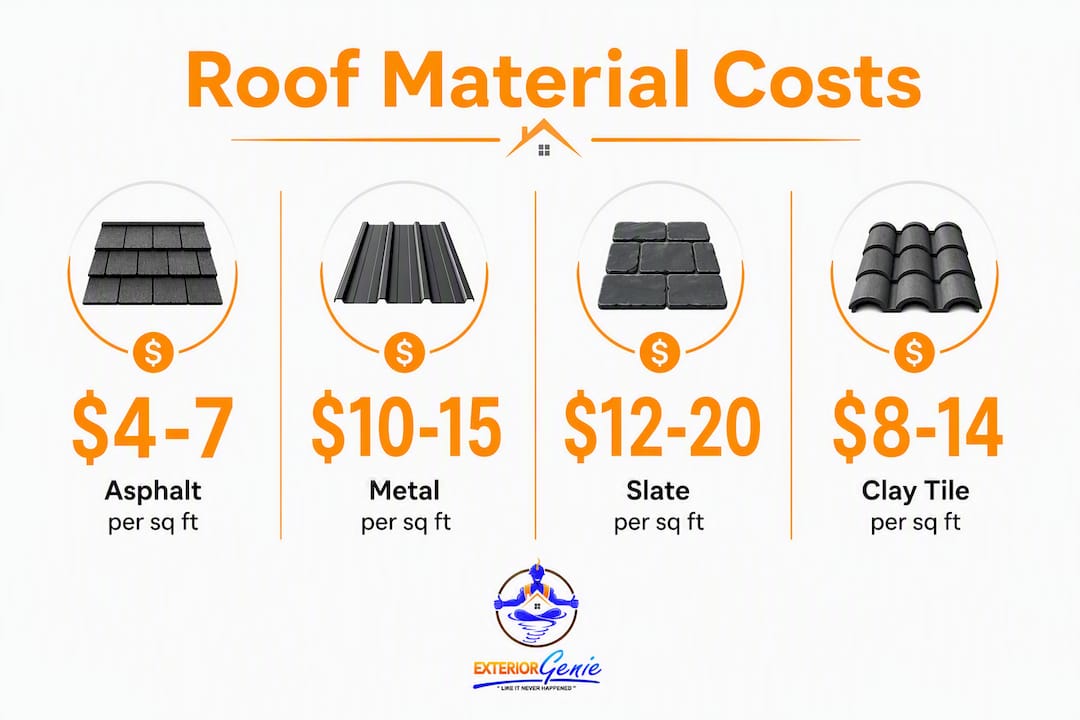
The outliers worth flagging: natural slate and clay tile require reinforced decking and specialized labor, so the installed cost often runs well above the material price alone. For most homeowners, architectural asphalt shingles remain the practical default. For a deeper look at residential roofing materials and how they perform by climate, Exteriorgenie's material guide covers the tradeoffs in detail.
What else drives the cost beyond materials?
Roof complexity is a bigger labor cost driver than raw square footage. A simple gable roof on a single-story home costs far less to install than the same square footage spread across a multi-slope, multi-story structure with chimneys and skylights.
- Pitch/steepness. A 6/12 pitch is manageable; anything above 8/12 requires safety harnesses, slower work, and more crew time. Steep-slope adders commonly run $1.00–$2.00 per sq ft extra.
- Number of existing layers. Tearing off two layers of old shingles instead of one adds disposal weight and labor time. Most jurisdictions require full tear-off before re-roofing anyway.
- Valleys, skylights, and chimneys. Each penetration requires custom flashing and more precise cutting. A single skylight can add $300–$600 in labor; a chimney re-flash runs $200–$500.
- Multi-story access. Upper-story work requires longer ladders, additional safety rigging, and slower material staging. Expect a 10–20% labor premium on two-story homes.
- Decking replacement. Rotted plywood or OSB found after tear-off is priced per sheet at $75–$125. Budget for several sheets on any roof older than 20 years.
- Ventilation upgrades. Ridge vents, soffit vents, or power ventilators are often added during replacement. A full ventilation upgrade can run $300–$800.
- Permit and disposal fees. Permits range from $150 to $1,000 depending on the municipality. Dumpster rental and disposal add $300–$900 in most markets.
- Flashing replacement. Step flashing, drip edge, and valley flashing should be replaced with every new roof. Skipping it voids most manufacturer warranties.
Pro Tip: Ask every contractor to send a written estimate that lists tear-off, disposal, permit, underlayment, flashing, and decking replacement as separate line items. A quote that bundles everything into one number is hiding something. Low-ball bids almost always omit one or more of these items, and you'll pay for them as change orders after the job starts.
How does your location affect the price?
National averages are a useful starting point, but where you live can shift the final number by several thousand dollars. Labor markets, disposal costs, local permit fees, and climate-driven material requirements all vary by region.
- South (including Southeast). Labor rates tend to be moderate, and mild winters mean fewer weather delays. Suburban Southern markets often land in the mid-range of national estimates. High-wind and hurricane zones along the Gulf Coast push material specs up, though.
- Northeast. Urban labor rates and strict permitting push costs higher. Ice-and-water shield underlayment is code-required in most Northern states, adding material cost. Expect totals at or above the national high end for complex jobs.
- Midwest. Mid-range labor costs, but hail-prone states like Kansas, Nebraska, and Oklahoma drive demand for impact-rated shingles. Seasonal demand spikes after spring storm season can push contractor availability and pricing up.
- Mountain West and rural markets. Labor can be lower in rural areas, but material delivery costs offset some of that savings. High-altitude and heavy-snow markets favor metal roofing for its snow-shedding performance.
- California and high-cost coastal states. State-specific factors like strict building codes, fire-resistant material requirements, and high labor costs push totals materially above national averages. A project that runs $12,000 in South Carolina might run $18,000–$22,000 in the Bay Area.
The practical takeaway: get at least two or three local quotes and ask each contractor to break out the per-sq-ft rate separately from disposal and permit fees. That breakdown lets you compare apples to apples across bids.
How do contractors calculate your actual roof area?
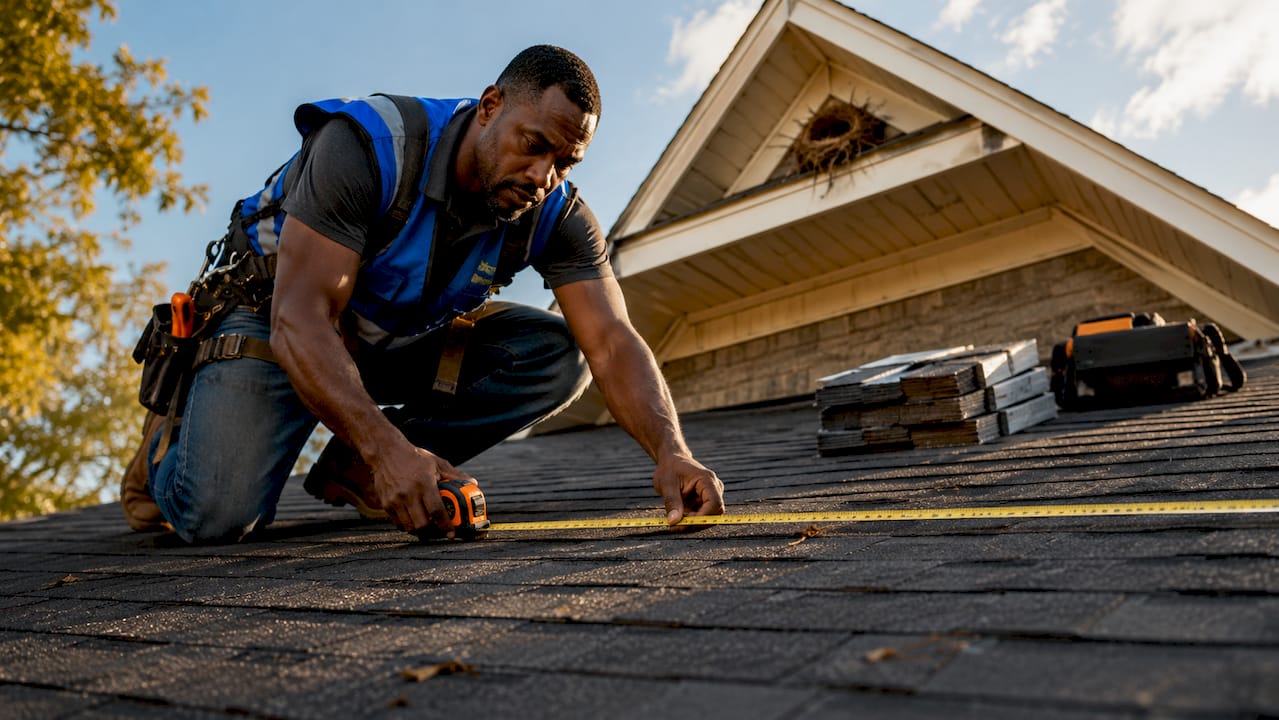
Your house footprint and your roof surface area are not the same number. A 1,600 sq ft home footprint almost always produces more than 1,600 sq ft of actual roof surface once pitch, overhangs, and waste are factored in.
The roofing square
Contractors measure roofing jobs in squares, where one square equals 100 sq ft of roof surface. A 1,600 sq ft home footprint typically yields 18–24 roofing squares of actual surface area, depending on pitch and overhang depth.
How pitch changes the math
- Low slope (3/12 pitch): Multiply footprint by roughly 1.08. A 1,600 sq ft footprint becomes about 1,730 sq ft of roof surface, or 17–18 squares.
- Moderate slope (6/12 pitch): Multiply by roughly 1.12–1.18. The same footprint becomes 1,790–1,890 sq ft, or 18–19 squares.
- Steep slope (9/12 pitch): Multiply by roughly 1.25–1.30. That 1,600 sq ft footprint becomes 2,000–2,080 sq ft, or 20–21 squares.
- Add waste factor. Contractors typically add 10–15% for cuts, overlaps, and waste. On a complex roof with multiple valleys, that waste factor climbs to 15–20%.
One-story homes also produce significantly more roof area than two-story homes with the same footprint. This Old House models a one-story 1,600 sq ft home at roughly 1,900+ sq ft of roof surface versus under 1,000 sq ft for a two-story home of the same footprint.
Worked cost examples
Example A: Basic asphalt install, one-story, moderate pitch (6/12)
- Estimated roof surface: 19 squares (1,900 sq ft)
- Material + labor at a moderate rate per square foot installed
- Add permit and disposal fees as applicable, varying by locale
- Assumptions: single-layer tear-off, standard underlayment, no decking repairs, no skylights
Example B: Standing-seam metal, one-story, moderate pitch (6/12)
- Same 19 squares
- Material + labor at $13.00/sq ft installed: $24,700
- Add permit ($400) + disposal ($700): $25,800 total
- Assumptions: same as above; premium underlayment included
These examples show why the "1,600 sq ft" label in a quote can mean very different things. Always ask the contractor to state the total square count they measured on-site, not just the house footprint.
How long does a roof replacement take, and how long will it last?
For a 1,600 sq ft home, most replacements finish within a few days under normal conditions. A simple gable roof with no penetrations and a single-layer tear-off is often a one-day job for an experienced crew. Add skylights, chimneys, multiple slopes, or a steep pitch, and two to three days is more realistic. Weather delays, material backorders, and permit inspection requirements can extend the schedule further.
| Material | Typical Install Time (1,600 sq ft) | Expected Lifespan | Maintenance Notes |
|---|---|---|---|
| 3-tab asphalt | 1 day | 15–20 years | Annual inspection; replace cracked shingles promptly |
| Architectural asphalt | 1–2 days | 25–30 years | Clean gutters; check flashing every 2–3 years |
| Designer/luxury shingles | 1–2 days | 30–50 years | Same as architectural; impact-rated versions need less frequent checks |
| Standing-seam metal | 2–3 days | — | Inspect sealants at penetrations every 5–10 years |
| Metal shingles | 2–3 days | — | Check fasteners after severe storms |
| Clay/concrete tile | 3–5 days | 50–100 years | Replace cracked tiles immediately; check underlayment at 20 years |
| Natural slate | 5–10 days | 75–150 years | Annual inspection by slate specialist; repoint flashings |
A few scheduling notes worth knowing:
- Late summer and fall are peak season for roofers in most U.S. markets. Demand is high after storm season, which can push lead times out two to four weeks and occasionally nudge prices up.
- Late winter and early spring often offer better contractor availability and sometimes lower pricing, though cold temperatures can affect shingle sealing in Northern climates.
- Storm-season timing matters in the Southeast and Midwest. If you're replacing after hail or wind damage, contractors book up fast. Having a relationship with a local roofer before a storm hits is worth more than most homeowners realize.
How do you pay for it, and what about insurance?
Financing options
Most homeowners don't pay cash for a roof replacement. Common paths:
- Contractor financing. Many roofing companies offer in-house payment plans, sometimes with promotional 0% periods. Read the terms carefully; deferred-interest products can be expensive if not paid off in time.
- Home improvement loans. Unsecured personal loans from banks or credit unions. Rates vary by credit score but avoid putting your home as collateral.
- HELOC (home equity line of credit). Lower interest rates than personal loans, but your home secures the debt. Best for homeowners with significant equity and a longer repayment horizon.
- Insurance claim. If storm, hail, or wind caused the damage, your homeowner's policy may cover most of the replacement cost minus your deductible.
Insurance basics
Not every roof replacement qualifies for an insurance claim. Policies typically cover sudden damage from storms, hail, wind, and falling objects. Normal wear and age-related deterioration is almost never covered. The difference between a covered claim and a denied one often comes down to documentation.
A HAAG-certified inspector produces a damage assessment that insurance adjusters take seriously. HAAG certification is a forensic roofing credential that trains inspectors to distinguish storm damage from normal wear, which is exactly the distinction your insurer will scrutinize. Contractors who carry HAAG certification can document damage in the format adjusters expect, reducing disputes and speeding up claim approvals.
For more on how a professional inspection supports your claim, Exteriorgenie's insurance claim guide walks through the documentation process step by step.
Contractor quote checklist
When comparing bids, require these line items in writing:
- Total roof area measured on-site (in squares), not just the house footprint
- Tear-off and disposal of existing layers (number of layers specified)
- Permit fee (included or billed separately)
- Underlayment type and coverage
- Flashing replacement (drip edge, step flashing, valley flashing)
- Decking inspection and per-sheet replacement rate if rot is found
- Manufacturer warranty details and workmanship warranty length
Three red flags in a quote: a single lump-sum number with no line items; no mention of permit or disposal; a warranty that covers only materials but not labor.
Warranty and maintenance plans affect lifetime cost more than most homeowners account for. A 30-year architectural shingle with a 10-year workmanship warranty from a certified contractor costs more upfront than the same shingle installed by an uncertified crew, but the workmanship warranty is what actually protects you if a leak develops in year three.
Why contractor credentials matter more than you might think
The cheapest bid and the best bid are rarely the same thing. Credentials protect you in two specific ways: they reduce the chance of a botched install, and they give you legal and financial recourse if something goes wrong.
- HAAG certification. A HAAG-certified inspector has completed forensic training in damage assessment. For insurance claims, this credential carries weight with adjusters. For a standard replacement, it signals the contractor understands how damage progresses and what a proper install requires. Learn more about why HAAG certification matters for both residential and commercial work.
- State contractor license. Licensing requirements vary by state, but a licensed contractor has passed minimum competency and background checks. Always verify the license number through your state's contractor licensing board before signing anything.
- Proof of insurance and bonding. General liability insurance protects your property if the crew damages something. Workers' compensation covers crew injuries on your property. Ask for certificates of insurance, not just verbal assurances.
- Manufacturer certification. GAF Master Elite, Owens Corning Preferred, and similar programs require contractors to meet installation standards. These certifications are often required to access the manufacturer's extended warranty.
A professional inspection before and after installation should cover: decking condition and any soft spots, existing flashing integrity, ventilation adequacy, underlayment type and installation method, and evidence of prior storm or moisture damage. Documenting inspection findings in writing, with photos, protects your warranty eligibility and gives you a paper trail for any future insurance claim.
Pro Tip: Before your adjuster visits, ask your contractor to walk the roof with you and photograph every area of damage. An adjuster who arrives to a documented, itemized damage report moves faster and denies less than one who is seeing the roof cold.
Key Takeaways
Replacing a 1,600 sq ft roof costs $7,600–$16,000 for standard asphalt, with material choice, roof complexity, and hidden decking repairs doing most of the work on final price.
| Point | Details |
|---|---|
| National cost range | Most homeowners pay $7,600–$16,000 for asphalt; metal runs $14,000–$26,000 installed. |
| Roof area vs. footprint | A 1,600 sq ft footprint typically yields 18–24 roofing squares of actual surface area. |
| Biggest hidden cost | Rotted decking found after tear-off runs $75–$125 per sheet; budget for it on older roofs. |
| Insurance claims | HAAG-certified inspectors produce documentation that reduces adjuster disputes on storm claims. |
| Exteriorgenie | Offers full replacements, HAAG-backed inspections, insurance-claims assistance, and financing in Lexington, SC. |
What crews actually see that homeowners miss
Most homeowners budget for the shingles and forget everything else. That's the gap where projects go sideways.
The most common surprise on a 1,600 sq ft job isn't the material cost. It's the decking. Tear off a 20-year-old roof and you'll often find soft spots, delaminated OSB, or outright rot that wasn't visible from the ground or even from a ladder inspection. A contractor who didn't account for decking repairs in the original quote will hand you a change order on day one. That's not a scam; it's physics. But a contractor who charges a flat per-sheet rate disclosed upfront is treating you fairly. One who charges whatever they feel like after tear-off is not.
The second thing crews see constantly: mismatched warranties. A homeowner buys a 30-year shingle but hires an uncertified installer to save $800. The manufacturer's extended warranty requires certified installation. The homeowner finds out when they file a claim in year seven and gets denied. The $800 savings cost them the warranty.
Do this:
- Require a written, line-item quote before signing anything
- Ask for the contractor's license number and verify it with your state board
- Request certificates of insurance, not just a verbal "we're covered"
- Get the manufacturer warranty terms in writing before the job starts
Avoid this:
- Signing a contract with a single lump-sum price and no line items
- Accepting verbal promises about what's included
- Choosing a contractor solely on price without checking credentials
- Skipping the post-installation inspection walkthrough
Exteriorgenie handles 1,600 sq ft replacements in Lexington, SC
Getting an accurate estimate starts with someone who actually measures your roof, not someone who quotes from satellite imagery and hopes for the best. Exteriorgenie is a veteran-owned roofing company serving Lexington, SC and the surrounding Midlands area, with 25 years of experience and HAAG-certified inspectors on staff.

For a 1,600 sq ft replacement, Exteriorgenie covers the full scope: tear-off, decking inspection, material selection, installation, and final inspection. If storm or wind damage is involved, the team provides insurance claims assistance backed by HAAG certification, which means your adjuster gets a damage report that holds up. For homeowners who need payment flexibility, financing options are available so the project doesn't have to wait. Emergency roof tarping is available 24/7 for active leaks. Request an on-site estimate by calling (803) 999-7663 or visiting exteriorgenie.com.
Useful sources and next steps
Use these resources to verify estimates, check local licensing, and connect with trusted professionals:
- Fixr: Cost of New Roof 1,600 Sq Ft — national average ranges and material breakdowns
- This Old House: Roof Replacement Cost for a 1,600 Sq Ft House — story-by-story cost modeling and pitch assumptions
- CurrentCost: Roof Replacement Cost for 1,600 Sq Ft — per-component cost breakdowns and installed per-sq-ft ranges
- Eagle River Roofing: Budgeting for a New 1,600 Sq Ft Roof — material-by-material installed ranges and metal vs. asphalt comparison
- Exteriorgenie Financing Page — payment plans and financing pre-approval for Lexington, SC homeowners
- Exteriorgenie Insurance Claims Assistance — HAAG-backed inspection and claims support
Before signing any contract, verify your contractor's license at your state licensing board's website. In South Carolina, the SC Contractor's Licensing Board maintains a public lookup. Always read the written estimate line by line and confirm that permit, disposal, and flashing are explicitly included.