
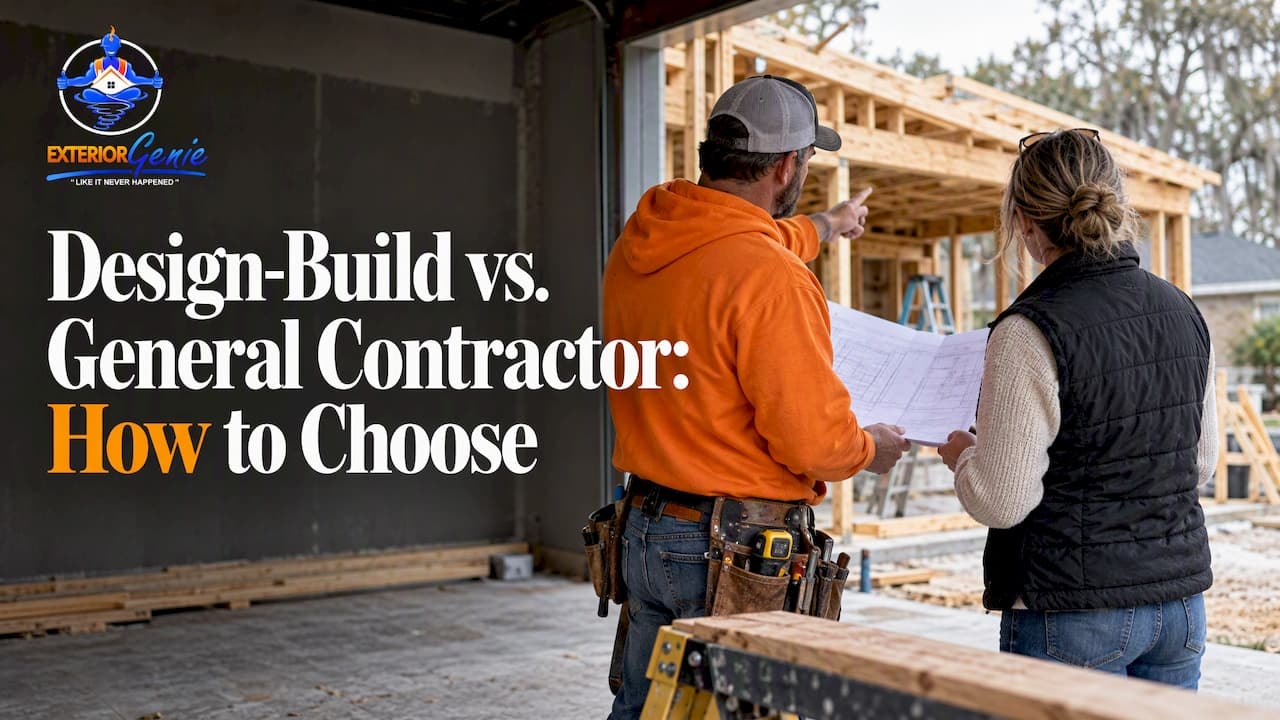
Design-build means one company signs one contract and answers for both the design and the construction. With a general contractor, you usually hire a designer or architect separately, then hire the builder, and you sit in the middle. For a like-for-like roof replacement, siding or gutters, you rarely need a designer, so a good general contractor is the simpler fit. For an addition, a structural change or a major remodel, a single accountable team can save you coordination headaches. The rest of this guide shows how to tell which situation you are in.
TL;DR
- Design-build is a contracting method: one entity holds responsibility for design and construction. A general contractor is the party that runs the construction side.
- A general contractor can also be the design-builder if the contract covers design. Compare what is written in each proposal, not the job titles.
- Roof replacement, repair, siding and gutters usually need no architect. Additions, structural changes and larger remodels often benefit from coordinated design and construction.
- Published studies of design-build report gains in speed and cost, but they measured commercial buildings. Do not read them as a promised saving on your house.
- In South Carolina, check the contractor's state license and your city or county's permit rules before you sign, whatever the company calls its service.
Table of Contents
- What each term actually means
- How the two paths compare
- What the evidence says about cost and speed
- When a general contractor is the right call
- When a design-build approach earns its place
- Questions to ask any contractor before you sign
- South Carolina: licensing and permits matter more than the label
- For property managers and investors
- Storm damage: why coordination counts
- Our perspective
- Where Exterior Genie fits
- FAQ
- Sources
What each term actually means
The confusion starts because the two phrases do not describe the same kind of thing. One names a contracting method. The other names a role.
Design-build is a project delivery method. The AGC defines it as one in which design and construction contracts are combined. You deal with one entity, and that entity is responsible for both. The AIA's primer on delivery terms lists it alongside design-bid-build and construction manager at risk as one of the three most common methods. The design-builder may be led by an architect or by a contractor.
A general contractor (GC) is the party that oversees the construction: specialty trades, labor, materials, safety and completion, as Procore's definition puts it. How much a GC does depends on the contract and the delivery method.
Design-bid-build, the traditional alternative, is what most people picture when they say "hire a contractor." The AIA's guidance for owners explains that you have separate agreements with an architect and a contractor. You usually retain the architect first to develop the design, then bring in the builder.

So the real question is not "design-build or general contractor?" It is: who is legally responsible for the design, who is responsible for the construction, and are they the same party?
How the two paths compare
| Question | Design-build | Separate designer + general contractor |
|---|---|---|
| Contracts | One contract with one entity | Two or more, each signed by you |
| Who coordinates design and construction | The design-build team | You, as the link between them |
| Sequence | Design and construction can overlap | Usually linear: design, bid, then build |
| Choice of designer and builder | Limited to the integrated team | You pick each independently |
| Budget knowledge | Builder input during design | Firm pricing often arrives after plans are done |
| Best when | Scope is not yet defined, or several trades interact | You already have complete plans |
The AIA notes that in design-build, design and construction can overlap, while design-bid-build generally runs in sequence. That overlap is where the time savings come from. It is also why you need to be clear on scope early.
What the evidence says about cost and speed
You will see confident claims online that design-build is faster and cheaper. Here is what the data supports.
A Penn State comparison of 351 U.S. building projects, published through the CII research program, reported design-build averaging 6% lower unit cost, 12% faster construction speed and 33% faster total delivery than design-bid-build. Those are averages from commercial building projects. They are not guarantees, and they say nothing about what your bathroom remodel or roof will cost.

The Design-Build Institute of America lists single-point responsibility, earlier cost knowledge, fewer changes and claims, and faster delivery as the intended benefits. The same material makes clear that you still have to choose a capable team and a balanced contract. Design-build does not automatically mean the lowest initial price.
Take the numbers as a reason to ask good questions, not as a promise.
When a general contractor is the right call
A conventional general contractor is usually the better match in these situations:
- You already have drawings. If an architect or designer has produced complete plans, you need someone to build them and price them competitively.
- The job is like-for-like. A tear-off and new roof, a siding replacement, new seamless gutters or a repair does not need an architect. You need a licensed, insured crew and a written scope.
- You want to choose the designer separately. Some owners care about a specific architect's style and want independence from the builder.
- You want to bid the work. With a complete set of plans, several builders can price the same scope, which makes comparison easier.
Most roof and exterior work in the Midlands falls into the first two groups. If you are replacing a roof after a hailstorm, you are not shopping for a design. You are shopping for a scope, a material, a schedule and a warranty. Our guide to reviewing a new roof contractor's contract covers what that scope should spell out.
When a design-build approach earns its place
Integrated design and construction pays off when the project has moving parts that depend on each other:
- Additions and structural changes. Framing, roof tie-ins, drainage, electrical and permits all interact. A team that handles design and construction together can catch conflicts on paper instead of on site.
- Larger remodels. A kitchen or bathroom gut renovation involves layout decisions, plumbing and electrical rough-ins, selections and inspections. Changing the layout late is where budgets drift.
- Commercial build-outs. Tenant improvements involve engineering, code review and a fixed move-in date.
- Storm restoration with interior damage. Roof, decking, insulation, drywall and sometimes engineering have to happen in the right order, and an insurance adjuster is watching the scope.
The AIA's guidance on design-build notes the owner is buying coordinated responsibility, not just one more trade. The more your project depends on several trades lining up, the more that is worth.
A quick test
Ask yourself three questions:
- Is the finished result already defined, such as a same-size roof in the same style? If yes, hire a general contractor for the build.
- Will the work change how the structure, layout or floor plan is arranged? If yes, you need design input, and one accountable team is worth pricing.
- Do you have the time and appetite to coordinate a designer, a builder and an inspector yourself? If not, lean toward a single contract.
Questions to ask any contractor before you sign
Whether the proposal says "design-build," "general contracting" or just "remodeling," the label does not tell you what you are buying. Put these questions to every bidder:
- Who is responsible for the design? Is it in the contract, who performs it, and who signs off on the completed work?
- What does the written scope include? Demolition, materials by brand and line, underlayment, flashing, ventilation, cleanup, disposal, permits.
- What are the allowances? Fixtures, tile, windows and similar items are often priced as placeholders. Find out the number.
- How are changes handled? Change orders should be written, priced and signed before the work happens.
- What are the payment milestones? Payment should follow completed stages, not arrive up front in full.
- What warranties apply, and who stands behind them? Separate manufacturer and workmanship coverage.
- What insurance does the company carry? Ask for a certificate.
The AIA and DBIA materials both point to the same lesson: define scope early and make the contract balanced. For more on vetting people, see our hiring tips for exterior repair contractors.
South Carolina: licensing and permits matter more than the label
A delivery method is not a qualification. In South Carolina, check the license first.
The state licensing board lists roofing as a general-contractor subclassification and notes that municipalities and counties may require additional licensing or permitting. The Residential Builders Commission handles residential builders and specialty contractors, so confirm the company's registration in the category that matches your work. Richland County's residential page states that state law requires residential construction to be done by licensed residential builders and specialty contractors, with narrow exemptions.
Permits vary by jurisdiction. Richland County asks for materials such as a roofing contract, a detailed scope and a permit application for residential roofing and siding submissions. Your city or county office is the authority, and the rules for Lexington County, Columbia or a smaller town can differ. Our walkthrough of South Carolina roofing permits explains the filing steps so you avoid delays and fines.
The same applies to design. If your project changes the structure, ask whether the local office wants stamped drawings or engineering, and who on the team provides them.
For property managers and investors
If you manage several properties, you care less about design philosophy and more about predictable, documented outcomes. One point of contact for estimates, scheduling, tenant notice and invoicing cuts the number of vendors you chase. The principle is the same one covered in this maintenance coordination playbook for managers: fewer handoffs mean fewer surprise bills.
For commercial roofing, our commercial roof replacement planning guide walks through budgeting and timing. For tenant improvements and build-outs, the scope usually involves more design input, so ask about it up front.
Storm damage: why coordination counts
After hail or wind, the work rarely stays on the roof. You may have tarping, a claim, an adjuster visit, decking repairs, interior drywall and paint. The South Carolina Department of Insurance has a post-disaster claims guide that covers the recovery phase, including choosing building materials and working with contractors. Read it before you sign anything with a contractor who knocks on your door after a storm.
What helps here is a contractor who documents the damage, talks to your insurer's adjuster and sequences the trades. That is a coordination job more than a design job, and it is the reason the storm-repair side of our business is built around communication.
Our perspective
We are a veteran-owned general contractor serving Lexington, Columbia and the surrounding Midlands, and we handle roofing, storm restoration, siding, gutters, remodeling, additions and commercial construction. Here is how we see this question.
Most of our homeowners do not need a new design. They need a roof that is correctly scoped, installed by a crew that shows up and finished with a warranty they can read. For that work, a general contractor with strong project management is the right answer, and adding an architect would only add cost and time. We tell people that plainly, and we give honest repair-versus-replacement guidance, even when it means a smaller job.
The picture changes with a larger remodel, an addition or a commercial build-out. There, what matters is that someone owns the interfaces between trades. That is the discipline we bring from our military background: a clear plan, clear communication and one person who answers your call. If a project needs design or engineering input, we will say so at the start and explain who provides it, rather than discover it halfway through.
Our advice is to judge any contractor, including us, on the written scope, the license, the warranty and how they handle changes. Titles are marketing. Paper is protection.
— Ebben
Where Exterior Genie fits
If your project is a roof, siding, gutters or storm repair, start with our roof replacement and exterior services. If you have storm damage and need help with an insurance claim, our insurance claims assistance uses HAAG-certified inspectors, and we offer 24/7 emergency roof tarping. For an interior project, see our kitchen remodeling and bathroom remodeling pages, or contact us through the main site to talk through a larger addition or commercial job.
FAQ
Is design-build more expensive than hiring a general contractor?
Not necessarily, and not necessarily cheaper either. A large U.S. comparison found lower average unit cost for design-build on commercial buildings, but individual results vary. Compare written scopes, allowances and change-order terms rather than the headline price.
What is a disadvantage of design-build?
You give up some independence, because you choose one integrated team instead of picking the designer and builder separately. DBIA and other owner guidance stresses choosing a capable team and a balanced contract. You also need to settle the scope early so the price means something.
Can a general contractor do design-build?
Yes. A general contractor can serve as the design-builder by adding design capability or contracting for it, as the AIA's delivery primer describes. The test is whether one contract makes one party responsible for both design and construction.
Do I need design-build for a roof replacement?
Usually not. A like-for-like reroof does not need architectural design, so a licensed roofing or general contractor with a detailed written scope is enough. Ask your local building office whether your project needs a permit or any plans.
Sources
- Design-Build | Associated General Contractors of America
- A primer on project delivery terms | AIA
- Construction Basics for Owners: Design-Bid-Build vs. Design-Build | AIA Contract Documents
- What Is Design-Build? | DBIA
- General contractor definition | Procore
- A Comparison of US and UK Project Delivery Systems (CII/Penn State)
- South Carolina LLR, Contractors' Licensing Board
- South Carolina Residential Builders Commission
- South Carolina Department of Insurance: Post-Disaster Claims Guide