

A disciplined preventive program, not reactive repairs, is the lowest-cost way to extend a commercial roof's useful life. The math is straightforward: catching a failed flashing in spring costs a few hundred dollars; ignoring it until water reaches the deck can cost tens of thousands. Start with these five actions today.
- Schedule semiannual inspections every spring and fall, plus a check within 48 hours of any significant storm.
- Clear every drain, scupper, and downspout of debris before standing water has a chance to pond.
- Patch open seams, loose flashings, and torn membrane sections the same week they are found.
- Restrict rooftop access to designated walkway pads and documented access paths.
- Create a written record of every inspection, repair, and contractor visit, with date-stamped photos.
The single most expensive roofing decision most building owners make is waiting. A semiannual inspection program with documented repairs consistently reduces lifecycle costs compared with reactive maintenance, and it keeps manufacturer warranties intact.
Call for an infrared moisture survey or a HAAG-certified inspector when you see recurring leaks, suspect wet insulation, or are weighing a coating versus a full replacement. Those two tools answer the questions no visual inspection can.
Key Takeaways
A disciplined preventive program combining semiannual inspections, prompt small repairs, and annualized cost thinking is the most reliable way to extend a commercial roof's useful life and reduce lifetime ownership cost.
| Point | Details |
|---|---|
| Inspect twice a year | Schedule spring and fall inspections plus a post-storm check within 48 hours of any significant weather event. |
| Fix small defects immediately | Open seams, loose flashings, and blocked drains repaired promptly prevent progressive insulation damage and preserve coating eligibility. |
| Run annualized cost math | Divide installed cost by expected service life; a 60-mil membrane or a timely coating often beats a cheaper option on a per-year basis. |
| Coat only on a sound substrate | Infrared and core sampling must confirm dry insulation and intact seams before specifying any coating; wet insulation above 25% of roof area typically favors replacement. |
| Exteriorgenie for certified inspections | Exteriorgenie's HAAG-certified inspectors provide documented surveys, coating and replacement services, and 24/7 emergency response in Lexington and Columbia, SC. |
Table of Contents
- How to build a routine maintenance program that actually works
- Which roofing membrane gives you the longest service life?
- When does a coating restore your roof, and when does it just delay the inevitable?
- How to budget for roof maintenance and set up a contract that protects you
- The failure points that cause the most damage, and how to stop them early
- Why proactive maintenance is the only strategy that actually pays
- Exteriorgenie brings 25 years of field experience to your roof's long-term health
- Sources
- FAQ
How to build a routine maintenance program that actually works
Commercial roof maintenance works best when it runs on a fixed calendar, not on a "when something looks wrong" basis. The cadence that industry guidance consistently recommends: full inspections in spring and fall, a post-storm walkthrough within 48 hours of any hail or high-wind event, and a quick visual after any rooftop contractor work.
What each inspection should cover:
- Membrane surface: blisters, cracks, punctures, granule loss (on mod-bit), and UV chalking (on TPO)
- All flashings: perimeter edge metal, curb flashings, pipe boots, and HVAC curb details
- Seams and laps: open or lifting seams, especially on EPDM and TPO
- Drains, scuppers, and downspouts: clear of debris, no standing water 48 hours after rain
- Penetrations: any pipe, conduit, or duct that passes through the membrane
- Rooftop equipment pads and walkway areas: cracked pads, displaced ballast, foot-traffic damage
Drainage is the highest-leverage maintenance task on a flat or low-slope roof. Ponding water accelerates membrane degradation, adds structural load, and voids most manufacturer warranties. If a drain repeatedly clogs, the fix is not more frequent clearing; it is to add a secondary drain or tapered insulation to eliminate the low spot.
Debris, vegetation, and trees deserve attention every inspection cycle. Leaves and organic matter trap moisture against the membrane. Vegetation roots work into seams. Tree branches that overhang the roof abrade the surface in wind and deposit debris year-round. Trim branches to at least 10 feet of clearance.
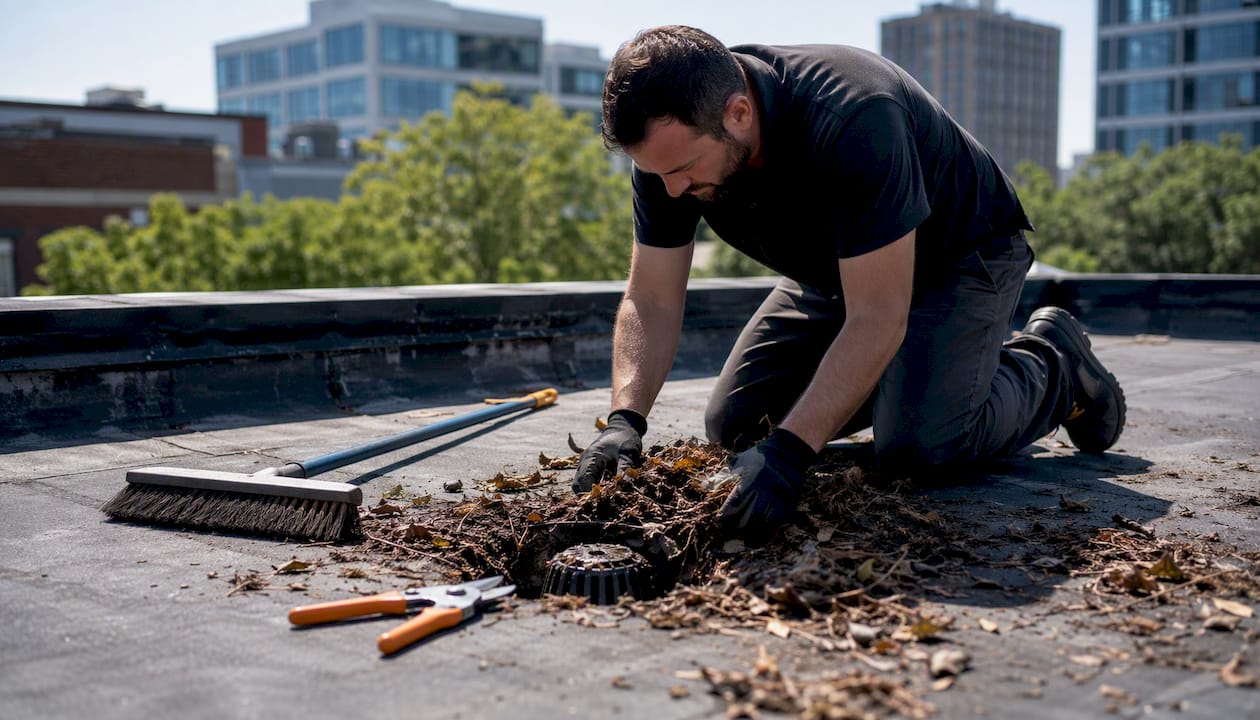
Rooftop traffic is an underappreciated source of membrane damage. Every HVAC technician, telecom contractor, or facilities worker who walks the roof without a designated path risks puncturing the membrane. Install rubber walkway pads on high-traffic routes and require a sign-in log for any rooftop access.
Tools worth using on every formal inspection:
- Infrared camera: detects wet insulation beneath the membrane without cutting into it
- Moisture meter: confirms suspect areas flagged by infrared
- Drone with high-resolution camera: covers large footprints quickly and safely, with a photo record
- Smartphone camera: minimum standard for documenting every defect found
Pro Tip: When your inspector finds an open seam or a lifted flashing, fix it the same day if materials are on hand. A seam that is open for one rain event can saturate insulation beneath it, turning a $200 repair into a $2,000 insulation replacement.
| Inspection Type | Frequency | Primary Focus |
|---|---|---|
| Routine preventive | Twice yearly (spring, fall) | Full membrane, drains, flashings, penetrations |
| Post-storm | Within 48 hours of event | Hail impact, wind-lifted seams, debris |
| Post-contractor | Within 1 week of rooftop work | Penetrations, foot-traffic damage, debris |
| Infrared moisture survey | Every 3–5 years or when leaks recur | Wet insulation mapping |
A written inspection report, with the inspector's name, date, condition codes, photos, and a prioritized repair list, is not optional. Documented records improve warranty claim outcomes and give you real leverage in insurance conversations after storm events.
Which roofing membrane gives you the longest service life?
Membrane type is one of the biggest drivers of why commercial roof lifespan varies from building to building. Real-world lifespan ranges show meaningful differences across systems, and those differences compound when you run annualized cost math.
| Membrane | Typical Lifespan | Installed Cost (per sq ft) | Key Maintenance Focus |
|---|---|---|---|
| TPO | 20–30 years | $5–$10 | Seam integrity, UV degradation, puncture repair |
| EPDM | 25–35 years | $5–$10 | Seam adhesion, flashing details, ponding zones |
| PVC | 25–30 years | $6–$12 | Chemical resistance, seam welding, UV chalking |
| Modified bitumen | 15–25 years | $4–$8 | Granule loss, blister repair, flashing retermination |
| BUR (built-up roofing) | 20–30 years | $5–$10 | Gravel surfacing, blister repair, drain maintenance |
| Standing seam metal | 40–70 years | $10–$20 | Fastener inspection, sealant at penetrations, coating |
Climate, installation quality, drainage condition, and maintenance frequency drive variance within every one of those ranges. A 60-mil TPO membrane installed by a Carlisle-certified crew on a well-drained deck in a mild climate will routinely hit 25 years. The same membrane installed at 45 mil, with poor seam welding, in a hail-prone region, may fail at 12.
Membrane thickness matters more than most owners realize. Moving from 45-mil to 60-mil TPO or EPDM adds roughly $0.50–$1.00 per sq ft at installation, but it extends expected service life by 5–8 years on average. Spread that extra cost across the additional years and the annualized cost often drops. For owners with a 10-year or longer hold period, specifying 60-mil or 80-mil membrane is almost always the better financial decision.
System-specific maintenance notes:
- EPDM: Seam adhesion is the primary failure mode. Inspect lap seams and T-joints every cycle. Flashings at curbs and walls are the second most common leak source.
- TPO: UV exposure degrades the surface over time. Seam quality at installation is critical; re-welding failed seams is the most common repair.
- PVC: Excellent chemical resistance makes it the right call for restaurants, food processing, or any building with grease exhaust. Seam welding must be done by a trained installer.
- Modified bitumen and BUR: Granule loss exposes the asphalt to UV. Blistering is common in hot climates. Both systems benefit from a reflective coating in the later years of their service life.
- Standing seam metal: The longest-lived option by a wide margin. Fastener inspection and sealant maintenance at penetrations are the primary tasks. Explore system comparisons to match the right system to your building's use case and climate.
When does a coating restore your roof, and when does it just delay the inevitable?
Coating restoration is one of the most cost-effective tools available to extend a commercial roof's useful life, but it is also one of the most oversold. The difference between a coating that adds 15 years and one that fails in three comes down to substrate condition.
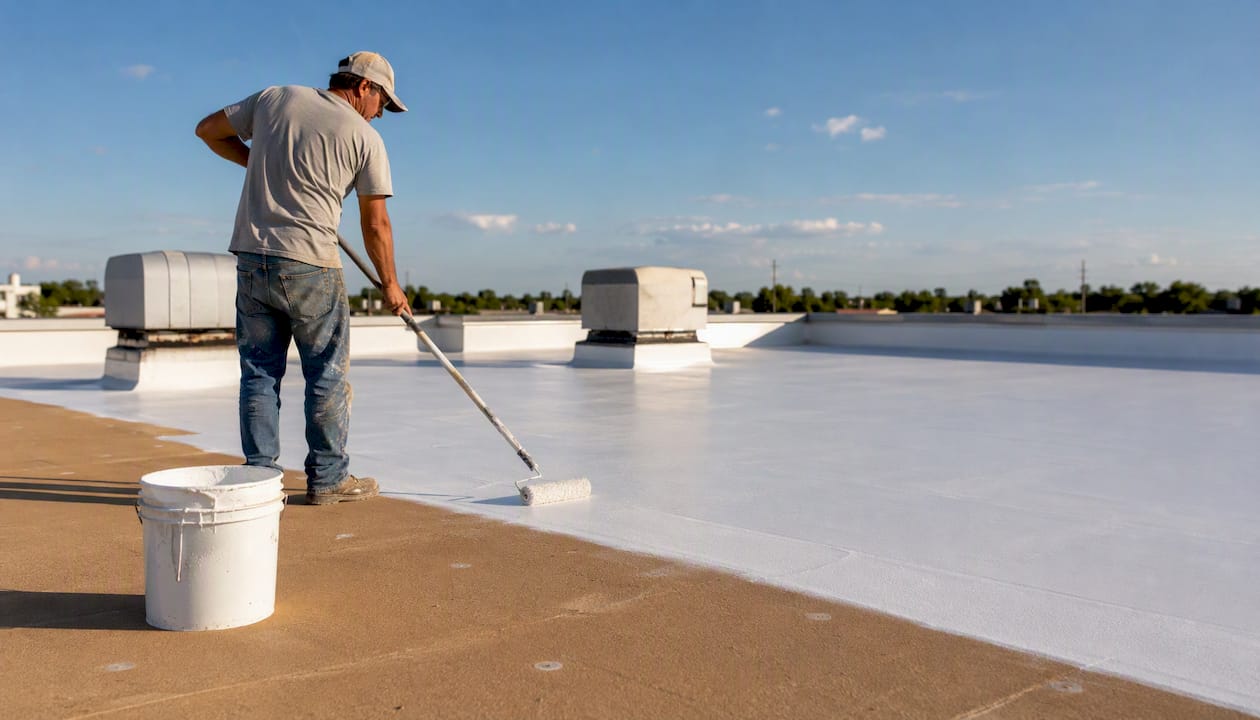
A silicone or acrylic coating over a sound substrate can extend useful life roughly 10–15 years at about $2.50–$5.00 per sq ft installed. That is a fraction of a full replacement, which typically runs $8–$20 per sq ft depending on system and tear-off requirements. The economics are compelling when the preconditions are met.
Hard preconditions for a successful coating:
- Dry insulation confirmed by infrared survey and core sampling
- Structurally sound deck with no rot, delamination, or deflection
- Functioning drains with no chronic ponding zones
- Seams in acceptable condition (no widespread open laps or failed adhesion)
- Membrane surface that is clean, adhered, and free of large blistering
If any of those conditions fail, the coating is not a solution; it is a cover-up that will fail and leave you with a more expensive problem.
Coating chemistry and common brands:
Silicone, acrylic, and polyurethane are the three dominant chemistries. Silicone handles ponding water best and tends to deliver the longest field life in moderate climates. Acrylic is the most affordable option and performs well in low-ponding environments with good UV exposure. Polyurethane offers the best impact and abrasion resistance, making it a strong choice for roofs with heavy foot traffic. Gaco (silicone), Henry (acrylic and silicone systems), and Conklin (acrylic and polyurethane) are widely used manufacturer reference points in the commercial market.
The recoat rhythm: Most silicone and acrylic systems need a recoat layer every 10–15 years to maintain warranty coverage and performance. Budget for that recoat when you plan the initial restoration, because it is a known future cost.
| Decision Factor | Restore with Coating | Replace |
|---|---|---|
| Wet insulation (infrared) | <10–25% of roof area | >25% of roof area |
| Seam condition | Mostly intact, repairable | Widespread failure |
| Deck condition | Sound | Rotted, deflecting, or delaminated |
| Owner hold period | 5–15 years | Long-term hold or sale prep |
| Budget cycle | Capital-constrained | Capital available |
Cost comparison: Restoration at $2.50–$5.00 per sq ft versus replacement at $8–$20 per sq ft. On a 20,000 sq ft roof, that is a difference of $50,000–$300,000 in upfront capital. Annualized cost analysis often narrows that gap, but restoration still wins when the substrate qualifies.
Owners selling within five years often find restoration the right call even on a marginal substrate, because it defers capital and transfers the replacement decision.
For a deeper look at coating options and ideal conditions, the full facility guide covers application requirements, warranty terms, and common pitfalls.
How to budget for roof maintenance and set up a contract that protects you
The number most building owners underestimate is not the replacement cost; it is the annual maintenance cost they should have been spending all along. Proactive maintenance typically runs $0.04–$0.14 per sq ft per year in many markets. On a 20,000 sq ft roof, that is $800–$2,800 per year, a number that looks large until you compare it with a single emergency repair call.
Annualized cost math (example):
The annualized cost framework consistently shows that a higher-spec membrane or a well-timed restoration beats reactive maintenance on a per-year-of-life basis. The hold period affects this math significantly; a five-year owner and a 20-year owner should reach different conclusions from the same numbers.
What a good maintenance contract must include:
- Semiannual inspection visits with written reports and photos
- Post-storm review within 48 hours, included in the contract scope
- Emergency response terms (response time, after-hours availability)
- Contractor qualifications: HAAG-certified inspector involvement for insurance-relevant inspections, manufacturer certifications for warranty-compliant repairs
- Repair authorization thresholds: what the contractor can fix on the spot versus what requires owner approval
- Documentation: date, inspector name, condition codes, photos, prioritized repair list with cost estimates
Inspection report minimum fields:
- Date and time of inspection
- Inspector name and certification (HAAG-certified if applicable)
- Roof condition code (Good / Fair / Poor / Critical)
- Defects found, location, severity, and photo reference
- Recommended repairs ranked by urgency (immediate / within 30 days / next scheduled visit)
- Budget estimate for each repair category
The failure points that cause the most damage, and how to stop them early
Most commercial roof failures trace back to the same handful of locations. Knowing where to look, and what to do when you find a problem, is what separates a $300 repair from a $30,000 remediation.
Top failure sources, ranked by frequency:
- Flashings and perimeter details. The metal and membrane at walls, parapets, and edge conditions move with thermal cycling. Adhesion fails, caulk cracks, and water finds the gap. Reterminate lifted flashings with fresh adhesive or new termination bar; replace cracked caulk with a compatible sealant.
- Roof penetrations. Every pipe, conduit, and HVAC curb is a potential leak point. Pipe boots crack with UV exposure. Curb flashings lift at corners. Inspect every penetration every cycle and reseal or reflash as needed.
- Drains and downspouts. A blocked drain creates ponding; ponding accelerates membrane failure and adds structural load. Clear drains every inspection. If a drain repeatedly clogs, add a secondary drain or scupper as a backup.
- Seams and laps. Open seams on EPDM or TPO allow water direct access to the insulation. Patch open seams with compatible tape or liquid-applied membrane; re-weld TPO seams with a hot-air welder.
- Ponding zones. Low spots that hold water 48 hours after rain are a chronic problem. Short-term fix: add a temporary scupper or extend a drain. Long-term fix: tapered insulation to redirect water.
- Rooftop equipment interfaces. HVAC units, solar mounts, and satellite dishes create concentrated foot traffic and penetration points. Require walkway pads and inspect equipment bases every cycle.
On-the-spot repairs that buy time:
- Seam patch with self-adhering membrane tape (compatible with the existing membrane)
- Flashing retermination with termination bar and lap sealant
- Drain clearing and temporary scupper installation
- Targeted membrane patch over a puncture or blister
- Emergency tarping over an active leak area until a contractor can respond
Red flags that require an immediate contractor call:
- A leak that recurs in the same location after two repairs
- More than three separate repair calls in a single year
- Infrared or moisture meter readings showing wet insulation in more than 10% of the roof area
- Large blistering or widespread membrane separation
- Any visible deck deflection or sagging
Prioritization rubric: Safety first, always. Then stop active water intrusion. Then restore drainage. Then address flashings and seams. Document every step with photos and written notes. A commercial roofing service call checklist gives contractors a structured framework for on-site assessment that maps directly to this priority order.
Why proactive maintenance is the only strategy that actually pays
The conventional wisdom in facilities management is that roofs are a capital expense you plan for every 20–30 years and mostly ignore in between. That framing is wrong, and the cost data makes it obvious.
Reactive roofing, where you respond only when something leaks, consistently produces higher lifetime costs than a structured preventive program. The real cost of reactive maintenance includes emergency-call premiums, accelerated membrane degradation from unaddressed ponding and open seams, and the compounding effect of wet insulation that disqualifies a roof from coating restoration. By the time a reactive-maintenance owner is ready to act, the only option left is full replacement.
What changes with a documented semiannual program is not just cost; it is optionality. Owners who have clean inspection records, dry insulation confirmed by periodic infrared surveys, and a history of prompt small repairs have choices: coat, recover, or replace on their timeline, not under emergency pressure. HAAG-certified inspector involvement in those surveys also matters more than most owners expect. When a storm event triggers an insurance claim, a documented inspection history and a HAAG-certified assessment give you a defensible record that adjusters take seriously.
The one thing worth saying plainly: the semiannual inspection is not a luxury for large portfolios. A 5,000 sq ft retail building benefits from it just as much as a 200,000 sq ft distribution center, because the cost of a missed flashing failure scales with the building's interior, not its roof area.
Exteriorgenie brings 25 years of field experience to your roof's long-term health

Exteriorgenie is a veteran-owned commercial roofing contractor serving Lexington and Columbia, SC, with 25 years of hands-on experience and HAAG-certified inspectors on staff. For building owners who want to extend roof life rather than replace prematurely, Exteriorgenie offers semiannual inspection contracts, infrared moisture surveys, coating and restoration services, and full replacement when the substrate demands it. Emergency roof tarping is available 24/7, and the team provides personalized insurance claim assistance backed by HAAG-certified documentation.
The difference between a contractor who shows up and one who protects your asset is a written program, certified expertise, and a team that answers the phone at 2 AM when a storm tears a seam. Schedule a commercial roof inspection with Exteriorgenie and get a written asset survey you can hand to your operations team, your insurer, or your next buyer.
Sources
- Flat Roof Lifespan 2026: How Long Each Material Lasts | TRB
- Commercial Roofing Maintenance: A Year-Round Checklist | Rimkus
- Roof Coating for Commercial Buildings: A Facility Guide
- Life-cycle cost analysis considerations for roofing | Siplast
FAQ
What is the typical lifespan of a commercial roof?
Lifespan varies significantly by membrane type: TPO runs 20–30 years, EPDM 25–35 years, PVC 25–30 years, modified bitumen 15–25 years, BUR 20–30 years, and standing seam metal 40–70 years. Climate, installation quality, drainage, and maintenance frequency all drive where a specific roof lands within those ranges.
What is the 25% rule for commercial roofing?
Below that threshold, restoration is usually the better financial choice on a sound substrate.
How do you calculate whether to restore or replace a commercial roof?
Divide the installed cost of each option by its expected service life to get an annualized cost per sq ft per year. Restoration at $2.50–$5.00 per sq ft over 12–15 years often competes favorably with replacement at $8–$20 per sq ft over 20–30 years, but only when the substrate passes an infrared and core-sample inspection.
Does a 30-year roof really last 30 years?
Only with consistent maintenance. A 30-year membrane rating assumes proper installation, adequate drainage, semiannual inspections, and prompt repair of defects.
How often should a commercial roof be professionally inspected?
The industry standard is twice per year, typically spring and fall, plus a check within 48 hours of any significant storm or after any rooftop contractor work. HAAG-certified inspectors are worth specifying when the inspection results will be used for insurance claims or warranty documentation.