
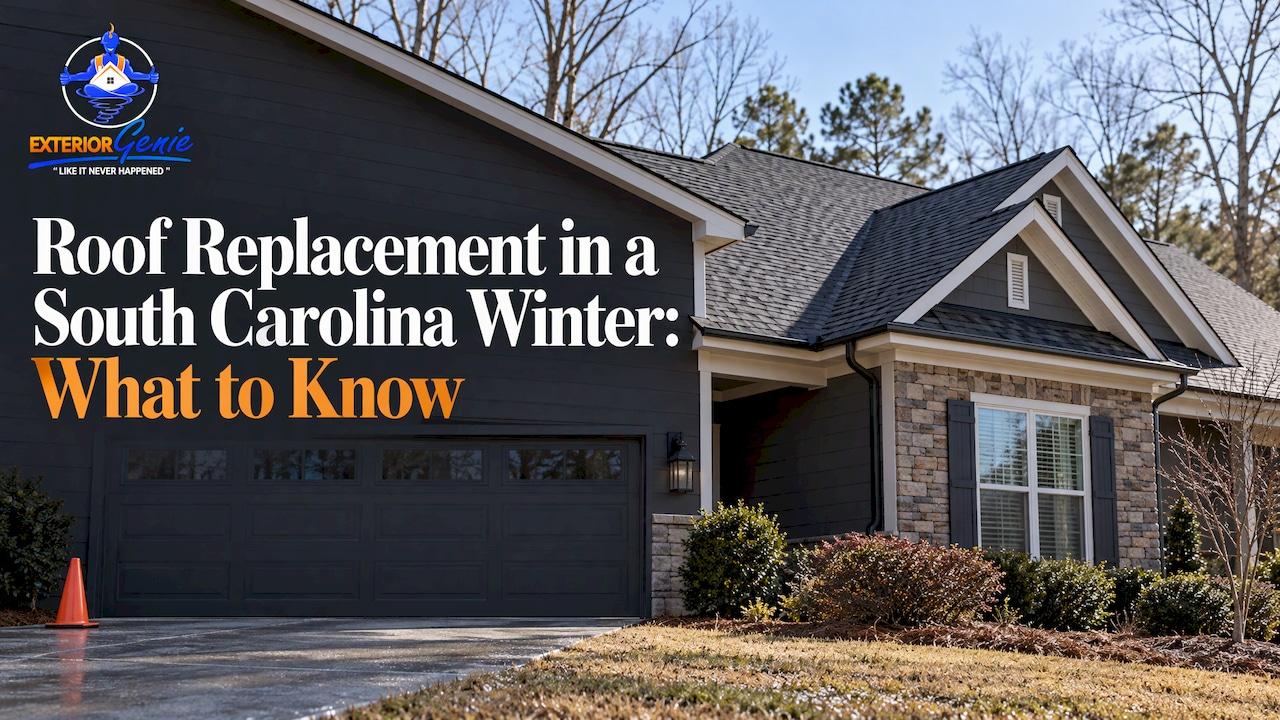
Yes, you can replace a roof in a South Carolina winter, and for many homeowners it is a sound choice. The Palmetto State's winters are mild enough that most weeks include days warm enough for shingles to seal. The work has to be planned around temperature, not the calendar. A roof that is already leaking should not wait for spring at all. If you are in Lexington, Columbia or the rest of the Midlands, Exterior Genie can inspect the roof, tell you honestly whether it needs repair or replacement, and tarp it any hour of the day if water is getting in.
TL;DR
- Winter replacement works in South Carolina because cold snaps are usually short. Asphalt shingles seal best above 40°F, so a good crew schedules around the forecast.
- A leaking or storm-damaged roof should be covered and replaced now. Waiting for a perfect season can cost far more in interior damage than the roof itself.
- A full replacement generally needs a building permit. Check with your city or county, or confirm your contractor is handling it.
- Ask any roofer how they handle cold mornings, shingle storage and sealing. The answers show whether the job will hold up in a windstorm.
- Nationally, spring and fall are the preferred seasons. Winter is a practical option in the South when the crew watches the weather.
Table of Contents
- Can you replace a roof in winter in South Carolina?
- What cold actually does to a new roof
- How a winter replacement is scheduled, step by step
- When you should not wait for better weather
- Storm damage and your insurance claim
- What a winter roof replacement costs in South Carolina
- Permits for a roof replacement in South Carolina
- Questions to ask before you sign
- Get a roof inspected and priced in the Midlands
- Our perspective: winter is a scheduling question, not a quality question
- FAQ
- Sources
Can you replace a roof in winter in South Carolina?
In the South, usually yes. GAF, one of the largest shingle manufacturers in the country, notes that in southern regions roof replacements can often be completed in winter because there is less chance of bad weather. The same page says that long stretches of very cold weather are not suitable for installing asphalt shingles.
That sums up the South Carolina situation. The City of North Charleston describes its winters (December through February) as typically mild, with daily temperatures averaging between 47°F and 52°F. It puts the first freeze in early December and the last in late February. Statewide, the State Climatology Office's monthly averages for a sample winter were about 47°F in January and February. That same document shows how winters can swing from spring-like warmth to a deep cold snap within weeks.
So a South Carolina winter is not one season for roofing purposes. It is a string of workable days with the occasional bad stretch. A roofer's job is to know which is which.
What cold actually does to a new roof
Most homes in the state wear asphalt shingles, so that is the material to understand. Two things matter in cold weather.
Shingles get stiff. GAF's technical bulletin on temperature extremes says there is no practical lower or upper temperature limit for applying fiberglass asphalt shingles. For easiest handling, though, it wants temperatures above 40°F in cold weather. Below that, shingles can become brittle and crack, or need hand sealing.
The sealing strip needs warmth. Each shingle has a thermally activated adhesive strip. GAF's cool-weather installation guide explains that the strip needs warmth, sun and temperatures above 40°F to activate. Shingles that never bond properly are vulnerable to wind uplift and water getting underneath, and GAF recommends installing at 40°F or higher.
There is one more manufacturer tip worth knowing. GAF suggests storing shingles in a heated area above 70°F for at least 24 hours before use, when possible, to make them more pliable in cold-weather installation.
In plain terms: a roof installed on a 55°F sunny afternoon in January seals well. A roof installed during a 30°F morning with the strip never warming may look fine from the street and still be at risk in the first big wind. That is why "winter roofing" is not good or bad in itself. The quality depends on how the crew handles the temperature.

How a winter replacement is scheduled, step by step
Here is the process from first call to final inspection, with what to watch at each stage.
1. Start with an inspection, not a quote
Some roofs need replacing and some need a repair. A good inspector walks the roof, checks the decking and flashing, and tells you which it is. Exterior Genie employs HAAG Certified inspectors and gives honest repair-versus-replacement guidance. That matters in winter, because a repair on a sound roof can carry you into spring, while a failing roof should not wait. You can book through our roof inspections page.
Where it goes wrong: a quote handed over from the driveway, without anyone checking the decking, can change once the old shingles come off.
2. Choose the material and the scope
Asphalt shingle is the most common choice, and the asphalt shingle roofing page explains the options. Exterior Genie is an Owens Corning Platinum Preferred Contractor, and Owens Corning makes shingles and roofing systems for homes. Settle the scope in writing: tear-off, decking repair, underlayment, flashing, ventilation and cleanup.
Where it goes wrong: vague scopes. If the decking is rotted, you want to know in advance who pays for replacing it and at what rate.
3. Handle the permit
A permit is usually required for a full replacement. More on that below. In winter the paperwork can run alongside the material order, so a permit should never be the reason for a delay.
4. Schedule around the forecast, not a fixed date
This is the winter-specific step. Ask your contractor how they decide to proceed or postpone on a given day. A sensible answer mentions temperature, sun and wind, plus rain and a plan to dry in the roof the same day it is opened up. Tear-off should never be started on a day when the roof cannot be covered before dark.
Weather planning is a discipline in its own right. If you are curious how professionals think about it, this overview of construction weather delays covers their causes and how to plan around them.
Where it goes wrong: a rigid start date. A crew that must start Monday because Monday is on the calendar may shingle on the coldest day of the week.
5. Install, then inspect
The crew removes the old roofing, checks the deck, lays underlayment and flashing, then installs shingles. Afterward, someone should walk the roof and check that the shingles have sealed, particularly if the crew worked on cool days. Exterior Genie backs its workmanship with a lifetime workmanship warranty.
Where it goes wrong: nobody goes back. Shingles that did not seal on a cold day are easy to fix when someone looks, and expensive when a windstorm finds them first.
When you should not wait for better weather
Everything above assumes the roof is holding for now. If it is not, the calculation changes.
A roofing expert quoted by Martha Stewart makes the point directly: if a roof is compromised, waiting for the perfect season can lead to interior damage that far exceeds the cost of timely replacement. The same article notes that spring and fall are the usual best seasons nationally, thanks to moderate temperatures and drier conditions, and that spring works well in the Gulf South so a roof can settle before storms. That is a fair general rule. For a roof that is already failing, though, the best season is the one before it leaks.
Signs the roof should not wait:
- Water stains or drips on ceilings or in the attic
- Missing, curled or cracked shingles after a windstorm
- Daylight visible through the attic decking
- Granules piling up in gutters
- Sagging areas on the roof
If water is coming in tonight, the first step is not a replacement. It is a tarp. Exterior Genie offers 24/7 emergency roof tarping, so the roof is covered and the damage stops growing while the permanent fix is planned. You can read more about emergency repair services or call about roof patching and leak repairs.
Storm damage and your insurance claim
If a storm caused the damage, your homeowner's policy may be involved, and the claim usually needs documentation before repairs are finished. Photograph the damage, protect the roof from further harm, and keep your receipts. Exterior Genie's HAAG Certified inspectors assist with insurance claims, and the team has experience with complex ones. The details are on the storm damage restoration page.
Winter is not a disadvantage here. A tarped roof can be documented, inspected and scheduled for replacement on the first good-weather window.
What a winter roof replacement costs in South Carolina
Price depends mostly on material, roof size and complexity, not the month. According to a 2026 South Carolina cost guide from RoofObservations, average residential replacement runs from about $5 per square foot for basic asphalt shingles to about $30 per square foot for high-end copper. For a typical 1,700-square-foot pitched roof, that works out to a range of $8,500 to $51,000 depending on material. The same guide notes that steep or complex roofs can add as much as 30%.

To see what that means for a smaller house, read our breakdown of the cost of a new roof on a 1,600 square foot home.
A worked example: at the guide's $5 per square foot for basic asphalt on a 1,700-square-foot roof, you are at $8,500. If the roof is steep and complex and adds 30%, that becomes $11,050. The decking, the tear-off and any hidden damage are what move the final number, which is why an inspection should come before a price.
Winter can be a time when contractors have more room in the schedule, but treat that as a bonus, not a promise. Ask for the price in writing, with the scope, and compare like for like.
Permits for a roof replacement in South Carolina
Permit rules are local, so the answer depends on your city or county.
- Lexington County: The county's building permits FAQ says a permit is required to construct, enlarge, renovate or replace regulated systems under the Building Codes Ordinance. It also says ordinary repairs and maintenance do not need one.
- City of Charleston: The city's residential roofing guideline says a re-roofing permit is filed as an alteration or repair. Homeowners may apply, contractors must be licensed, and the application asks for the type of roof covering. Metal or elastomeric materials need manufacturer specifications.
- Hardeeville: The town's permit page lists installing new shingles or other roofing materials as work that needs a permit.
The pattern is clear: repairing a few shingles is generally treated differently from replacing the roof. For a step-by-step explanation, see our guide to South Carolina roofing permits for homeowners. Confirm with your local building department before work starts.
Questions to ask before you sign
Whatever the season, these questions separate a careful contractor from a rushed one:
- What temperature do you stop at, and what do you do on a cold morning?
- How will the roof be dried in if weather turns mid-job?
- Who pulls the permit, and is it included?
- What happens if you find rotted decking?
- What does the workmanship warranty cover, and for how long?
- Will someone check that the shingles have sealed after installation?
Our longer list is in questions to ask before a roof replacement.
Get a roof inspected and priced in the Midlands
Exterior Genie is a veteran-owned general contractor serving Lexington, Columbia and the surrounding Midlands. We handle residential and commercial roofing, including replacement, repair, storm damage restoration and insurance claim help. If you want to know whether your roof can make it to spring or should be replaced now, start with a free instant estimate for roof replacement or look at our full list of services.

If you manage a commercial property, the same applies: tell us what the roof is doing and we will tell you whether it needs repair or replacement.
Our perspective: winter is a scheduling question, not a quality question
We hear the same assumption every winter: roofs get replaced in spring, so anything done now must be second best. We see it differently.
The shingle does not know the month. It knows the temperature on the day it goes down and whether the sealing strip got the warmth it needs. That is a planning problem, and planning is what we do. We came out of a military culture where you check conditions, set a plan and do not start a job you cannot finish safely. Applied to a roof, that means we watch the forecast, we do not open a roof we cannot cover, and we tell you honestly when the right answer is to wait a few days.
The costlier mistake is the opposite one. A homeowner with a stained ceiling decides to hold out until April, and by April the insulation, drywall and framing are wet. A tarp is available 24 hours a day for exactly this reason, and a replacement can follow as soon as the weather and the paperwork line up.
Our advice is simple. Get the roof inspected by someone qualified to read it. If it is sound, repair what needs repairing and plan the replacement for the season you prefer. If it is not, cover it now and replace it on the first good days. Either way, you should hear the reasons, not just the price.
Ebben
FAQ
Is it bad to replace a roof in winter in South Carolina?
Not when the work is timed to the weather. Southern winters are mild, and manufacturers say replacements can often be done in the South in winter. The risk comes from installing shingles on days below about 40°F, when sealing strips may not bond properly. A contractor who watches the temperature avoids that.
What is the best time of year to replace a roof in South Carolina?
Spring and fall are generally the preferred seasons because of moderate temperatures and drier conditions, according to Martha Stewart's roofing timing guide. Winter is a practical option when the roof is aging or damaged, since the cost of waiting can exceed the benefit of a perfect season.
Do I need a permit to replace my roof in South Carolina?
Usually yes for a full replacement, though the rules are set by your city or county. Lexington County requires permits for replacing regulated systems but exempts ordinary repairs. Confirm with your local building department, or ask your contractor who is handling the application.
How much does a roof replacement cost in South Carolina?
A 2026 state cost guide puts residential averages at roughly $5 per square foot for basic asphalt shingles and up to about $30 per square foot for copper. Steep or complex roofs can add up to 30%. A written estimate after an inspection gives you your actual number.
Sources
- When Is the Best Time to Replace a Roof (GAF)
- Temperature Extremes & Fiberglass Asphalt Shingles (GAF technical bulletin R-133)
- Cool Weather Roofing: Installing Shingles in Cool Temperatures (GAF)
- Weather and climate, City of North Charleston
- South Carolina 2005 Weather in Review, State Climatology Office
- When Is the Best Time of Year to Replace Your Roof? (Martha Stewart)
- South Carolina Roof Replacement Cost Guide (RoofObservations)
- Building Permits FAQs, County of Lexington
- Residential Roofing Replacement & Repair permit guideline, City of Charleston
- Do I Need a Permit, Hardeeville, SC
- Owens Corning roofing