
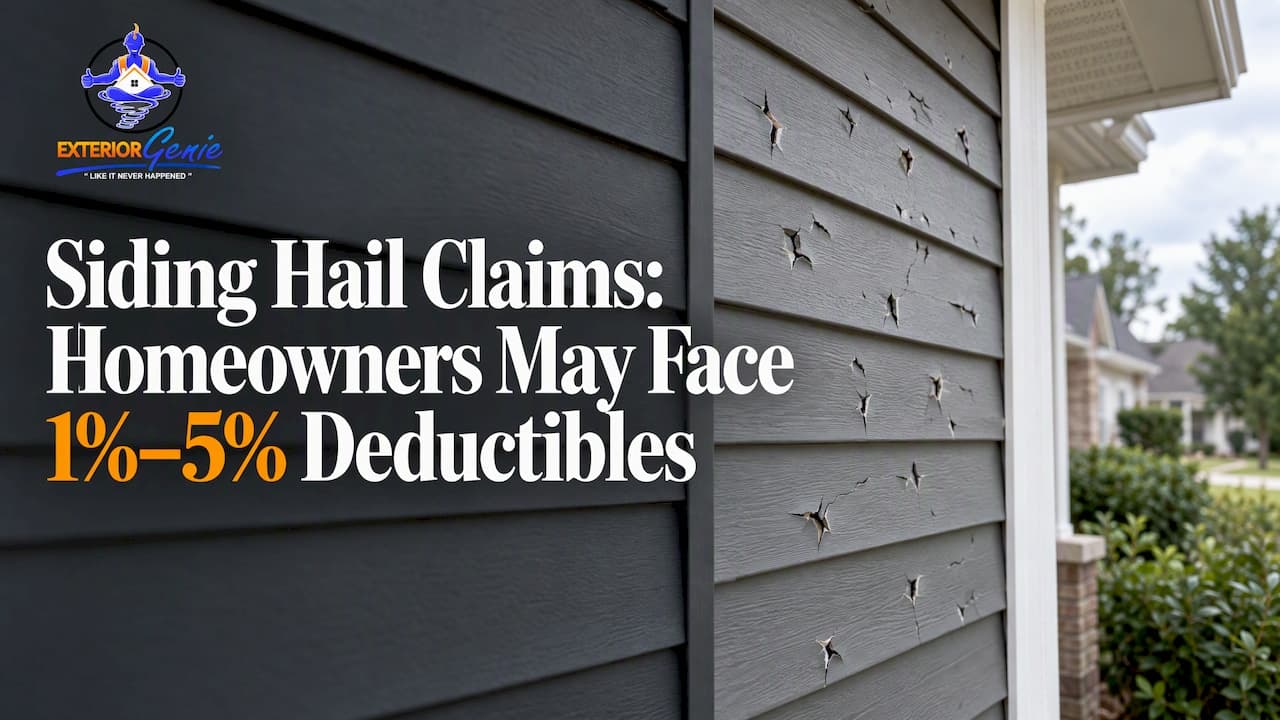
Most standard homeowners policies cover hail damage to siding, but your deductible and policy terms decide what you actually receive. Damage that lets water in, such as cracks or punctures, is far easier to get paid than dents that only change the look. Photograph everything, save broken pieces, and report the loss to your insurer promptly. A HAAG-certified inspection can strengthen your case.
TL;DR:
- Check for wind and hail exclusions, replacement cost or depreciated actual cash value, and a deductible that may equal 1% to 5% of insured value.
- Photograph cracks, holes, and interior water stains with time stamps, save siding samples, and keep receipts for temporary repairs that prevent further damage.
- A percentage deductible is calculated from the home’s insured value, not the claim amount, and its trigger and calculation vary by policy.
- Insurers do not automatically pay to match undamaged siding; ask whether a matching endorsement applies or whether a full wall replacement can be justified.
- Review the settlement against contractor estimates before accepting, and ask early whether your mortgage lender must be named on structural repair checks.
Table of Contents
- What does homeowners insurance cover for hail-damaged siding?
- How do you inspect siding for hail damage and document it?
- How do insurers evaluate hail claims and apply deductibles?
- What are the steps to file a siding hail damage claim?
- What if the new siding doesn't match the old?
- Should you repair or replace hail-damaged siding?
- Why does a contractor with claims experience matter?
- How can Exterior Genie help with hail-damaged siding?
- FAQ
- Sources
What does homeowners insurance cover for hail-damaged siding?
Consumer insurance guidance says standard homeowners insurance typically covers hail damage to siding, subject to your deductible and policy terms. Three items on your declarations page matter most:
- Covered perils. Confirm wind and hail are covered. Some policies exclude wind and hail in coastal areas, so ask your agent whether special deductibles apply.
- Payout basis. Replacement cost pays to repair or replace with new material. Actual cash value subtracts depreciation, so an older siding job pays out less. Check which one your policy uses before you file.
- Deductible type. Wind and hail deductibles often run 1% to 5% of the home's insured value, and insurers must disclose them on the declarations page. That is a different out-of-pocket number than a flat $1,000 deductible, so run the math.
Policies also draw a line at upkeep. Homeowners insurance is for sudden, accidental damage, and claims for wear and tear or lack of maintenance are commonly denied.
How do you inspect siding for hail damage and document it?
Start with the signs that affect performance, not just appearance. Punctures, fractures, gaps at seams, and water stains on interior walls all point to functional damage. Dents alone are usually treated as cosmetic.
- Walk each elevation of the house and look for cracks, holes, chips, and warped or displaced panels.
- Check soft metals for dents, since they show hail direction and size: gutters, vents, and window trim. Our guide on how hail damages gutters covers what to look for.
- Take time-stamped photos of each damaged area from several angles, with a close-up and a wide shot.
- Record a slow video walkthrough of every side of the home.
- Save broken pieces or samples, and note the date of the storm.
- Photograph interior ceilings and walls near damaged siding for stains.
NAIC advises documenting damage before cleanup and contacting your insurer promptly after a storm.
Pro Tip: Shoot each photo twice, once with a coin or tape measure for scale and once without, so the adjuster sees both the size and the context.
If the damage is widespread or you can't tell whether it is functional, a written report from a HAAG-certified inspector gives the adjuster something concrete to review. This partner guide to storm-damaged siding adds more inspection tips.
How do insurers evaluate hail claims and apply deductibles?

After you file, the insurer sends an adjuster who inspects the property and classifies each area of damage. The adjuster's call on functional versus cosmetic often decides the outcome, because cosmetic-only damage is often excluded. That is why clear evidence of cracks, holes, and water entry matters so much.
Here is how the process typically works:
- Inspection. The adjuster measures, photographs, and notes which panels are damaged and why.
- Percentage deductibles. When your policy has one, it is figured from the home's insured value, not from the size of the claim. Types and triggers vary, and insurers must explain how they are calculated.
- Temporary repairs. Reasonable steps to stop further damage, like tarping an opening, are usually expected. NAIC says to keep receipts for anything you spend.
- Water entry. Rain that comes through a hole made by a covered peril is usually covered, but flood is not.
For scale, the Insurance Information Institute reports an average hail claim of $13,511, covering roofs, windows, siding, and other components together. Your own claim may be far above or below that.
What are the steps to file a siding hail damage claim?
- Gather your policy number, the storm date, and your first photos.
- Call your insurer or agent and open the claim as soon as you can.
- Make reasonable temporary repairs and keep every receipt.
- Collect one or more contractor estimates, ideally with a written inspection report.
- Meet the adjuster on site, walk through each damaged area, and hand over your documentation.
- Review the settlement offer against your estimates before you accept.
Expect payment in stages. An initial advance may cover emergency needs, followed by the structure settlement. If you have a mortgage, your lender may need to appear on checks for structural repairs, so ask your insurer early.
Our roof insurance claim checklist walks through a similar sequence, and you can adapt it for siding.
What if the new siding doesn't match the old?
Insurers owe you repair of the direct physical loss from a covered peril. They don't automatically owe you matching undamaged siding. In Maryland's guidance, matching is not guaranteed unless your policy has a specific matching endorsement.
When an exact match is no longer made, you have a few paths:
- Localized repair. The insurer replaces only the damaged section, which can leave a visible color or profile difference.
- Appearance allowance. The insurer offers a payment for the mismatch instead of replacing more siding.
- Full elevation replacement. Ask the adjuster whether replacing an entire wall is justified, and be ready to show why.
- Matching coverage in advance. If you're shopping for a policy, ask about an endorsement before a storm hits.
Keep samples of the old siding and ask for every option in writing.
Should you repair or replace hail-damaged siding?
Patching can work when damage is limited and functional problems are minor. Replace instead when panels are brittle, warped, or leaking, since a patch there often fails again.
Common materials trade off differently:
- Vinyl: affordable and easy to replace, but it can crack under impact.
- Fiber cement: dense and durable, though heavier and costlier to install.
- Engineered wood: a wood look at a moderate price, with more upkeep needs.
NAIC suggests considering impact-resistant materials when rebuilding, and some insurers may offer mitigation credits. If hail also hit your roof, you will likely meet roofing products such as Owens Corning Shingles while coordinating repairs, and our post on hail damage to shingles explains what to check first.
Why does a contractor with claims experience matter?
Most hail disputes come down to proof. A carrier-ready inspection from a HAAG-certified or experienced inspector shows functional damage clearly, which narrows the room for disagreement. Good coordination also keeps your insurer and mortgage company working from the same documents, so repairs start sooner. Be careful with any paperwork that hands your claim rights to a contractor. NAIC warns against signing away your insurance benefits, so read before you sign.
— Ebben
How can Exterior Genie help with hail-damaged siding?
If your siding took a beating, we handle the whole path: a HAAG-certified inspection, a written estimate, and claims coordination with your insurer. Our storm damage restoration and siding teams repair or replace what the storm broke, and our emergency roof repair is available when a leak can't wait. Schedule a free inspection and estimate and we will take it from there.

FAQ
Can home insurance pay for new siding?
Yes, when hail or another covered peril damages it. Payment depends on your policy terms, your deductible, and whether your coverage pays replacement cost or actual cash value. Cosmetic-only damage may be excluded.
Can insurance adjusters tell how old hail damage is?
Often, yes. Adjusters look at weathering, oxidation, and whether dents or cracks have aged, and they compare damage to storm dates. Time-stamped photos taken soon after the storm help prove the loss is recent.
What should you avoid saying to a home insurance adjuster?
Avoid guessing about causes or dates, and don't downplay damage you haven't fully inspected. Stick to what you observed, share your documentation, and ask for questions you can't answer to be answered in writing later.
What kind of water damage is not covered by insurance?
Flood damage is excluded under standard homeowners policies and needs separate flood coverage. Rain that enters through a hole created by a covered peril is usually covered, but long-term leaks from poor upkeep typically are not.