

TPO is the best cost-per-year roofing option for most flat commercial buildings when properly specified and installed. It combines a heat-welded, watertight seam system with a white reflective surface that meets ENERGY STAR cool-roof requirements, all at an installed cost that typically runs below PVC and modified bitumen. The benefits of TPO roofing for commercial properties are real and measurable — but they depend almost entirely on membrane thickness, contractor certification, and weld quality.
Quick pros and cons for decision-makers:
- Energy savings: White TPO membranes reflect a high percentage of solar radiation. EPA cool-roof research shows that peak cooling demand drops 11–27% with reflective TPO, depending on climate and building type.
- Lower installed cost: TPO typically comes in below PVC and modified bitumen on a per-square-foot basis, giving it a strong cost-per-year profile over a 20–30 year service life.
- Heat-welded seams: Fusion bonds are stronger than the membrane sheet itself — a 2020 field study found aged TPO welds averaged roughly 15% stronger than published averages for new-weld samples.
- Repairability: New TPO welds fuse cleanly to aged membrane, enabling patches and overlays without full tear-off.
- Installation-dependent failure: Improper hot-air welding calibration is the leading cause of premature failure — the membrane itself is not the weak link; the contractor is.
Pro Tip: Before you sign any TPO contract, ask for the contractor's manufacturer certification and a written seam-testing protocol. Those two items predict long-term performance better than any spec sheet.
Table of Contents
- What is TPO roofing and how does it work?
- What are the key benefits of TPO roofing for commercial buildings?
- What are the drawbacks and failure modes of commercial TPO?
- How long does a commercial TPO roof last, and what does it cost?
- How do you choose the right TPO membrane and specify it correctly?
- What does proper TPO installation and maintenance look like?
- When should you choose TPO versus EPDM, PVC, or modified bitumen?
- Key Takeaways
- What experienced commercial roofers actually see in the field
- Exteriorgenie: certified TPO roofing for commercial properties in Lexington, SC
- Authoritative references and further reading
What is TPO roofing and how does it work?
TPO stands for thermoplastic polyolefin, a single-ply membrane made from a blend of polypropylene and ethylene-propylene rubber. Manufacturers reinforce it with a polyester scrim layer that carries tensile load and resists puncture. The membrane ships in rolls, typically 10 or 12 feet wide, and is installed in overlapping sheets across a flat or low-slope commercial roof deck.
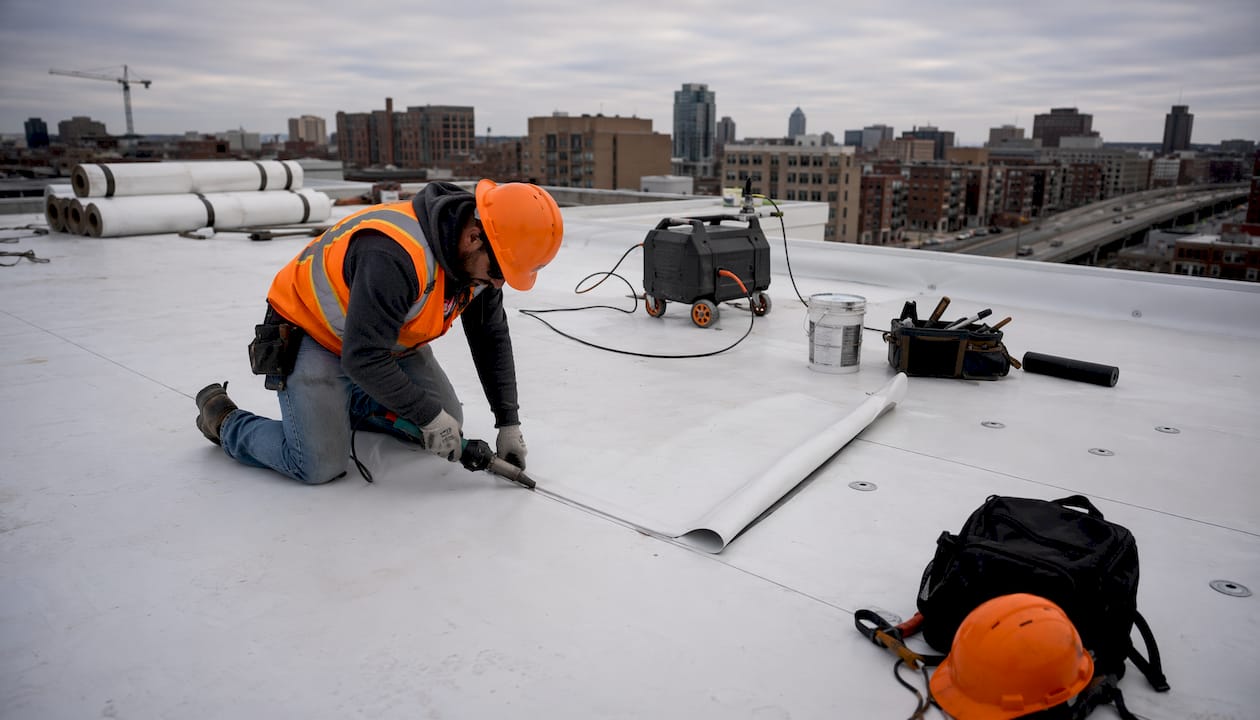
Seams are joined by hot-air welding: a robotic or hand-held welder drives a stream of air at 700–1,000°F between overlapping membrane edges, melting them together into a single fused bond. That bond, when properly calibrated, is stronger than the surrounding sheet.
Common attachment methods:
- Mechanically attached: Screws and plates fasten the membrane to the deck at seam lines; the most common method and the most cost-effective for large open roofs.
- Fully adhered: Membrane is bonded to the substrate with adhesive across its full surface; provides the most uniform wind-uplift resistance and is preferred for high-wind zones.
- Induction welded: Plates are pre-installed under the membrane and activated by an induction tool; eliminates exposed fasteners and is used on certain recover applications.
Certifications and listings to require in your bid documents: ENERGY STAR and CRRC cool-roof ratings for reflectivity, FM or UL wind-uplift listings matched to your local wind zone, and the manufacturer's Environmental Product Declaration (EPD) if sustainability credits matter.
What are the key benefits of TPO roofing for commercial buildings?
Energy efficiency and cool-roof performance
White TPO membranes carry an initial solar reflectance of 0.79–0.87 and thermal emittance around 0.92, both meeting ENERGY STAR requirements. On a hot summer day, that reflectivity can cut surface temperatures by 50–60°F compared to a dark membrane, which translates directly into reduced HVAC load. Buildings in cooling-dominant climates — the Gulf Coast, the Southeast, the Southwest — see the largest dollar savings, and many utility programs offer rebates for ENERGY STAR-qualified roofs.
Installed cost and lifecycle economics
In markets like Dallas-Fort Worth, TPO installed costs generally run below those for modified bitumen. When factoring in energy savings over the roof's service life, the cost advantage of TPO becomes more pronounced, resulting in substantial savings for large warehouse roofs.
Seam strength and watertightness
Heat-welded seams are the defining structural advantage of TPO over taped or adhesive-bonded systems. The fusion bond becomes part of the membrane, not a separate material sitting on top of it. That matters most at penetrations, drains, and perimeter edges — the locations where most commercial roof leaks originate.
Flexibility in attachment and deck compatibility
TPO works over steel deck, concrete, wood, and existing insulation boards. Mechanically attached systems can be engineered to meet FM wind-uplift requirements in hurricane zones by increasing fastener density at perimeters and corners. Fully adhered systems distribute load across the entire membrane surface, which is the right call for buildings with complex geometry or irregular deck conditions.
Repairability and lifecycle CAPEX
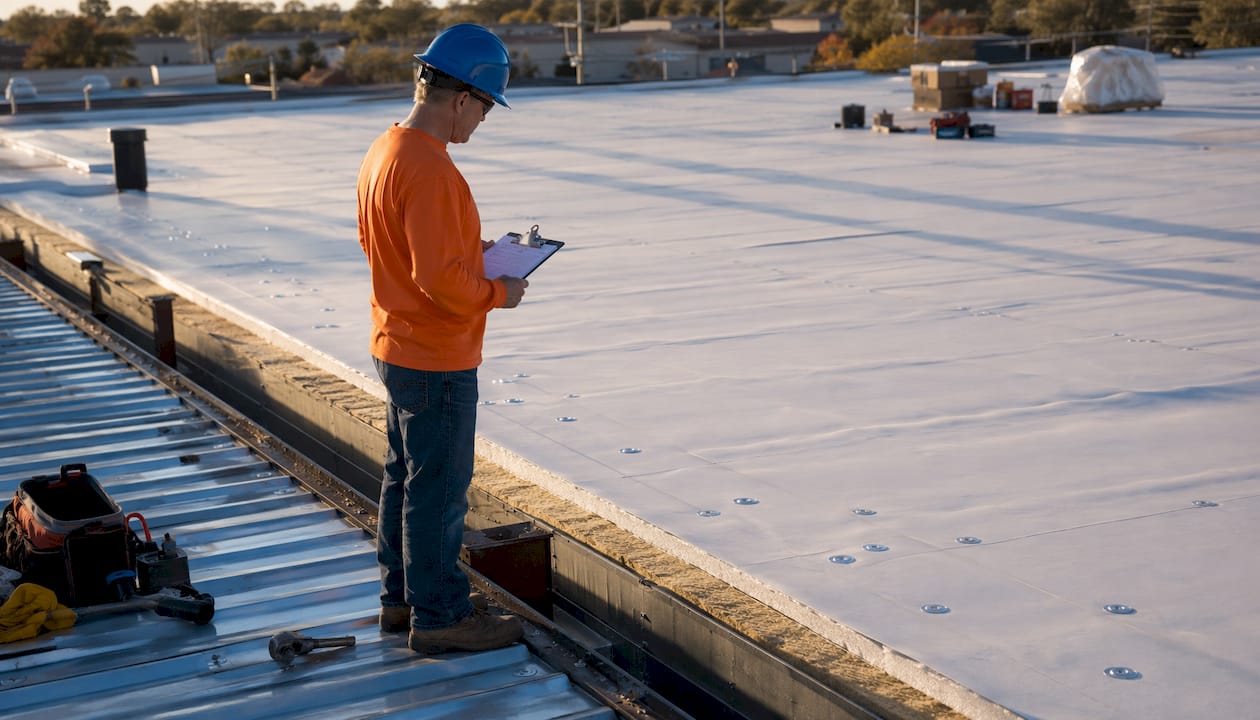
When a TPO roof needs a patch, a trained technician welds new membrane directly to the existing surface. No adhesives, no primers in most cases, no waiting for cure time. That repairability keeps maintenance costs predictable and avoids the capital shock of premature tear-off. For a commercial roof maintenance program, TPO is one of the most forgiving systems to manage.
Market availability and contractor competition
TPO dominates new commercial installations across North America, with over 1 billion square feet of single-ply installed annually and TPO holding a commanding share. That penetration means multiple manufacturers, broad material availability, and genuine bid competition among certified contractors — all of which work in the building owner's favor.
Pro Tip: Specify 60-mil or 80-mil membrane in your bid documents. Thicker membranes resist thermal fatigue and puncture far better than the 45-mil entry option, and the cost difference per square foot is small relative to the lifespan gain.
What are the drawbacks and failure modes of commercial TPO?
TPO's vulnerabilities are real, and most of them trace back to two sources: installation quality and drainage design.
The leading failure modes:
- Improper seam welding: Incorrect heat settings create hidden voids in the weld that look fine on the surface but fail under thermal cycling or wind load. Poor contractor selection is the primary cause of premature TPO failure — not the membrane itself.
- Shrinkage at perimeters: TPO can pull away from edge metal and flashings over time, particularly when the membrane was installed under tension or the edge detail was undersized.
- Ponding water: Extended standing water accelerates membrane degradation and promotes microbial growth in seams and low spots. Drainage design is not optional — it is a lifespan variable.
- Puncture vulnerability: TPO is more puncture-prone than modified bitumen under heavy foot traffic. Rooftop HVAC maintenance routes need walk pads.
- Chemical exposure limits: TPO resists many cleaning solutions but is not the right choice where grease, animal fats, cooking oils, or industrial chemicals reach the roof surface. PVC is the correct specification for those conditions.
- Manufacturer formulation variability: TPO performance depends on manufacturer additives — UV stabilizers, antioxidants, and flame retardants vary by brand. Off-brand or unspecified membranes can void meaningful warranty coverage.
Before you accept a bid, ask these four questions: Does the contractor hold manufacturer certification for the specific TPO brand specified? What is the welding calibration procedure and how is it documented? Will destructive seam test samples be pulled and submitted? What does the warranty cover — materials only, or labor and materials under an NDL (No Dollar Limit) policy?
How long does a commercial TPO roof last, and what does it cost?
Lifespan expectations
A properly specified and maintained TPO roof typically lasts multiple decades. The factors that push a roof toward the low end: 45-mil membrane, poor drainage, no maintenance program, and high UV exposure without shade. The factors that push it toward the high end: 60-mil or 80-mil membrane, positive slope or tapered insulation, twice-yearly inspections, and prompt repairs.
Installed cost ranges
| Membrane Type | Typical Installed Cost (per sq ft) | Relative Position |
|---|---|---|
| TPO (standard) | $4.50–$7.50 | Lowest among thermoplastics |
| PVC | Higher than TPO | 20–30% premium over TPO |
| Modified bitumen | $6.00–$10.00 | Higher than TPO |
| EPDM | Comparable to TPO | Varies by attachment method |
Cost ranges reflect market data from the Dallas-Fort Worth region; your market will vary based on access, insulation requirements, and deck condition.
Warranty types
- Manufacturer material warranty: Covers defects in the membrane itself, typically 10–20 years depending on membrane thickness and manufacturer.
- NDL (No Dollar Limit) warranty: Covers both materials and labor up to the full replacement cost; requires manufacturer-certified installation and usually a minimum membrane thickness (often 60-mil).
- Contractor workmanship guarantee: Covers installation defects; duration and scope vary widely — require a minimum of two years in contract language.
Lifecycle cost framework
- Calculate energy savings using EPA cool-roof data (11–27% peak cooling reduction) applied to your current cooling costs.
- Add repairability value: TPO patches cost a fraction of tear-off and replacement.
- Compare total cost of ownership over 20 years, not just installed price.
- Require documentation: O&M manual, as-built drawings, and a scheduled inspection cadence as contract deliverables.
How do you choose the right TPO membrane and specify it correctly?
Getting the specification right protects your investment before the first roll is unloaded.
- Specify membrane thickness explicitly. Write 60-mil minimum for standard commercial applications; 80-mil for high-traffic roofs or aggressive climates. Never leave thickness open to contractor discretion.
- Require scrim and tensile data. Mil thickness alone does not tell you fatigue resistance. Request the spec sheet with scrim weight and tensile values — the scrim construction determines how the membrane handles thermal cycling over decades.
- Require ENERGY STAR and CRRC listings. These are not marketing claims; they are independently verified reflectivity measurements. If your jurisdiction has energy code requirements or you are pursuing LEED credits, these listings are the documentation you need.
- Match attachment method to wind zone. Require engineered wind-uplift calculations in the bid package, stamped by a licensed engineer where your jurisdiction requires it. FM or UL listings must match the actual wind zone, not a generic regional average.
- Require manufacturer certification. Only manufacturer-certified contractors can issue NDL warranties. If a bidder cannot produce current certification for the specific brand they are proposing, that bid is incomplete.
Contractor minimum requirements to put in writing:
- Current manufacturer certification for the proposed TPO brand
- HAAG-certified or equivalent inspector for pre-installation deck assessment
- Written seam-testing protocol (destructive pull tests and/or electronic seam scanning)
- Documented welding calibration log submitted as a project milestone
Pro Tip: Ask every bidder to submit the manufacturer's EPD and recycling program information. Contractors who cannot produce these documents are often not buying from authorized distributors — a red flag for warranty validity.
When evaluating contractors, a commercial roofing contractor checklist helps you standardize bids and avoid comparing apples to oranges across proposals.
What does proper TPO installation and maintenance look like?
Installation best practices
Hot-air welding calibration is the single most critical installation variable. Welders must be set between 700°F and 1,000°F depending on ambient temperature, membrane brand, and wind conditions on the day of installation. Too cool and the weld is incomplete; too hot and the membrane scorches. Contractors should document calibration settings at the start of each shift.
Installation checkpoints to require:
- Seam direction runs perpendicular to slope to prevent water tracking along weld lines
- Edge metal and termination bar properly fastened and sealed before membrane is lapped
- All penetrations (pipes, curbs, drains) flashed with TPO-compatible flashing material, not caulk alone
- Fastener pattern at perimeters and corners matches the engineered uplift calculation
Inspection and maintenance schedule
- Twice-yearly inspections (spring and fall): check seam integrity, flashing condition, drain flow, and surface for punctures or blisters.
- After major storms: inspect perimeter edge metal, penetration flashings, and any area with visible debris impact.
- Ongoing maintenance: keep drains clear, install walk pads on HVAC maintenance routes, and patch any puncture promptly with heat-welded TPO — not caulk or tape.
Tapered insulation or positive-slope design during a reroof is the single best investment for long-term TPO performance. Ponding water accelerates degradation faster than UV exposure in most climates, and fixing drainage at reroof time costs far less than addressing it later.
Pro Tip: Insist on a destructive seam test sample and a calibration log as contractual milestones before final payment is released. These two documents are your evidence that the weld quality meets spec — and your leverage if problems appear in year three.
For ongoing maintenance, Exteriorgenie's TPO membrane repair service uses heat-welded patches that fuse directly to existing membrane, avoiding the cost and disruption of full tear-off.
When should you choose TPO versus EPDM, PVC, or modified bitumen?
The right membrane depends on four decision axes: climate, chemical exposure, budget, and desired lifespan.
Core decision framework:
- Cooling-dominant climate (Southeast, Gulf Coast, Southwest): TPO's reflectivity advantage is largest here. EPDM's dark surface absorbs heat and increases cooling costs.
- Chemical or grease exposure: Specify PVC. It is the only single-ply membrane that resists animal fats, cooking oils, and most industrial chemicals. TPO is not the right call for restaurant rooftops or food-processing facilities.
- Cold-climate longevity: EPDM has 40-plus years of field data in northern climates and performs well where heating dominates. TPO works in cold climates but has a shorter track record.
- Heavy foot traffic or built-up details: Modified bitumen handles foot traffic better than TPO and integrates well with built-up roof assemblies. It costs more but may be appropriate for roofs with frequent maintenance access.
| Roof Type | Best Fit | Why |
|---|---|---|
| Warehouse / distribution center | TPO | Wide rolls, minimal seams, mechanical attachment over metal deck |
| Office / retail (no chemical exposure) | TPO | Cool-roof performance, NDL warranty, competitive cost |
| Restaurant / food processing | PVC | Chemical and grease resistance |
| Cold-climate building (heating-dominant) | EPDM | Proven long-term performance, lower cost in some markets |
| High-traffic roof or complex built-up detail | Modified bitumen | Foot-traffic durability, compatibility with built-up assemblies |
For a broader look at how TPO stacks up against other systems, the commercial roofing systems guide covers the full range of options with decision criteria for each.
If you are evaluating contractors in Texas, choosing a roofing contractor in Austin offers a practical model for vetting credentials and comparing bids that applies across markets.
Key Takeaways
TPO delivers the best cost-per-year for most flat commercial roofs when you specify 60-mil or 80-mil membrane, require manufacturer-certified installation, and build a maintenance program around twice-yearly inspections and prompt heat-welded repairs.
| Point | Details |
|---|---|
| Energy savings are measurable | Peak cooling demand drops 11–27% with reflective TPO, per EPA cool-roof research. |
| Thickness determines durability | Specify 60-mil minimum; 45-mil is prone to early fatigue under thermal cycling. |
| Installation quality is the risk | Improper seam welding is the leading cause of premature failure — contractor certification is non-negotiable. |
| Lifecycle cost beats installed cost | TPO's repairability and energy savings make it cheaper per year than most alternatives over a 20–30 year service life. |
| Exteriorgenie delivers certified TPO work | Exteriorgenie's HAAG-certified inspectors and 25 years of commercial experience back every TPO installation in Lexington, SC. |
What experienced commercial roofers actually see in the field
The gap between a TPO roof that lasts 28 years and one that fails at 11 is almost never the membrane. It is the weld.
Building owners consistently underestimate how much installation quality drives long-term outcomes. They compare bids on price per square foot, choose the lowest number, and then wonder why they are dealing with seam failures in year four. The membrane that failed was probably fine. The weld that held it together was not.
The other pattern worth naming: owners who skip drainage fixes during a reroof to save money almost always regret it. Ponding water does not just shorten membrane life — it creates a maintenance cycle that costs more over ten years than the drainage correction would have cost at reroof time.
Exteriorgenie is a veteran-owned commercial roofing company with 25 years of experience and HAAG-certified inspectors on staff. The discipline that comes from that background shows up in documentation, calibration logs, and seam-testing protocols — the details that protect your warranty and your asset. If you are budgeting a commercial TPO project in Lexington, SC, prioritize weld QA, fix your drainage, and build a maintenance reserve into your operating budget from day one.
Exteriorgenie: certified TPO roofing for commercial properties in Lexington, SC
When the article you just read points to installation quality as the single biggest risk factor in commercial TPO, the next question is obvious: how do you find a contractor who actually gets that right?

Exteriorgenie is a veteran-owned roofing company with 25 years of commercial experience, HAAG-certified inspectors, and manufacturer-certified TPO installation. Every project includes documented welding calibration, seam-testing protocols, and a transparent bid process — no surprises on scope or price. The team handles everything from new TPO installations and TPO membrane repairs to post-storm inspections and insurance claim assistance, available 24/7 for emergencies. If you are planning a commercial reroof or need a certified assessment of your current system, explore Exteriorgenie's roofing financing options and get a quote today.
Authoritative references and further reading
- tporoofing.org — MRCA TPO Advisory: Industry advisory document covering TPO specification, installation standards, and warranty requirements from the Midwest Roofing Contractors Association.
- Flat Roof Report — TPO Roofing Guide for Building Owners: Comprehensive owner-facing guide covering membrane selection, attachment methods, wind-uplift design, and Gulf Coast performance considerations.
- GAF — TPO Roofing Resources: Manufacturer resource hub with technical data sheets, installation guides, and warranty documentation for commercial TPO systems.
- Roof Observations — TPO Roofing Introduction: Practitioner-level overview of TPO formulation variability, ponding water risks, and drainage design considerations.
- Core Commercial Roofing — TPO Pros and Cons: Field-informed analysis of TPO performance, seam strength data, and contractor selection guidance.
- Kingspan Roofing — 5 Benefits of TPO Membranes: Manufacturer perspective on TPO durability, recyclability, and energy performance for commercial applications.
- Johns Manville — TPO Roofing Application Guide: Step-by-step installation guide covering insulation layering, deck requirements, cold-weather procedures, and membrane attachment specifications.
- Exteriorgenie — TPO Roofing Membrane Guide: Exteriorgenie's overview of TPO basics, comparisons to EPDM and PVC, and guidance for property owners evaluating membrane options.
- REPS Roofing — Roof Repair Service, Austin TX: Partner resource on commercial repair service offerings and maintenance agreements, useful for owners evaluating repair versus replacement decisions.