
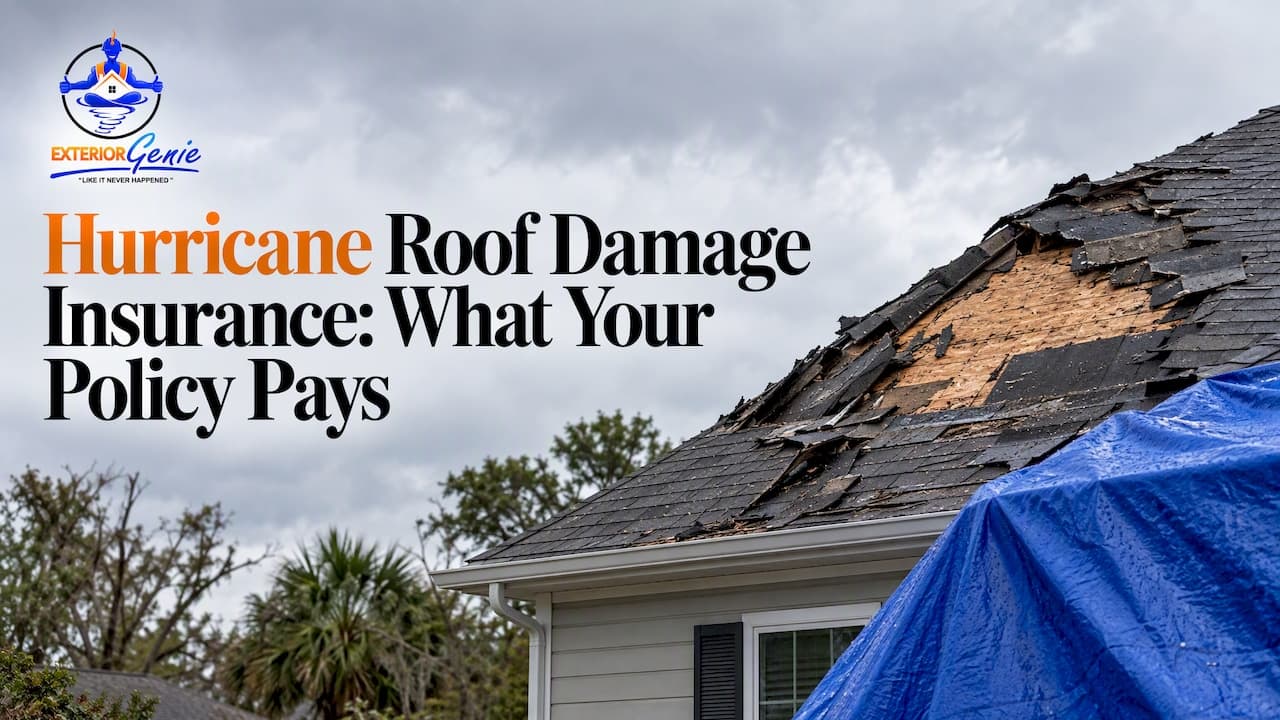
If a hurricane damaged your roof, your homeowners policy will usually pay for wind damage and wind-driven rain that enters through a roof opening. It will not pay for flood. What you actually receive depends on three things in your policy: the named-storm deductible, whether your roof is covered at replacement cost or actual cash value, and how well you document the damage before repairs begin.
This guide walks through each of those, in the order you will meet them after a storm. We are a roofing and storm restoration contractor in the Midlands of South Carolina, so we also say where a contractor helps and where you should wait for your insurer.
TL;DR
- Standard homeowners policies generally cover wind and wind-driven rain damage to a roof. Flood from rising water or storm surge is excluded and needs a separate flood policy.
- Many policies carry a separate hurricane or named-storm deductible, commonly 1% to 15% of insured home value, not a flat dollar amount. Find it on your declarations page before you call anyone.
- Tarp the roof right away to stop more water getting in, photograph everything before and after, and keep every receipt. Hold off on permanent repairs until the adjuster has inspected.
- Check whether your roof is paid at replacement cost or actual cash value. It can change your payout by thousands of dollars on an older roof.
Table of Contents
- What hurricane roof damage insurance actually covers
- The named-storm deductible: read it before you plan repairs
- Replacement cost vs. actual cash value on your roof
- What to do in the first 72 hours
- Meeting the adjuster
- Our perspective: repair or replace, and why paperwork wins claims
- Reducing the next claim: FORTIFIED and roof upgrades
- How we help after a hurricane
- Questions to ask before you hire a roofer after a storm
- FAQ
- Sources
What hurricane roof damage insurance actually covers
A hurricane hits a roof in several ways: shingles lifted or torn off, flashing peeled back, decking exposed, debris punching through, and rain driven under loosened material. Most of that falls under the wind coverage in a standard homeowners policy. FEMA explains that these policies cover wind-driven rain and damage from a roof breach but not flood damage from groundwater, storm surge or overflowing water bodies.
The line between the two matters. Water that comes through a hole the wind made in your roof is a homeowners claim. Water that rises through your front door is a flood claim. If you have both policies, you may deal with two adjusters, because the carriers have to agree on the cause of each part of the damage. FEMA notes that the building coverage in a standard NFIP flood policy tops out at $250,000 for a single-family home, with a separate $100,000 limit for contents.
The South Carolina Department of Insurance says the same thing in plain terms in its post-disaster claims guide: most policies will not cover floods or earthquakes unless you bought that coverage separately. The department also offers free help if you have questions about your claim.
What is usually not covered
- Flood damage, as above.
- Wear and tear, age-related deterioration and neglected maintenance. An adjuster may attribute missing granules or curling shingles to age rather than the storm.
- Interior damage that policy language ties to long-term leaks rather than a sudden storm opening.
- Anything above your policy limits.
The wear-and-tear point is where many claims get argued. A documented, dated inspection that separates storm damage from age is your best evidence. Our guide on how a roof inspection supports your insurance claim covers what a good report contains.
The named-storm deductible: read it before you plan repairs
This is the part that surprises people most. A hurricane deductible is separate from your standard deductible. The National Association of Insurance Commissioners explains that it is usually a percentage of your home's insured value, and it only applies when the National Weather Service or National Hurricane Center has named or categorized the storm.
Here is what the percentage means in dollars. These are illustrations of the arithmetic, not quotes:
| Dwelling coverage (Coverage A) | 1% deductible | 2% deductible | 5% deductible |
|---|---|---|---|
| $200,000 | $2,000 | $4,000 | $10,000 |
| $350,000 | $3,500 | $7,000 | $17,500 |
| $500,000 | $5,000 | $10,000 | $25,000 |
Now compare it to the repair. If a hurricane strips part of a roof and the repair costs $6,000, a 5% deductible on a $350,000 dwelling limit means the insurer pays nothing, because the loss is under what you owe. That is why you should read the number before you decide whether to file.
Per event or per season
Check how the deductible resets. NAIC flags that some policyholders assume they pay once, when a per-event deductible can apply again if successive named storms damage the home in one season. Your declarations page spells this out. If it is unclear, ask your agent to explain it in writing.
How to find it
- Pull up your declarations page, the summary at the front of your policy.
- Look for "hurricane," "named storm" or "windstorm" next to a percentage.
- Multiply by your dwelling coverage amount.
- If you can't find your full policy, request a copy. California's regulator notes that insurers there must provide one free within 30 days of a request. That is a California rule, so ask your South Carolina carrier or the SC Department of Insurance what applies to you.
Replacement cost vs. actual cash value on your roof
The second number that decides your payout is how the policy values the roof. Replacement cost value (RCV) pays what it costs to put on a comparable new roof, minus your deductible. Actual cash value (ACV) subtracts depreciation, so an older roof is worth far less on paper.
Many RCV policies pay in two steps. You get the depreciated amount first, and the held-back portion once the work is done. California's insurance department states that in many cases you must actually repair or replace the property to collect full replacement cost, and that declared emergencies can extend the deadlines. Those are California examples, but the mechanism is common. Ask your adjuster for your policy's exact timeline.
Some policies also put roof-specific limits or age schedules on older roofs. If your roof is 15 years or more old, read the roof endorsement before a storm, not after.

What to do in the first 72 hours
1. Get safe, then protect the structure
Stay off a damaged roof. If you have water coming in, move belongings and shut off power to affected areas where it is safe to do so. The SC Department of Insurance guide and NAIC's post-disaster claims guide both tell you to secure the property once your family is safe.
2. Document before you touch anything
Photograph and video the roof from the ground, the attic, and every ceiling or wall with water marks. Note the date and the storm name. Our step-by-step on how to document roof damage for your insurer lists the specific shots adjusters want.
3. Report the claim
Call your insurer or agent as soon as you can. Policies often require prompt notice, and the SCDOI guide advises reporting as soon as possible. Start a claim diary: date, time, name and what was said in every call. Keep every estimate and receipt.
4. Make temporary repairs, and only temporary ones
Your policy expects you to prevent further damage, and the cost of reasonable temporary repairs is typically part of the claim. California's regulator advises that you take photos before and after temporary work and keep receipts, and that you shouldn't do permanent repairs before the adjuster inspects. Follow that principle here and confirm the specifics with your South Carolina insurer.
Temporary means a properly installed tarp, board-up or sealed opening. We cover your options in temporary roof repair that protects your home fast. Speed matters, because the Insurance Institute for Business & Home Safety describes the goal after a roof breach as to stop cascading damage. A small leak that sits for a week becomes ruined insulation, drywall and mold.

5. Be careful with who you sign with
After a big storm, out-of-area crews knock on doors. Don't sign a contract for permanent repairs, or anything that hands over your claim, before you have talked to your insurer. California's guidance says the same: consult your insurer or adjuster first. A reputable contractor will be fine with that order of operations.
Meeting the adjuster
The adjuster's visit shapes the estimate, so prepare for it.
- Have your photos, claim diary and temporary repair receipts ready.
- Walk the whole property, not only the roof: gutters, siding, fascia, windows and interior ceilings.
- Ask how the adjuster is separating storm damage from pre-existing wear.
- Ask for the estimate in writing, itemized, and for the reasoning behind any line they deny.
- If the roofer's scope and the adjuster's scope differ, ask for a re-inspection with the contractor present rather than arguing by phone.
If your home has both wind and flood damage, expect separate adjusters. Keep photos that show water entering from above separate from photos of water that came in at ground level. That helps the carriers assign each part correctly.
A written estimate from a contractor with trained inspectors gives the conversation a factual footing. Our team includes HAAG-certified inspectors, and we explain how that supports a claim in our roof inspection and claim guide.
Our perspective: repair or replace, and why paperwork wins claims
We are a veteran-owned general contractor, and we bring a simple discipline to storm work: stabilize first, document second, repair third. The order protects the homeowner's claim as much as the house.
Three things we see again and again:
- Homeowners wait too long on the tarp. Water damage inside the house is what turns a roof claim into a much larger one, and it is also what gets argued about later.
- The deductible is a surprise. Many people learn about their named-storm percentage only after the adjuster's number comes in. We'd rather you learn it on day one, so you can decide with your eyes open whether to file.
- Not every damaged roof needs replacing. We give straight repair-versus-replace guidance. If a repair is the honest answer, we say so. If decking and underlayment are compromised or the shingles can no longer seal, we show you why, with photos.
If you do replace, the roof system matters for the next storm. IBHS research notes that standard asphalt shingles can begin to dislodge in winds as low as 60 mph, and that sealing the roof deck can cut water intrusion risk by as much as 95%. Ask any contractor, us included, what the plan is for decking, underlayment and fastening. We are an Owens Corning Platinum Preferred Contractor and offer lifetime workmanship warranties, and we're glad to explain what each covers in writing.
— Ebben
Reducing the next claim: FORTIFIED and roof upgrades
IBHS reports that science-backed roof retrofits can reduce expected storm losses by 30% to 50% in hurricane-prone states. If you are replacing a roof anyway after a hurricane, talk with your insurer about whether upgrades such as a sealed deck or the FORTIFIED standard affect your coverage or premium. Don't assume a discount exists. Ask for it in writing. We also help homeowners with the SC Safe Home Program, so ask us whether your project may be a fit.
How we help after a hurricane
When a storm damages a Midlands roof, we can do the following:
- Emergency tarping, any hour: we run 24/7 emergency repair, so the roof is protected while the claim moves.
- Inspection and documentation by HAAG-certified inspectors, with a written scope you can hand to your adjuster.
- Insurance claim assistance: we explain the process and work with you and your adjuster on scope.
- Permanent roof repair or full replacement, plus gutters and siding that took damage, under one project plan.
Our storm damage restoration page explains how a project runs. To book an inspection, call (803) 999-7663 or start from exteriorgenie.com.
Questions to ask before you hire a roofer after a storm
- Can you tarp today, and will you photograph before and after?
- Who inspects the roof, and what are their credentials?
- Will you give me a written, itemized scope I can share with my adjuster?
- Do you ask me to sign over my claim or pay anything before my insurer has inspected?
- What is the warranty on workmanship, and what does it exclude?
- How will you handle supplements if hidden damage turns up once the old roof comes off?
For a longer checklist, see our roof insurance claim checklist and the roof damage insurance claim steps. To learn what adjusters look for, read types of storm roof damage.
FAQ
Does homeowners insurance cover a roof damaged by a hurricane?
Usually yes for wind damage and wind-driven rain, up to your policy limits and after your deductible. Flood is excluded and needs a separate policy. Wear and tear are also typically excluded, so documentation of the storm cause matters.
How much is a hurricane deductible?
It is typically a percentage of your insured home value, commonly between 1% and 15% according to NAIC, rather than a flat amount. On a $300,000 dwelling limit, 2% is $6,000. Your declarations page gives your exact percentage.
Should I fix the roof before the adjuster comes?
Make temporary repairs only, such as tarping, to stop more water getting in. Photograph the damage before and after and keep receipts. Wait for the adjuster's inspection before permanent repairs, and confirm with your insurer.
Is flood damage to my roof area covered by my homeowners policy?
No. Rising water, storm surge and overflowing water bodies are flood events, which a standard homeowners policy excludes. Flood coverage usually comes through the National Flood Insurance Program or a private flood policy. If both wind and flood hit, expect more than one adjuster.
Sources
- NAIC: Hurricane deductibles
- FEMA: Flood insurance and homeowners coverage
- FEMA fact sheet: Understand what your flood insurance policy covers
- South Carolina Department of Insurance: Post-Disaster Claims Guide
- NAIC: Post-Disaster Claims Guide
- California Department of Insurance: Top tips for storm damage
- California Department of Insurance: Residential Property Claims Guide
- California Department of Insurance: Guide for adjusting property claims after a major disaster
- IBHS: Two critical ways to reduce risk of storm damage
- IBHS: What if? Making Section 8 housing FORTIFIED