
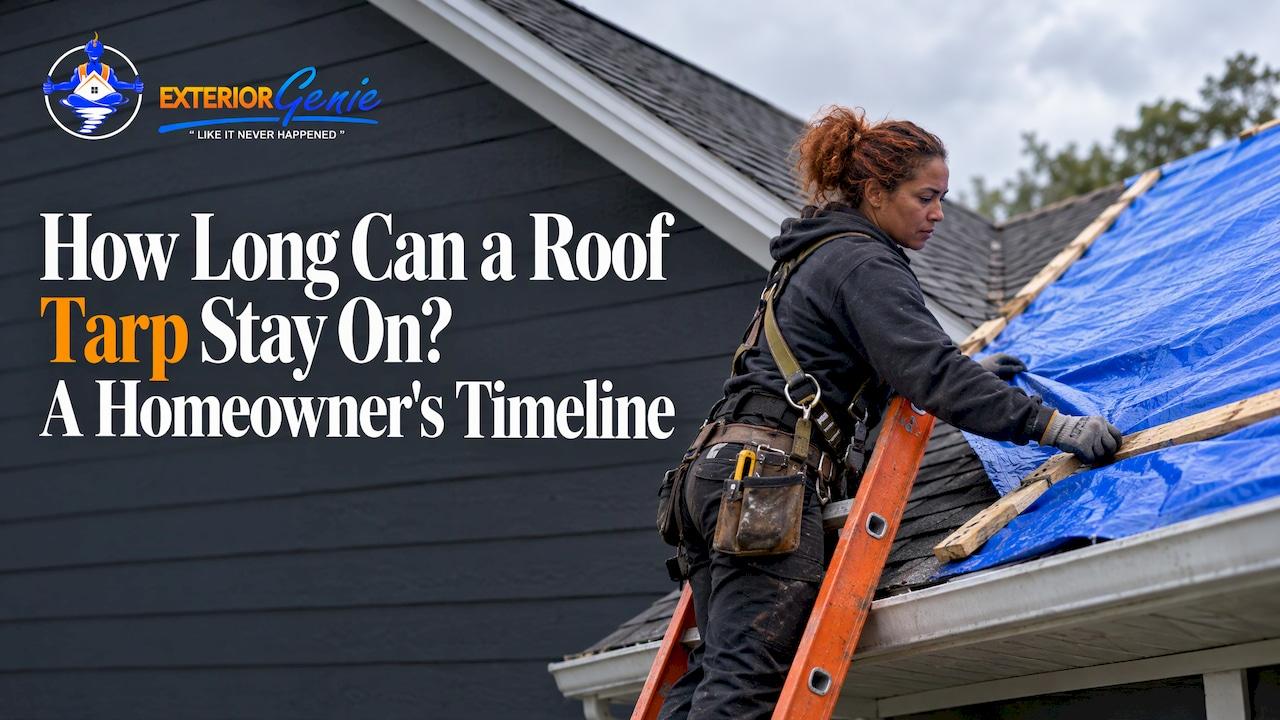
A roof tarp should stay on for weeks, not months. Plan on permanent repairs within about 30 days. That is the window the federal government uses for its own temporary roof covers. Even a well-installed, heavy-duty tarp is a short-term shield, and the longer it stays, the more likely it is to tear, loosen or trap moisture against your roof deck.
This guide explains where the 30-day and 90-day figures come from, what makes a tarp fail early, how often to check it, and how to handle your insurance claim while the tarp is up.
TL;DR
- Aim to have permanent repairs done within 30 days of tarping. FEMA says its Blue Roof sheeting is designed to last 30 days.
- Even a perfect installation should not stay up longer than the tarp maker recommends, usually about 90 days, and exposed storm conditions can wear a tarp out much sooner.
- Wind, sun, heavy rain, roof slope and how well the tarp is fastened decide how long it really lasts.
- Check the tarp after every wind or rain event, and keep photos and receipts for your insurer.
- Call a roofer early. Waiting on the claim does not mean waiting on the inspection.
Table of Contents
- How long a roof tarp lasts: the realistic timeline
- What shortens (or extends) the life of a tarp
- Sizing and installation details that affect longevity
- How often to check a tarp, and what to look for
- When the clock is running out: scheduling permanent repairs
- Tarping and your insurance claim
- Our perspective on tarps
- Get the tarp off your roof for good
- FAQ
- Sources
How long a roof tarp lasts: the realistic timeline
There is no single number, but there are useful benchmarks. Think of them as a ladder, from the safest plan to the outer limit.
| Timeframe | What it means | Source |
|---|---|---|
| Up to 30 days | The design life of reinforced blue plastic sheeting used in the federal Operation Blue Roof program. Homeowners are told to arrange permanent repairs within 30 days if possible. | FEMA |
| Up to about 90 days | The usual maximum a tarp maker recommends, even with a flawless installation. | Bob Vila |
| Days to a few weeks | What lightweight tarps may manage under direct storm exposure. | Field experience, see below |
The practical takeaway: treat 30 days as your target and 90 days as a hard ceiling you should never plan around. FEMA describes its Blue Roof program as a temporary covering that is intended to last until permanent repairs can be made. That is the right way to think about any tarp, whether it is installed by a government program or a roofing crew.
The ideal outcome is that the tarp comes off the day the permanent repair goes on. Bob Vila notes that the longer a tarp is secured, the more likely it is to tear or rip off in powerful wind, heavy rain, or freezing snow and ice.
What shortens (or extends) the life of a tarp
Two homes can be tarped on the same day with the same material, and one tarp can be shredded in a week while the other holds for a month. These are the variables that matter.
Material and thickness
Tarps are rated in mils, which measure thickness. A lightweight hardware-store tarp is built for covering a woodpile, not for sitting on a roof through a storm. Heavier, UV-stabilized polyethylene resists sun and tearing far better. The thicker the sheet, the longer it can hold, but thickness never makes a tarp permanent.
Wind
Wind is the biggest enemy. It lifts edges, snaps fasteners and works at seams. A tarp that flaps even a little will chafe and tear itself, so a tight installation matters as much as the material. A tarp needs to stay taut, keep debris out and send water off the roof quickly.
Sun and weather cycles
Ultraviolet light breaks down plastic over time. Repeated cycles of soaking rain, hot afternoons and cool nights add stress to every seam and grommet. In our experience, a tarp that looks fine on day ten can be brittle by week six.
Roof pitch and shape
Steeper roofs shed water faster but are harder to tarp securely, and wind catches them differently. Complicated roof lines with valleys, dormers and chimneys create more places for water to sneak under the sheet.
How it was fastened
A tarp held down with a few loose nails or weighted with sandbags is a very short-term fix. Proper tarping uses wood battens or furring strips, secured through the tarp into solid framing, with the sheet run over the ridge so water cannot get underneath. Sloppy fastening also causes damage of its own, since each fastener hole is a new opening in your shingles.
Moisture trapped underneath
If a roof was already wet when it was tarped, or if water got under the edge, the tarp can hold that moisture against the deck. Left too long, that dampness promotes mold and mildew growth underneath. This is one more reason the clock matters.

Sizing and installation details that affect longevity
A tarp that is too small is a tarp that fails early. The Roofing Brief advises extending the tarp at least 4 feet past the damage on every side, with the sheet wrapped over the ridge so water cannot pool at the top edge. It also suggests measuring the damaged span, then adding overlap on both sides, and allowing for the finished tarp to run about 3 to 5 percent shorter than its cut size once it is pulled tight.
A few more basics:
- Cover the whole vulnerable area. Water follows the path of least resistance, so the tarp should protect the damaged spot and the surrounding area where water could get in.
- Go over the ridge. Running the tarp over the peak, rather than stopping below it, keeps water from draining under the top edge.
- Keep it tight. Smooth the sheet to remove wrinkles and loose pockets. Wrinkles are weak points and they channel water into seams.
- Fasten into solid framing. Batten strips distribute the load so the wind does not tear the tarp at the fasteners.
Tarping is dangerous work. Climbing a wet, damaged roof is how homeowners get hurt. If the roof is steep, wet, or visibly sagging, stay on the ground and call a professional. Our guide to temporary roof repair options covers what a safe stopgap looks like, and our temporary roof patch steps explain what a crew does on arrival.
How often to check a tarp, and what to look for
The rule of thumb is simple: check it after any wind or rain. A tarp that was fine yesterday can be loose after one gusty night. You do not need to climb up to do it. Walk around the house and look from the ground, and look inside too, since the first sign of failure is often indoors.
From the ground, look for:
- Edges that lift, flap or have pulled away from the roof surface
- Rips, pinholes or frayed corners, especially near fasteners
- Pooling water or a sagging pocket in the sheet
- Loose or missing battens, or debris sitting on the tarp
- A faded, chalky or brittle look to the plastic, which signals sun damage
From the inside, check the attic and ceilings:
- New brown stains or spreading water marks on a ceiling
- Dripping, damp insulation or a musty smell in the attic
- Daylight or moisture around the damaged area of the deck
If you see any of these, the tarp needs to be re-secured or replaced, and you should not wait for the next storm to find out. A tarp that has been up more than a few weeks and is showing wear is telling you the permanent fix is overdue.
When the clock is running out: scheduling permanent repairs
The tarp buys you time for three things: getting an inspection, working through your insurance claim and ordering materials. Those steps can overlap, and they should.
- Get an inspection right away. A roofer can tell you whether you need a patch, a section repair or a full replacement. Our roof inspection is built for exactly this situation, and an emergency roof inspection explains what the visit covers.
- Start your claim immediately. Do not wait for the tarp to fail first.
- Line up materials. Shingles, underlayment and flashing can take time to arrive, especially after a widespread storm when everyone nearby needs the same products.
- Book the repair. After a major storm, crews get busy. The earlier you get on the schedule, the more likely the tarp comes off inside that 30-day target.
If the claim is slow, talk to your insurance company about it. A longer tarp period is not unusual after big storms, but it should be an open conversation with your adjuster, and you may need to have the tarp inspected or replaced if it has to stay on beyond a few weeks.
Some damage is beyond tarping altogether. If large parts of the roof structure are damaged, a cover will not make the house safe. That calls for structural repair and an immediate call to a licensed contractor.
Tarping and your insurance claim
Tarping is not only practical, it is usually expected. Your policy typically requires you to protect the property from further damage. A court opinion summarizing a standard policy, from the Iowa Court of Appeals, states that the insured must make reasonable and necessary temporary repairs and keep an accurate record of what was spent. Your own policy language controls, so read it or ask your agent.
What to do, in order:
- Photograph and video the damage first. FEMA guidance tells homeowners to take photos and videos of damaged property, and says that in most situations you may take steps to prevent further damage, such as tarping, but you cannot make permanent repairs before the adjuster's visit.
- Keep every receipt and invoice for the tarp. An insurance agency's hurricane claim checklist advises documenting damage before cleanup when it is safe and keeping receipts for tarping as part of emergency mitigation.
- Call your insurer promptly and tell them what was done to protect the home.
- Do not tear off or replace roofing until your adjuster has seen the damage.
We walk through the whole process in our guides on documenting roof damage for your insurer, a roof insurance claim checklist and roof damage insurance claim steps.
Our perspective on tarps
We see tarps every week, and the pattern is consistent: the tarp is almost never the problem. The delay is.
A good tarp installed by a trained crew will protect your home through the gap between the storm and the repair. It stops working when it sits too long, so our approach is to treat the tarp as day one of the repair plan, not as the end of the emergency.
That is why we run 24/7 emergency roof repair and tarping, and why our HAAG-certified inspectors document damage the same visit. Good photos and a clear damage report make the claim conversation easier, and they let us book the permanent work while the tarp is still holding.
We are veteran-owned, and we bring discipline to the sequence: secure the roof, document, communicate with your carrier, then repair. We would rather give you honest repair-versus-replacement guidance than sell you a bigger job than you need, and our lifetime workmanship warranty stands behind the permanent work we do.
Ebben
Get the tarp off your roof for good
If your roof is tarped now, or if a storm just damaged it, the best next step is a permanent plan. Exterior Genie serves homeowners and commercial property owners in Lexington, Columbia and across the Midlands of South Carolina. We handle emergency tarping, storm damage repair, insurance claim assistance and full roof replacement, all through one team that coordinates the project from first call to final cleanup.

Start with our storm damage restoration services or request a roof repair estimate. If the damage is larger than a repair, ask about roof replacement. For commercial buildings, our commercial roofing team can do the same. You can reach us through exteriorgenie.com.
FAQ
Can a roof tarp stay on for six months?
It should not. Tarp makers usually recommend removing a tarp by about 90 days at the very latest, and the federal Blue Roof program is designed around 30 days. After that, plastic degrades, edges loosen and moisture can build up underneath. If repairs are delayed, have the tarp inspected and replaced rather than leaving it to age.
Will my insurance company cover the cost of tarping?
Many policies treat emergency tarping as part of protecting the property after a covered loss, but coverage depends on your policy and the cause of damage. Keep every receipt, take photos before and after, and report the tarping to your carrier. Ask your agent or adjuster to confirm what your policy pays.
What is the difference between a 10 mil and a 16 mil tarp?
Mil is a measure of thickness: 1 mil is one thousandth of an inch. A 16 mil tarp is thicker and generally tougher against tearing and sun than a 10 mil tarp, which makes it a better fit for roof use. Thickness helps, but fastening and wind exposure still decide how long either one lasts.
How much of the roof should a tarp cover?
The tarp should extend at least 4 feet past the damage on every side and wrap over the ridge so water cannot get underneath the top edge. Covering only the visible hole leaves the surrounding area exposed. For a large or steep roof, let a crew do it.
Sources
- FEMA: Operation Blue Roof guidance
- FEMA: The difference between FEMA tarps and USACE Blue Roofs
- FEMA: Insurance and documentation guidance
- Bob Vila: How to Tarp a Roof During Repairs
- The Roofing Brief: Roof Tarp Types, Sizes, and How to Tarp a Roof
- Iowa Court of Appeals opinion on duty to mitigate
- Hurricane claim documentation checklist