
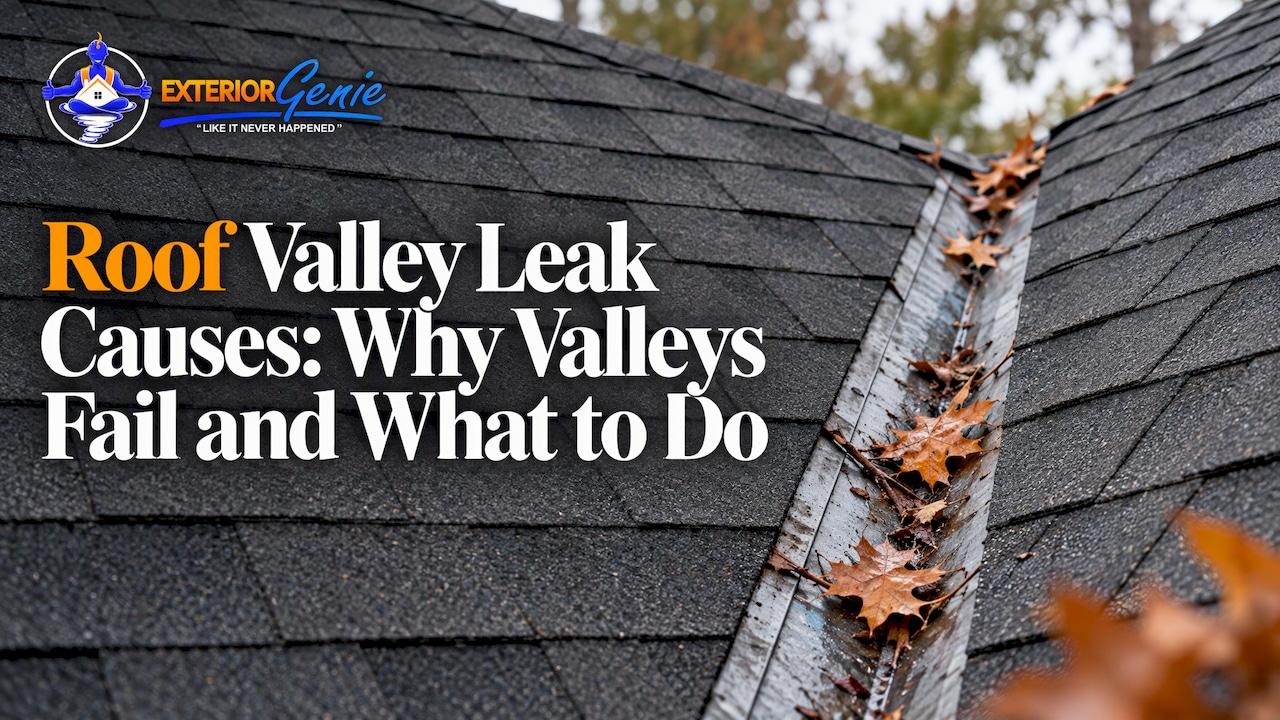
A roof valley leaks for one of a few reasons: debris damming the water, a nail or crack in the valley metal, worn shingles along the seam, or an installation that never had enough protection underneath. The valley is where two roof slopes meet and send their water down one channel, so a small flaw there gets tested harder than almost anywhere else on the roof.
This guide explains each cause, why the leak can seem to come and go, and how to limit damage while you arrange an inspection. We built it for homeowners and property managers in the Midlands of South Carolina, but the physics apply to any shingle roof.
TL;DR
- Valleys carry the runoff of two roof planes, so debris, ice, worn shingles or a single misplaced nail can let water under the roofing.
- Installation is a leading cause. Industry guidance calls for valley underlayment at least 36 inches wide and fasteners kept at least 8 inches from the valley centerline.
- Leaks that show up only in heavy rain or wind-driven rain often point to a valley, because that is when the channel carries its most water.
- Stay off the roof. From inside, protect belongings, contain the water and photograph the damage, then book a professional inspection.
- A leak that has been active for a while may involve wet decking and insulation, so the fix is rarely just a dab of sealant.
Table of Contents
- Why valleys leak more than other parts of the roof
- The most common roof valley leak causes
- Why a valley leak shows up only sometimes
- How to tell if the leak is in the valley
- What to do while you wait for the inspection
- Repair or replace the valley?
- Perspective: how we approach valley leaks
- Get your valley leak looked at
- Preventing the next valley leak
- FAQ
- Sources
Why valleys leak more than other parts of the roof
Picture a roof with two slopes meeting at an inside corner. Every drop of rain that lands on both slopes funnels into that seam. A valley handles more water, moving faster, than any flat stretch of shingles beside it. That concentrated flow is why valleys are unforgiving of small mistakes.
The National Roofing Contractors Association (NRCA) describes valley underlayment and flashing, together with the valley construction itself, as one of the most critical details of an asphalt shingle roof system. When that detail is right, a valley can last as long as the field of the roof. When it is wrong, the leak often starts years later, after the first few seasons of wear.
There are three common valley styles, and each fails differently:
- Open valley: metal flashing is exposed down the center and shingles are trimmed back on both sides. The metal itself can be punctured, dented or corroded.
- Closed-cut valley: shingles from one slope run over the valley and the other slope's shingles are cut along a line. Cut edges and nails near that line are the weak points.
- Woven valley: shingles from both slopes are interlaced. This style relies on many overlapping layers and can trap debris in the weave.
Whichever style your roof has, the causes below are what contractors find again and again.
The most common roof valley leak causes
1. Debris that dams the water
Leaves, pine needles, sticks and seed pods settle in valleys because the channel is where everything on the roof slides to. A mat of debris acts like a small dam. Water slows down, spreads sideways and can climb under shingle edges that would shed it perfectly well in a clear channel.

This matters in the Columbia and Lexington area, where mature pines and oaks overhang a lot of roofs. Wet debris also holds moisture against the shingles long after the rain stops, which speeds up granule loss and decay along the seam.
A valley that empties into a clogged gutter has a related problem. When the gutter backs up at the bottom of the valley, water can overflow right where the two slopes deliver their flow. Keeping gutters clear matters as much at the valley's lower end as anywhere else, and so does making sure the downspout carries water well away from the house. A downspout fix at ground level is part of the same water path.
2. Poor installation and missing underlayment
Many valley leaks are built in. Common installation errors include:
- Underlayment too narrow or missing. NRCA guidance calls for valley underlayment at least 36 inches wide, and recommends a centered, full-width sheet of polymer-modified bitumen, base or self-adhering material. A narrow strip leaves the sides of the valley exposed.
- Nails too close to the center. The same NRCA guideline keeps fasteners a minimum of 8 inches from the valley's centerline. A nail driven into the channel is a direct path for water.
- Insufficient overlap. Building America's guidance says valley membrane sections should overlap by at least 6 inches in shingle fashion so water flows unobstructed down the valley.
- No sealed layer under the underlayment. The same resource calls sealing valleys with a self-sealing bituminous membrane beneath the underlayment a fundamental strategy for vulnerable intersections.
If your roof leaks in a valley within the first several years, installation is the first suspect. Our guide to roofing underlayment options explains what should be under your shingles and why the layer matters.
3. Nails, cracks and punctures in the valley metal
In an open valley, the metal flashing is the waterproof surface. A roofer's nail through the center, a fastener that backed out, a dent from a fallen branch or a rusted patch can each let water through. Metal also expands and contracts with heat, and over many seasons that movement can loosen laps and fasteners.
If the valley metal has been patched repeatedly with roofing cement, that is a clue the problem has been chased rather than solved. Tar over a failing joint usually dries, cracks and lets the water back in.
4. Aging shingles along the seam
Shingles at the edge of a valley take the heaviest water flow and the most sun. Over time they lose granules, curl and crack. Water running along the edge finds those fissures, and what was a tight seam becomes a path under the shingles.
Age is often the honest answer when a roof is near the end of its service life. Several valley repairs in a short period on an older roof can mean the surrounding shingles are done too. We cover how to weigh that choice in common residential roof repair types.

5. Wind and storm damage
Strong wind can lift shingle edges, especially ones that were poorly sealed or nailed. In a valley, a lifted edge exposes the underlayment and lets rain get under the roofing. Hail can bruise shingles and dent valley metal. South Carolina's thunderstorm and tropical season puts the Midlands through both.
Storm damage in a valley is also a common reason for an insurance claim. If you suspect wind or hail caused the leak, our storm damage restoration team can document it, and our HAAG-certified inspectors can explain what they see in terms your adjuster will recognize.
6. Ice dams in cold climates
In snowy regions, ice can build along the eaves and block meltwater, which then backs up under the shingles. Valleys are especially exposed because they collect snow from two slopes. In the Midlands this is rare, but if you own property in the mountains or elsewhere, it is a cause worth knowing.
7. Other roof features that feed the valley
A valley rarely works alone. Chimneys, dormers, skylights and wall intersections often end at or near a valley, and their flashing can leak into it. A chimney that meets the roof in a valley zone needs both the masonry and the flashing checked, and a guide to chimney repair signs and fixes shows what to look for on the chimney side. Our article on roof flashing leaks explains how to find and fix flashing trouble elsewhere on the roof.
Why a valley leak shows up only sometimes
Readers often ask why a roof leaks in some storms and not others. With valleys the answer is usually volume and direction.
- Heavy rain. A light shower trickles down the channel without trouble. A downpour sends a surge of water through, and a small gap, lifted edge or partial debris dam that was fine all summer now overflows.
- Wind-driven rain. Rain pushed sideways can get under shingle edges and over the valley's edge from one direction only, so the leak appears with storms from a particular side.
- Debris after a storm. Wind drops leaves and branches into the valley. The next rain then meets a dam that was not there a week before.
- Slow absorption. Water may soak into decking and insulation first and show on the ceiling hours or days later, long after the rain ended. The stain can also appear several feet from the real entry point, because water travels along rafters and the underside of the deck.
This delay is why guessing where to patch from the ceiling stain alone often fails.
How to tell if the leak is in the valley
A few clues point toward a valley:
- The stain follows the roof's geometry. A ceiling stain below the line where two slopes meet is a good sign.
- It shows after heavy rain. Leaks that appear only in downpours fit the surge pattern above.
- Valley debris is visible from the ground. Binoculars from the yard can show leaves piled in the channel, granules in the gutter or a visibly dented or rusted metal valley.
- The attic shows moisture along the valley line. Dark or damp decking, stained rafters or wet insulation under the valley is strong evidence.
Our step-by-step article on how to diagnose a roof valley leak with the attic water test walks through the attic check in detail. Do not climb on a wet or steep roof to look for yourself. Falls are the real danger in roof inspection, and a professional has the harnesses and training to work safely.
What to do while you wait for the inspection
The goal is to limit damage and keep a record, not to repair the valley yourself.
- Protect the room. Move furniture and electronics out from under the stain. Place a bucket under a drip and poke a small hole in a bulging, water-filled ceiling bubble only if it is safe to do so, so the water drains into the bucket rather than collapsing the drywall. If water is near light fixtures or outlets, stay away and turn off power to that area at the breaker if you can do it safely, and call an electrician if you are unsure.
- Photograph everything. Take dated photos and video of the stain, the attic and any visible roof damage. If you may file a claim, this documentation helps.
- Arrange a temporary cover if rain is coming. A proper tarp installation keeps the valley dry until the permanent work is done. Our guide to temporary roof repair options explains what holds up and what does not. We offer 24/7 emergency roof tarping.
- Schedule a roof inspection. An inspector can find the entry point, check the decking and tell you whether you need a valley repair, a section replacement or a full roof conversation.
- Check your policy. If the cause was a storm, call your insurer early and ask about the claim process. Keep receipts for emergency measures.
Repair or replace the valley?
What the repair looks like depends on what the inspection finds.
| Finding | Typical approach |
|---|---|
| Debris only, no damage | Clear the valley, flush the gutter and check the surrounding shingles |
| Punctured or loose valley metal | Replace the damaged metal section and reseal the area |
| Worn shingles along the seam | Replace shingles along the valley and re-lay underlayment |
| Narrow or missing underlayment, nails near the center | Open the valley, install the correct underlayment and flashing, and re-shingle |
| Wet decking or widespread aging | Replace damaged decking and consider replacing the roof sections or the whole roof |
A quick coat of sealant is a short-term step at best. A durable fix goes down to the underlayment and the metal, which is why the right repair often means removing the shingles on both sides of the valley.
Perspective: how we approach valley leaks
At Exterior Genie, we treat the valley as a system, not a spot. A leak at the seam is a symptom, and we want to know the cause before anyone picks up a tube of sealant.
That is why our inspectors follow the water from the attic up, check the decking for moisture and look at the underlayment and flashing on both sides of the valley. Our HAAG-certified inspectors are trained to read storm and wear patterns, which matters when you are deciding between a repair and a replacement, or when you are talking with an insurance adjuster.
We give honest repair-versus-replacement guidance. If a valley section will solve the problem, we say so. If the shingles around it are at the end of their life, we explain why and show you what we found. As an Owens Corning Platinum Preferred Contractor, we install complete roofing systems, with the underlayment, flashing and shingles designed to work together, and we stand behind our workmanship with a lifetime workmanship warranty.
Our veteran-owned team brings discipline to the job: clear communication, coordinated scheduling and a site left clean.
Ebben
Get your valley leak looked at
If you see a stain below a roof intersection, or a storm has just passed and you are worried about a valley, we can help you find the source and fix it correctly. Our roof repair team serves Lexington, Columbia and the surrounding Midlands, and our roof inspections are designed to pinpoint where water is getting in.

For active leaks, our roof patching and leak repair service addresses the entry point, and we can also help with the insurance side of a storm-related claim. To see everything we do, visit Exterior Genie.
Preventing the next valley leak
- Keep valleys clear. Have debris removed after storms and in the fall, especially if trees overhang the roof. Do this from the ground with a safe tool or hire a professional rather than climbing up.
- Keep gutters flowing. The lower end of every valley should drain into a clear gutter.
- Trim overhanging branches. Fewer leaves in the channel means fewer dams.
- Inspect after severe weather. Wind and hail can damage valleys without obvious signs from the ground.
- Ask about the valley detail at replacement. When you get a new roof, ask what underlayment is going into the valleys, how wide it is and where the nails will sit.
- Address small problems early. A single lifted shingle or a loose piece of metal is a much cheaper job than wet decking.
FAQ
What is the most common cause of a roof valley leak?
Debris damming, damaged or punctured valley flashing and poor installation are the most common causes. A valley built with narrow underlayment or nails too near the center can leak within a few years. An inspection can tell which one you have.
Why does my roof leak only when it rains hard?
In heavy rain the valley carries a surge of water from both slopes, and a small gap or debris dam that copes with light rain overflows. Wind-driven rain can also push water under shingle edges. Because water often travels along the decking before it drips, the stain can show up well after the rain and away from the entry point.
Can I fix a roof valley leak with roofing cement?
Sealant may slow a drip for a short time, but it does not rebuild the underlayment or replace damaged metal, and it can crack as the roof moves. A lasting repair addresses the layers under the shingles. For safety, leave work on the roof to a professional.
How much does it cost to fix a roof valley leak?
Cost depends on what is wrong: clearing debris, replacing a metal section, re-laying shingles and underlayment, or repairing wet decking. We do not publish a flat price, because the repair depends on the inspection. Contact us for an estimate.
Sources
- IN THE VALLEY, NRCA roofing guidelines
- Roof Valleys and Penetrations Sealed, Building America Solution Center