

Reflective roofing, commonly called a cool roof, is a roofing system or coating engineered to reflect solar radiation and release absorbed heat so commercial buildings stay cooler and demand less from their HVAC systems. For property owners and facility managers, that translates directly into lower cooling energy costs, more consistent interior temperatures, a longer roof service life, and a measurable reduction in urban heat island contribution. The U.S. Department of Energy confirms that a conventional dark roof can reach 150°F on a summer afternoon while a reflective roof under the same conditions may stay more than 50°F cooler. That temperature gap is where the business case begins.
Who benefits most from reflective roofing:
- Hot-climate and mixed-climate commercial buildings with significant cooling loads
- Low-slope roofs on big-box retail, warehouses, distribution centers, and office buildings
- Facilities with aging roofs that still have structural life remaining (ideal for a reflective coating)
- Buildings planning a reroofing cycle in the next one to three years
Three metrics define whether a product qualifies: solar reflectance, thermal emittance, and the combined Solar Reflectance Index (SRI). The Cool Roof Rating Council (CRRC) independently tests and publishes these values for thousands of products, giving you a reliable way to compare options before you commit.
Table of Contents
- How reflective roofing reduces heat: solar reflectance, thermal emittance, and SRI
- Common commercial reflective options you should know
- Concrete benefits commercial property owners should expect
- When reflective roofs help most: climate, insulation, and building type
- Typical installed costs, service life, and payback considerations
- What installation and upkeep typically involve
- How to evaluate products and contractors before you commit
- How reflective roofs actually extend roof life: the thermal-stress mechanism
- Key Takeaways
- A contractor's honest perspective on reflective roofing
- Exteriorgenie can assess your commercial roof and specify the right system
- Authoritative resources for further research
How reflective roofing reduces heat: solar reflectance, thermal emittance, and SRI
Solar reflectance measures the fraction of sunlight a surface bounces back, on a scale of 0 to 1. Thermal emittance measures how efficiently that same surface sheds the heat it does absorb, also on a 0-to-1 scale. A white TPO membrane might carry a solar reflectance of 0.80 and a thermal emittance of 0.90. A conventional dark built-up roof might sit at 0.05 and 0.90. The difference in surface temperature under a July sun is dramatic, and it flows directly into the building below.
The Solar Reflectance Index combines both properties into a single number, with a standard black surface scoring 0 and a standard white surface scoring 100. Most commercial cool-roof specifications set a minimum SRI, so you can compare products across different material types on one scale.
Key temperature fact: Under summer sun, conventional roofs reach 150°F while a reflective roof can stay more than 50°F cooler under the same conditions, directly reducing heat transfer into the building.
One detail worth knowing: roughly half of sunlight arrives as invisible near-infrared (NIR) radiation. Cool-color pigment technology exploits that fact by reflecting NIR even in darker shades, so a charcoal or terra-cotta roof can be engineered to perform far better than a conventional dark roof. The EERE guidelines note that cool-colored products typically reflect 30–60% of sunlight, compared to 60–90% for white surfaces. That range matters for businesses with branding or aesthetic constraints.
What the metrics mean in practice:
- High solar reflectance = less heat absorbed at the surface
- High thermal emittance = faster heat release, lower surface temperature at night
- High SRI = best overall cool-roof performance, the number to request from any contractor or supplier
- Aged values matter: CRRC publishes both initial and three-year aged SR/TE data, because many surfaces lose reflectance over time
Common commercial reflective options you should know
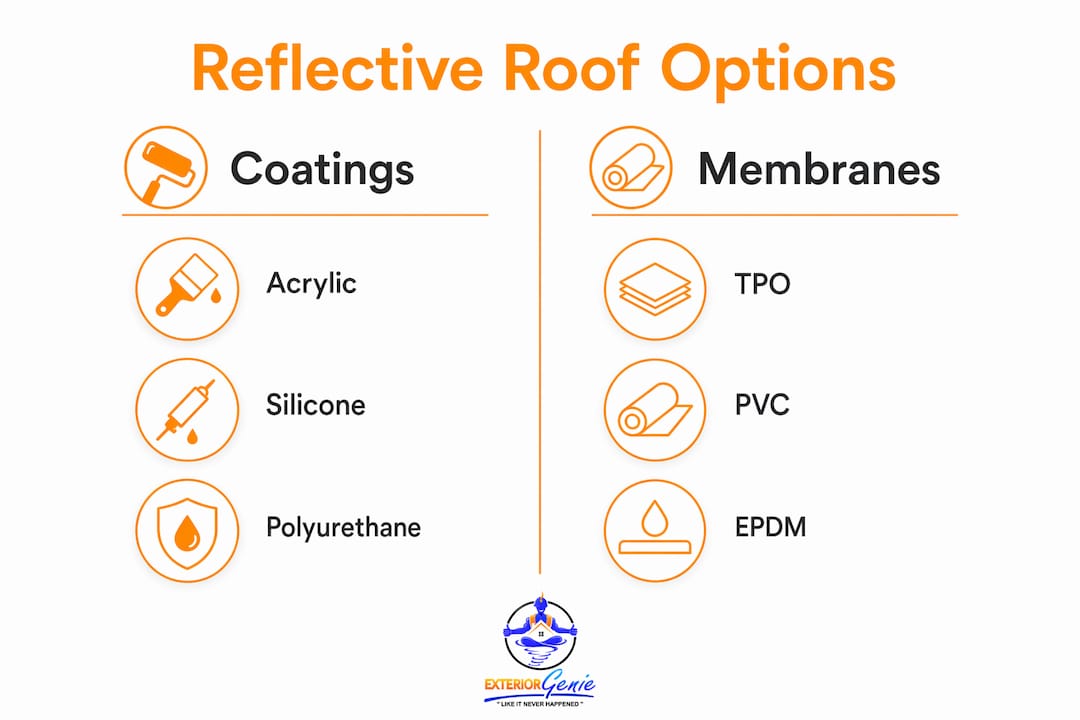
The types of reflective roofing materials available for commercial buildings fall into four main families. Each suits different substrates, budgets, and visual requirements.
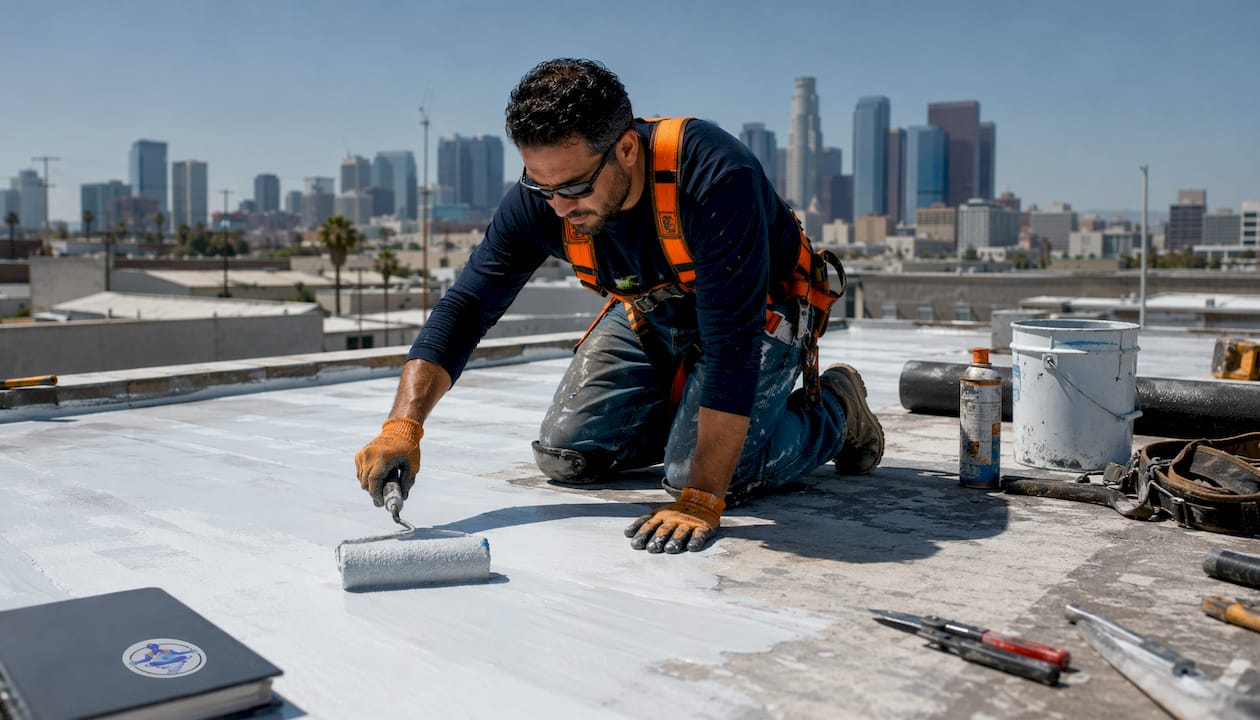
Reflective roof coatings (acrylic, silicone, polyurethane) are fluid-applied systems sprayed or rolled onto an existing roof. Acrylic coatings work well on metal and modified bitumen in low-moisture climates. Silicone holds up better in ponding-water conditions and is a strong choice for low-slope roofs with drainage issues. Polyurethane offers the best impact resistance and is often used as a base coat under a topcoat. All three can extend service life when the underlying roof still has structural integrity.
White and light-colored single-ply membranes (TPO, PVC, and certain EPDM variants) are the dominant choice for new commercial construction and full replacements. TPO in particular has become the most widely installed low-slope commercial membrane in the U.S., partly because white TPO meets most cool-roof code thresholds at no cost premium over conventional alternatives.
Reflective metal roofing uses factory-applied paint systems with high-reflectance pigments. Standing-seam and exposed-fastener metal panels are available in CRRC-rated finishes. Metal is a long-life option, often 40+ years with proper maintenance, and recoating with a reflective coating at mid-life is straightforward.
Cool-color factory systems cover tiles, shingles, and modified bitumen surfaces with NIR-reflective pigments. These are the right answer when a building's aesthetics or slope rules out a white membrane.
| Option | Energy savings potential | Typical installed cost | Best substrate fit | Lifespan / maintenance | Appearance |
|---|---|---|---|---|---|
| Reflective coating (acrylic/silicone) | Moderate to high | Lower upfront; add labor for prep | BUR, modified bitumen, metal | —; recoat at interval | White or light tints |
| TPO/PVC single-ply membrane | High | Mid-range; full replacement cost | New construction or full reroof | —; periodic inspection | White, tan, gray |
| Reflective metal (factory finish) | Moderate to high | Higher upfront; low lifecycle cost | Metal decks, retrofit over purlins | 40+ years; recoat at mid-life | Wide color range with cool pigments |
| Cool-color tile/shingle system | Moderate | Varies by material | Steep-slope, tile substrates | 25–50 years depending on material | Broad palette via NIR pigments |
To verify any product, search the CRRC Rated Products Directory for its initial and three-year aged solar reflectance and thermal emittance values before specifying it.
Pro Tip: Ask your contractor for the CRRC product listing number, not just a spec sheet. The CRRC entry shows aged performance values, which are what actually matter for long-term energy savings and warranty compliance.
Concrete benefits commercial property owners should expect
The most direct benefit is lower cooling energy consumption. Modeling across U.S. cities shows warm-climate metros like Phoenix, Miami, and Houston see the greatest annual energy savings per roof area, with positive results extending through climate zone 6 for many building types. Warehouses and big-box retail with large, poorly insulated low-slope roofs tend to see the sharpest reductions because the roof surface is a dominant heat-gain path.
Energy savings context: Reflective roofs produce the greatest cooling savings in warm climates, with Phoenix, Miami, and Houston consistently ranking highest in modeled annual energy savings per roof area.
Beyond the utility bill, there are three other business outcomes worth quantifying in your project analysis:
- Extended roof service life. Lower surface temperatures mean fewer expansion-and-contraction cycles, which slows membrane fatigue and adhesive degradation. The EERE guide notes that coatings both increase reflectivity and provide protective restoration when the underlying roof is still structurally sound.
- Reduced HVAC wear. Rooftop units running against a 150°F surface work harder and fail sooner. Drop that surface temperature by 50°F and you reduce compressor cycling and extend equipment life.
- Urban heat island reduction. Commercial roofs cover enormous surface areas. Switching to reflective systems lowers ambient air temperatures in the surrounding area, a benefit that some municipalities now incentivize through rebate programs.
Pro Tip: If your roof has five or more years of remaining life, a reflective coating is often the right move: you get energy savings and life extension without paying for a full teardown. If the roof is already failing, a reflective membrane replacement makes more sense than coating over a problem.
Commercial roof maintenance is the other side of this equation. A reflective surface that accumulates dirt and biological growth loses reflectance quickly, so the energy benefit and the coating investment both depend on a basic maintenance schedule.
When reflective roofs help most: climate, insulation, and building type
The DOE guidance is direct: cool roofs achieve the greatest cooling savings in hot climates but can increase energy costs in colder climates if the annual heating penalty exceeds cooling savings. For most of the South, Southwest, and much of the Midwest, the net annual benefit is positive. In climate zones 7 and 8 (think northern Minnesota or Alaska), a careful cost-benefit analysis is required before specifying a highly reflective system.
Insulation level changes the math significantly. When a roof assembly has low insulation, the roof surface temperature has a direct path to the conditioned space below, so reflectivity matters a great deal. A well-insulated roof assembly already blocks most of that heat transfer, which means the marginal benefit of reflectivity is smaller, though still positive in warm climates.
Building type also shapes the outcome:
- Big-box retail and warehouses with large, low-slope roofs and minimal insulation see the largest absolute savings
- Low-rise offices and schools benefit from both energy savings and improved occupant comfort, especially in top-floor spaces
- Multi-story buildings gain less per floor because the roof represents a smaller fraction of the total envelope
Climate note: Research modeling shows reflective roofs deliver positive net annual energy results for most building types through climate zone 6; zones 7–8 require a site-specific analysis that accounts for heating penalties.
For borderline climates or buildings with unusual insulation profiles, an EnergyPlus-based energy model or a simple payback calculation using local utility rates will give you a defensible number before you commit to a specification. Your state energy office or local utility may offer free modeling support.
Typical installed costs, service life, and payback considerations
Cost ranges for commercial reflective roofing vary widely by roof size, substrate condition, and product type. Public estimates from Fixr show national average installed costs varying widely depending on project scale, roof size, and product type, with commercial projects scaling by square footage and complexity. A reflective coating on an existing sound roof is almost always the lowest-cost entry point; a full TPO replacement costs more upfront but resets the service life clock.

| System | Typical installed cost range | Expected service life | Maintenance needs |
|---|---|---|---|
| Reflective coating (silicone/acrylic) | Lower; varies by roof area and prep | — | Annual inspection; recoat at interval |
| TPO/PVC single-ply replacement | Mid to higher; full reroof scope | — | Bi-annual inspection; seam checks |
| Reflective metal (new or recoat) | Higher upfront | 40+ years | Periodic recoat; fastener checks |
Payback depends on four variables: local utility rates, what fraction of your energy bill is cooling, available rebates or incentives, and the condition of your existing roof. A warehouse in South Carolina paying above-average commercial electricity rates with a dark, under-insulated roof can see payback in a few years on a coating project. A well-insulated office in a mild climate will take longer.
Pro Tip: The single best way to reduce payback period is to time a reflective upgrade with a planned reroofing cycle. You pay for the reflective membrane instead of a conventional one, often at little or no cost premium, rather than paying for a separate coating project on top of a functioning roof.
Utility rebate programs and state incentives can meaningfully shorten payback. ENERGY STAR maintains a list of certified cool-roof products, and many utilities offer demand-reduction rebates for commercial buildings that install qualifying systems. Check your utility's commercial energy efficiency program and your state energy office for current offerings. California's Title 24 code mandates minimum aged solar reflectance and emittance values for most commercial low-slope roofs, and similar requirements are spreading to other states.
For commercial roof replacement planning, integrating a reflective specification into the project scope from the start is far more cost-effective than retrofitting later.
What installation and upkeep typically involve
Installation scope depends on which system you choose, but the sequence is consistent: inspection and substrate assessment, surface repair (patching, seam reinforcement, drain clearing), primer application where required, product application, and a final quality check against the manufacturer's spec.
For coatings, surface preparation is the most critical step. A coating applied over wet insulation, loose seams, or active leaks will fail early regardless of product quality. Expect a reputable contractor to spend as much time on prep as on application.
Typical maintenance checklist for reflective systems:
- Inspect twice per year (spring and fall) and after major storms
- Clear drains, scuppers, and gutters to prevent ponding water
- Check seams, flashings, and penetrations for separation or cracking
- Remove biological growth (algae, moss) promptly to protect reflectance
- Document surface condition with photos at each inspection for warranty purposes
- Schedule recoating at the manufacturer's recommended interval, typically before reflectance degrades below the warranty threshold
A detailed commercial roof maintenance checklist helps facility managers track these intervals systematically.
Warranty terms vary significantly. Material warranties cover product defects. Labor warranties cover installation workmanship. System warranties (the most comprehensive) cover both and are typically offered by manufacturers when a certified installer applies their product. Read the exclusions carefully: most warranties void if the roof is not maintained per the manufacturer's schedule or if unauthorized repairs are made.
Installation red flags to watch for:
- Contractor skips a moisture survey or core sample before coating
- No written surface-preparation plan provided before work begins
- Installer cannot provide CRRC product listing numbers or aged performance data
- Warranty offered verbally but not in writing before contract signing
How to evaluate products and contractors before you commit
Choosing the wrong contractor or product on a commercial roof is an expensive mistake; contractors can learn best practices from this local lead-generation guide for contractors. A structured evaluation process protects your investment.
Contractor questions to ask during RFP or site bid:
- What CRRC-rated products do you specify, and can you provide the listing numbers?
- What are the three-year aged solar reflectance and thermal emittance values for your proposed product?
- How many projects of this roof type and size have you completed in the past three years?
- Do you hold HAAG certification or equivalent inspector credentials for damage assessment?
- What does your surface-preparation process include, and will it be documented in the contract?
- What warranty do you offer, and is it a material, labor, or system warranty?
- Can you provide three local commercial references with contact information?
Product evaluation checklist:
- Verify initial and aged SR/TE values from the CRRC Rated Products Directory
- Confirm the SRI meets or exceeds the project specification or local code minimum
- Check substrate compatibility with your existing roof assembly
- Confirm the product is approved for your roof slope
- Review the manufacturer's maintenance requirements before signing off on the spec
Red flags in product or contractor proposals:
- Only initial reflectance values provided, no aged data
- Warranty language that excludes "normal weathering" or requires proprietary maintenance products available only from the contractor
- No local commercial references
- Bid price significantly below market without a clear explanation of scope differences
For a broader contractor selection framework, reviewing the full checklist before issuing an RFP saves time and reduces procurement risk.
How reflective roofs actually extend roof life: the thermal-stress mechanism
The lifespan benefit of reflective roofing is often undersold relative to the energy savings story, but for many commercial property owners it is the stronger financial argument.
Every time a roof surface heats up and cools down, the membrane, adhesive, and substrate expand and contract. Over years, those cycles fatigue the material at seams, flashings, and penetrations. A roof that regularly reaches 150°F and then drops to 70°F overnight is cycling through an 80-degree thermal swing. A reflective roof that peaks at 100°F cuts that swing nearly in half.
"Coatings both increase reflectivity and provide protective restoration; energy savings alone often do not justify coating unless it also extends service life." — EERE Guidelines for Selecting Cool Roofs
The practical implication is straightforward. Apply a reflective coating to a roof that still has structural integrity and you slow the degradation clock, potentially adding years before a full replacement is needed. Apply it to a failing roof and you are spending money on a surface that cannot support the coating's performance. The condition assessment before any coating project is not optional.
UV exposure compounds the thermal-stress problem. Reflective surfaces absorb less UV energy, which slows the oxidation and embrittlement of asphalt-based and polymer-based membranes. That is a secondary but real contributor to extended service life, particularly for modified bitumen and BUR assemblies.
One caution worth flagging: in dense urban projects, a highly reflective roof can redirect concentrated solar radiation onto adjacent facades or rooftop equipment. The EERE guidelines recommend checking sightlines and neighboring building impacts before specifying a very high-reflectance system in a tight urban context.
Key Takeaways
Reflective roofing delivers the strongest return for warm-climate commercial buildings with low-slope roofs, especially when the upgrade is timed to a planned reroofing cycle rather than treated as a standalone project.
| Point | Details |
|---|---|
| Prioritize warm climates | Greatest net energy savings occur in hot and mixed climates; zones 7–8 require a site-specific payback analysis. |
| Time it with reroofing | Specifying a reflective membrane during a planned reroof avoids paying for a separate coating project on a functioning roof. |
| Verify CRRC aged values | Always request three-year aged solar reflectance and thermal emittance data, not just initial values, before specifying a product. |
| Life extension is the hidden ROI | Reducing thermal cycling slows membrane fatigue; for roofs with remaining life, a coating can defer full replacement by years. |
| Exteriorgenie for SC commercial roofs | Exteriorgenie provides HAAG-certified commercial roof assessments, reflective coating and replacement services, and financing options in Lexington, SC. |
A contractor's honest perspective on reflective roofing
The energy savings headline is real, but it is not the whole story. What I see most often in commercial roofing is property owners who focus exclusively on the utility bill projection and overlook the lifecycle cost argument, which is frequently the stronger case.
A reflective coating on a sound 15-year-old modified bitumen roof in South Carolina can add meaningful years of service life. That deferred replacement cost is often worth more than the cumulative energy savings over the same period, particularly for owners who plan to hold the asset long-term. The two benefits compound: you spend less on cooling every year and you push back the capital expense of a full reroof.
The other thing that gets underestimated is the importance of aged performance values. A product that starts at a solar reflectance of 0.85 and drops to 0.55 after three years of weathering is a very different investment than one that holds at 0.75. That gap does not show up in a standard spec sheet. It shows up in the CRRC listing, which is exactly why requiring that data before contract signing is non-negotiable.
Climate matters too. South Carolina sits in a climate zone where reflective roofing almost always pencils out positively. Facility managers in colder northern states need to run the numbers more carefully, accounting for the heating penalty in winter months. The DOE guidance on this is clear and worth reading before any specification decision.
Exteriorgenie can assess your commercial roof and specify the right system
Exteriorgenie brings 25 years of commercial roofing experience and HAAG-certified inspection credentials to every project in the Lexington, SC area. For property owners evaluating reflective roofing, that means a site assessment grounded in real substrate analysis, not a generic product pitch.
The practical difference: Exteriorgenie's inspectors verify existing roof condition before recommending a coating or replacement, confirm CRRC product ratings for any proposed system, and walk you through the payback math using your actual building size and local utility rates. If your roof has been through storm or wind damage, the team also handles insurance claims assistance through HAAG-certified inspectors, which can significantly offset project costs.
What Exteriorgenie offers commercial clients:
- No-obligation commercial roof assessment with condition documentation
- Reflective coating application and full membrane replacement
- CRRC-verified product specifications for energy code compliance
- 24/7 emergency tarping and storm damage repair
- Financing options for projects of all sizes
Ready to find out whether a reflective roof makes financial sense for your building? Request a commercial assessment from Exteriorgenie and get a clear, documented recommendation based on your roof's actual condition.
This article provides general information about reflective roofing systems. Consult a qualified roofing professional and your local building authority to confirm current code requirements and incentive programs for your specific building and location.
Authoritative resources for further research
These sources back the claims in this article and give you the tools to verify product data and incentive availability independently.
- U.S. Department of Energy: Cool Roofs — Plain-language explanation of how cool roofs work, climate considerations, and product types. Start here for a policy-neutral overview.
- Cool Roof Rating Council (CRRC) — The CRRC Rated Products Directory lists initial and three-year aged solar reflectance and thermal emittance values for thousands of products. Use it to verify any product a contractor proposes.
- EERE Guidelines for Selecting Cool Roofs — Detailed procurement and installation guidance covering coatings, membranes, and metal systems, with specific notes on when coatings extend service life versus when replacement is the right call.
- ENERGY STAR Certified Roof Products — Lists certified cool-roof products by category and links to utility rebate programs. Check here for incentive eligibility before finalizing a specification.
- MDPI Energy Study: Cool Roofs in the U.S. — Peer-reviewed modeling study showing climate-zone-by-zone energy savings for reflective roofs across building types. Useful for validating payback projections in your climate.
- Roof coating guide for commercial buildings — Practical application guidance covering coating types, prep steps, and performance expectations for commercial substrates.
- Local utility rebate search — Most major U.S. utilities offer commercial demand-reduction rebates for ENERGY STAR or CRRC-rated cool-roof installations. Search your utility's commercial energy efficiency program or use the DSIRE database (dsireusa.org) for state and local incentive listings.