
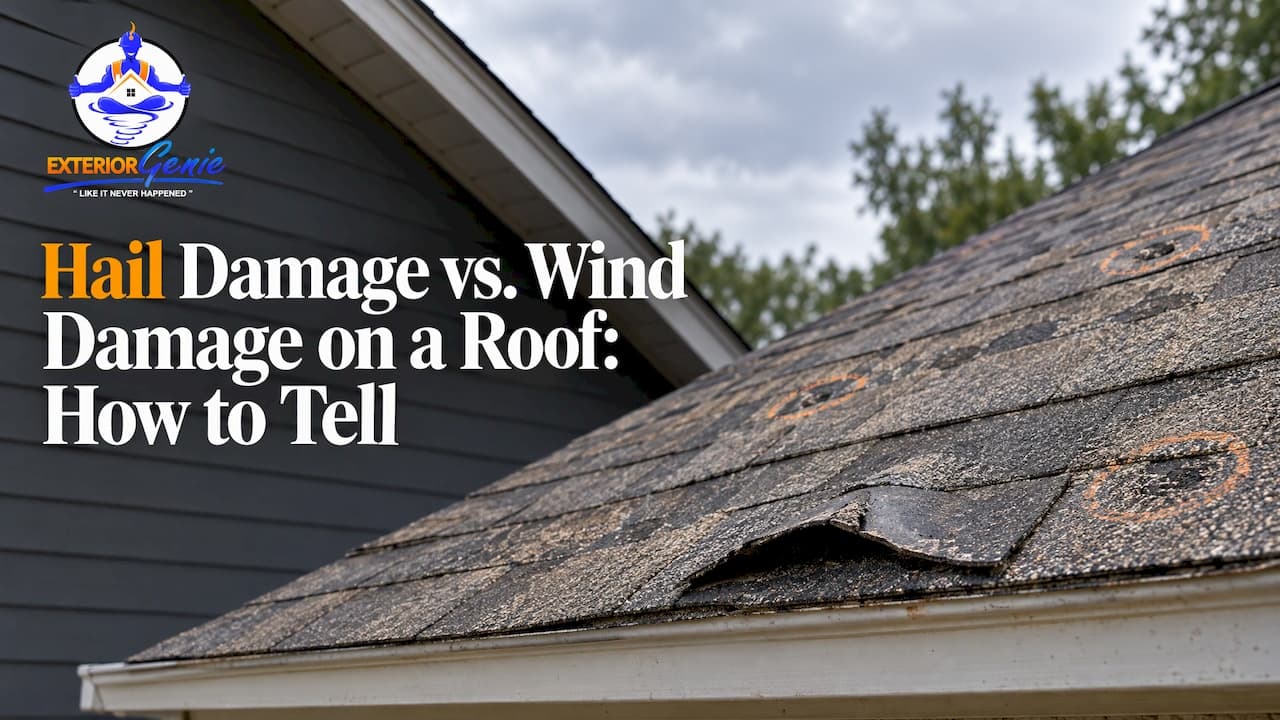
Hail damage is spread across the roof and shows up as bruises, dents and missing granules on the slopes the storm hit. Wind damage starts at the edges and high points, where shingles lift, crease, tear or blow off. Many storms bring both, so the real job is to work out which one did what, because that decides the repair, the claim and how much of the roof needs work.
We are Exterior Genie, a veteran-owned general contractor serving Lexington, Columbia and the Midlands of South Carolina. Below is how we sort hail from wind, what to photograph before anyone touches the roof, and how the difference plays out with your insurer.
TL;DR
- Hail leaves random, widespread impact marks: bruised or cracked shingles, bare spots where granules were knocked off, dents in metal, gutters and vents.
- Wind leaves directional damage: lifted, creased, torn or missing shingles, mostly along edges, ridges, corners and the windward side.
- Many storms cause both. Hail marks on the same slope as wind-torn shingles are common, and each is documented separately.
- Stay off a damaged roof. Photograph from the ground, cover openings with a tarp if you must, and keep receipts.
- Have a qualified roofing inspector confirm the cause before you settle with the insurer.
Table of Contents
- The quick difference at a glance
- How hail damages a roof
- How wind damages a roof
- When hail and wind hit together
- Why the difference matters for repair
- Insurance: will it pay for hail or wind damage?
- Safety first after a storm
- Getting your roof checked in the Midlands
- FAQ
- Sources
The quick difference at a glance
| What you see | Points to hail | Points to wind |
|---|---|---|
| Pattern | Scattered across whole slopes, mostly the side facing the storm | Concentrated at edges, corners, ridges and rakes |
| Shingle surface | Round bruises, soft spots, granule loss exposing the mat | Creased, folded, torn or missing tabs |
| Shingle position | Still sealed and in place | Unsealed, lifted, curled back or gone |
| Metal and accessories | Dents in vents, flashing, gutters, AC fins | Bent or displaced flashing and ridge caps |
| Underside clues | Cracks in the shingle mat | Exposed nails, torn nail holes |
Treat the table as a starting point. Real roofs mix the signs, and age, shingle type and previous repairs change how damage looks.
How hail damages a roof
Hail falls everywhere at once, so its damage is random and spread out. On asphalt composition shingles, Texas windstorm guidelines describe functional hail damage as fractures that reduce the shingle's ability to shed water or shorten its expected life. In practice that means bruises you can feel as soft spots, cracked mats and bare patches where granules were knocked off.
Other materials tell the story differently. The same guidelines list dents in metal roofing, cracks in tile, and splits, splinters or dents in wood shakes as hail clues. Wind, by contrast, may loosen tile from its mortar or nails, or break it with flying debris.

Clues you can see from the ground
You do not need to climb to start collecting evidence. A county risk-management hail checklist points to dented gutters, downspouts, siding, window screens, satellite dishes, vents and air-conditioner fins. If the soft metal around your house is dimpled, the shingles above it deserve a close look.
Our own guides go deeper on what to check first when hail hits shingles and on roof impact damage.
Does 1-inch hail damage a roof?
It can. The Nebraska Department of Insurance explains that lightweight composition shingles may show damage from 1-inch hail, heavier composition and wood-shake roofs generally need about 1¼-inch hail, and deteriorated shingles can be hurt by stones smaller than 1 inch.
Penn State impact research points the same way. It found that aged organic-mat asphalt shingles were damaged about half the time by 1-inch ice stones, aged fiberglass-mat shingles needed roughly 1¼ inches, thicker laminated shingles about 1½ inches, and the most resistant products about 2 inches. The study treats these as general thresholds, affected by product and condition.

The takeaway: stone size is one clue, not a verdict. Density, speed, angle of impact and the age of your shingles all matter, as a professional inspector education series explains. We cover this more in our piece on why 1-inch hail often damages shingles.
How wind damages a roof
Wind works from the outside in. The National Roofing Contractors Association explains that negative pressure begins at edges and lifts material, exposing the underside and setting up a progressive peeling effect. That is why wind damage clusters at eaves, rakes, ridges and corners, and why one missing shingle can turn into a bare patch during the next gust.
What to look for:
- Shingles that are creased across the middle, folded back or torn.
- Tabs that have lost their seal and sit raised or curled.
- Exposed nails or torn nail holes.
- Missing shingles or ridge caps, often on the side the wind came from.
- Displaced or bent flashing.
The Texas guidelines list tearing, bending and bruising as typical wind effects on shingles. Lifted shingles can look minor from the yard and still leave the roof open to water, which is why we wrote about staying off the roof after a storm.
When hail and wind hit together
Severe storms rarely pick one. A line of storms can drop hail and push 60 mph gusts at the same time, so the same slope may show scattered bruises and a torn edge. That is normal, and it is the situation where careful documentation pays off.
A practical way to sort it out:
- Start with the pattern. Random, roof-wide marks suggest hail. Edge-focused, directional damage suggests wind.
- Check every slope. Hail damage is usually heaviest on the sides facing the storm. Wind damage follows the gust direction and exposure.
- Check the soft metals. Dents on vents, gutters and flashing support a hail finding even when shingles look ambiguous.
- Look at the shingle underneath. A bruise with a fractured mat is hail. A crease with a torn nail hole is wind.
- Record each type separately. One line item for hail, another for wind, each with photos.
Our guide to the types of storm roof damage walks through more examples, including debris impact and granule loss.
Why the difference matters for repair
The cause changes the scope. Wind damage is often local: replace the missing or creased shingles, reseal tabs, repair flashing. Hail damage, because it falls across the whole slope, can leave many damaged shingles spread over a large area, and spot-repairing hundreds of bruises is rarely practical. When the damage is widespread, replacing the slope or the roof is often the honest answer.
Our approach is to give you straight repair-versus-replacement guidance based on what the inspection finds, not on what is easiest to sell. If a few shingles fix the problem, we say so. If the roof has reached the point where patching will not hold, we show you the photos and explain why.
What about the "25% rule"?
You may hear that if more than a quarter of a roof is damaged, the whole thing must be replaced. That figure is a rule of thumb that shows up in some local building codes and some insurer practices, but it is not a single national law. Whether it applies depends on your jurisdiction, your policy and the roofing material. Ask your local building department and your insurer how repairs are treated where you live, and have your roofer put the damaged area in writing.
Insurance: will it pay for hail or wind damage?
Most standard homeowners policies cover sudden storm damage from both hail and wind, but the terms vary by policy, so read yours. One South Carolina detail worth knowing: state regulation addresses separate hurricane, named storm and wind/hail deductibles and how insurers must tell policyholders about them. Look at your declarations page to see whether your policy carries a separate percentage deductible for wind or hail, because it changes whether a smaller repair is worth filing.
The North Carolina Department of Insurance, in its guidance after storms, suggests asking about estimates, coverage including additional living expenses, deductibles and when to expect an adjuster. Those are good questions in any state.
Document before anyone touches the roof
The National Association of Insurance Commissioners recommends photos or video, written notes, contractor bids when available and receipts for emergency repairs. It also advises being present when the adjuster visits and asking about next steps.
A simple routine:
- Photograph every elevation of the house from the ground, then close-ups of dented gutters, vents and screens.
- Note the date, time and what you heard or saw during the storm.
- Keep a folder for bids, receipts, adjuster emails and claim numbers. The same organizing habits help if you ever sell, and these questions for vetting home inspectors show why a clean paper trail on a property's history matters.
- Get a written inspection from a roofing professional.
We have step-by-step guides on how to document roof damage for your insurer, a roof insurance claim checklist and roof damage insurance claim steps. For how an inspection supports the claim, read how a roof inspection backs up your claim.
If the adjuster sees something different
Adjusters sometimes attribute damage to wear or to a different cause than you or your roofer do. The NRCA notes that if the findings differ from a professional inspection, you may request a reinspection where the adjuster and your roofing professional review the damage together. That is one reason to have a roofer who can speak the language of claims on the roof with you.
Safety first after a storm
A damaged roof and a stormy night are a bad mix. The NRCA advises prioritizing safety, never inspecting a potentially unsound roof alone, never climbing a ladder in the dark, wearing sturdy footwear, long sleeves and work gloves, and using a tarp to temporarily cover openings instead of attempting ordinary repairs.
Inside and around the house, the CDC recommends avoiding damaged buildings, exposed nails, broken glass and fallen power lines, leaving if you smell gas or hear shifting or unusual noises, and using flashlights rather than candles.
On repairs, Minnesota's Department of Commerce advises making only temporary repairs to prevent further damage, keeping receipts, and waiting for the insurer's instructions before arranging permanent repairs or throwing away damaged property. Check your own policy and your insurer's instructions for South Carolina.
Our perspective
After a storm, most homeowners ask us the same thing: "Is this hail or wind, and does it mean a new roof?" Our answer starts with the roof, not the sales pitch. We look at the pattern, the soft metals and the shingle itself, and we explain what we see with photos you can keep.
We believe the best result for a homeowner is an accurate diagnosis. Our team includes HAAG-certified inspectors, and we bring military discipline to the process: clear communication, coordinated project management and no surprises. When repair is enough, we tell you. When replacement is the honest answer, we show you why and stand behind our work with a lifetime workmanship warranty.
Because storms often leave both hail and wind damage on the same roof, we document each cause separately so your claim reflects what actually happened. We also help you work through the insurance side, and we are an Owens Corning Platinum Preferred Contractor.
Ebben
Getting your roof checked in the Midlands
If a storm just passed over Lexington, Columbia or nearby, the first step is a professional look. Our roof inspections in Lexington cover hail and wind, and our storm damage restoration team can handle everything from emergency tarping, available 24/7, to full replacement. We also assist with insurance claims and can meet your adjuster on the roof.

Need a repair estimate or a roof replacement? Start with our roof repair services, explore everything else on our services page, or contact Exterior Genie to schedule an inspection.
FAQ
Can 1-inch hail damage my roof?
Yes, it can, especially on lightweight or aging composition shingles. Heavier shingles generally need larger stones, around 1¼ inches or more, to be damaged. Because condition and product matter, a professional inspection is the reliable way to know.
How can I tell if my roof has hail or wind damage?
Look at the pattern. Hail leaves random bruises, bare spots and dents across whole slopes and on soft metals. Wind leaves lifted, creased, torn or missing shingles, mostly along edges and ridges. If you are unsure, an inspector can read the signs on the roof.
Will insurance pay for roof hail damage?
Many homeowners policies cover sudden hail and wind damage, subject to your deductible and policy terms. Some policies carry a separate wind/hail deductible, so check your declarations page. Document the damage and ask your insurer about next steps before you arrange permanent repairs.
What should I avoid doing after a storm?
Do not climb onto a damaged roof, and do not make permanent repairs before talking to your insurer. A temporary tarp over openings is the safe step, and you should keep every receipt. Be present for the adjuster's visit and keep your photos and notes organized.
Sources
- TWIA & TFPA Property Damage Evaluation Guidelines
- Checklist to Spot Roof Hail Damage
- Hail Damage: Does My Roof Need Repair? (Nebraska Department of Insurance)
- Hail damage threshold sizes for common roofing materials (Penn State)
- Mastering Roof Inspections: Hail Damage, Part 3
- Roof Repair After Strong Winds (NRCA)
- S.C. Code Regs. § 69-56, Hurricane, Named Storm or Wind/Hail Deductible
- Claims and Adjuster Information (NC Department of Insurance)
- Post-Disaster Claims Guide (NAIC)
- Safety Guidelines: After a Tornado (CDC)
- Tips for Residential Property Owners and Renters on Filing a Claim (Minnesota Department of Commerce)
- Avoid Inspection Surprises: 6 Questions to Vet Maine Home Inspectors