
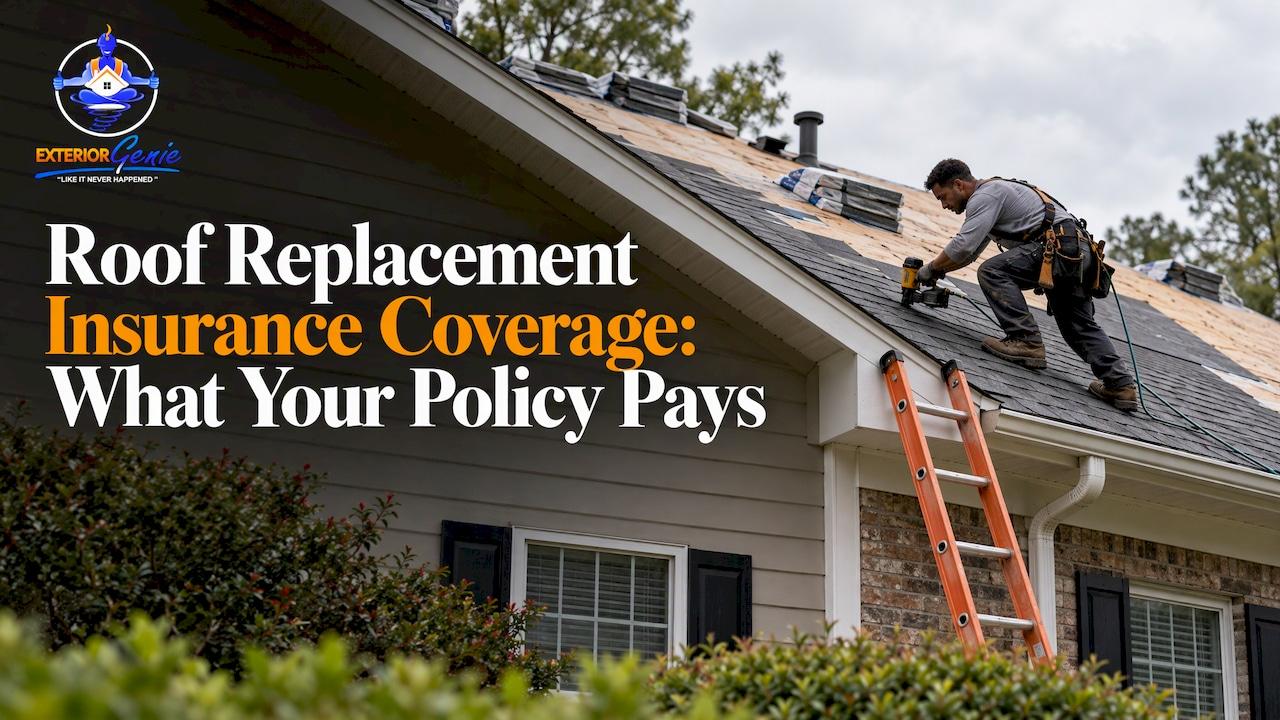
Homeowners insurance can pay for a new roof, but only when a covered event, such as a windstorm, hail or a falling tree, damages it. It will not pay because the roof is old or worn out. How much you receive depends on the cause of the damage, your roof's age and condition, whether your policy pays replacement cost or actual cash value, and your deductible.
This guide explains each of those pieces in plain terms. It also covers what a new roof costs, how to file a claim, and what to do when the estimate comes back too low.
TL;DR
- Insurance may cover a roof damaged by a covered peril. It will not pay for a new roof just because it is old or worn out.
- A covered event can lead to payment for only the damaged part of the roof, not an automatic full replacement.
- Replacement cost value (RCV) coverage usually pays in two checks. Actual cash value (ACV) pays less on an older roof.
- Report damage promptly, photograph it, make only temporary repairs and keep every receipt.
- If the estimate seems low, tell the insurer why in writing, get a second estimate and consider appraisal.
Table of Contents
- When insurance pays for a roof replacement
- What insurance usually does not cover
- Replacement cost vs. actual cash value
- How roof age changes your coverage
- What a new roof costs, and what you pay yourself
- How to file a roof insurance claim
- What to avoid with the adjuster
- If the estimate is too low or the claim is denied
- Perspective: why documentation decides the outcome
- Get your roof inspected and your claim organized
- FAQ
- Sources
When insurance pays for a roof replacement
Standard homeowners policies typically cover sudden, accidental losses from named perils. The Maryland Insurance Administration lists fire, wind, hail and the weight of ice or snow among them. Progressive adds sleet, lightning and falling objects to the commonly covered causes, subject to your policy.

When a covered peril causes structural damage, a replacement may be covered, up to your policy limits and after your deductible. The key word is may. The same Maryland advisory notes that a covered peril can result in payment for only the damaged portion of the roof rather than the whole thing.
So the question is rarely "does my policy cover roofs?" It is closer to "is the damage widespread enough, and documented well enough, that replacing the roof is the right repair?" In the Midlands of South Carolina, where summer thunderstorms, hail and tropical systems all reach the roof, that question comes up often. Our own guide to types of storm roof damage shows what each kind looks like on shingles.
Repair or replace: where the line falls
There is no single legal threshold. Some roofing articles cite a rule of thumb that a full replacement becomes the safer call once roughly a quarter to a third of the roof is damaged. Treat it as a conversation starter, not a rule. The real factors are:
- How many slopes are affected, and whether damage is scattered or concentrated.
- Whether matching shingles are still available.
- The condition of the roof deck underneath.
- Whether the repair would leave a roof that is sound and watertight.
An honest inspection that explains these points is what turns a vague "some damage" into a claim the adjuster can evaluate. We cover how that works in how a roof inspection supports your insurance claim.
Fallen trees and debris
A tree limb through the shingles is a classic covered loss, and it usually creates two jobs at once: the roof repair and the tree removal. Practical advice on handling the tree side safely is in this storm-damaged trees action guide. Whatever happens with the tree, photograph the roof before anything is moved, and cover the opening quickly to stop water getting in.
What insurance usually does not cover
The most common reason a roof claim is reduced or denied is that the damage comes from age, not an event. According to the Maryland Insurance Administration, damage arising from a roof's deterioration or maintenance needs generally is not covered. A covered event may also not be paid in full if the roof was already in poor shape.
Progressive says standard policies generally exclude damage from wear and tear, neglect, animals, flooding or earthquakes. Flood and earthquake damage may need separate insurance.
In practice, that means:
- Covered: a hailstorm bruises the shingles, wind lifts a section, a branch punctures the decking.
- Not covered: granules wearing away over fifteen years, curling shingles from age, a slow leak from a failed seal nobody maintained.
- Gray area: an older roof hit by a real storm. The storm damage may be covered, but the roof's age and condition affect the payout. For more on that, see why insurance denies roof claims.
Replacement cost vs. actual cash value
This is the single biggest factor in how much money reaches you. Check your declarations page or ask your agent which one your policy uses for the roof.
| Replacement cost value (RCV) | Actual cash value (ACV) | |
|---|---|---|
| What it pays | The cost of new, like-kind materials | Replacement cost minus depreciation |
| How you are paid | Usually two checks | Usually one check |
| Effect of roof age | Less direct, but some policies change terms as the roof ages | Older roof means a bigger reduction |
| Condition to collect in full | Complete the work, sometimes within a set period | None beyond the deductible |
The Texas Department of Insurance explains that insurers may switch to actual cash value as roofs age, and that a roof in poor condition may not be covered at all.
How the two checks work
With replacement cost coverage, the first payment is reduced by depreciation and your deductible. The insurer releases the withheld depreciation after you provide the bill for the completed job. The Maryland Insurance Administration describes the same pattern: the depreciated amount is paid first, and the rest follows once the repair or replacement is done.
There can be a clock on that second check. The Ohio Department of Insurance notes that policies may require work within a specified period, such as 180 days, to receive the full amount. Read your own policy for its deadline, and schedule the work with that in mind. Our replacement cost value guide for roofing goes deeper on recoverable depreciation.
A worked example
The Texas Department of Insurance gives a clear illustration. Take a $10,000 roof with a $2,000 deductible:
- Replacement cost policy: the insurer pays $8,000 toward the new roof.
- Actual cash value policy: if the roof's depreciated value is $7,000, the same deductible leaves a payment of $5,000.
Same roof, same storm, $3,000 apart. That gap is why the coverage type matters as much as the damage itself.
How roof age changes your coverage
Age works in three ways. First, a worn roof is more likely to fall into the "wear and tear" exclusion. Second, insurers may move older roofs to actual cash value settlement. Third, some policies carry a roof endorsement. The Iowa Insurance Division says these endorsements can change settlement to ACV or set depreciation by roof age and material.
The same division notes that roof coverage generally falls under dwelling Coverage A, so your dwelling limit caps what the insurer can pay. Insurance.com adds that settlement varies with like-kind materials and local construction costs, and that the commonly cited 80% insurance-to-value requirement can affect full settlement.
If your roof is entering its later years, find out your policy's terms before a storm, not after. We break down the premium side in does roof age affect insurance coverage and premiums.

What a new roof costs, and what you pay yourself
National numbers are a starting point only. The Iowa Insurance Division reports an average roof replacement cost of $10,000, citing the U.S. Department of Energy. Progressive estimated that a new roof in 2024 could cost about $5,000 to $20,000.
What moves the number:
- Material, from asphalt shingles to metal or tile.
- Roof size, pitch and complexity, including valleys, dormers and penetrations.
- Tear-off of existing layers and disposal.
- Hidden deck damage found once the old roof comes off.
- Local labor and permit costs.
Your share is the deductible, plus anything the policy does not pay: depreciation on an ACV policy, upgrades beyond like-kind materials, or costs above your limits. Wind and hail can carry their own deductible, separate from other losses, as the Texas Department of Insurance points out. Look for it on your declarations page before you file.
If you want a ballpark for your own house before talking to anyone, the free instant roof replacement estimate for Lexington-area homes is a quick place to start.
How to file a roof insurance claim
Steps that protect both your claim and your home:
- Report promptly. Policies commonly set filing deadlines, sometimes one year unless there is good cause for delay. Check yours.
- Photograph everything first. Take wide and close-up photos of the roof, gutters, ceilings and any water intrusion before repairs. Our guide on how to document roof damage shows what adjusters want to see.
- Stop further damage. Temporary measures such as tarping are expected. Keep every receipt.
- Get a professional inspection. A written inspection report ties the damage to the storm and gives you something concrete to hand the adjuster.
- Be there for the adjuster visit. Walk the roof's problem areas with them if you can.
- Review the estimate against your policy. Confirm whether your roof settles at replacement cost or actual cash value.
- Choose your contractor and schedule the work. Keep your policy's completion deadline in mind so you can collect any withheld depreciation.
The roof insurance claim checklist and our claim steps for homeowners put this in a printable order.
What to avoid with the adjuster
The biggest mistake is permanent repair before the insurer has seen the damage. The Texas Department of Insurance warns the company might deny the claim if you do. Make temporary repairs only.
A few other habits help:
- Describe what you observed, such as the date of the storm and where water came in. Avoid guessing about causes or the roof's age.
- Do not minimize or exaggerate. Stick to documented facts.
- Do not sign anything you have not read, and keep a copy of every document.
- Keep notes of each call: date, name, what was said.
If the estimate is too low or the claim is denied
A first estimate is not always the final word. If you disagree, the Texas Department of Insurance advises telling the insurer why and considering appraisal or a written complaint. A denial must be explained in writing.
A sensible sequence:
- Ask for the reason in writing and compare it with your policy language.
- Gather evidence: photos, inspection report, repair estimates.
- Get a second opinion. The Ohio Department of Insurance recommends more than one estimate.
- File an appeal. Insurance.com suggests including a roofing inspection with it.
Most disputes come down to scope: what the adjuster counted versus what a thorough inspection found. Clear documentation is what closes that gap.
Perspective: why documentation decides the outcome
We see the same pattern on Midlands roofs after nearly every storm. Homeowners assume the question is whether insurance covers a replacement. The real question is whether the damage was found, photographed and written up before the adjuster arrived.
That is why our team includes HAAG-certified inspectors. A trained inspector knows how to separate storm damage from age-related wear, and how to explain the difference in terms an insurance company recognizes. We bring military discipline to the process: clear communication, coordinated project management and no surprises.
We also believe in honest repair-versus-replacement guidance. If a repair is the right answer, we say so. If the roof needs replacing, we help you document why, work through the claim with you and build the new roof to last, backed by our lifetime workmanship warranty.
As an Owens Corning Platinum Preferred Contractor, we install a roofing system designed to perform for years after the claim check is spent. Your insurance pays for the loss. We make sure the result is a roof you will not think about again.
Ebben
Get your roof inspected and your claim organized
Exterior Genie is a veteran-owned general contractor serving Lexington, Columbia and the Midlands of South Carolina. We handle roof replacement, repair and storm damage restoration, offer insurance claim assistance through HAAG-certified inspectors, and provide 24/7 emergency roof tarping when water is coming in.

If a storm has hit your roof, start with a roof inspection in Lexington or learn more about our storm damage restoration work. You can also browse everything we do on our main site.
FAQ
Does homeowners insurance cover roof replacement?
It can, when a covered peril such as wind, hail or a fallen tree damages the roof enough to require replacement. It does not cover replacement caused by age, wear or lack of maintenance. Your deductible and policy limits apply either way.
Will insurance pay for a whole new roof or just the damaged section?
That depends on the extent of the damage and your policy. A covered loss may result in payment for only the damaged portion, so a thorough inspection and clear documentation matter when you believe the whole roof is affected.
What is recoverable depreciation on a roof?
On a replacement cost policy, the insurer first pays the roof's value minus depreciation and your deductible. It then releases the withheld depreciation once you complete the work and submit the final bill. Some policies set a time limit for finishing the job, such as 180 days.
How long do I have to file a roof claim?
Policies commonly set filing deadlines, sometimes one year unless there is a good reason for delay. Report as soon as you find damage, and check your policy for the exact wording.
Does my roof's age affect whether I get paid?
Yes. Insurers may move older roofs to actual cash value settlement, and a roof in poor condition may not be covered. Some policies include roof endorsements that set depreciation by age and material.
Sources
- Texas Department of Insurance: Insurance and your roof
- Texas Department of Insurance: Home insurance guide
- Maryland Insurance Administration: Roof replacement advisory (2019)
- Ohio Department of Insurance: Roof insurance, repair and replacement
- Iowa Insurance Division: Roof coverage options (2024)
- Progressive: Does home insurance cover roof damage?
- Progressive: How much does a new roof cost?
- Insurance.com: How to get insurance to pay for roof replacement