
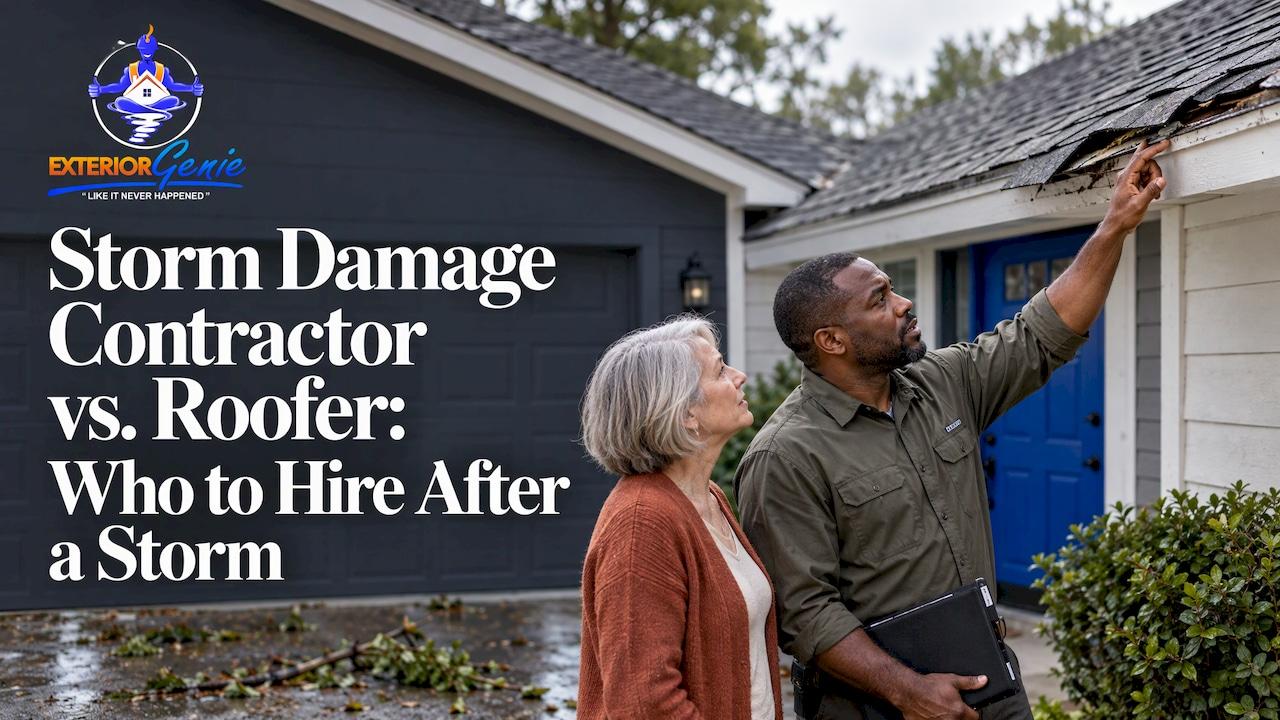
For roof damage, you want one licensed, insured, local roofing contractor who also handles storm restoration and insurance paperwork. The two labels overlap far more than they differ. A "roofer" is the person on the roof. A "storm damage contractor" is usually a roofing company that is set up for insurance-driven work. The risk is not picking the wrong label. It is hiring someone who arrived after the storm and will be gone before your warranty matters. At Exterior Genie, we do emergency tarping, storm repair and claims assistance under one roof for homeowners and businesses in Lexington, Columbia and the rest of the Midlands.
TL;DR
- A roofer installs and repairs roofing. A roofing contractor runs the whole job: estimate, permits, crews, materials, code compliance. "Storm damage contractor" usually means a roofing contractor that works with insurance claims.
- Inspect from the ground only, photograph everything, and get a professional to stop active leaks before they spread.
- Before anyone touches your roof, verify the license, liability insurance and workers' compensation coverage, and get a written estimate.
- Walk away from door-knockers who offer to waive your deductible, ask for full payment upfront, or push you to sign before your claim is approved.
- Choose a contractor who can tarp tonight, document the damage for your insurer, and still be there for the warranty.
Table of Contents
- What the difference really is
- Who to call first after a storm
- When a roofer is enough, and when you need a full storm contractor
- What the insurance claim looks like
- How to vet any contractor before you sign
- Repair or replace after storm damage?
- A quick example of how it plays out
- Commercial buildings and property managers
- Our perspective
- Talk to a local team that does it all
- FAQ
- Sources
What the difference really is
The terms get used loosely, which is why searching for them is confusing. Here is how they break down in practice.
A roofer is a tradesperson who installs and repairs roofing materials. Per Invoice Fly's 2026 guide, a roofing contractor is the licensed business owner who estimates jobs, obtains permits, hires and supervises crews, orders materials and makes sure the work meets code.
A storm restoration contractor is a roofing or exterior company that specializes in insurance-claim work. The same guide describes them as working closely with adjusters, and often in high-volume mode after major storms.
That last phrase matters. Some storm restoration firms are established local companies that handle storm work year-round. Others are crews that follow weather events from state to state. Both call themselves storm damage contractors. What separates them is whether they are licensed in your state, insured, and still reachable in two years.
| Roofer (tradesperson) | Roofing contractor | Storm restoration contractor | |
|---|---|---|---|
| Does the work on the roof | Yes | Through its crews | Through its crews |
| Pulls permits, orders materials | Usually no | Yes | Yes |
| Holds the license and insurance | Not necessarily | Yes | Should |
| Works with insurance adjusters | Rarely | Sometimes | Core of the business |
| Handles repairs beyond the roof | Rarely | Sometimes | Often (gutters, siding, interior) |
For a homeowner, the useful question is not which row to hire. It is whether one company can cover every column.
Who to call first after a storm
Start with safety, then the roof, then the insurer.
The National Roofing Contractors Association advises that after a severe storm, owners inspect the roof for damage from ground level and do not attempt repairs themselves. Closer assessment and repair belong to a professional roofing contractor. Wet shingles, loose debris and ladders are how a storm turns into an injury.
A sensible order:
- Make sure everyone is safe. Stay out of rooms with sagging ceilings or active dripping near light fixtures.
- Photograph from the ground. Capture missing shingles, debris on the roof, damaged gutters and siding, and any interior water stains, with dates visible.
- Call a roofing contractor who can respond fast. If water is getting in, the first job is a temporary cover, usually a tarp, not a full repair. We offer 24/7 emergency roof tarping across the Midlands, so a leak at 2 a.m. does not wait for business hours.
- Contact your insurance company to open a claim. You do not need a finished repair estimate to do that.
- Keep every receipt for temporary repairs.
Reviews.com notes that insurers increasingly use aerial imagery and roof-age rules when triaging claims. It also points out that on-the-ground photos taken before temporary repairs help establish cause and timing. Our guide on how to document roof damage for insurer claims walks through what to shoot and how.
When a roofer is enough, and when you need a full storm contractor
A plain roof repair job, such as a few lifted shingles, a damaged flashing or a small leak, is well within a good roofing contractor's scope. You may not need to file a claim at all if the repair costs less than your deductible.
You need broader storm restoration capability when:
- The damage crosses trades. Roof, gutters, siding, windows and interior water damage all came from the same storm.
- Insurance is involved. Someone needs to produce a scope of work, photos and measurements an adjuster can use.
- The roof may need replacing. Hail and wind can compromise a roof that looks fine from the driveway.
- Fire or heavy debris damage is part of the picture.
This is why we run these services together. Roof repair, storm damage restoration, gutters, siding and insurance claim assistance with HAAG-certified inspectors are one team, not four vendors you have to coordinate during the worst week of your year. HAAG certification is a credential for inspecting roofs and assessing storm damage.
What the insurance claim looks like
Most of the confusion between roofers and storm contractors comes from insurance, so it helps to know the basics.
Per Reviews.com's November 2025 claim guide, most standard homeowners policies cover sudden, accidental roof damage from fire, wind, hail, falling objects and the weight of ice or snow. Wear and tear and faulty installation are excluded. The same guide says many carriers apply separate wind/hail or hurricane deductibles of 1% to 5% of the dwelling coverage (Coverage A), and some pay only actual cash value for roof surfaces.
What that means for you:
- Read your declarations page first. A 2% wind/hail deductible on a $300,000 dwelling limit is $6,000, which may be more than a minor repair costs.
- Age matters. If your policy pays actual cash value on the roof, the payout reflects depreciation.
- Cause matters. A claim for storm damage needs evidence that a storm caused it. Photos and a documented inspection are your evidence.
We cover the details in separate guides: the roof insurance claim checklist, roofing insurance claim deductibles, and why insurers deny roof claims.
A contractor can inspect, photograph, prepare a scope and estimate, and be present when the adjuster visits. The final settlement is between you and your insurer, so your policy and your adjuster make the coverage decision. See why a roofing contractor estimate matters for claims.
How to vet any contractor before you sign
The National Association of Insurance Commissioners publishes a post-disaster claims guide with a clear checklist. Collect and confirm:
- The contractor's ID.
- The business license, including its expiration date.
- Proof of workers' compensation insurance.
- Proof of liability insurance, verified by calling the insurer that issued it.
The guide also distinguishes licensed contractors, who passed exams and met competency requirements, from merely registered ones. It recommends getting estimates from more than one contractor and asking to see building permits. In South Carolina, confirm the license status through the state's licensing board before work starts, and ask your insurance agent or the South Carolina Department of Insurance if you are unsure about a claim step.
Then apply three practical tests:
- A written, itemized estimate. It should list materials, scope, the area covered, cleanup and the warranty.
- A real local presence. An office, a track record in your county, and references you can call.
- A written contract. Everything promised verbally goes in the contract.
Red flags that show up after storms
The NAIC guide and consumer-protection checklists point to the same patterns:
- Door-to-door pressure to decide today.
- Offers to waive or absorb your deductible. This is illegal in most states.
- Demands for cash only or full payment upfront.
- Missing credentials or no local address.
- Pressure to sign before your claim is approved, or to sign an Assignment of Benefits, which hands your claim rights to the contractor.
None of this means every contractor who knocks is a scammer. It means a legitimate company will still be there when you ask for the paperwork, will let you read the contract overnight, and will not need your decision before your insurer has spoken.
Repair or replace after storm damage?
This is the question that follows every storm inspection, and it is where an honest contractor earns trust.
Repair usually makes sense when the damage is localized: a section of shingles, a damaged vent boot or flashing, and a roof with years of life left. Replacement tends to make sense when damage is widespread, when the roof is near the end of its service life, or when repairs would keep chasing new failures.
Cost context from published 2025 and 2023 figures:
- Reviews.com puts typical roof repairs at about $900 to $1,200 nationally, with a common range of $300 to $2,000 and major structural fixes reaching $5,000 to $7,000 or more.
- Forbes Home reports that hail-damaged roof repair averages about $4,250, and that a full replacement can exceed $32,500 on larger or premium roofs.
These are national averages. South Carolina pricing varies with roof size, pitch, material and access, so treat them as a sanity check on a written estimate, not a quote. Our roof repair and roof replacement pages cover what we do in each case, and our article on how roofers determine replacement versus repair explains the inspection logic.
If a replacement is needed, the materials and the warranty behind them matter. We are an Owens Corning Platinum Preferred Contractor, and we back our work with a lifetime workmanship warranty.

A quick example of how it plays out
Say a windstorm lifts shingles on the south slope of a 15-year-old roof in Lexington, and water starts showing on a bedroom ceiling that night.
- You photograph the exterior from the ground and the ceiling stain inside.
- A roofing contractor tarps the damaged area that night or the next morning, which limits further water entry.
- You open a claim and check your declarations page for a wind/hail deductible.
- A certified inspector documents the roof and prepares an estimate with photos and measurements.
- The adjuster inspects. The contractor can attend and walk through what the documentation shows.
- Once coverage is decided, repair or replacement is scheduled and permitted, and you receive a written warranty.
With two separate companies, steps 2, 4 and 6 can come with different people, different paperwork and a gap in accountability. With one, the same team that saw the damage is the one that fixes it.
Commercial buildings and property managers
The same logic applies to commercial roofs, with higher stakes: tenants, downtime and lease obligations. Flat and low-slope systems such as TPO and PVC have their own repair methods, and storm damage often shows up first as ponding or seam failure. Property managers should require the same credential checks and written scope, plus documentation that can be shared with the building owner and carrier. We handle commercial roofing and commercial construction in the Columbia and Lexington area.
Our perspective
We hear "storm damage contractor or roofer?" as a question about labels, but homeowners are really asking whom to trust with the worst week of the year.
Our answer is a roofing contractor that does the whole job. That means someone who can get a tarp on at night, inspect the roof properly, document it so your insurer can understand it, and then do the repair or replacement themselves and stand behind it. We are veteran-owned, and we run our projects with the discipline that comes from that background: clear communication, a coordinated plan, and no surprises.
We give honest repair-versus-replacement guidance, because a roof that can be repaired should be repaired, and a roof that cannot should not be patched again and again. That is the advice we would want for our own homes.
Ebben
Talk to a local team that does it all
If your roof or exterior took a hit, we can start with a 24/7 emergency tarp, then move to inspection, claim documentation and the repair itself. Our team includes HAAG-certified inspectors who can assist with your insurance claim, and we serve homeowners and businesses across Lexington, Columbia and the Midlands. See our storm damage roof repair services or get a free online roof repair estimate.

For an inspection before you decide anything, start with our roof inspections in Lexington, or reach us through Exterior Genie.
FAQ
Is a storm damage contractor different from a roofer?
Often it is the same kind of company with a different focus. A roofer does the roofing work, while a storm damage contractor is set up for insurance-related work and often handles damage to several parts of the home. What matters more than the title is a valid license, insurance and a local track record.
Does insurance cover roof damage from wind?
Most standard homeowners policies cover sudden, accidental damage from wind and hail, but not wear and tear. Many carriers apply a separate wind/hail or hurricane deductible of 1% to 5% of dwelling coverage, according to Reviews.com. Check your declarations page and call your insurer to confirm your own terms.
Should I hire a contractor who knocks on my door after a storm?
Be cautious. Verify the license, liability insurance and workers' compensation, and never sign anything on the spot. Refuse any offer to waive your deductible and any request for full payment upfront. Choosing a contractor with a local office and references you can call is the safer path.
Should I repair or replace a storm-damaged roof?
Repair fits localized damage on a roof with plenty of life left. Replacement fits widespread damage or an aging roof. A written inspection with photos and measurements shows which one your roof needs.
Sources
- Roofer Contractor: What They Do & How Roofing Contractors Work (Invoice Fly)
- Roof Repairs After a Storm (National Roofing Contractors Association)
- How to File a Homeowners Insurance Claim for Roof Damage (Reviews.com)
- Post-Disaster Claims Guide (NAIC)
- How Much Does Roof Hail Damage Repair Cost? (Forbes Home)