
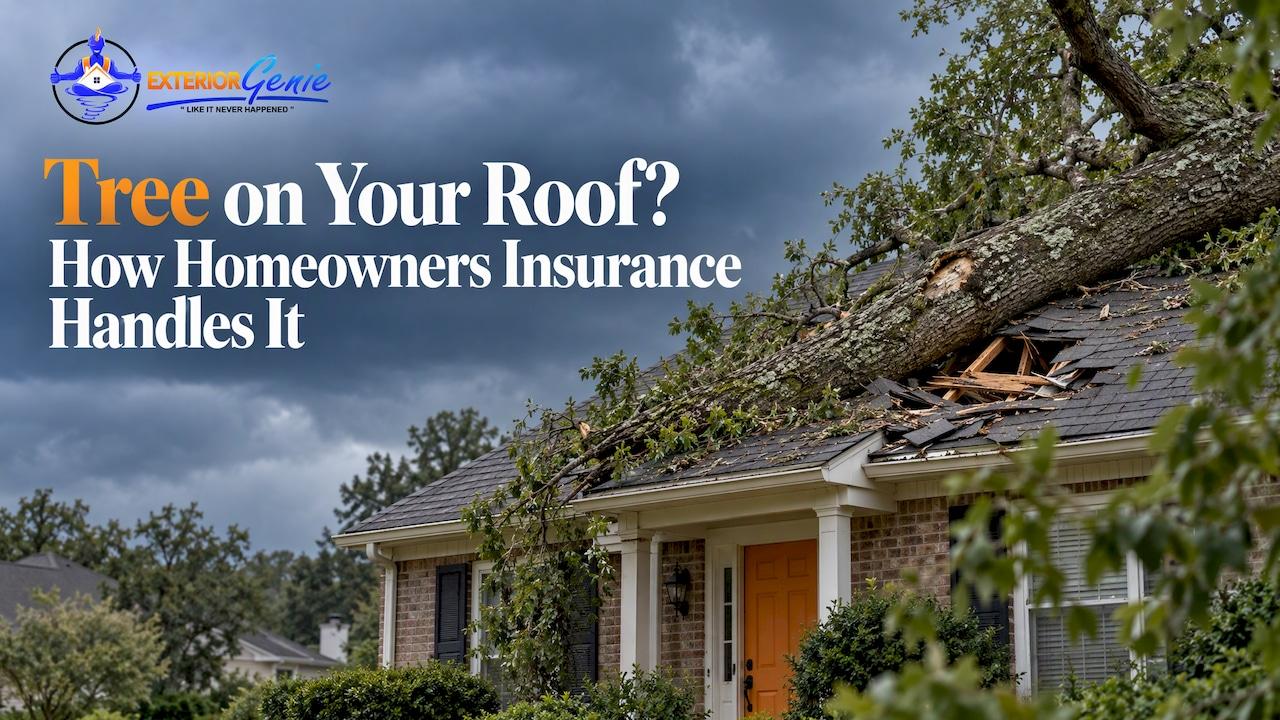
If a tree falls on your roof, your homeowners insurance will usually pay to repair the damage, as long as a covered peril such as wind, hail, lightning or the weight of ice and snow brought it down. Removing the tree itself is often capped at a few hundred dollars up to $1,000, and a tree that was already dead or rotting can change the outcome. Get everyone safe, photograph the damage, stop water from getting in, then call your insurer.
This guide walks through the first hour, the coverage rules, the neighbor's-tree question, the removal cap, and how roof repair or replacement gets decided, with South Carolina specifics where they matter.
TL;DR
- Safety comes first: get out, stay away from power lines and gas smells, and call 911 if anyone is in danger.
- Standard policies generally cover sudden damage from a tree felled by a covered peril, even when the tree came from a neighbor's yard.
- Tree removal is usually limited to about $500 to $1,000 per event, separate from the cost of repairing the house.
- Photograph everything before temporary repairs, tarp the roof to prevent more water damage, and keep every receipt.
- Your policy's deductible, especially a wind or hail deductible, decides how much of the bill you actually pay.
Table of Contents
- What to do first when a tree lands on your roof
- Stop the water: temporary protection
- Document the damage before anything moves
- Does homeowners insurance cover a tree on the roof?
- Whose tree is it? Neighbor's tree on your roof
- Who pays to remove the tree?
- How insurers decide: repair or replace the roof
- Filing the claim step by step
- Our perspective
- Get help with the roof, not just the claim
- Reduce the risk before the next storm
- FAQ
- Sources
What to do first when a tree lands on your roof
Do not start with the roof. Start with people. Amica advises waiting until the area is safe before you assess damage or move debris, staying at least 30 feet from downed power lines, and watching for signs of a gas leak such as a rotten-egg smell or a hissing sound. If any of those are present, get everyone out and call 911.
Consumer Reports adds a simple sequence: confirm everyone is unharmed, check for downed lines, and contact your utility to cut power if lines are down. Forbes Home says that if the tree pulled down lines or may have damaged a gas line, you should shut off the main breaker or the gas at the meter, but only when you can reach it safely.
A short order of operations:
- Move everyone, pets included, away from the impact area.
- Call 911 for injuries, fire, downed lines or gas.
- Do not walk under the damaged section or enter a room with a sagging ceiling.
- Once it is safe, take photos and video from a distance.
- Call your insurance agent or the claims line.
- Arrange emergency protection for the roof.
If the tree is resting on the roof, do not climb up or try to cut it yourself. A loaded tree can shift when weight is removed, and a saw, a ladder and a wet roof is how a bad day gets worse.
Stop the water: temporary protection
A hole in the roof lets in rain with every storm that follows, and interior water damage is a separate and growing cost. Most policies expect you to take reasonable steps to prevent further loss, and the cost of those temporary repairs is typically part of the claim. Check your policy language or ask your adjuster, and keep the receipts.
Shelter Insurance advises taking pictures of the damage exactly as you found it before temporary repairs, making sure your address is visible for adjusters, and keeping receipts for repairs and additional living expenses if the home becomes unlivable.
Temporary protection usually means a tarp or board-up secured over the opening once the tree is off or safely supported. A professional crew does this with the right fasteners and overlap so the covering holds through wind. We cover the options in temporary roof repair options that protect your home, and if water is already coming in, see how to stop a roof leak emergency.
If the tree also hit a shed or outbuilding, these shed roofing options for wet, windy sites show how material choice affects how a small roof stands up to weather.
Water rarely shows up where it enters. Consumer Reports notes that you should check for wet insulation and for staining or dripping along trusses, in closets and storage rooms, and around recessed lighting. Tell the adjuster about anything you find, even if it looks minor.
Document the damage before anything moves
Good documentation is the difference between a smooth claim and weeks of back-and-forth. AAA Club Alliance suggests photos and video of the tree and visible damage once you are in a safe spot, and a list of damaged property (house, garage, shed, fence, vehicle, belongings) before you notify the insurer.
One adjuster-focused guide recommends photographing the point of impact before the tree is moved, unless it has to come off right away for safety or to stop more damage. It suggests wide, medium and close shots of the tree, impact point, roof and interior, with a tape measure or ruler for scale.
Your checklist:
- Wide shots showing the whole tree and the house
- Close shots of broken rafters, punctured decking, cracked shingles, gutters and siding
- Interior ceilings, walls, insulation and attic
- The stump or root ball, which shows whether the tree was healthy
- Receipts for tarping, hotel stays, meals and cleanup
- Date, time and weather conditions
The stump matters. Insurers look at whether a tree failed suddenly or was visibly dead, which brings us to coverage.
Does homeowners insurance cover a tree on the roof?
In most cases, yes. The Iowa Insurance Division explains that standard homeowners insurance generally covers damage from a fallen tree or large limb when the fall is sudden and accidental and caused by a covered peril like wind, hail, lightning, or the weight of ice or snow. The policy may pay for structural repairs, tree removal up to a stated amount, and temporary living expenses if the home is uninhabitable.
Progressive says the policy may pay for damage to your home, belongings and other structures minus your deductible when the cause is outside your control.
When coverage gets harder
Allstate notes that a healthy tree felled by wind is typically covered, but damage from negligence or a maintenance problem, such as a tree that was rotting and ready to fall before the storm, usually is not. USAA says the same and adds that in high-risk storm areas a standard policy may exclude certain perils like windstorm.
That last point matters on the South Carolina coast and, to a lesser degree, in the Midlands. South Carolina regulation defines named storm and wind/hail deductibles as separate deductibles that apply to wind or hail losses, and requires insurers to tell policyholders when one is in the policy. Read your declarations page now, not after a storm, so you know whether your deductible is a flat dollar amount or a percentage of your dwelling coverage.
Your limits set the ceiling
Allstate points out that your dwelling and other-structures limits determine how much the insurer may pay. A $350,000 dwelling limit, for example, may help pay up to that amount to repair or rebuild the home, minus your deductible. Most tree-on-roof claims come nowhere near the limit. The deductible is the number that usually matters.
Whose tree is it? Neighbor's tree on your roof
The tree's address does not decide who pays. The Oregon Division of Financial Regulation states that your homeowners policy may cover the damage even if the tree is rooted in your neighbor's yard, and that you submit the claim to your own insurer.
Liability is a separate question. The Connecticut Department of Insurance explains that a tree owner is legally liable only if negligence caused the fall. Otherwise it is treated as an act of God, and your own property coverage responds. If a neighbor ignored a clearly dead tree after being warned, their liability coverage may come into play, and your insurer may pursue it on its own.
In practice:
- File with your own insurer first, regardless of whose tree it was.
- Do not argue fault with your neighbor at the scene.
- Photograph the tree's condition, since it supports the sudden-failure story.
- Keep written records of anything you told the neighbor about the tree beforehand.
Who pays to remove the tree?
This is where homeowners are most often surprised. Removal is typically covered only up to a small limit, and only when the tree damaged a covered structure or blocked something like a driveway.
| Source | What it says about removal |
|---|---|
| Oklahoma standard policy form | Up to $1,000 per loss, no more than $500 per tree, when a tree damages a covered structure or blocks a driveway or ramp |
| Connecticut Department of Insurance | Generally up to $500 when the tree damages a covered structure or blocks a driveway |
| Maryland Insurance Administration | Usually $500 to $1,000, based on the event rather than the number of trees |
| Texas Department of Insurance | Many policies cover some removal when the tree damages the house or blocks a driveway; trees falling in the yard usually are not covered |
The Oregon regulator adds that if a tree falls and does not damage the residence, a typical policy does not pay to remove it. Policy forms differ, so your own declarations and endorsements control.
The cap applies to hauling the tree away. Repairing the house is a different part of the claim. One industry news report describes a case where a crane and crew cost $2,500 and the policy contributed only $1,000 of it. Ask your agent whether your policy offers a higher debris-removal limit, and request quotes for removal before work starts so the insurer knows what you are dealing with.
The Maryland page also notes that coverage for the trees, shrubs and plants themselves is generally limited, usually to 5% of the dwelling limit and $500 per item, and that wind, snow and ice damage to them is generally not covered. So a tree that falls without hitting anything is mostly your cost.
How insurers decide: repair or replace the roof
A tree strike can mean a patch, a section rebuild or a full replacement. The decision turns on how much of the roof is damaged, whether decking and rafters are affected, and the condition of the roof before the tree fell.

Adjuster guidelines from the Texas windstorm association describe a brittleness test: if shingles crack or tear when lifted, the roof likely cannot be repaired. The same guidelines say scattered damage is priced per shingle, concentrated damage per square, and that depreciation should not be applied to labor or tear-off. These guidelines come from one state's wind pool, so treat them as an illustration of how adjusters think, not a rule that binds your insurer in South Carolina.
Our own explainer on how roofers determine replacement versus repair covers what we look at on the roof, and why roof repair cost varies by damage type explains why two tree strikes can produce very different estimates.
Replacement cost versus actual cash value
The Maryland Insurance Administration explains the difference. Replacement cost value coverage pays to repair or replace without deducting for depreciation. Actual cash value coverage pays the depreciated amount. Under a replacement cost policy, the insurer may first pay only the actual cash value, then release the held-back depreciation once you show the work was done.
That is why you keep invoices. Our guide to replacement cost value for roofing goes deeper on how this affects a roof claim.
Filing the claim step by step
- Call your insurer or agent promptly. Report the loss and ask what the policy requires for temporary repairs.
- Give the facts plainly. Date, cause, what the tree hit, and what you did to protect the property.
- Send your photos and the damaged-property list. Include interior damage.
- Get a roofing inspection and written estimate. An independent opinion on the damage gives you something to compare with the adjuster's scope. Our roof inspections in Lexington are performed by HAAG-certified inspectors.
- Meet the adjuster at the property. Walk them through every impact point and every interior spot you found.
- Review the estimate line by line. Check that decking, underlayment, flashing, gutters and interior repairs are included, not only shingles.
- Keep paperwork. Receipts, invoices, emails and claim numbers in one folder.
Supplements are normal. Hidden damage like cracked rafters or wet insulation often appears once shingles come off, and a contractor can document it for your insurer.
Our perspective
We see tree-on-roof calls after almost every serious Midlands storm, and the pattern is consistent: the homeowner's first fear is the claim, but the first job is the opening in the roof. Water entering a house overnight does more harm than most people expect, so we treat emergency tarping as the first step, and we offer it around the clock.
Our second priority is an honest read on repair versus replacement. A tree can punch through decking and crack a truss while the shingles a few feet away look fine. Our HAAG-certified inspectors check the structure, the decking and the attic, not just the visible damage, and we tell you plainly what the roof needs.
Insurance claims are confusing when you are also dealing with a ceiling in your living room. We help homeowners understand the process and document the damage so the scope reflects the real repair. As a veteran-owned company, we run jobs the way we were trained to: clear communication, coordinated project management and no surprises.
When a roof does need replacing, we install Owens Corning shingles as an Owens Corning Platinum Preferred Contractor, and our workmanship is backed by a lifetime warranty.
Ebben
Get help with the roof, not just the claim
If a tree has hit your home in Lexington, Columbia or elsewhere in the Midlands, we can tarp the roof, inspect the damage and help you through the insurance process. Our storm damage restoration team handles emergency protection, repair and rebuilding under one coordinated plan.

If the inspection shows the roof is beyond patching, we can price a full roof replacement in Lexington. For smaller strikes, see our roof repair page. Not sure what you need yet? Read emergency roof repair explained for homeowners or reach us through our main site.
Reduce the risk before the next storm
Because coverage can hinge on a tree's condition, a little prevention protects both the house and a future claim:
- Have an arborist look at large trees within falling distance of the roof, especially those with dead limbs, fungus at the base, leaning trunks or heaved soil.
- Remove dead or declining trees promptly and keep the invoice.
- Trim branches that overhang the roof.
- Review your policy each year for deductible type, replacement cost versus actual cash value, and debris-removal limits.
- Book a roof inspection after any major storm, even if you see no obvious damage.
FAQ
Does insurance pay for tree removal after a storm?
Usually only in part. Many policies pay a limited amount, commonly $500 to $1,000 per event, when a fallen tree damages a covered structure or blocks a driveway. A tree that falls in the yard without hitting anything is generally not covered. Check your policy for its exact debris-removal limit.
Will my rates go up if I file a tree damage claim?
That depends on your insurer, your claims history and your state, so we cannot give a general answer. Ask your agent how a claim may affect renewal before you file. Reporting the loss promptly is still the safer path, because delays can complicate coverage.
What if the tree that fell was dead?
Insurers may deny or limit a claim when they conclude the tree was rotting or poorly maintained before the storm. Photos of the stump, the weather that day and any arborist records help show what happened. Ask your insurer to explain any denial in writing.
Can I have the tree removed before the adjuster arrives?
Photograph the tree and impact point first. Then, if it is blocking access or threatening more damage, have it removed and tell your insurer what you did. Do not wait days with an open roof just to preserve the scene.
Should I tarp the roof myself?
No. Climbing onto a damaged, wet roof with a tree on it is dangerous. Have a professional crew secure it, and keep the invoice for your claim.
Sources
- What to Do if a Tree Falls on Your House (Amica)
- How to Keep Your Home Safe and What to Do in an Emergency (Consumer Reports)
- Here's What To Do If A Tree Falls On Your Home (Forbes Home)
- After a Storm (Shelter Insurance)
- What Should You Do If a Tree Falls on Your House (AAA Club Alliance)
- Tree Impact Insurance Claim: How to Document Fallen Tree Damage
- Tree Damage and Insurance (Iowa Insurance Division)
- Does Home Insurance Cover Fallen Trees? (Progressive)
- Fallen Tree Damage and Homeowners Insurance (Allstate)
- Does Homeowners Insurance Cover Tree Damage? (USAA)
- South Carolina Regulation 69-56, Hurricane, Named Storm or Wind/Hail Deductible
- Storm Damage (Oregon Division of Financial Regulation)
- Homeowners Storm Claims (Connecticut Department of Insurance)
- Homeowners Protection Policy, Special (Oklahoma Insurance Department)
- Fallen Tree (Maryland Insurance Administration)
- FAQ: Homeowners Insurance and Disaster Claims (Texas Department of Insurance)
- A Storm Dropped Her Neighbor's Oak on the Roof (Daily Insurance News)
- Property Damage Evaluation Guidelines (TWIA and TFPA)
- Post-Disaster Claims Guide (Maryland Insurance Administration)
- Shed Roofing Options for Wet, Windy Sites